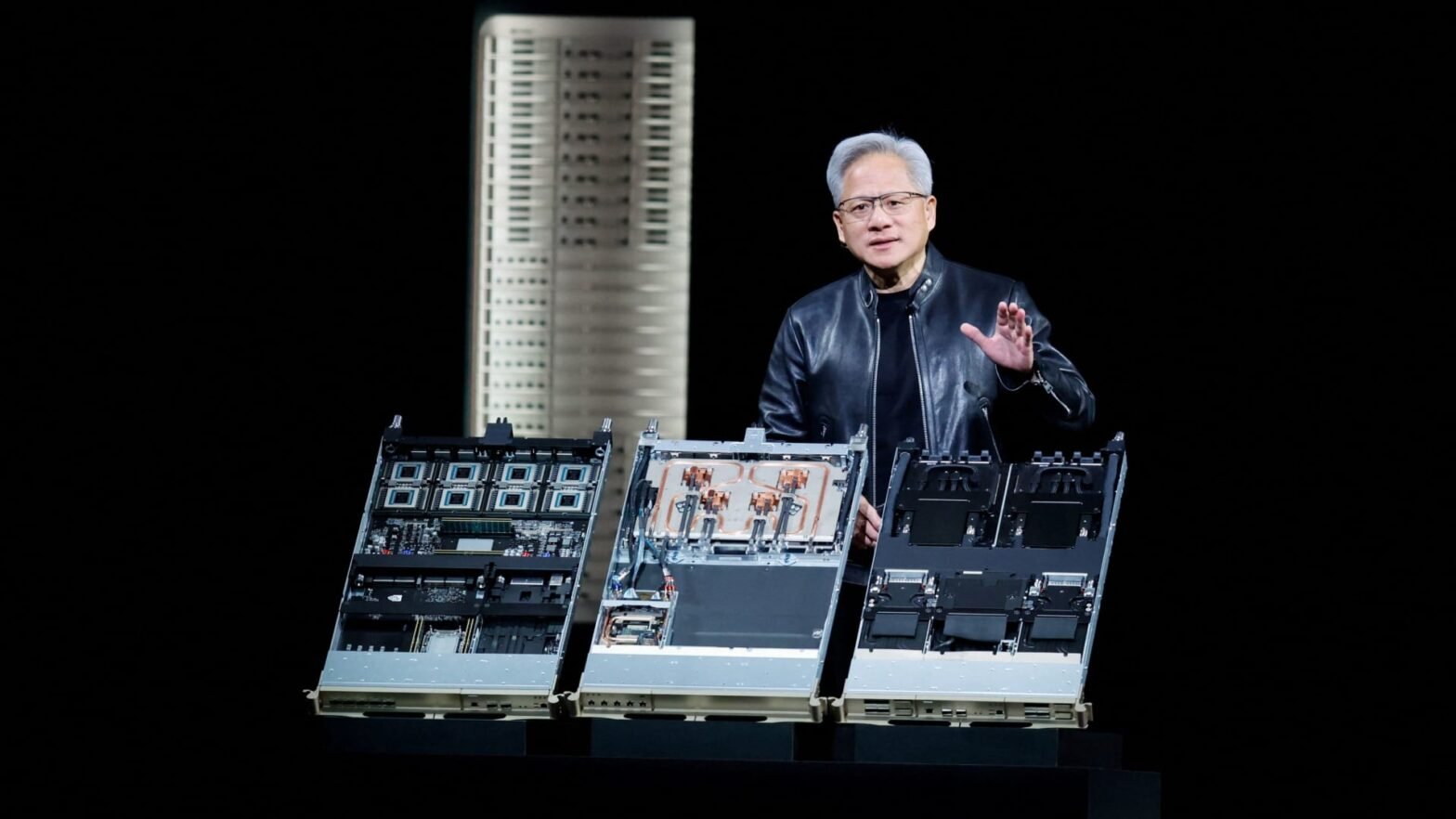
It’s a brand new day, and yet Nvidia investors are asking themselves the same old question: What’s it going to take to get this frustrating stock rolling again? If that sounds familiar, well, that’s because it is. Not even 24 hours ago, we explored why Nvidia’s stock has been stuck in the mud despite a flurry of good news — both this week during its buzzy AI conference called GTC (short for GPU Technology Conference) and over the past few months. Now, we have yet another positive update about Nvidia’s business prospects and an important clarification on the company’s demand outlook, all for the stock to once again do next to nothing. After moving lower Wednesday morning, shares are up fractionally in afternoon trading. That advance pales in comparison to what we’ve learned since we published our last Nvidia story. So, our advice remains the same: Stick with the stock, and if you don’t own any, this is a great chance to get in. Late Tuesday, CEO Jensen Huang said at a press conference that t he company had restarted manufacturing of a Hopper-generation AI chip, known as the H200, for the Chinese market. Hopper is the predecessor to Nvidia’s current Blackwell family of chips. Jensen later told our CNBC colleague Kristina Partsinevelos that Nvidia had clearance from both governments to restart Hopper sales — with Beijing’s stamp of approval being the most notable detail. Then, early Wednesday morning, Reuters reported Nvidia was already working on a modified version of its new Groq-infused AI inference chip for the Chinese market. China represents a major growth opportunity for Nvidia, but the company had become locked out of the market due to geopolitical tensions between the world’s two largest economies. Starting under former President Joe Biden, the U.S. banned the sale of Nvidia’s most cutting-edge chips to China. The company was initially able to sell throttled-back versions of its chips to Chinese customers, but nearly a year ago, the Trump administration curtailed shipments of those made-for-China processors, too. Recently, the Trump White House reversed course and gave Nvidia the green light to export the H200 to China, in exchange for the U.S. government receiving a 25% cut of sales. That was significant because the H200 had once been Nvidia’s top-of-the-line chip sold to U.S. customers — not a modified configuration. However, the lifting of the ban has been slow to convert to orders, with Beijing supposedly harboring national security concerns of its own and, at the same time, looking to push its domestic semiconductor industry to better compete with Nvidia. At various times during the Nvidia-in-China saga, we’ve seen headlines about Beijing pressuring its tech giants to avoid Nvidia, including reports of outright bans . As a result of this rollercoaster ride, Nvidia has adopted a policy of providing guidance that assumes no data center chip sales to China. That also means that analysts have had to keep the sales out of their models or, at the very least, be extremely conservative in predicting when sales would resume, if ever. Nvidia executives last year said the AI chip market in China was a roughly $50 billion opportunity. Any bit of that market opportunity Nvidia does capture amounts to upside to both management forecasts, as well as Wall Street estimates. Translation: This China news provides upward support to 2026 earnings estimates and beyond. That’s not the only reason to believe estimates need to move higher, though. NVDA 1Y mountain Nvidia’s stock performance over the past 12 months. We’re getting more clarity on Jensen’s “high confidence” revenue visibility comments from his Monday GTC keynote, and the big takeaway is that is that $1 trillion is very much the floor for the 2025 to 2027 period. On Tuesday afternoon, Nvidia management held a question-and-answer session with Wall Street analysts, and the analysts published their reactions in notes to clients afterward. As we go through those notes Wednesday, it’s further evident that plenty of important Nvidia products aren’t factored into that $1 trillion disclosure. It was simply sales of Blackwell and next-generation Vera Rubin systems, which are set to ship to customers later this year. We wrote on Tuesday that we learned from Jensen’s interview with Jim Cramer that it didn’t include sales of Nvidia’s new standalone central processing units (CPU) or anything tied to the new Groq chip. However, the analysts’ notes make it clear the forecast also excludes sales of Vera Rubin Ultra systems — the Ultra is an updated version currently slated to start shipping in late 2027, in accordance with Nvidia’s annual release cycle for new AI chips. It also doesn’t include any revenues tied to Nvidia’s new storage systems , which the company says provide the high-speed data access that’s crucial for agentic AI workloads . Agentic systems go a step further than a basic generative AI chatbot and are capable of completing tasks, making decisions, and taking actions with limited user oversight. When Jensen initially called out the $1 trillion number Monday afternoon, the stock popped on the idea that Wall Street estimates were way too low. However, as investors started to realize that the $1 trillion number was for all of calendar 2025 through 2027, the stock came back down. The market came to the realization that while it was better than expected — to the tune of $40 billion to $60 billion, depending on which estimate you use — it wasn’t the blowout it sounded like. Well, it seems Jensen was just trying to be conservative. According to the analysts at KeyBanc, Nvidia’s new CPU rack offering is a material but smaller opportunity — though small in the context of $1 trillion is still tens of billions of dollars. However, the Groq and storage-related products opportunities are quite material. In fact, adding in all the stuff Jensen left out, that $1 trillion forecast starts to look more like $1.5 trillion. Add it all up — the significant China developments and the new information on the line-of-sight to $1 trillion — and, somehow, we’re still looking at a stock stuck in the low $180s on Wednesday afternoon. However, we have even more reason to believe that Nvidia’s stock is cheaper than it was eight months ago, when shares traded at similar prices, and even cheaper than it was Tuesday afternoon. Stocks are typically valued on future earnings estimates, so when those estimates move higher but the stock barely budges, the end result is a more attractive price-to-earnings valuation. In August, with shares in the low $180s, Nvidia traded at roughly 34 times the next 12 months worth of earnings estimates, according to FactSet. Now, its forward P/E is about 21, roughly in line with that of the S & P 500 . Nvidia is certainly no average company. Plus, we’d argue the stock is likely even cheaper than that since the estimates aren’t baking in anything from China and the additional clarity around the $1 trillion. Would a little more clarity on the $1 trillion messaging from the outset on Monday have been ideal and allowed the stock to hold its initial pop, perhaps serving as the breakout we’ve needed? Yes, though we do understand Jensen’s desire to be conservative. Nonetheless, it’s clear that, fundamentally, this is a must-own stock for the long term. Perhaps there’s a silver lining: All the confusion about Jensen’s outlook through 2027 means that members have a chance on Wednesday to buy a best-in-class stock that has seemingly gotten cheaper by the hour this week. (Jim Cramer’s Charitable Trust is long NVDA. See here for a full list of the stocks.) As a subscriber to the CNBC Investing Club with Jim Cramer, you will receive a trade alert before Jim makes a trade. Jim waits 45 minutes after sending a trade alert before buying or selling a stock in his charitable trust’s portfolio. If Jim has talked about a stock on CNBC TV, he waits 72 hours after issuing the trade alert before executing the trade. THE ABOVE INVESTING CLUB INFORMATION IS SUBJECT TO OUR TERMS AND CONDITIONS AND PRIVACY POLICY , TOGETHER WITH OUR DISCLAIMER . NO FIDUCIARY OBLIGATION OR DUTY EXISTS, OR IS CREATED, BY VIRTUE OF YOUR RECEIPT OF ANY INFORMATION PROVIDED IN CONNECTION WITH THE INVESTING CLUB. NO SPECIFIC OUTCOME OR PROFIT IS GUARANTEED.
Here’s our advice on Nvidia, the frustrating stock that looks cheaper by the day
Mar 18, 2026