March 20, 2026
Delhi flights may be hit as rain and strong winds disrupt India weather
India’s capital is enjoying a rainy, cloudy end to the workweek, with temperatures dropping as low as 16 degrees Celsius after overnight showers.
Gusty winds, thunderstorms, rainfall and even hailstorms have hit several other cities through the week.
According to the Indian Meteorological Department (IMD), Delhi will experience more rain, thunderstorms, lightning and strong winds on Friday. Similar weather is likely across east India on Saturday as well.
Hilly regions in North India, including Himachal Pradesh and Ladakh, experienced fresh snowfall this week. While snowfall in March is not unheard of, it is rare.
The national weather agency attributed this unusual weather to a “western disturbance” that has affected much of the country.
“Because of large scale thunderstorm activity in many parts of the country and consecutive approach of Western Disturbances, normal to below normal day temperatures likely during next one week,” the IMD said on Friday.
The windy, rainy weather is a respite for many Indians who were preparing for harsh summer conditions. The first week of March already saw heatwaves and higher-than-normal temperatures in several regions.
At least one downside has emerged. Indian airlines warned travelers on Thursday that “persistent rains and gusty winds” may affect flight operations in Delhi and Bengaluru.
IndiGo, India’s largest airline, urged passengers to check their flight status before heading to the airport.
https://p.dw.com/p/5Algp
March 20, 2026
WATCH: Climate, water and us: Stories of change
In Mumbai, climate change is eroding trust among the Koli fishing community.
Climate, water and us: Stories of change
https://p.dw.com/p/5AlJv
March 20, 2026
Targeting commercial ships ‘unacceptable,’ India says
The targeting of merchant ships and their civilian crews in the Gulf, amid the US-Israel war with Iran, is “unacceptable,” said senior Indian diplomat Vikram Doraiswami, as he addressed the International Maritime Organization.
A video of his comments was shared by India’s national radio.
Doraiswami, currently the High Commissioner of India to the UK, was appointed as the Indian ambassador to Beijing on Thursday. He is expected to change assignments “shortly.”
“Such attacks have resulted in the loss of innocent lives, injuries and heightened risks including to seafarers,” Doraiswami said, adding that so far three Indian seafarers had died due to the conflict. Another four have been injured and one remains missing, he said.
Iran effectively closed the Strait of Hormuz in response to strikes by US and Israel, attacking ships which attempt to pass through the key chokepoint for global shipping routes.
India’s foreign ministry, after talks with Tehran, has successfully managed to bring three Indian-flagged vessels back from the Gulf. Two carried LPG while one carried crude oil.
Even then, two dozen Indian ships remain in the Gulf, the diplomat told the forum. There are “22 vessels west of the Strait of Hormuz with 611 Indian seafarers on board and two vessels east of the strait with 47 seafarers onboard,” he said.
India’s foreign ministry has said it is still in talks with Iran for safe passage of its ships but had asked the 22 vessels to stay put for now.
India is one of the key suppliers of seafarers to the world’s shipping industry, accounting for 13% of the global seafaring workforce, Doraiswami said.
https://p.dw.com/p/5AlQH
March 20, 2026
Indian aviation regulator asks airlines to avoid Gulf nations amid escalation
India’s civil aviation regulator has issued an urgent advisory telling airlines to avoid flying in 11 Middle Eastern countries, citing an “escalation in security risks” amid the war in Iran.
The countries include Bahrain, Iran, Iraq, Israel, Jordan, Kuwait, Lebanon, Oman, Qatar, the United Arab Emirates and Saudi Arabia, according to ANI and other Indian news outlets.
The Directorate General of Civil Aviation (DGCA) told airlines to “refrain from operating within the affected airspace” at “all flight levels and altitudes,” except in Saudi Arabia and Oman, where carriers were advised to fly above designated airspace.
The DGCA said operations to the affected countries must include “robust contingency planning to cover all eventualities.”
Its risk assessment warned of a high probability of “spill-over” threats, including misidentification of civilian aircraft or failures in military interception procedures amid retaliatory strikes between US-Israel and Iran.
Indian airlines, which operate scheduled and nonscheduled flights between Gulf nations and Indian cities to bring citizens home, have not publicly responded or altered operations.
https://p.dw.com/p/5AlHL
March 20, 2026
India, Pakistan trade accusations as Indus Waters Treaty remains in abeyance
A landmark water-sharing treaty between India and Pakistan will remain suspended, or as Delhi puts it: “in abeyance,” the country told the United Nations.
between India and Pakistan will remain suspended, or as Delhi puts it, “in abeyance,” India told the United Nations.
India’s permanent envoy to the UN, Parvathaneni Harish, speaking at a UN forum to mark World Water Day, urged Islamabad to end support for terrorism before raising treaty-related issues.
Harish said the Indus Waters Treaty would stay suspended until Pakistan “unconditionally abjure terrorism as an instrument of its state policy. It must uphold the sanctity of human life before talking of upholding the sanctity of treaties.”
“India entered into the Indus Water Treaty 65 years ago in good faith, in the spirit of good will and friendship. Pakistan violated this spirit by inflicting three wars and thousands of terror attacks on India,” he said, adding that India’s “patience” did not “change Pakistan’s way.”
Pakistan called the terrorism allegations “baseless.”
Pakistan’s Second Secretary Aleena Majeed said the treaty does not allow unilateral “suspension or modification or so-called ‘abeyance.’ Such actions amount to the weaponization of water for narrow political gains, jeopardizing the lifelines of millions,” she said.
India announced its decision to hold the treaty in abeyance after the 2025 attack in Indian-administered Kashmir, where militants shot and killed 26 civilians. The attack sparked military clashes between India and Pakistan that ended with a cease-fire.
New Delhi accused Islamabad of backing the attack — a claim Pakistan denies. India has long maintained, including on international platforms, that Pakistan uses terrorism as a tool of statecraft.
The Indus is the longest river in South Asia, stretching more than 3,000 kilometers (1,864 miles). Its complex network of tributaries flows from Tibet, through divided Kashmir, and into Pakistan before emptying into the Arabian Sea near Karachi.
To read more about the Indus Water Treaty and what its abeyance means,click here.
https://p.dw.com/p/5Akor
March 20, 2026
What do you need to know about India’s LPG shortage?
Indian businesses and households continue to face a shortage of LPG, with many fearing the crisis will only get worse as tensions escalate in the Middle East.
On Thursday evening, foreign ministry spokesperson Randhir Jaiswal told reporters that India is trying to import LPG from all available sources, including from Russia. His statement came in response to increased attacks on energy infrastructure in the Middle East.
On Thursday morning, Iranian missiles hit and damaged Qatar’s Ras Laffan gas field, which is a key exporter of LPG to the world. India, the world’s second-largest LPG importer, relies heavily on Qatar and Middle Eastern nations for its energy needs.
Since the US-Israel war with Iran began, the Indian government has taken several steps to ensure a stable energy supply at home. Even so, consumers are complaining about the lack of LPG cylinders in the market.
Several eateries and food-related businesses across India have temporarily shut down. A local eatery in Delhi said it was impossible for small business owners to survive in these conditions. “The official platforms are not giving LPG and the black market is selling it three times the official price. How can I turn a profit on that?” he told DW.
Even households are now careful to preserve the gas they have. “We’re only cooking basic food which requires minimum gas time,” a domestic worker told DW, adding that her family feared their LPG cylinder could run out anytime.
Meanwhile, here are some of the steps the government has taken:
- The government has classified energy data as a national security matter.
- It has mandated all entities across the oil and gas value chain to furnish detailed operational information.
- The petroleum ministry is allowing commercial use of alternative fuels like kerosene, coal and biomass to ease pressure on LPG supply channels.
- The government is releasing additional amounts of alternative fuel to states amid the LPG shortage.
- India has increased domestic LPG production by at least 25%, according to the finance minister.
- The government has urged households to shift from LPG to piped natural gas (PNG), which Indian refiners say is in abundant supply.
https://p.dw.com/p/5AkVP
March 20, 2026
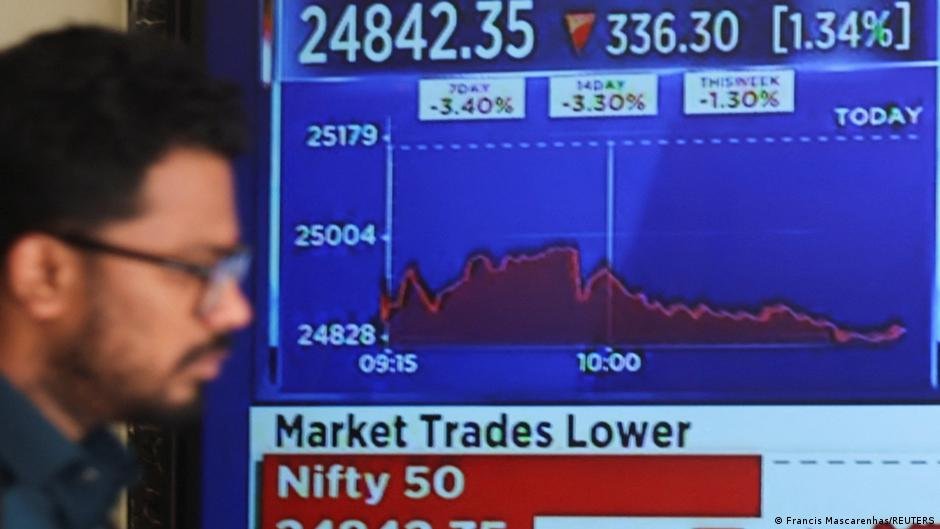
Indian stock market open in green after huge sell-off
India’s two key indices rose on Friday morning after investors saw a massive sell-off on Wednesday that wiped nearly Rs 12 lakh crore ($1.2 billion, €1.1 billion) in investor wealth.
The BSE Sensex, an index of 30 of India’s largest and most actively traded companies, rose 1.35% as of 11 a.m. local time. The NSE Nifty 50 Index was up 1.37% at the same time.
On Wednesday, both indices fell more than 3.3%, reaching their lowest point in nearly a year.
The sell-off was largely driven by a sharp rise in Brent crude oil prices, which climbed well above $118 at one point, close to their highest level since 2022.
Energy prices surged after Iran threatened “zero restraint” if Israel continued attacking Iranian infrastructure. Several of Qatar’s liquified natural gas (LNG) facilities at Ras Laffan came under renewed attack in the early hours of Thursday. Energy experts say the damage will have a severe impact on global LPG supply.
Iranian state media had earlier named the Ras Laffan facility as a potential target after Israel struck the South Pars gas field in the Persian Gulf — the world’s largest natural gas reserve, owned jointly by Iran and Qatar, which supplies 70% of Iran’s gas.
India imports 65% of its LPG needs, 90% of which transit through the Gulf of Hormuz. About one-third of India’s LPG supply comes from Qatar.
On Friday, Israel said it would continue striking Iranian infrastructure but would refrain from targeting South Pars, offering investors a glimmer of hope.
Why the Iran war might not end when the fighting stops
https://p.dw.com/p/5AkPi
March 20, 2026
Welcome to our coverage
Good morning! And welcome to DW’s India blog.
This is Mahima Kapoor from the New Delhi studio, and I will be bringing you a roundup of the biggest headlines from India this Friday.
Indians are waking up to more pain and uncertainty as the escalated attacks on energy infrastructure in the Middle East threaten to worsen the shortage of liquefied petroleum gas (LPG) at home.
Indian households and businesses widely use LPG as cooking gas.
India’s stock market opened on a positive note on Friday after a massive tumble on Thursday that wiped billions of investor wealth from the market. The sell-off was largely driven by rising crude prices due to the ongoing US-Israel war with Iran, which has impacted most of the Middle East.
The Indian government has assured citizens that it is attempting to buy LPG from every available source to fulfill needs at home. It is also encouraging the use of alternative fuels like piped natural gas to take some of the pressure off.
Stick with us as we break down the day’s news for you.
https://p.dw.com/p/5AkOt



![i’m-nervous,-too!-[part-2]](https://10xwealthreport.com/wp-content/uploads/2026/03/177042-im-nervous-too-part-2-1568x784.jpg)