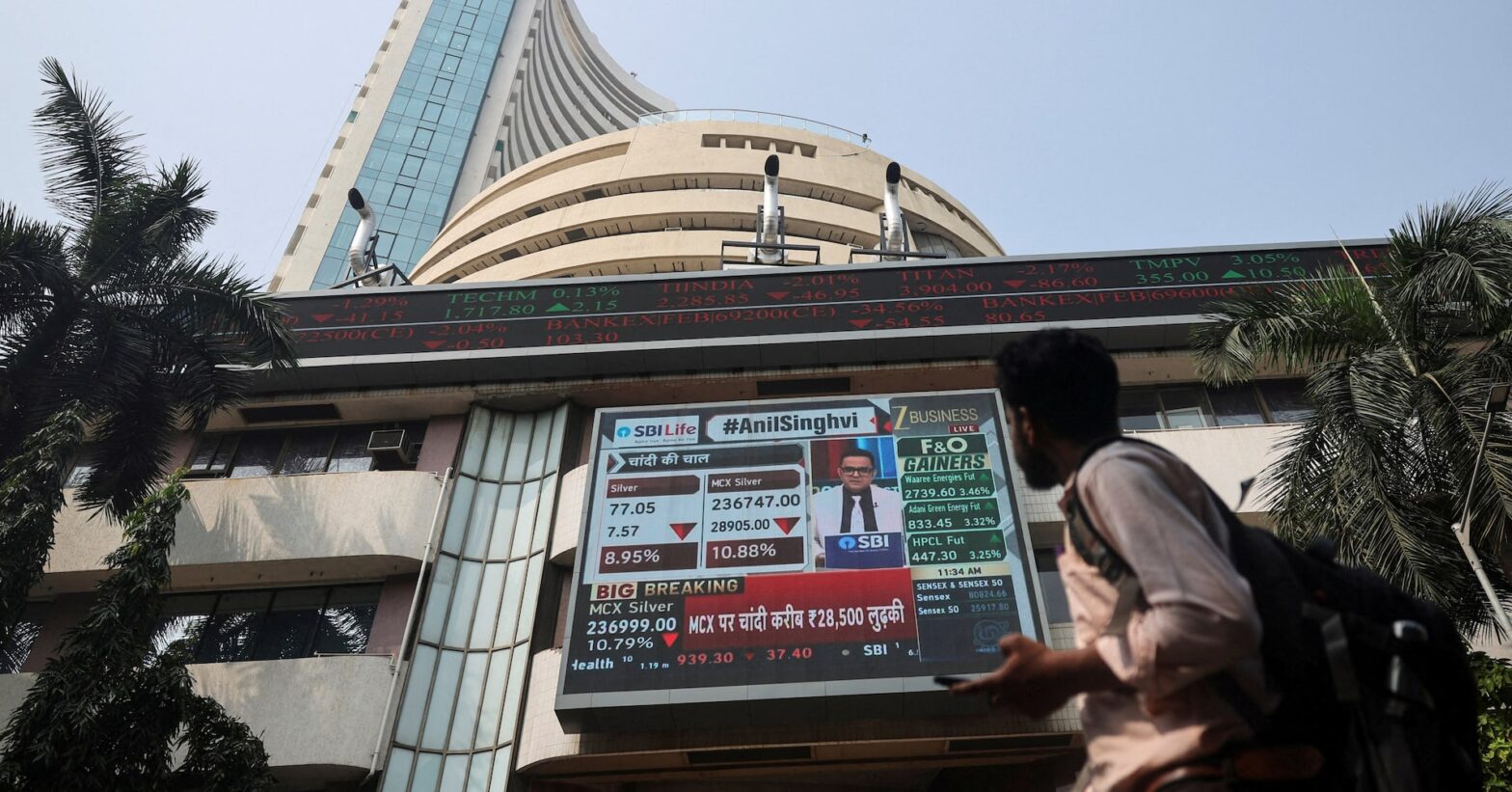

A man looks at a screen outside the Bombay Stock Exchange (BSE) building in Mumbai, India, February 2, 2026. REUTERS/Francis Mascarenhas/File Photo Purchase Licensing Rights, opens new tab
March 13 (Reuters) – Indian shares extended losses for a third session on Friday, with benchmark indexes recording their biggest weekly drop in years, as a raging war in the Middle East kept crude oil prices above $100 a barrel, stoking inflation and growth jitters for the world’s third-largest crude importing country.
The Nifty 50
shed 2.06% to 23,151.1 and the BSE Sensex
lost 1.93% to 74,563.92 on Friday. The Nifty 50 has dropped 5.3% this week, marking its biggest drop since June 2022, while 30-stock Sensex slid 5.5% in worst week since May 2020.
Sign up here.
“India faces a material terms-of-trade shock from rising energy prices amid the ongoing Middle East conflict,” as per Goldman Sachs.
The conflict, which began with joint Israeli-U.S. strikes on Iran in late February, has killed more than 2,000 people, disrupted millions of lives and shaken global energy and financial markets.
Supply disruptions through the Strait of Hormuz are likely to hit sectors including automobiles, oil marketing, tourism, consumer durables, electronic manufacturing services, fertilisers and chemicals, and city gas distribution.
“The extent of earnings damage will be dependent on the duration of conflict. Going by evolving dynamics, around 200 bps drop in FY27 earnings growth projections of Indian companies is likely,” said Dharmesh Kant, head of equity research at Cholamandalam Securities.
Meanwhile, India will hold off on signing a trade deal with the U.S. for several months, four Indian sources said, after President Donald Trump’s administration launched fresh investigations into what it calls excess industrial capacity among trading partners.
All the 16 major sectors logged losses this week. The broader mid-caps
and small-caps
dropped 4.6% and 3.7%, respectively.
Auto stocks
plunged 10.6%, the biggest laggards, as fears the Middle East war could hit production and exports rattled investors. It was their steepest weekly drop in six years.
Heavyweight financials
also slumped 5.7% amid intensifying foreign investor outflows.
Bucking the trend, Coal India
jumped 6% as an early summer raised prospects for higher coal demand.
Reporting by Vivek Kumar M and Bharath Rajeswaran; Editing by Sumana Nandy and Nivedita Bhattacharjee
Our Standards: The Thomson Reuters Trust Principles., opens new tab