Moneywise and Yahoo Finance LLC may earn commission or revenue through links in the content below.
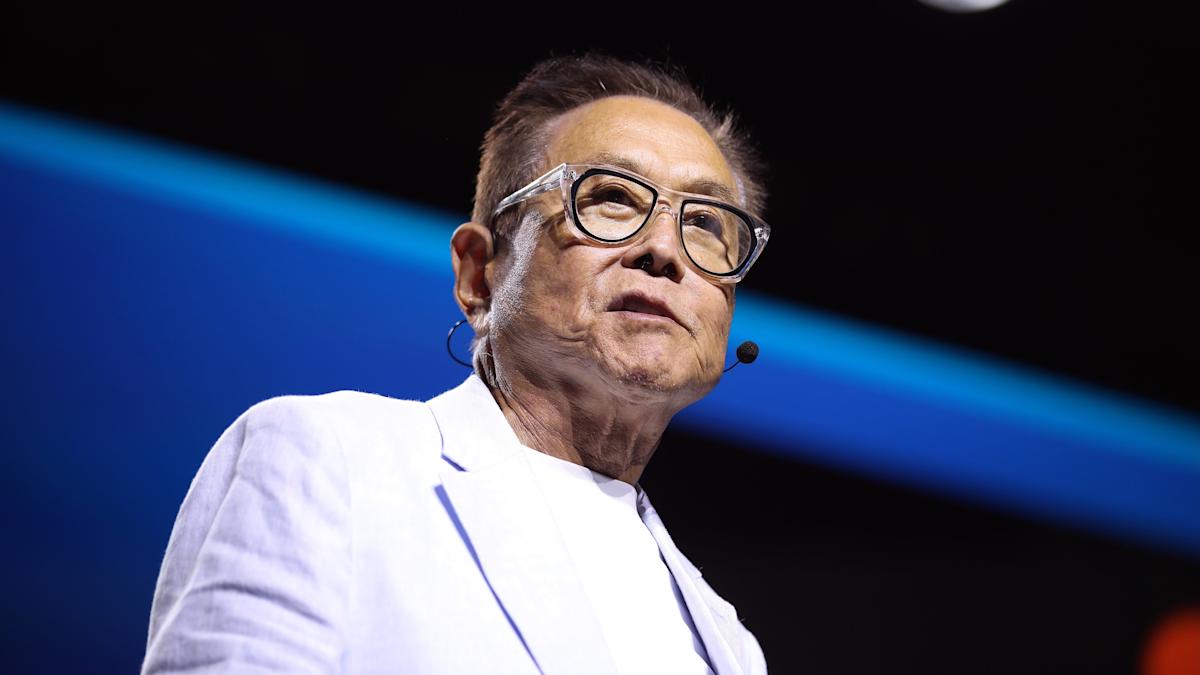
As markets start to slip from their highs, “Rich Dad Poor Dad” author Robert Kiyosaki is issuing a stark warning for investors.
“In Rich Dad’s Prophecy (2013) I warned the biggest stock market crash in history….was STILL coming. In 2026, I hope I am wrong…. Yet I am afraid that crash is now arriving,” Kiyosaki wrote in a recent post on X (1).
-
Thanks to Jeff Bezos, you can now become a landlord for as little as $100 — and no, you don’t have to deal with tenants or fix freezers. Here’s how
-
Most Americans earn a dismal 0.39% APY on their cash at big banks. Unlock up to 4.05% APY and pay $0 in account fees instead with a Wealthfront Cash Account
-
Dave Ramsey warns nearly 50% of Americans are making 1 big Social Security mistake — here’s what it is and the simple steps to fix it ASAP
He argued that the root cause of the 2008 financial crisis was “never fixed,” meaning the next crash “could only get bigger.”
The 2008 financial crisis was largely triggered by a housing bubble fueled by risky mortgage lending and complex securities tied to those loans. Regulators later introduced stricter rules on banks and mortgage lending, though some critics argue financial risks have simply shifted to other parts of the financial system, such as the “shadow banking” sector (2).
The S&P 500 plunged 38.5% in 2008. Given how much wealth is tied to the stock market today, a crash of the magnitude Kiyosaki predicts — larger than the 2008 decline — could have far-reaching consequences. The author warned that one group in particular could be hit hard.
“Baby boomers retirements will be wiped out all over the world because the world is loaded with debt it cannot pay back,” he said.
That risk could be significant because many retirement portfolios are heavily invested in equities. U.S. private sector defined-contribution pension plans now hold nearly 70% of their assets in stocks, while U.S. households hold a record 45.4% of their financial assets in equities, Reuters reported (3).
Still, Kiyosaki also offered suggestions on how investors might prepare for a crash of historic proportions.
“I continue to suggest investors become proactive and acquire gold, silver, Bitcoin, Ethereum and partnerships in real oil wells,” he wrote.
Let’s take a closer look at some of these assets.
Kiyosaki has never been shy about his love for gold and silver — and in moments of crisis, he turns to them with even more conviction. The reasoning is straightforward: “I’m not buying gold because I like gold, I’m buying gold because I don’t trust the Fed,” he said in an interview back in 2021 (3).
Gold and silver have long been viewed as safe-haven assets. Unlike fiat currencies, they can’t be printed at will by central banks and their value isn’t tied to any single country or economy. That scarcity, combined with their time-tested reputation as a store of value, is why investors often flock to the metals during periods of inflation, market turmoil or geopolitical unrest — pushing prices higher.
Kiyosaki has been hoarding gold.
“I have boxes of gold. I own gold mines,” he revealed in a 2025 interview (4).
More recently, he has also been highlighting silver’s accessibility. “I love silver because even in 2026, if you have $10 you can go to a gold and silver dealer and buy $10 worth of junk real silver,” he wrote.
And the market has rewarded precious metals investors. Over the past 12 months, gold prices have surged by more than 70%, while silver has more than doubled.
One way to invest in gold and silver that also provides significant tax advantages is to open a precious metals IRA with the help of Thor Metals.
Precious metals IRAs allow investors to hold physical gold, silver or other related assets within a retirement account, thereby combining the tax advantages of an IRA with the protective benefits of investing in gold and silver, making it an option for those looking to help shield their retirement funds against economic uncertainties.
To learn more, you can get a free information guide that includes details on how to get up to $20,000 in free metals on qualifying purchases.
Read More: I’m almost 50 years old and don’t have retirement savings. Is it too late to catch up?
Read More: Non-millionaires can now invest in this $1B private real estate fund starting at just $10
Precious metals aren’t Kiyosaki’s only refuge. In past warnings of a 1929-style Depression, he pointed to one income-generating asset he believes can hold up even during a crash: real estate.
“I have always recommended people become entrepreneurs, at least a side hustle and not need job security. Then invest in income-producing real estate, in a crash, which provides steady cash flow,” he wrote (5).
Real estate has long been a favored asset for income-focused investors. While stock markets can swing wildly in headlines, high-quality properties often continue to generate stable rental income.
It can also be a powerful hedge against inflation. When inflation rises, property values often increase as well, reflecting the higher costs of materials, labor and land. At the same time, rental income tends to go up, providing landlords with a revenue stream that adjusts with inflation.
Perhaps that’s why Kiyosaki once disclosed he owns 1,500 rental properties (4).
Today, you don’t need to be as wealthy as Kiyosaki to get started in real estate investing. Crowdfunding platforms like mogul offer an easier way to get exposure to this income-generating asset class.
Mogul is a real estate investment platform offering fractional ownership in blue-chip rental properties, which gives investors monthly rental income, real-time appreciation and tax benefits — without the need for a hefty down payment or 3 A.M. tenant calls.
Founded by former Goldman Sachs real estate investors, the team hand-picks the top 1% of single-family rental homes nationwide for you. In other words, you gain access to institutional-quality offerings for a fraction of the usual cost.
Each property undergoes a rigorous vetting process, requiring a minimum 12% return even in downside scenarios. Across the board, the platform features an average annual IRR of 18.8%. Offerings often sell out in under three hours, with investments typically ranging between $15,000 and $40,000 per property.
You can sign up for an account and then browse available properties here.
Another option is Lightstone DIRECT, which offers accredited investors access to institutional-quality multifamily and industrial real estate — with a minimum investment of $100,000.
Founded in 1986 by David Lichtenstein, Lightstone Group is one of the largest privately held real estate investment firms in the U.S., with more than $12 billion in assets under management.
Over nearly-four decades, their team has delivered strong, risk-adjusted performance across multiple market cycles — including a 27.6% historical net IRR and a 2.54x historical net equity multiple on realized investments since 2004.
With Lightstone DIRECT, you gain access to the same multifamily and industrial deals Lightstone pursues with its own capital.
Here’s the kicker: Lightstone invests at least 20% of its own capital in every deal — roughly four times the industry average. With skin in the game, the firm ensures its interests are directly aligned with those of its investors.
Kiyosaki has been a vocal backer of cryptocurrencies, repeatedly stating that he owns both Bitcoin and Ethereum.
Recent pullbacks in Bitcoin have once again underscored just how volatile the asset can be, but Kiyosaki has made it clear that price swings don’t shake his conviction. If anything, he views them as a buying opportunity.
“I am so bullish on Bitcoin I am buying more and more as Bitcoin’s price goes down,” he stated last month, pointing to the scarcity of the world’s largest cryptocurrency (6). Unlike traditional currencies, Bitcoin can’t be created in unlimited quantities — its supply is capped at 21 million by mathematical algorithms.
Kiyosaki added that he will be “buying more Bitcoin as people panic and sell into the coming crash.”
That said, cryptocurrencies remain highly volatile — and not everyone has the stomach for the swings. But for those curious about adding crypto exposure, getting started has never been easier.
For instance, Robinhood Crypto allows users to buy and sell crypto with as little as $1 without any trading fees or commissions.
Robinhood Crypto has the lowest trading cost on average in the U.S. — meaning you could get up to 3.5% more crypto compared to trading on other platforms.
Prominent investors often stress the importance of diversification — and for good reason. Many traditional assets tend to move in tandem, especially during periods of market stress.
That message feels especially relevant today. Nearly 40% of the S&P 500’s weight is concentrated in its ten largest stocks and the index’s CAPE ratio hasn’t been this high since the dot-com boom.
This is where, for many investors, alternative assets come into play. These can include everything from real estate and precious metals to commodities and collectibles.
But there’s one store of value that routinely flies under the radar: It’s scarce by design, coveted worldwide and frequently locked away by institutions.
We’re talking about post-war and contemporary art — a category that has outpaced the S&P 500 with low correlation since 1995.
It’s easy to see why art pieces often fetch new highs at auctions: The supply of the best works of art is limited and many of the most desirable pieces have already been snatched up by museums and collectors. That scarcity can also make art an attractive option for investors looking to diversify and preserve wealth during periods of high inflation.
Until recently, purchasing art has been a domain reserved for the ultra-wealthy — like in 2022 when a collection of art owned by the late Microsoft co-founder Paul Allen sold for $1.5 billion at Christie’s New York, making it the most valuable collection in auction history (7).
Now, Masterworks — a platform for investing in shares of blue-chip artwork by renowned artists, including Pablo Picasso, Jean-Michel Basquiat and Banksy — can help you get started with this asset class. It’s easy to use and, with 25 successful exits to date, Masterworks has distributed more than $65 million in total proceeds (including principal).
Simply browse their impressive portfolio of paintings and choose how many shares you’d like to buy. Masterworks can handle all the details, making high-end art investments both accessible and effortless.
New offerings have sold out in minutes, but you can skip their waitlist here.
Note that past performance is not indicative of future returns. Investing involves risk. See Reg A disclosures at masterworks.com/cd.
-
The average tax refund could hit $3,500 in 2026. Here’s how to turn that juicy check into a long-term retirement win
-
Vanguard reveals what could be coming for U.S. stocks, and it’s raising alarm bells for retirees. Here’s why and how to protect yourself
-
Robert Kiyosaki begs investors not to miss this ‘explosion’ — says this 1 asset will surge 400% in a year
-
Warren Buffett used these 8 repeatable money rules to turn $9,800 into a $150B fortune. Start using them today to get rich (and stay rich)
Join 250,000+ readers and get Moneywise’s best stories and exclusive interviews first — clear insights curated and delivered weekly. Subscribe now.
We rely only on vetted sources and credible third-party reporting. For details, see our editorial ethics and guidelines.
@theRealKiyosaki (1, 6, 7); Board of Governers of the Federal Reserve System (2); Reuters (3); Yahoo!Finance (4); The Iced Coffee Hour (5); Christie’s (8)
This article provides information only and should not be construed as advice. It is provided without warranty of any kind.