The Aussie dollar has dipped 0.4 per cent overnight, but it is still touching 70 US cents. Meanwhile, there was an AI stock sell-off in Wall Street overnight, dragging the Nasdaq down.
Follow the day’s financial news and insights from our specialist business reporters on our live blog.
Disclaimer: this blog is not intended as investment advice.
Key Events
Market snapshot
- ASX 200: -0.1% at 8,918 points
- Australian dollar: +0.1% at 70.03 US cents
- Wall Street: Dow Jones (+0.5%), S&P 500 (-0.5%), Nasdaq (-1.5%)
- Europe: FTSE (+0.9%), DAX (-0.7%), Stoxx 600 (flat)
- Spot gold: -0.2% to $US4,955/ounce
- Spot silver: flat to $US87.87/ounce
- Oil (Brent crude): -1% to $US68.75/barrel
- Iron ore: -1% to $US101.40 a tonne
- Bitcoin: -0.3% to $US72,414
Prices current around 12:17pm AEDT
Live updates on the major ASX indices:
Key Event
New website launched for Shield and First Guardian investors
Super Consumers Australia (SCA) has launched a new website to provide help for the about 11,000 people who invested about $1.1 billion in the Shield and First Guardian Master Funds.
The website is funded by the Australian Securities and Investments Commission to assist people who lost their super following the collapse of the two funds.
“Thousands of people have had their retirement savings wiped out after being steered into high-risk products that were never right for them,” said Xavier O’Halloran, CEO of SCA.
“Take Your Super Back is about giving people clear, independent information so they can understand what happened and take action before it’s too late.”
Fewer than 2,000 people invested in Shield and First Guardian have lodged complaints with the Australian Financial Complaints Authority to claim compensation for their losses, according to the organisation.
“The fact that only a small fraction of affected investors have complained tells us many people either don’t know they can take action or don’t know where to start,” Mr O’Halloran added.
“This website is designed to remove those barriers by providing clear information in plain English.”
Key Event
Debt markets firm on interest rate hike by May
The Australia 3-Year Bond yield is trading at 4.32%.
Australian bonds, both at the short and long ends, have sold off this week after the Reserve Bank’s decision to hike the cash rate by 0.25%.
Analysts say debt markets are pricing in another RBA interest rate hike by May.
A further hike may depend on the quarterly inflation data published on April 29.
Selloff wipes out nearly $US1 trillion from software and services stocks
Investors have been assessing whether a selloff in global software stocks this week had gone too far, as they weighed whether businesses could survive an existential threat posed by artificial intelligence.
The answer: It’s unclear, but AI’s development will involve volatility.
After a broad selloff on Tuesday that saw the S&P 500 software and services index fall nearly 4%, the sector slipped another 0.7% on Wednesday, notching the sixth straight session of losses and wiping out about $US830 billion in market value since January 28.
Software stocks have been under pressure in recent months as AI has shifted from a tailwind for many of these companies to a possible disruption.
The latest selloff was triggered by a new legal tool from Anthropic’s Claude large language model.
The tool — a plug-in for Claude’s agent for tasks across legal, sales, marketing and data analysis — underscored the push by LLMs into the “application layer”, where these firms are increasingly muscling into lucrative enterprise businesses for revenue they need to fund massive investments.
If successful, investors are worried that it could wreak havoc across industries from finance to law and coding.
Reporting with Reuters
Key Event
Macquarie Bank to makes changes to interest rates
Macquarie Bank has announced it will increase variable interest rates paid on its transaction and savings accounts by 0.25% pa from February 20, 2026.
The bank will also increase its variable home loan reference rates by 0.25% pa from the same day.
Ben Perham, head of personal banking at Macquarie Bank, says the lending market remains very competitive for borrowers.
“After a year of falling rates, this move by the RBA may be a wake-up call for those who have been considering switching their loan to another bank,” he said.
Meanwhile, Mr Perham says the cash rate hike is welcome news for many savers.
“With the ongoing or base rate paid on many savings accounts now near zero if monthly conditions aren’t met, and most transaction accounts paying no interest at all, it’s very important to check you’re still getting the best deal.”
Key Event
More sectors higher than lower despite decline in ASX 200
The ASX 200 edges down by 0.1% to 8,918 points.
The bottom-performing stocks in this index are Neuren Pharmaceuticals and NexGen Energy (Canada), down 7.5% and 6.6%, respectively.
Looking at sectors, 6 of the 11 are higher today despite the decline in the ASX 200.
Health Care is the best-performing sector, gaining 0.7% and 0.3% over the past five days, while Materials underperformed, falling by 1.4%.
Key Event
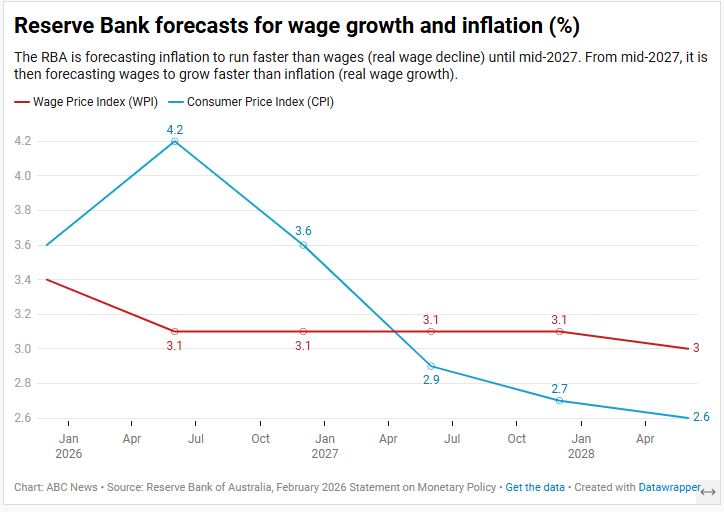
Reserve Bank’s forecasts for real wage declines this year
In the Reserve Bank’s latest forecasts (found in its Statement on Monetary Policy, released on Tuesday), the RBA is forecasting annual inflation growth to run faster than annual wage growth until mid-2027.
When inflation runs faster than wages, it means the “real” value of your wages (your purchasing power) is deteriorating (real wage decline).
From mid-2027, the RBA is forecasting wages to grow faster than inflation (real wage growth), which will see your purchasing power improve again.
This is what those forecasts look like in a graph:
But what those forecasts don’t show is what’s happened in the recent past.
According to Bureau of Statistics data, Australians have enjoyed real wage growth for the past two years (roughly), since late 2023.
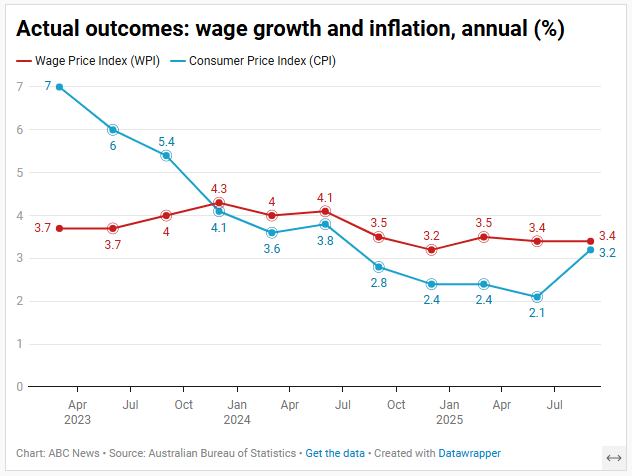
The pick-up in inflation in the back half of last year has brought that real wage growth to an end.
In its Statement on Monetary Policy, the RBA offered these reasons for some of the pick-up in inflation.
“The roll-off of government electricity price rebates contributes to higher inflation in the near term and adds some volatility to the forecasts.
“Because headline inflation can be affected by large swings in the prices of individual items, we will continue to pay close attention to underlying measures as an indicator of momentum in consumer price inflation.
“Housing inflation — measured in the CPI as the cost of constructing a new dwelling and rents currently being paid by households — is expected be higher in the near term relative to the November Statement. The outlook for new dwellings inflation has been revised higher in the near term, which reflects the stronger-than-expected momentum in recent data. New dwellings inflation is expected to remain elevated in coming quarters, before easing in line with a weaker outlook for housing market activity. CPI rents are also expected to be a little higher over the forecast period. Near-term indicators of advertised rents suggest more strength in the rental market than assumed in November, which gradually passes through to the stock of rents as measured in the CPI.
“Market services inflation is forecast to remain higher in the near term than in the November Statement. A stronger profile for market services inflation reflects our assessment that there will be more capacity pressure in the economy than previously thought. Market services inflation is expected to increase in the first half of the year, before slowing only gradually as capacity and labour cost pressures ease.”
Key Event
Bunnings justified in use of facial recognition technology
The Administrative Appeals Tribunal (AAT) has found the use of facial recognition technology (FRT) in Bunnings stores was justified for the “purpose of combating very significant retail crime and protecting their staff and customers from violence”.
Bunnings challenged an original decision by the Privacy Commissioner, which was covered by the ABC in 2025.
In a decision handed down yesterday, the appeals tribunal found in favour of the retailer, after The Privacy Commissioner argued the hardware giant had collected “sensitive information” and was in breach of the privacy act.
In a statement, Bunnings said the decision “recognised the need for practical, common-sense steps to keep people safe”.
However, the tribunal also found Bunnings had failed to provide appropriate notice to customers about its use of FRT.
Bunnings said it accepted that it “didn’t get everything right, including signage, customer information, processes and our privacy policy”.
The Office of the Australian Information Commissioner said it would be “carefully considering this decision and its implications”.
Key Event
Australia’s biggest bank still has no decision on savings rates
We’ve been doing the whip around to major banks this morning, asking if they have decided how or if they will pass on the RBA’s rate hike to their savings customers.
CBA, the country’s biggest bank, has just responded with a spokesperson telling ABC News:
“We are still reviewing savings rates. No decision has been made.”
ANZ and NAB have also said the same. We’re waiting for a reply from Westpac. All of the Big Four banks took less than a day to announce they are passing the RBA’s rate hike onto their variable home loan customers in full by February 13, except for Westpac which is waiting four extra days.
ANZ confirms it’s still reviewing interest for savings
All of the Big Four banks took less than 12 hours after the RBA’s rate hike call to announce that they’ll pass a 0.25% cash rate increase onto their variable home loan customers by February 13 (except for Westpac, which is giving its customers four extra days).
We’ve just contacted all of those banks this morning to ask if they’ll be doing the same for variable deposit rates on savings accounts. NAB says it’s still assessing savings and deposit rates, with “updates” to come into effect by February 13.
And ANZ has just told us it’s still reviewing the rates. It hasn’t put a deadline on when it could announce changes.
Have you got a savings deposit rate increase note from your bank? We’d love to see it! Or let us know if you’re still waiting. Email our journalist on terzon.emilia@abc.net.au or comment here.
Mixed comments on housing tax reform
Regardless of the different viewpoints being expressed in relation to CGT on investment properties, at least we are having a healthy discussion. That’s good.
– Peter
Interesting comments on housing tax reform. Also interesting that of all the reactions to my comment to limit negative gearing to one property only 3 people reacted “concerned”. Seems a large percentage would back it. I assume Jim Chalmers is conducting research with similar results.
– Phillip
Not sure if changing the CGT discount will make much of an impact, pretty sure treasury modelled this a little while ago and found it would only make a ~2% difference. for proper housing reform we need to increase supply. if we want to target the demand side, land taxes are the way to go, this is a state based tax, not sure there’s too many levers the feds can do
– Realistic
I have an extended family member who owns 50 homes and is mortgaged up to the hilt. You aren’t allowed to borrow to that extent for the share market. Every time there’s a slight drop in housing he complains about how unfair it is, as if it’s just expected that housing will never drop but will keep going higher and higher. Meanwhile he’s taking advantage of negative gearing for each of his property (another option that is not open to stock market investors.) I’m really okay with limiting how many investment properties any one person can have . . . but consider, too, that there are other ways to own investment properties that aren’t outright ownership, like through SMSFs and family trusts. Changes to ownership in those structures should also be considered.
– Max
Thanks again for your comments on this news story today. Looks like you’ve got lots of thoughts on this one.
For modelling on what housing tax changes could do to property prices, you can’t go past this story from our acting editor and resident tax policy guru, Nassim Khadem.
ASX opens marginally down on Thursday
The Australian share market has bucked futures predictions, trading down so far this mornng with the ASX 200 off about 0.2%. That’s following mixed results on Wall Street, with the tech heavy Nasdaq dropping on AI stocks, while the Dow actually rose overall.
NAB pledges ‘updates’ to savings rates by February 13
All of the Big Four banks took less than 12 hours after the RBA’s rate hike call to announce that they’ll pass a 0.25% cash rate increase onto their variable home loan customers by February 13 (except for Westpac, which is giving its customers four extra days).
We’ve just contacted all of those banks this morning to ask if they’ll be doing the same for variable deposit rates on savings accounts, which would give savers back more cash in interest.
We’ve just got this statement back from NAB, on behalf of Sweta Mehra, who heads up Personal Everyday Banking.
“We’re working through updates to our savings and deposit products following the RBA’s decision, and these are expected to come into effect from 13 February. We’ll share more details as soon as everything is finalised. Changes may roll out at different times across savings products, reflecting differences in funding costs, market conditions, and product features.”
Have you got a savings deposit rate increase note from your bank? We’d love to see it! Or let us know if you’re still waiting. Email our journalist on terzon.emilia@abc.net.au or comment here.
Key Event
‘There will be strike action’: ACTU pushes more than 4% pay increase
The peak union body’s secretary, Sally McManus, spoke to the ABC’s national breakfast TV program this morning, where she noted the ACTU’s push for above-inflation wage increases.
As well as collective bargaining to get the outcome from employers, the ACTU is saying it’ll push for real wage increases during this year’s minimum wage and AWARD agreement negotiations with the FWU.
“Landlords keep putting up rents,” McMcManus said.
“Your average worker is either a renter or they’re a first home buyer and they’re the ones under the most amount of cost-of-living pressure for many reasons. Rents are part of it.
“In order to just keep up, you need a 4% pay increase. People are going to want to get ahead, and that means more than 4%.”
“Lots of employers are reasonable, but some aren’t,” she added, noting “there will be strike action if we can’t get wages that will keep us ahead.”
CPI (inflation) actually came in at 3.8% for the 12 months ending in December 2025. The next round of inflation data is due out on February 25.
We’ll bring you more on this developing story today. For now, here’s more on the breakdown of what inflation is doing.
Thanks for your comments on Capital Gains
Changes to the housing tax policy seems like a no-brainer. Victoria has a reasonably restrictive land tax for non-primary place of residence and has seen significantly slower growth in housing prices compared to the national average as a result. If the goal is to improve affordability, isn’t that considered a resounding success? Most of the reporting of housing prices bemoans the slow growth of Melbourne’s property prices, but isn’t that the point?
– Stuart
I think any taxation changes should focus on the policy objective…incentivizing overall supply & providing subsidized rentals (In the absence of social housing – although how Defense Housing could be a good model for social housing). Capital gains tax discounts should be limited to new builds only (So not applicable to established homes) with a minimum holding period. Negative gearing should be limited to people who are providing long term rentals, explicitly excluding any short term rental. Finally, there should be a vacancy tax. Simply put…the objective should be tilted heavily towards supply & “cheaper” rentals. Most of all, it should penalize speculation.
– Allan
I find it wild that negative gearing can be across different assets. One solution would be to limit the losses to only the asset that incurs the loss, rather than setting against the income of the owner. Similar to how a family trust can’t distribute losses for tax purposes but has to hold them itself.
– Commenter
A government source told the ABC that, while a final decision had not been made, there was an appetite to pursue housing-related reform, that discussions were ongoing, and that changes to the capital gains tax had not been ruled out.
You can read more here.
Google’s AI platform reaches 750 million users
One of the world’s biggest tech companies, Alphabet, has just put out its results, where it has noted growing spending to push further into AI.
Google’s owner is planning a $US175 to $US185 billion dollar spend in 2026, which is far above expectations. Its share price has initially dropped 6% in after-hours trade on Wall Street on that news, but is now starting to come back.
CEO Sundar Pichai said in a release that Alphabet hiked its forecast spending to meet customer demand and capitalise on growing opportunities.
“We’re seeing our AI investments and infrastructure drive revenue and growth across the board,” he said.
The company spent $US91.45 billion in 2025, primarily on AI infrastructure, including servers, data centres and networking equipment. That’s pretty bang on its projections.
Growth in Google’s cloud division, where the company is enjoying early returns on AI investment, helped the stock pare losses. Overall, the company reported total revenue of $US113.83 billion for the quarter, very slightly higher than projections.
The aggressive expansion in outlay for AI comes at a time when investors have increasingly grown concerned about payoffs from the investments.
The launch of its latest Gemini 3 model, which is linked to its search engine Google, in November saw strong reception and propelled the company forward in the AI arms race. It now has 750 million users monthly, the company says.
Following the launch of Gemini 3, Sam Altman, CEO of AI frontrunner and ChatGPT creator OpenAI, reportedly issued an internal “code red” to push his teams to accelerate development.
Google has also struck a deal with Apple to power its revamped Siri voice assistant with Gemini, which is unlocking a huge market for the company due to the tech partnership.
Thanks for your comments so far today!
Limiting negative gearing to one property seems to be the way to go to me. It would still allow for individual investors who use an investment property for long term financial planning to continue whilst making investors who are in the market for purely speculative purposes re-appraise their approach.
– Phillip
Smaller banks start to announce savings rate increases
Well all of the Big Four banks have announced they’ll pass on the RBA’s 0.25% cash rate increase to their variable home loan customers by February 13, except for Westpac, which is giving its customers four extra days.
We’ve just contacted all of those banks to ask if they’ll be doing the same for variable deposit rates on savings accounts, which would give savers back more cash in interest.
So far, comparison website Canstar says it has noted savings rate increase announcements from smaller banks ING, Macquarie, and Ubank.
The Bank of Sydney has also just announced it’ll lift variable savings rates by 0.25% on February 10, followed by the same bump to its variable home loan rates by February 17.
Have you got a savings deposit rate increase note from your bank? We’d love to see it! Or let us know if you’re still waiting. Email our journalist on terzon.emilia@abc.net.au or comment here.
Obesity drug manufacturer forecasts 25% sales rise
Well it’s the growing business that’s helping people shrink. Now, major weight loss drug manufacturer, Eli Lilly, is forecasting a 25% revenue rise in 2026.
That is as its rival Novo, which makes Wegovy, says its sales are expected to fall between 5% and 13% in 2026.
Lilly’s successes have boosted its market value to more than $US1 trillion, the first pharmaceutical company to reach that milestone, while Novo shares have sunk 40% over the past year. On Tuesday, the Danish drugmaker warned investors of “unprecedented” pricing pressure in 2026.
Novo last month rolled out an oral version of Wegovy at an initial price of $US149, ahead of an expected April regulatory decision for Lilly’s rival weight-loss pill.
Lilly expects to launch its orforglipron pill in the US in the second quarter, and in most international markets in 2027, Ken Custer, the company’s head of cardiometabolic health, said on a call to discuss its results and outlook.
You can read more about the weight loss industry in this feature by our colleague Rachel Clayton from a while ago.
Australian steel businesses battling cheap imports
An interesting read from our colleagues this morning, about how Australian steel companies are battling to survive as cheap imports increase competition.
“We’re running almost unprofitably at the moment and hanging in there hoping things might get better,” one company’s boss tells ABC News.
“But if it doesn’t, we’ll have to make some drastic decisions.”
More here:





![i’m-nervous,-too!-[part-2]](https://10xwealthreport.com/wp-content/uploads/2026/03/177042-im-nervous-too-part-2-1568x784.jpg)