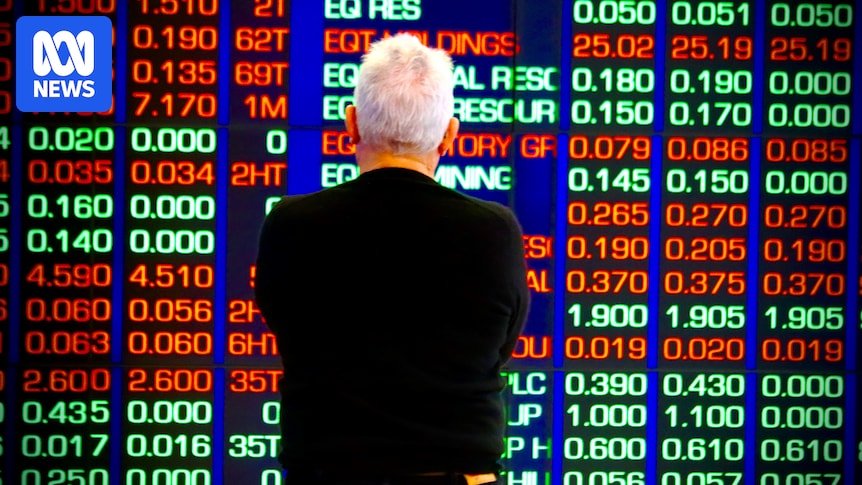
The Australian market is set for a disappointing end to the trading week, finding itself in negative territory on Friday, despite US stocks rising overnight.
A relief rally has continued on Wall Street, as investors mull the fragile two-week peace agreement in the Middle East.
The price of Brent crude oil is up to over $US96 a barrel, while the Australian dollar is slightly weaker against the greenback.
Follow the day’s financial news and insights from our specialist business reporters on our live blog.
Disclaimer: this blog is not intended as investment advice.
Key Events
Market snapshot
- ASX 200: -0.4% to 8,938.4
- Australian dollar: -0.1% at 70.70 US cents
- Wall Street: Dow Jones +0.6%, S&P 500 +0.6%, Nasdaq +0.8%
- Europe: FTSE flat, Stoxx 600 -0.2%
- Spot gold: -0.4% to $US4,759/ounce
- Spot silver: +0.7% to $US75.82/ounce
- Oil (Brent crude): +0.7% to $US96.59/barrel
- Iron ore: +0.1% to $US106.27/tonne
- Bitcoin: +0.2% to $US71,847
Prices current around 1:35pm AEST.
Live updates on the major ASX indices:
Key Event
Asia’s energy importers ‘biggest beneficiaries of ceasefire’: Barclays
There will be a price to pay for the past six weeks, but Asia’s energy importers are set to be among the biggest beneficiaries of a lasting ceasefire, according to Barclays.
Ajay Rajadhyaksha, Barclays global chairman of research, says a sense of relief is being experienced by its clients who are getting “back to fundamentals”.
‘[We] expect Asia’s energy importers to be among the biggest beneficiaries of a lasting ceasefire,” Mr Rajadhyaksha wrote in Barclays Thinking Macro report.
“The US-Iran ceasefire is holding. More or less. There are violations on both sides and some of them are serious. No-one knows definitively how long peace will last.
“But the shooting and bombing have mostly stopped, the diplomats are talking, and for the first time in six weeks the oil tape is not the first thing we look at in the morning.”
With the cost of Brent crude oil now under $US100 a barrel, equities in the US have clawed back losses and bond yields have stopped selling off due to fears of higher inflation.
Mr Rajadhyaksha is predicting an average of $US85 per barrel if the conflict continues to taper off.
“The oil premium is not fully disappearing, outages have left tens of millions of barrels permanently under the ground, and spare capacity to pump more is very limited,” he said.
“Ceasefires end wars, but they don’t undo them. And the conflict has left a few things behind that will not reverse even if the shooting stops.”
Key Event
Cost of building house ‘rises $120,000 in six weeks’
One construction boss estimates the cost of vital building materials has risen 50% since late February when the US and Israel began their offensive in Iran.
That flow-on effect means that a couple building their dream home at Pyalong, north of Melbourne, has seen a price rise of $120,000 in just six weeks.
The contruction sector is warning of mass layoffs and housing delays due to supply chain shocks caused by the Middle East conflict.
Read more from the ABC’s Sara Tomevska:
China inflation spike will be ‘short-lived’: Capital Economics
As we told you earlier, China’s consumer price index (CPI) rose 1% in March, with the core number — which excludes food and energy prices — hitting 1.1%.
The news came as Chinese Premier Xi Jinping met with Taiwan’s opposition leader Cheng Li-wun in Beijing.
But Capital Economics chief economist Zichun Huang says the inflation pickup is likely to be short-lived.
“The Iran War has ended three years of factory-gate deflation in China and pushed CPI inflation to its highest level since early 2023 (after adjusting for Lunar New Year distortions),” Ms Huang wrote.
“The big picture though is that the uptick is still fairly modest and is unlikely to prove durable.”
Ms Huang said she expected more price spikes over the next couple of months before things stabilised.
“Provided that the ceasefire announced on Tuesday doesn’t fall apart, the headline CPI rate should peak well below the PBOC’s target before dropping back under 1.0% by year end,” she said.
“There has so far been limited feed through to prices of consumer goods. Memory chip shortages are pushing up electronics prices, but factory-gate prices of consumer goods as a whole are still falling at a relatively rapid pace.”
Key Event
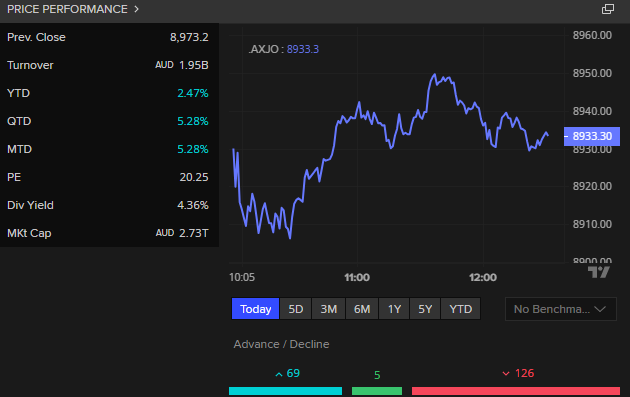
ASX is clawing back some of its earlier losses
The ASX 200 hasn’t been able to replicate the gains of Wall Street overnight.
But it is in a better spot that it was in the first hour of trading.
It’s down by about 0.4% today, having slumped by almost 1% at one point.
It’s at 8,933.3, a modest loss of about 40 points on the day.
Key Event
China’s inflation at 1%, non-food items 1.2%
China has coped with the impact of the Iran war better than many other countries.
It is about 85% self-sufficient when it comes to energy, although it does rely on imported liquid fuel to support its massive transportation demands.
The world’s most populous nation has just revealed its March inflation figures.
The consumer price index (CPI) rose 1% year-on-year in March, official data released on Friday showed.
The core CPI, which covers non-food items, increased 1.1% year on year, the food CPI was at 0.3%.
But on a month-on-month basis, the CPI fell 0.7% in March.
The producer price index, which measures costs for goods from factories, increased by 0.5% year-on-year in March.
That was the first increase following 41 consecutive months of declines.
With reporting by Reuters
Key Event
Venezuela’s inflation rate is 71.8% in 2026
It’s just over three months since the US invaded Venezuela, capturing incumbent President Nicolás Maduro and his wife, Cilia Flores, in a military raid codenamed Operation Absolute Resolve.
And the nation’s latest inflation figures are out.
Venezuela’s inflation rate was 71.8% in the first three months of 2026.
For March, inflation was 13.1% on a month-on-month basis, down from 14.6% in February, the country’s central bank reported on Thursday.
Adding March’s data, annualised inflation was 649.4%, according to Reuters calculations based on the central bank’s figures.
Westpac’s chief economist hopes she’s wrong but fears she’s right
Westpac’s chief economist, and former RBA assistant governor, Luci Ellis has released her usual Friday missive.
In it, she says the bank’s base case forecast of three more consecutive interest rate rises, taking the cash rate to 4.85%, is premised on significant disruptions of oil flow continuing in the Strait of Hormuz.
The ceasefire deal and looming weekend negotiations between the US and Iran mean this might not be the case, which may mean a quicker fall in oil and fuel prices, less inflationary pressure and few rate rises.
However, the other side of that inflation equation, she says, is not looking as hopeful.
“The real question for Australia, and for the domestic interest rate outlook, is how much of the energy price shock is already being passed through to prices of other goods and services. On this there is less cause for optimism,” she notes.
“While ‘temporary fuel levies’ are easier to unwind as fuel prices decline, for many products, list prices have been lifted significantly and a reversal seems less likely.
“Building materials are a particular issue, with the cost of building a detached home increasing as much as 10%, on our preliminary estimates. The lift in pricing has been widespread across industries and in some cases quite large relative to overall inflation trends.
“The RBA will be watching for this kind of behaviour, including through its liaison program, and will see it as a further leg up in underlying inflation from a rate that was already higher than desired.”
Ellis says Westpac’s next forecast round, scheduled for release next week, will contemplate both a case where traffic through the Strait remains disrupted and one where the ceasefire holds.
“If the ceasefire does hold, downside risks to growth diminish and inflation risks ease,” she writes.
“Because of the downstream pass-through to other prices we are already seeing, though, the inflation risks do not disappear and the RBA is still likely to raise the cash rate further.
“Still, it would be a better outcome than our current published baseline. This would be one of the instances where we would be quite happy to be wrong.”
Key Event
Outdated super exclusion costing domestic workers $150 million each year
We all remember a job where we worked incredibly hard, but received no benefits to our superannuation.
Now, the Super Members Council (SMC) is calling on the government to scrap current laws denying some access to super.
This will target domestic workers in private homes — cleaners, housekeepers and nannies, the majority of whom are women.
The Senate Economics Legislation Committee is inquiring into the laws that giverise to the exclusion of part-time domestic workers.
As it stands, domestic workers employed in private homes who work less than 30 hours a week for the same employer would continue to be excluded from receiving super.
New data from SMC shows around 37,000 domestic workers would be affected in 2026-27, with 86% of the workforce being women.
On average, each worker misses out on almost $4,000 a year in super contributions, amounting to nearly $150 million nationwide, with women missing out on about $126 million in that single year alone. It could mean a typical part-time domestic cleaner retiring with more than $130,000 extra in super, increasing retirement income by around $4,500 a year.
SMC says this law was originally made to prevent fees eroding low-balance super accounts, but that reason no longer stacks up now there are fee protections on small super balances.
The council recommends the government amend the regulations to remove the exclusion for domestic cleaners, housekeepers and nannies who work fewer than 30 hours a week, ensuring domestic work is treated the same as other forms of employment.
“Domestic workers are doing essential, paid work, yet the system still treats them as second-class workers when it comes to super — and that burden falls overwhelmingly on women,” says the Council’s Acting CEO Georgia Brumby.
“When something is outdated, you fix it. Fixing these outdated laws would help close the gender super gap and boost the retirement savings of thousands of hardworking Australians.”
Are you someone affected by these laws? I would love to hear from you. You can email me at miller.adelaide@abc.net.au
Key Event
Futures, spot prices … just give it to me strait
Are you confused about oil prices?
No? Brilliant.
Yes? I hope you’ll find the below info useful.
The oil market has four main components: contract prices, spot prices, front month prices, and futures.
Contract prices relate to long-term contracts. These prices are negotiated.
Brent contract prices are currently just north of $120 a barrel.
The spot market are prices for immediate delivery. The prices are market driven and fluctuate.
Spot Brent crude (also known as Dated Brent) reached a record high of $144.42 Wednesday but has since retreated to $119 as at 11am AEST.
Spot Brent continues to price in a so-called “war premium”.
Front month prices represent Brent crude for delivery “next month”.
Be warned though, the April contract is for June. Yes, it’s confusing.
It’s currently trading at $97 a barrel.
Futures prices cover the rest. Technically a futures contract is a price paid now for delivery in several months from now.
However, futures markets also serve the purpose of facilitating price discovery for other markets, and for making money through speculation.
Contract prices for July currently range from $90 to $92.
Oil markets are betting that over the course of the next few months oil supply will gradually ease.
As of writing this blog post, there is no firm evidence of that.
Market snapshot
- ASX 200: -0.4% to 8,938
- Australian dollar: -0.1% to 70.73 US cents
- Wall Street: Dow Jones +0.6%, S&P 500 +0.6%, Nasdaq +0.8%
- Europe: FTSE flat, Stoxx 600 -0.2%
- Spot gold: -0.1% to $US4,760/ounce
- Spot silver: +0.6% to $US75.46/ounce
- Oil (Brent crude): +1.1% to $US96.98/barrel
- Iron ore: +0.1% to $US106.27/tonne
- Bitcoin: +0.2% to $US71,932
Prices current around 11:05am AEST.
Live updates on the major ASX indices:
Senior Business Correspondent Carrington Clarke will answer your questions
More than ever, the geopolitical climate is linked to what we’re seeing playing out on financial markets, including the ASX 200.
You can follow the latest developments in the Middle East as a tenuous peace agreement comes under pressure in another of the ABC’s up-to-the-minute blogs.
And ABC Senior Business Correspondent Carrington Clarke will soon be answering reader questions on that platform.
Until recently, Carrington was the ABC’s North America correspondent and also covered East Asia for the network from Seoul.
Key Event
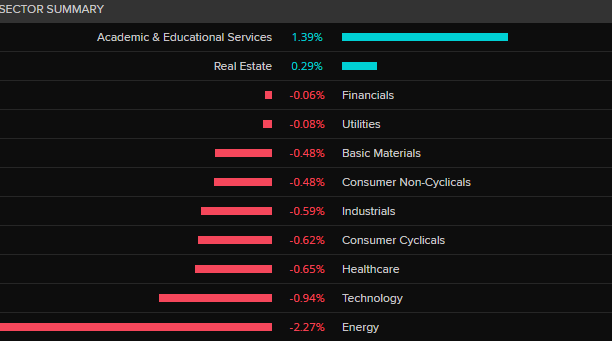
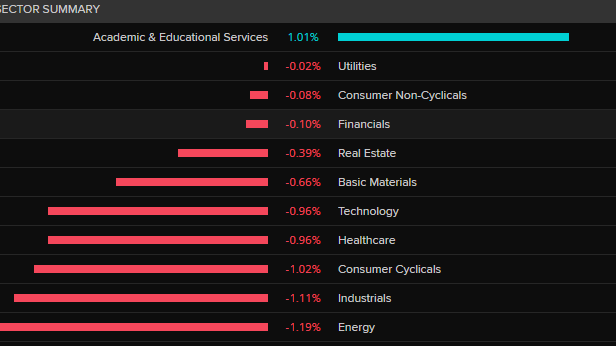
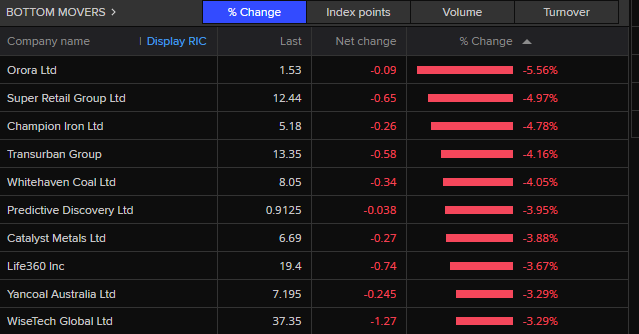
All sectors but one are down today on ASX
Academic & Educational Services is the only sector in positive territory on the ASX 200 today.
It is up just over 1%.
All the others are down with Consumer Cyclicals, Industrials and Energy — maybe no surprise there — taking the biggest hits so far on Friday.
Key Event
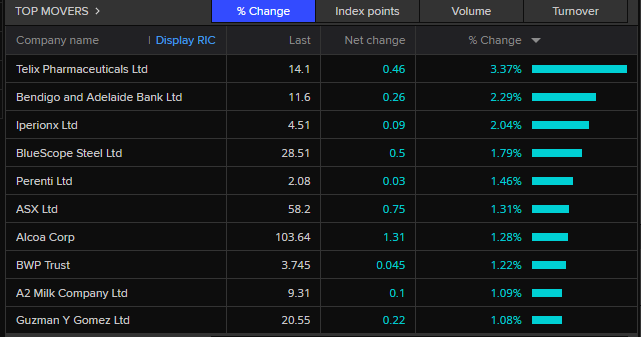
ASX slightly down in Friday trade
Well, we had high hopes of a good start to the final trading day of the week.
Unfortunately, those hopes have been dashed — for now.
The ASX 200 is down 58 points to 8,911, which is a fall of 0.68%.
Market snapshot
- ASX 200: -0.6% to 8,915
- Australian dollar: -0.1% to 70.71 US cents
- Wall Street: Dow Jones +0.6%, S&P 500 +0.6%, Nasdaq +0.8%
- Europe: FTSE flat, Stoxx 600 -0.2%
- Spot gold: -0.2% to $US4,754/ounce
- Spot silver: +0.1% to $US75.09/ounce
- Oil (Brent crude): +1.1% to $US96.89/barrel
- Iron ore: +0.1% to $US106.27/tonne
- Bitcoin: +1.3% to $US71,795
Prices current around 10:20am AEST.
Live updates on the major ASX indices:
Are markets trading like the war is over?
You will have seen that overnight, despite mass casualties in Lebanon and reports of the Middle East truce being shaky, Wall Street indexes continued to rise.
Our local market also closed slightly higher on Thursday, too.
Here’s some analysis on what markets are doing from Kyle Rodda at Capital.
The markets continue to hang on to a tenuous ceasefire between the US, Israel and Iran. Market participants are buying into any headline that suggests that it will hold.
For now, equities are trading as though there’s an optimism about the ceasefire holding and a lasting peace deal being achieved.
Crude prices, which were due to bounce after such an aggressive sell-off, still reflect a war premium and a risk to future supply.
Reports that Saudi Arabia’s oil output cut
Attacks on Saudi energy facilities have cut the kingdom’s oil production capacity by around 600,000 barrels per day and throughput on its East-West Pipeline by about 700,000 bpd.
That’s according to Saudi state news agency SPA, which reported this on Thursday, citing an official source at the Ministry of Energy.
The ministry source did not specify who launched the attacks, but Saudi Arabia has intercepted many Iranian missiles and drones in recent weeks.
The latest attacks, including previous strikes on some facilities, also disrupted operations at key oil, gas, refining, petrochemical and electricity sites in Riyadh, the Eastern Province and Yanbu Industrial City, SPA said.
Reporting from Reuters.
TelstraSuper closes Direct Access investment product
A superannuation investment option spruiked as offering “choice and flexibility” has been shut down, leaving members less than two months to sell all their assets.
TelstraSuper, a fund with around 87,000 members that operates independently of the telecommunication provider, notified customers in November that it would shut its Direct Access investment product.
The move blindsided some members, who were not aware TelstraSuper had changed its terms and conditions some 18 months earlier to allow it to shut the investment option with 30 days’ notice.
This one from our very own Adelaide Miller.
PM visiting Singapore today to lock in fuel supplies
Prime Minister Anthony Albanese is in Singapore today to discuss locking in fuel supplies with his counterpart, Prime Minister Lawrence Wong.
Singapore is a major oil refining hub. It is one of Australia’s most important sources of refined petroleum products and our largest source of petrol.
However, about two-thirds of the crude oil that normally goes into the city-state’s refineries has been significantly disrupted by the effective closure of the Strait of Hormuz for more than a month now, and they have had to cut output.
Key Event
Oil prices almost hit US$100 again overnight
Quite a week to be a commodities trader.
This is what has happened with trades on Brent crude futures in the last week, as focus has homed in on the crucial Strait of Hormuz pipeline during war in the Middle East.
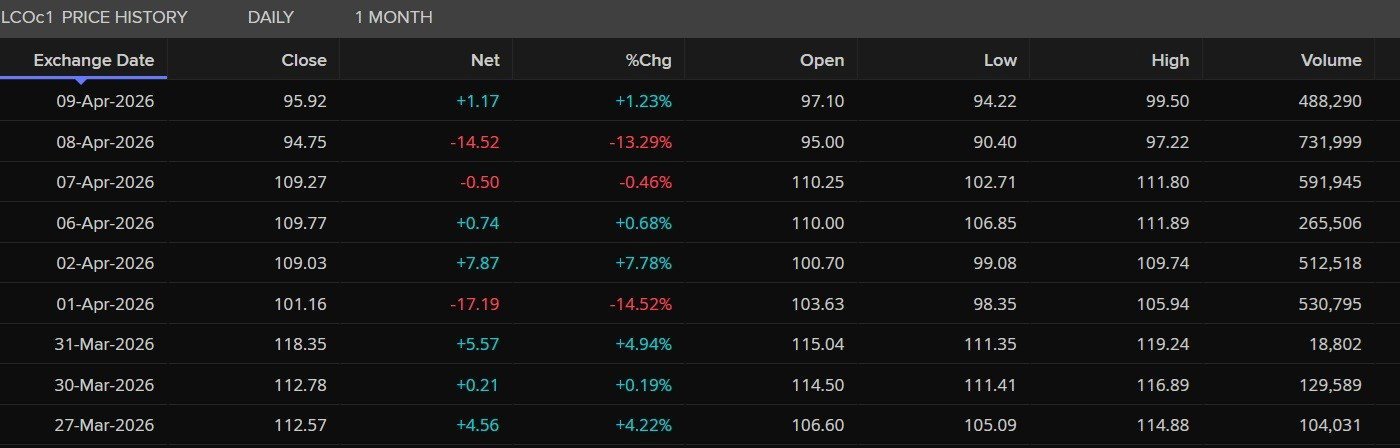
Important to note this is futures for June, so it’s what the market is betting prices will be on Brent in a few months time.
That big dive in price on 8 April was as a two-week peace deal was announced, contingent on Hormuz re-opening. Clearly, the market thought this would lead to more oil supplies coming back online by June.
You can also see that as this deal was looking shaky yesterday, prices started rising again and almost hit $US100/barrel in the middle of April 9 trade.
However, prices settled back down and closed at $US97.10.
Are you an oil trader? I would love to chat to you, even confidentially. Email me on terzon.emilia@abc.net.au