The Australian share market is set to fall for a third straight day as Wall Street tumbled to a one-month low on worsening relations between the United States and Europe.
Donald Trump’s threats to take over Greenland and impose tariffs on eight European nations also led to a sharp fall in the US dollar, and gold prices surged to a new record high.
See how the trading day unfolds on our blog.
Disclaimer: this blog is not intended as investment advice.
Key Events
Market snapshot
- ASX 200: -0.3% to 8,789 points (live figures below)
- Australian dollar: +0.3% to 67.3 US cents
- Wall Street: Dow Jones (-1.8%), S&P 500 (-2.1%), Nasdaq (-2.4%)
- Europe: FTSE (-0.7%), DAX (-1%), Stoxx 600 (-0.7%)
- Spot gold: +2% to $US4,762/ounce
- Oil (Brent crude): +0.1% to $US 64/barrel
- Iron ore: -0.4% to $US104.20/ tonne
- Bitcoin: -1.5% to $US88,054
- US 10-year bond yield: 4.3%
- Australian 10-year bond yield: 4.78%
Prices current at around 10:10am AEDT
Live updates on the major ASX indices:
Key Event
February rate hike possible: HSBC
HSBC chief economist Paul Bloxham says an interest rate hike as early as February is possible, but warns it would be a “painful” move.
He said a rate rise would suggest that the economic growth was hitting its speed limit “due to low productivity and strong public spending”.
“A lack of supply-side reform has meant productivity growth has stalled in recent years, and strong growth in public spending has been crowding out private sector activity,” he said in a note.
“It would also raise the question as to whether the RBA had cut rates a bit too far in 2025.”
HSBC’s central case remains that the RBA will not lift rates until the third quarter of 2026, but Mr Bloxham says a February hike cannot be ruled out.
Money markets have priced in a 27 per cent chance the RBA will raise the cash rate by a quarter of a percentage point when it meets on February 2-3.
ICYMI: Gen Z now expect same-day or next-day goods deliveries or else
Gen Z customers, according to one survey, now expect super-fast deliveries thanks to their experiences with the e-commerce giants.
In response, many businesses are dividing their shops into retail and wholesale to compete with fast delivery from major players.
By packaging in-store, smaller retailers say they hope to be able to deliver products directly to their customers, saving the business time and money on shipping.
Read this article from business correspondent David Taylor.
Key Event
‘Risk-off’ sentiment leads to market sell-offs and more record highs for gold price
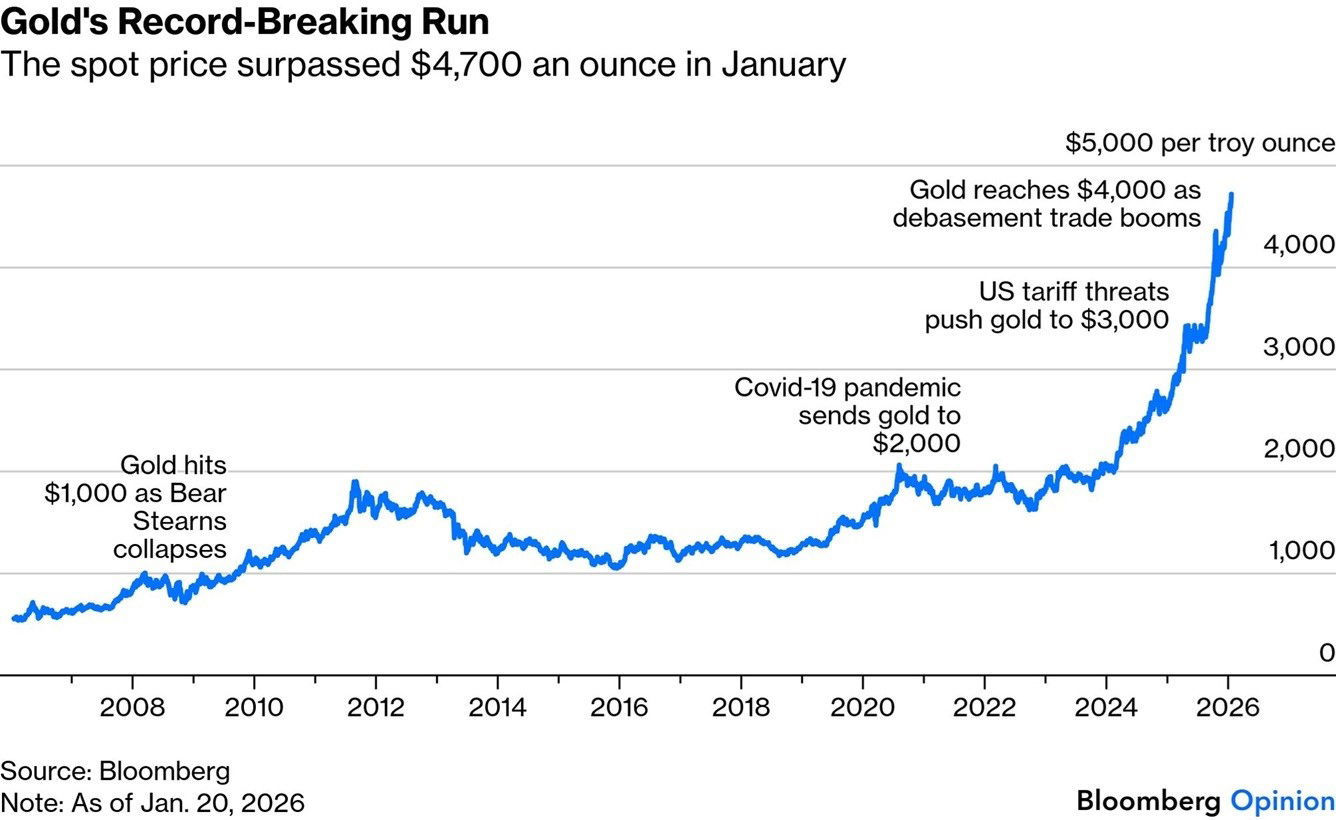
Gold prices continue to rise, with the precious metal’s spot value rising to a new record high of $US4,777 per troy ounce, by 11:30am AEDT.
In Australian dollars, you’d have to fork out $7,100 for just 31 grams of gold. (That’s how much a troy ounce is worth in the metric system.)
ANZ’s economics team says gold has surged amid a “risk-off tone” in global markets, triggered by a sharp sell-off in Japanese government bonds.
That was after Japan’s prime minister Sanae Takaichi called a snap election on Monday, and announced plans to cut taxes and boost spending.
“Concerns over fiscal sustainability prompted investors to seek alternative assets, such as gold,” ANZ economists Brian Martin and Daniel Hynes wrote in a note to clients.
“The bond selloff triggered a weaker USD and losses in global equity markets.
“Haven buying was prevalent, as tensions between the US and Europe over Greenland showed no sign of easing.
“Danish Prime Minister, Jens-Frederik Nielsen, said Greenland should start preparing for a possible invasion.
“President Trump has continued to threaten taking over the territory on national security grounds.
“Earlier in the day, he posted an AI-generated image of himself planting a US flag on the island.
“The US threat towards its NATO allies has rattled markets, adding new impetus to a record-breaking rally that has seen gold hitting record highs.”
Key Event
Westgold hits record high on strong quarterly output
Shares of gold producer Westgold Resources have risen as much as 8.2% to an all-time high of $7.43.
Stock was last up 9.2%, set for its best day since October 1, if current gains held.
The gold miner was among top gainers on the benchmark index, which was down 0.5%.
The company produced a record 111,418 oz of gold in Q2, 33% higher than Q1, driven by improving output from its Murchison operations in Western Australia.
It sold 115,200 oz of gold, generating revenue of $732 million.
Westgold has gained 6.7% this year, as of last close, after gaining 127.6% in 2025.
Reporting with Reuters
Key Event
Gold miners in high demand as tech stocks tumble on the ASX
Today’s best performing stocks have a few things in common.
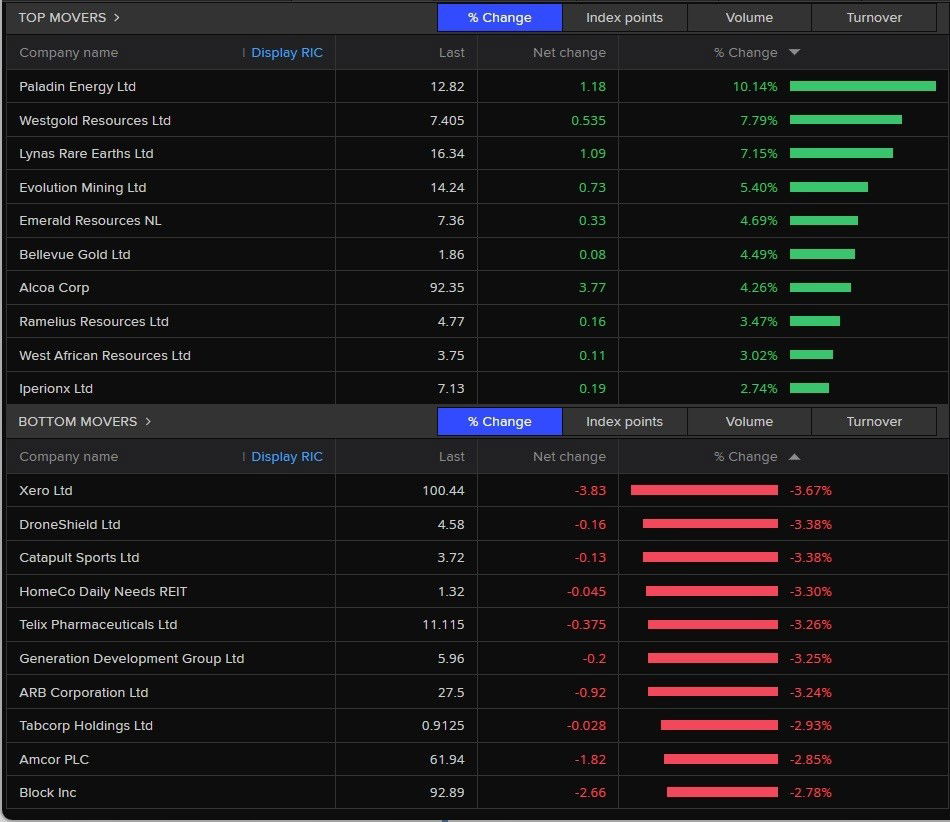
Many of them are gold miners like Westgold, Evolution Mining, Bellevue Gold, Ramelius Resources and West African Resources.
Shares of those companies have jumped between 3% and 8% in the first hour of trade on the ASX.
That’s being driven by the surge in gold prices, which hit a new record of over $4,700 per ounce.
Geopolitical tensions, particularly the worsening relationship between the US and Europe, have led to higher demand for safe haven assets like gold.
Also doing well today are Lynas Rare Earths (after it gave a strong trading update), uranium stock Paladin Energy and oil company Beach Energy.
On the flip side, technology companies and stocks with a high price-to-earnings ratio (ie. potentially overvalued) are being sold off.
Bookkeeping software firm Xero, DroneShield and electronic payments company Block are among the worst performers, with their share price down between 2.5% and 4%.
Key Event
Record quarterly production for iron ore giant Rio Tinto
The world’s largest producer of iron ore, Rio Tinto, has reported record quarterly iron ore production from its Pilbara operations.
Rio has recorded a 7% rise in its fourth-quarter iron ore shipments, to 91.3 million tonnes.
That’s up from 85.7 million tonnes for the same time last year.
Rio says mined copper production also grew in the quarter, up 5% to 240,000 tonnes.
Rio Tinto is in early takeover talks with miner Glencore, which could fast-track Rio’s copper expansion and reduce its reliance on iron ore.
Copper has experienced surging demand from artificial intelligence and the energy sectors.
Shares of Rio Tinto were up 1.1% to $147.94, by 10:45am AEDT.
– with Reuters
Key Event
Higher gold and oil prices boost resource stocks as most ASX sectors fall
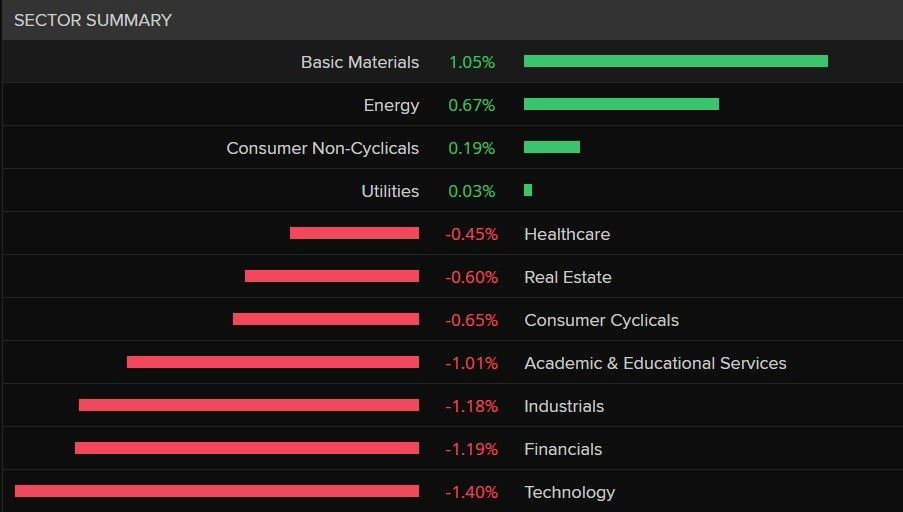
Most sectors on the local share market have fallen this morning, with technology, financials and industrials among the hardest hit.
The wave of negativity has led to the ASX 200 dropping 0.4% to 8,779 points, by 10:30am AEDT.
At the other end of the spectrum, today’s best performing sectors are materials (+1.1%) and energy (+0.7%).
That is mainly because of higher commodity prices boosting the share price of gold miners.
In particular, gold has surged to a record high, above $US4,700 an ounce.
Brent crude futures jumped 1.5% overnight to almost $US65 a barrel.
That was after a Kazakh oil producer Tengizchevroil, led by Chevron, said it had temporarily halted production at a couple of its oil fields due to issue affecting its power distribution systems.
A sliding US greenback also seems to be boosting commodity prices.
In general, a weaker greenback boosts demand for assets that are priced in US dollars (ie. gold and silver), so it becomes cheaper to purchase them.
Key Event
Shares of Lynas Rare Earths jump, along with its revenue
Lynas Rare Earths has reported a 43% rise in second-quarter revenue, despite a production shortfall.
Sales for the quarter are up to $201.9 million compared with $141.2 million a year ago.
The better-than-expected result led to Lynas’s share price surging 4.3% to $15.90, by 10:25am AEDT.
Lynas faced a production shortfall due to power disruptions at its Western Australia processing facility, however, higher prices have helped cushion revenue.
Lynas is the world’s largest producer of rare earths outside of China.
Rare earths are used in a variety of industries, from electric vehicles and medical equipment to military applications.
– with Reuters
Key Event
ASX opens with lower-than-expected drop
The Australian share market has started its day lower, but it’s not as bad as expected.
The ASX 200 fell 0.3% to 8,790 points.
The broader All Ordinaries index slipped by a similar percentage to 9,111 points.
In comparison, Wall Street’s S&P 500 dropped 2.1% overnight, while Europe’s Stoxx 600 index lost 0.7%.
We’ll have even more updates for you shortly!
‘Certainty that AI is going to be great’ boosts Wall Street despite the Trump-related risks: Alan Kohler
If you need a quick refresher before the ASX opens in a few minutes, I can certainly recommend Alan Kohler’s finance report.
In last night’s 7pm News bulletin, Alan talked about the US Economic Policy Uncertainty Index hitting a record high.
When that happens, the share market normally does badly, but not this time.
He says: “US share prices are also close to a record high, partly because there’s no US recession this time”.
Alan says it’s also because “the certainty that AI is going to be great is offsetting the uncertainty about what Donald Trump might do next”.
Loading…
Key Event
Canadian PM says medium-sized countries need to act together in Trump era
Canadian Prime Minister Mark Carney has told the World Economic Forum in Davos that the rules-based international order is dead and middle powers need to act together “because if we’re not at the table, we’re on the menu”.
The speech didn’t mention Donald Trump – but it also included an attack on US tariffs on countries opposing his Greenland takeover and a defence of Denmark’s sovereignty.
Carney said the old regime was always a bit of a fiction because big countries would exempt themselves from the rules when it suited them.
“This fiction was useful, and American hegemony, in particular, helped provide public goods, open sea lanes, a stable financial system, collective security and support for frameworks for resolving disputes,” he said.
But now:
“This bargain no longer works. Let me be direct. We are in the midst of a rupture, not a transition.
“Over the past two decades, a series of crises in finance, health, energy and geopolitics have laid bare the risks of extreme global integration. But more recently, great powers have begun using economic integration as weapons, tariffs as leverage, financial infrastructure as coercion, [and] supply chains as vulnerabilities to be exploited.”
The result:
“A world of fortresses will be poorer, more fragile and less sustainable. And there is another truth. If great powers abandon even the pretence of rules and values for the unhindered pursuit of their power and interests, the gains from transactionalism will become harder to replicate.”
And his solution:
“… the middle powers must act together, because if we’re not at the table, we’re on the menu.
“But I’d also say that great powers, great powers can afford for now to go it alone. They have the market size, the military capacity and the leverage to dictate terms. Middle powers do not.“
He went on:
“In a world of great power rivalry, the countries in between have a choice – compete with each other for favour, or to combine to create a third path with impact.“
Key Event
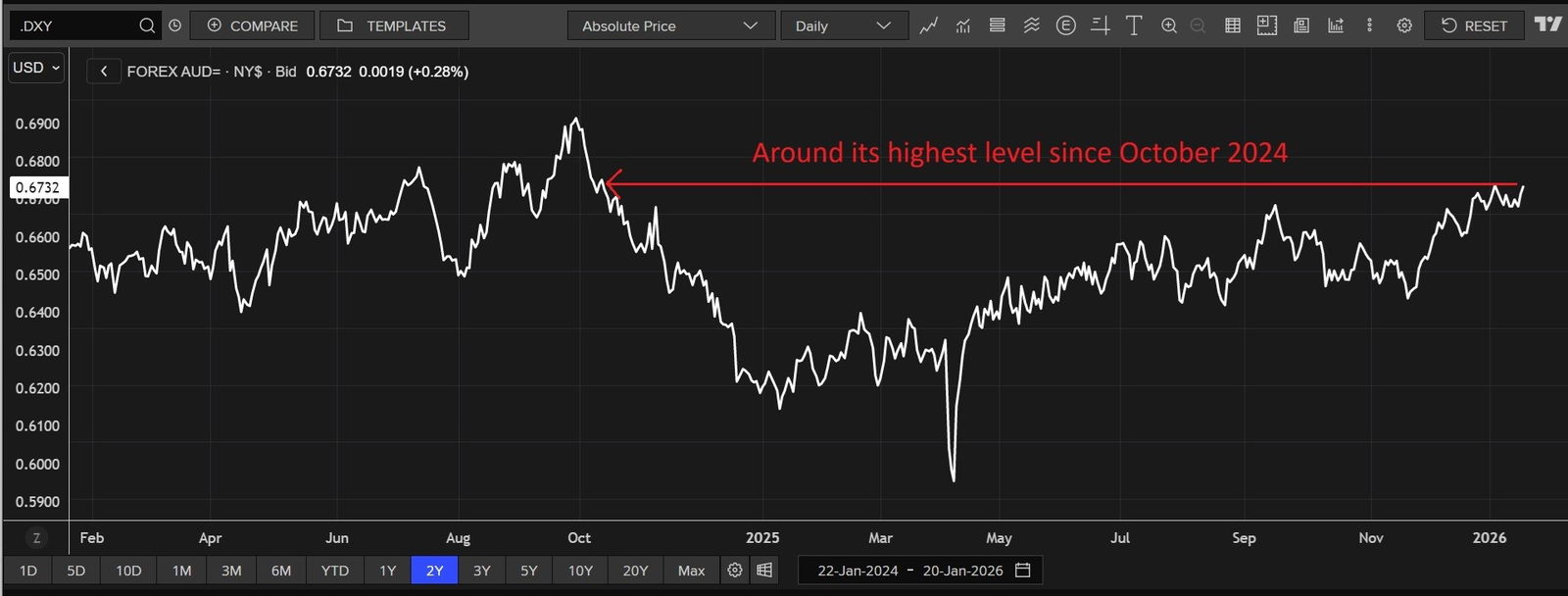
Australian dollar trades near 15-month high
The local currency is trading around its highest level since October 11, 2024.
Or expressed another way, the Australian dollar is near a 15-month high, or its strongest in more than a year.
Much of it is due to the US dollar falling sharply over the past year as a result of President Trump’s erratic trade policies and surge in US government debt.
It’s also been driven by the higher prices of commodities that Australia sells to overseas customers (ie. gold, iron ore, copper, etc).
Key Event
Denmark pension fund dumps $US100 million worth of American debt
One of Denmark’s largest pension funds has announced plans to sell off all its US Treasury bonds, worth $US100 million, by the end of this month.
This is certainly another factor which contributed to the sell-off in US debt markets overnight. This, in turn, pushed up the yield on US bonds (as investors are demanding a higher return from lending to the Americans).
AkademikerPension said its decision was not intended as a political statement linked to the worsening relationship between Denmark and the United States over Greenland’s sovereingty.
“The decision is rooted in the poor US government finances, which make us think that we need to make an effort to find an alternative way of conducting our liquidity and risk management,” investment director Anders Schelde said in a written statement.
“Thus, it is not directly related to the ongoing rift between the US and Europe, but of course that didn’t make it more difficult to take the decision,” he added.
AkademikerPension has in total 164 billion Danish crowns ($38.2 billion) worth of funds under management, it said on its website.
– with Reuters
Key Event
Netflix shares tumble in extended trade as Warner Bros bid looms over results
Netflix shares are down more than 4% in after-hours trade.
It comes after the streaming giant squeaked past Wall Street’s revenue estimates for its holiday quarter as it remains locked in a fierce bidding war for Warner Bros.
Revenue came in at $US12.1 billion ($18b) for October through December, modestly exceeding forecasts by analysts surveyed by LSEG. The company also surpassed 325 million subscribers.
Netflix offered a full-year revenue forecast of $US50.7 billion to $US51.7 billion for 2026 — a projection that, at the low end, fell below analysts’ estimates of $US50.98 billion.
Nielsen reported that Netflix’s monthly viewership rose 10% in December, thanks largely to the final season of hit sci-fi series Stranger Things, which generated 15 billion viewing minutes.
Investors remain focused on Netflix’s $US82.7 billion pursuit of Warner Bros Discovery’s studio and other entertainment assets, as it seeks to fend off a hostile bid from Paramount Skydance.
“Investors seem skeptical that the WBD purchase will pay off for them, which has contributed to the stock being down lately,” said Ross Benes, analyst at eMarketer.
“Netflix’s debt position is better than most entertainment companies. For the next few quarters, M&A will generally overshadow quarterly results.”
In its note to investors, Netflix said the Warner Bros acquisition would provide it with an even broader and higher-quality selection of movies and shows for its subscribers, while it would be able to offer more personalised, flexible subscription offers with the addition of HBO Max.
The company said it obtained commitments for a $US59 billion bridge loan on December 4 to support the Warner acquisition. On Monday, it increased the bridge loan commitment by $US8.2 billion to support its all-cash $US27.75 per-share offer.
Netflix also told investors it would pause share buybacks to accumulate cash to help fund the Warner deal. It has already incurred $US60 million in costs related to securing financing.
In financial results, Netflix reported adjusted per-share earnings of 56 US cents for the fourth quarter ended in December, slightly above estimates of 55 US cents per share.
Netflix forecast continued growth in 2026 and said ad revenue was expected to roughly double.
Reporting with Reuters
Key Event
US sell-off exacerbated by Japan’s borrowing costs hit record highs
The US dollar and Wall Street fell sharply overnight partly because of the “sell America” trade.
Essentially, nervous investors sold down their US assets in response to Donald Trump’s threats to start a trade war against eight European countries over their opposition to his Greenland takeover plans.
The other main reason was Japan’s bond sell-off, which led to borrowing costs hitting record highs for the Asian financial giant.
You’re probably wondering: what has this got to do with anything? I’m getting to it!
Japanese bond market sell-off
For many years, global investors have been borrowing Japanese money (at very low interest rates) to purchase stocks and assets on other markets (ie. Wall Street).
When Japanese rates climb, it usually leads to a big falls overseas. So, it was also a contributing factor to the weak performance of the US dollar and share market overnight.
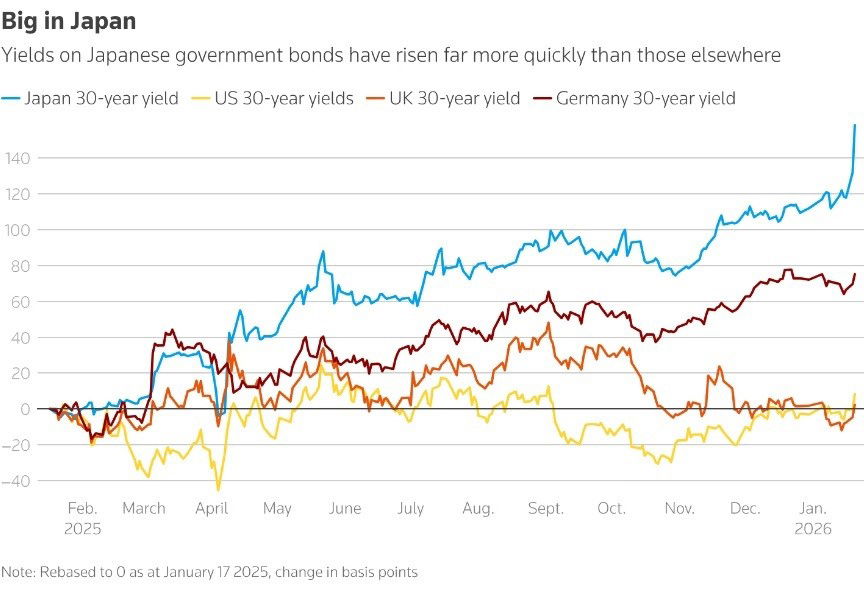
Now the situation is that investors who lend money to the Japanese government are demanding much higher returns.
The surge in Japan’s government bond yields coincides with Prime Minster Sanae Takaichi’s decision to call a snap election on Monday.
She’s running on a pro-stimulus platform, which means Japan will need to borrow a lot more money.
The price of a bond and its yield (or return) move in opposite directions.
So, when prices go down (because lots of people are selling), the yield needs to rise in order to incentivise people to purchase those bonds.
Now with that background out of the way, Japan’s 10-year government bond yields have jumped almost 19 basis points in two days, their sharpest rise since 2022.
Meanwhile, its 30-year yields rose 28 basis points overnight.
That’s the equivalent of one interest rate hike in a single day — and the biggest daily jump since 2003 as investors are bracing for increased government spending.
At 3.883%, Japan’s 30-year yield has surged to its highest level ever.
“If there is a strong mandate following the election, that could open the door to more fiscal spending,” said Seema Shah, chief global strategist at Principal Asset Management.
“It pulls a lot of global bond markets into a difficult story about debt and you can see that in the rise in borrowing costs.”
Key Event
Wall Street wipes out all its gains from past month
Wall Street has finished trading now and it’s been a rough day for US traders. Here are the closing figures:
- Dow Jones: -1.8% to 48,489 points
- S&P 500: -2.1% to 6,797 points
- Nasdaq Composite: -2.4% to 22,954 points
US markets fell quite sharply after they reopened for trade after the Martin Luther King Jr public holiday (and long weekend).
So while other markets in Europe, Asia and Australia had been falling for days, it was the first opportunity for US markets to react.
The last time the benchmark S&P 500 index fell this much (in a single day) was three months ago.
Today’s sell-off led to the S&P falling to a one-month low (ie. wiping out all its gains since December 18).
Key Event
US greenback drops 10 per cent in a year, boosting Aussie dollar
The Australian dollar has had a boost from the US dollar sell-off overnight, rising 0.3% to 67.36 US cents.
Earlier this month, it climbed as high as 67.66 US cents (on January 7 to be precise).
But if we look through that, the local currency is trading around its highest level since October 11, 2024.
In other words, the Aussie dollar is near a 15-month high (or its strongest in more than a year).
So that’s great if you’re travelling to the United States for a holiday (or another country that uses US currency), but not so great if you run an export business trying to sell goods to America at more competitive rates.
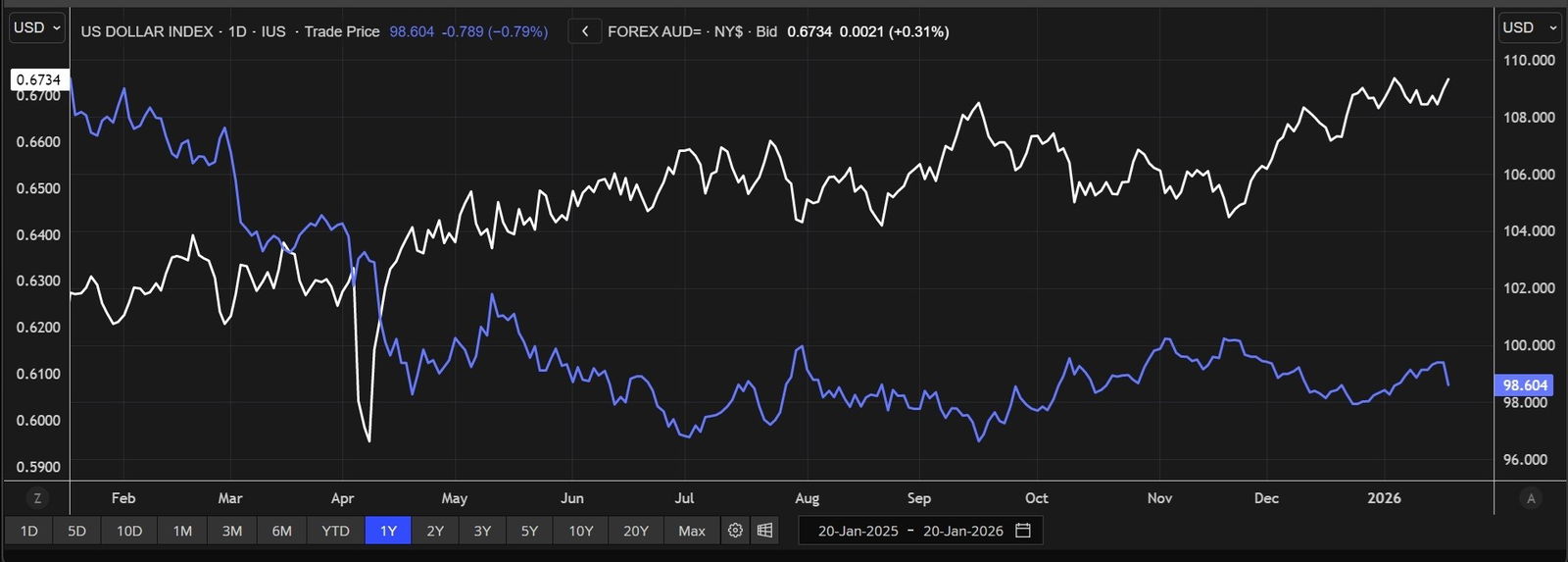
The US dollar index, on the other hand, dropped 0.8% overnight.
In case you’re wondering, that index is a way of tracking the value of the US greenback against a basket of major currencies (including the euro, Japanese yen, British pound, Canadian dollar, Swedish krona and Swiss franc).
The difference is even more stark when you compare the US and Australian dollars’ performances over the past 12 months.
While the Aussie dollar is up 8.7% over the past year, the US dollar index is down almost 10% in that time.
In short, President Trump’s policies are the main reason the greenback is so weak — from starting global trade wars, erratic shifts in policy and passing a “Big Beautiful Bill”, which will lead to ballooning US government debt.
This has led to what’s known as the “sell America” trade as investors divest their US assets (ie. currency and bonds) in favour of “safer” alternatives like gold (which has been hitting records constantly in the past year).
Key Event
S&P 500 on track for worst sell-off in three months
It’s about 3:50pm in New York, which means the US share market is about to end its trading day.
Wall Street is set to close with heavy losses across the board. Here’s how it’s looking:
- Dow Jones: -1.7% to 48,495 points
- S&P 500: -2.1% to 6,797 points
- Nasdaq Composite: -2.4% to 22,943 points
At this rate, it looks like the S&P 500, with its roughly 2% fall, will record its worst drop in three months.
Key Event
Gold and silver scale new highs
Gold prices have surged past $US4,700 an ounce for the first time ever as escalating geopolitical tensions between the US and Europe boosted safe-haven demand, while silver also climbed to a record price.
Spot gold gained about 2% to $US4,755 per ounce, after reaching as high as $4,766 overnight.
“Gold has surged deeper into uncharted territory as investors hedge against rising political risk,” said Fawad Razaqzada, market analyst at City Index and FOREX.com.
“A softer dollar is providing an additional tailwind for precious metals, reinforcing gold’s rally at a time when confidence in US assets appears to be wobbling.”
Wall Street’s main indexes dropped to a one-month low as investors were spooked by renewed tariff threats by Donald Trump against eight European countries over his plans to take control of Greenland.
The remarks have heightened tensions ahead of the US president’s expected meeting with global business leaders in Davos, Switzerland, on Wednesday (local time).
Rate cut expectations also driving gold higher
The US dollar was set for its largest daily fall in over a month, making greenback-priced gold more affordable for overseas buyers.
Gold, seen as a safe store of value during economic and political instability, soared 64% last year and has added another 10% since the start of the year.
The metal’s rally has also been supported by expectations of US interest rate cuts, which reduce the opportunity cost of holding non-yielding bullion.
Markets are pricing in two rate cuts of 25-basis-points from mid-2026, while focus intensified after US Treasury Secretary Scott Bessent said President Trump could name a new Federal Reserve chair as early as next week.
Spot silver slipped 0.7% to $93.95 an ounce, after hitting a record $US95.87 overnight.
The white metal added about 147% in 2025 and has gained more than 32% since the start of this year.
– with Reuters