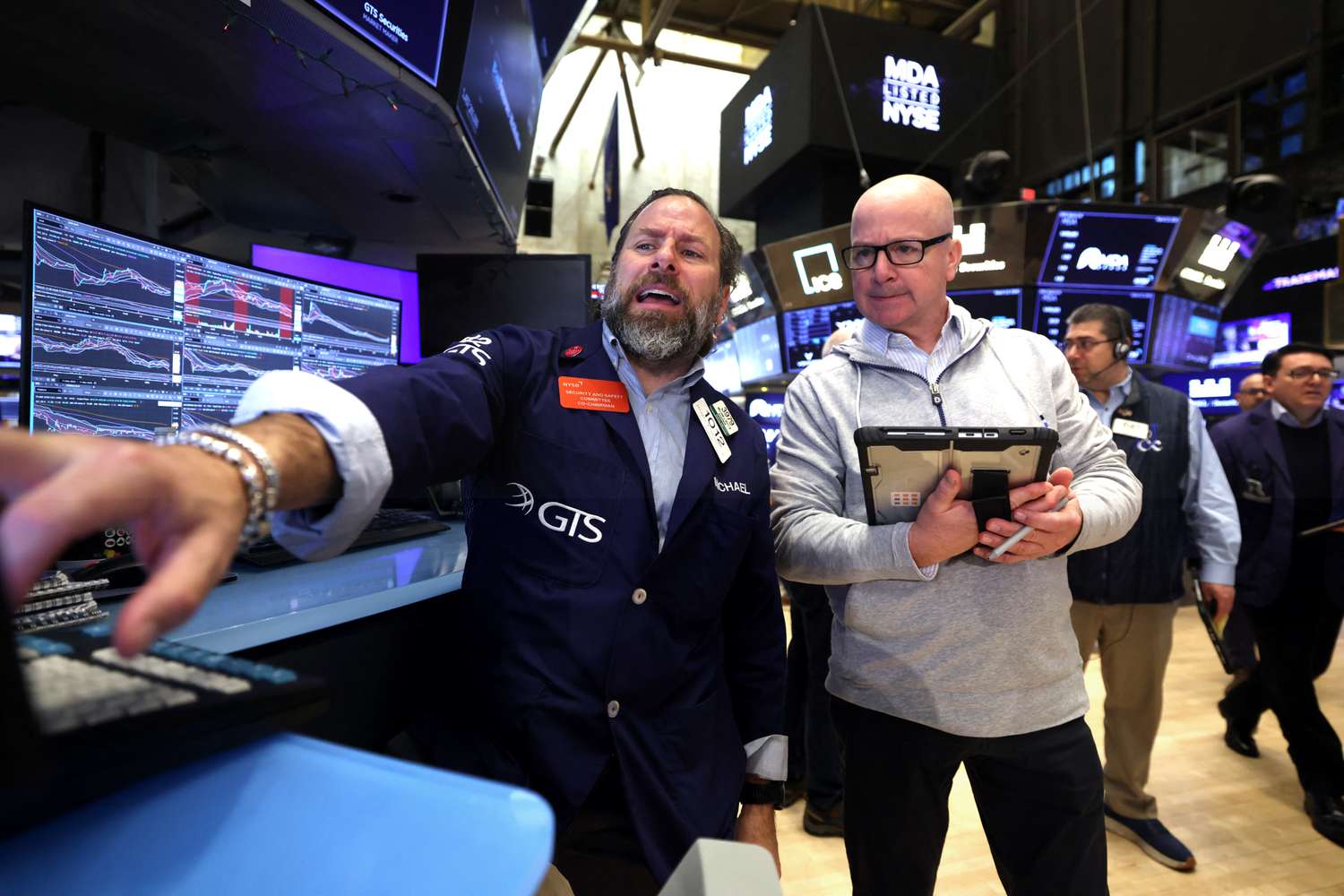
The leading U.S. stock indexes closed lower for a third straight week as oil prices continued to climb.
The tech-heavy Nasdaq, benchmark S&P 500, and blue-chip Dow Jones Industrial Average ended Friday down a respective 0.9%, 0.6%, and 0.3% to set fresh closing lows for the year.
West Texas Intermediate crude futures, the U.S. oil-price benchmark, were up about 2.5% to $98 a barrel at 4 p.m. ET, well above the roughly $67-a-barrel level before the U.S. and Israel attacked Iran on Feb. 28. Brent crude futures, the global benchmark, ticked lower to about $103 a barrel after closing above $100for the first time since August 2022 yesterday.
High oil prices have spurred responses from policymakers. Treasury Secretary Scott Bessent said Thursday the U.S. would temporarily let countries buy Russian oil already at sea. In addition, the International Energy Agency said it would release a record 400 million barrels of strategic reserves to stabilize prices amid “the largest supply disruption in the history of the global oil market.”
Investors on Friday digested the delayed release of the January Personal Consumption Expenditures (PCE) index. The Fed’s preferred inflation gauge indicated inflation rose 2.8% year-over-year in January, below economists’ expectations for a 2.9% rise, and 0.3% month-over-month, down from 0.4% in December and matching estimates. “Core” inflation ticked higher to 3.1% year-over-year and remained at 0.4% month-over-month, matching expectations. Fourth-quarter U.S. GDP was revised down to 0.7% growth, half its previous reading.
The yield on the 10-year Treasury note, which affects interest rates on all sorts of consumer loans, edged higher to near 4.29% from Thursday’s close around 4.27%—its highest closing level since Feb. 4.
Gold futures were down almost 2% to $5,030 an ounce, while silver futures fell 5.5% to around $80.30 an ounce. The U.S. Dollar Index, which tracks the value of the greenback against a basket of currencies, was up 0.7% to 100.44. Bitcoin was trading around $71,200, up from overnight lows around $70,000.
In post-earnings moves, shares of Adobe (ADBE) slumped 7% after CEO Shantanu Narayen plans to step down after 18 years on the job. Shares of Ulta Beauty (ULTA) sank 14% to lead S&P 500 decliners on soft full-year profit and comparable sales forecasts.
Shares of all the Magnificent Seven tech giants were lower, with Meta Platforms (META) leading declines at near 4%. A report in The New York Times said it was delaying the rollout of a new AI model due to performance concerns. All finished lower yesterday.
Mosaic (MOS), CF Industries (CF), and Nutrien (NTR) shares retreated about 6%, 4.5%, and 1%, respectively, after surging this month as fertilizer producers stand to benefit from supply disruptions due to halted transit through the Strait of Hormuz.
Investor attention now turns to the Federal Reserve, which meets next week and is widely expected to keep interest rates steady. A federal judge on Friday threw out the Justice Department’s attempts to subpoena Fed Chair Jerome Powell. Judge James Boasberg wrote that there was “abundant evidence that the subpoenas’ dominant (if not sole) purpose is to harass and pressure Powell either to yield to the President or to resign and make way for a Fed Chair who will.”
What Is the Jones Act—and Why Could the Trump Administration Waive It? What You Need to Know
FROM 2 hr 8 min ago
War in the Middle East has sent oil prices aloft. That’s focused the world’s attention on a vital shipping route—and to a U.S. rule that governs ship movements.
The Trump administration this week said it could waive a more-than-100-year-old maritime statute called the Jones Act to help smooth disruption in the movement of goods to U.S. ports. The act, also known as the Merchant Marine Act of 1920, requires shipping between U.S. ports to be done by U.S. ships, a law put in place to spur the shipping industry after World War I. Now it’s coming into play on the heels of the Trump administration’s attempts to address the consequences of the war in Iran.
Alex Wong / Getty Images
The de facto closure of the Strait of Hormuz has contributed to what’s considered the largest disruption in global oil supply in history; Brent crude oil prices have backed off $100 as of Friday, but they remain substantially higher than before the initial strikes on Iran. The administration is considering a 30-day waiver to the Jones Act, which would let foreign ships move things like fuel between U.S. ports. Some experts, however, think it would do little to help lower oil prices.
Read the full article here.
Dow, S&P 500, Nasdaq All Close Lower for 3rd Straight Week
FROM 2 hr 16 min ago
For a little while Friday, it appeared that the Nasdaq might close higher for the week. It didn’t end that way.
The Nasdaq, Dow Jones Industrial Average, and S&P 500 all finished lower for a third week in a row.
The tech-heavy Nasdaq was down 0.3% through the first four sessions but rose into positive territory for the week Friday morning before reversing course.
For the week, the Nasdaq closed down 1.3%, while the blue-chip Dow and benchmark S&P 500 ended 2.0% and 1.6% lower. This year, the Nasdaq, Dow, and S&P 500 are down roughly 6%, 3%, and 3%, respectively.
Target’s Been Falling Behind Discount Retail Rivals. Its New CEO Wants to Change That
FROM 2 hr 33 min ago
Target’s new CEO wants to win back customers with better deals.
Target (TGT) said this week that it’s slashing prices on more than 3,000 items as part of the retailer’s efforts to revitalize sales under the leadership of Michael Fiddelke, who took the helm of the company last month.
David Paul Morris / Bloomberg / Getty Images
Target said most of the cuts will be between 5% to 20% across a wide range of apparel and home items. The move could help Target appeal to value-hungry consumers, at a time when discount rivals such as Walmart have gained market share.
When Fiddelke’s appointment was announced last year, analysts said some investors were disappointed by the pick amid concerns that a company veteran could hold Target back from making a significant change in direction.
However, Fiddelke appeared to sooth some of those concerns during last week’s earnings call, when he told investors he plans to make a number of changes to “get Target back to growth,” including improving the retailer’s product lineup and renovating stores to better draw in shoppers.
Read the full article here.
Why a Wall Street Insider Warns Markets Feel ‘Ominously’ Like They Did in 2008
FROM 3 hr 3 min ago
Investors are increasingly worried that, despite talk of “unprecedented” times, we have been here before—and the first go didn’t turn out well.
Case in point: a take from Bank of America raising parallels between recent action in oil prices and concerns about the health of the financial system and the Great Recession of nearly two decades ago.
“Asset performance in 2026 is more ominously close to price action seen from mid’07 to mid’08,” wrote the bank’s strategist Michael Hartnett in a recent note to clients obtained by Bloomberg. He highlights that oil prices doubled between July 2007 and August 2008—right as the effects of subprime mortgage defaults rippled through the financial system, ultimately leading to the Great Recession.
Spencer Platt / Getty Images
Today, investors are worried that a similar pattern is playing out. They fear a sustained spike in oil prices stemming from the war in Iran will aggravate inflation and slow economic growth while stress in private credit markets spills over into the banking system.
Read the full article here.
Gas Prices Climb Again—See What Your State Is Paying
FROM 3 hr 39 min ago
Oil prices are extending their surge that began at the start of March, triggered by the Iran conflict. That escalating price for crude is continuing to filter through to drivers across the country.
The national average for regular gas rose another 3 cents overnight to $3.63 per gallon, according to AAA, bringing the increase this month to 65 cents. Before this run-up, the average had held below $3 for 13 straight weeks—the first time in $2 territory since 2021.
Investopedia / Sabrina Karl
Since gasoline prices don’t move in lockstep with crude oil prices, rapid increases in energy markets can continue filtering through to drivers for days or weeks.
Read the full article here.
Property Insurance Costs Hit Record High
FROM 4 hr 10 min ago
Property insurance payments hit an all-time high in 2025 and it could be pushing more people into delinquency.
The average annual home insurance payment rose by 6.6% in 2025, with homeowners paying a record $201 a month, according to mortgage data firm Intercontinental Exchange’s (ICE) Mortgage Monitor report for March. And rising insurance costs could be a factor pushing homeowners into delinquency, the data showed.
David Paul Morris / Bloomberg via Getty Images
Homeowners whose property insurance accounted for the largest portion of their annual housing costs were deliquent 7.6% of the time. Meanwhile, those with the smallest portion had a 2.9% delinquency rate, the report found. Overall, the delinquency rate was 3.6%, low by historical standards.
Read the full article here.
Klarna Stock Soars as Board Chair Buys $50M of Shares
FROM 4 hr 58 min ago
Klarna (KLAR) chairman Michael Moritz evidently is a big believer in the fintech company.
Moritz purchased nearly $50 million worth of the firm’s stock in recent days, Klarna announced Friday. Shares soared 10% in afternoon trading.
Moritz acquired 3,472,845 shares between March 3 and 11, at an aggregate cost of $49.9 million.
In addition, Chief Product & Design Officer David Fock bought 27,000 shares on March 9 for nearly $389,000.
Even with today’s sharp gains, Klarna shares have lost nearly two-thirds of their value since the buy now, pay later firm founded in Sweden and now based in London debuted on the New York Stock Exchange last September.
TradingView
Ulta Beauty’s Blistering Rally to Start the Year Just Lost Momentum. What Happened?
FROM 5 hr 38 min ago
Ulta Beauty shares were off to a strong start this year, until this week.
Shares of Ulta (ULTA) were down nearly 11% around $557 in recent trading, a day after the beauty retailer’s quarterly profits and outlook disappointed. It was the worst-performing stock in the S&P 500 Friday, erasing its year-to-date gains.
Ulta reported earnings per share of $8.01 for the fourth quarter, 2 cents shy of analyst estimates compiled by Visible Alpha. Its revenue of $3.9 billion topped expectations.
Looking ahead, Ulta forecast comparable store sales growth of 2.5% to 3.5% and earnings per share of $28.05 and $28.55 for 2026. Both missed analysts’ consensus projections.
Read the full article here.
Job Openings Unexpectedly Rose in January
FROM 6 hr 33 min ago
Job openings bounced back in January, a sign that the job market was beginning to stabilize after slowing dramatically last year.
U.S. employers had 6.9 million job openings in January, up from 6.6 million in December and the most since October, the Bureau of Labor Statistics said Friday. That was a significant bounce-back after three months of declines, and was higher than the 6.7 million openings economists surveyed by Dow Jones Newswires and The Wall Street Journal expected.
Victor J. Blue / Bloomberg via Getty Images
The report adds more detail to a picture of the labor market that appeared to be on the rebound in January, based on a payroll report released by the bureau last month. The figures had generated a short-lived sense of optimism about the job market, which faded after data from February showed the economy losing jobs and the unemployment rate rising.
Economists are watching jobs data for indications that the hiring market is pulling out of the slump it entered in 2025, which was the worst year for hiring outside a recession in decades. The uptick of job openings in January may not be enough on its own to dispel the impression that the market is in a low-hiring, low-firing limbo.
Read the full article here.
Guess What Asset Has Performed Well During the War in Iran? Believe It or Not—It’s Bitcoin
FROM 6 hr 53 min ago
Bitcoin appears to be doing what other haven assets haven’t lately.
The cryptocurrency has risen about 10% to above $72,000, since the initial strikes on Iran, outpacing the U.S. dollar and gold as well as major broad market indexes. That performance might not impress those who recall when its price could move that much in a day, but the moves nevertheless—in the short term, anyway—have it looking like a decent shelter as war in the Middle East has driven oil prices higher and led to wild swings in stocks.
Thomas Trutschel / Photothek via Getty Images
Bitcoin hasn’t always proven to be an effective hedge. Before the recently onset of what some called crypto winter, it was behaving more like a risk asset that tends to track technology stocks. Many market experts still poo-poo the digital asset’s use as a portfolio hedge as effective as gold, but investors appear to be wading back into crypto in recent days amid increased uncertainty about the path forward for war.
Read the full article here.
Economic Growth Was Slower Than Previously Believed in Fourth Quarter
FROM 7 hr 21 min ago
A preliminary estimate last month showing the economy growing at a solid clip in the fourth quarter may have been too optimistic
The U.S. economy grew at an inflation-adjusted annual rate of 0.7% in the fourth quarter, the Bureau of Economic Analysis said Friday. That was half the bureau’s preliminary estimate of 1.4% annual growth in February, and a significant slowdown from 4.4% annualized growth in Q3.
Mark Felix / Bloomberg via Getty Images
Forecasters had expected the revision to go the other way, anticipating an increase to 1.5% from the previous estimate, according to a survey of economists at Dow Jones Newswires and The Wall Street Journal.
Read the full article here.
Once Upon a Farm Stock Sinks After First Report Post-IPO
FROM 8 hr 26 min ago
Market reaction to Once Upon a Farm’s first quarterly report following its initial public offering likely was not what Jennifer Garner had hoped for.
Shares of Once Upon a Farm (OFRM) sank 15% Friday, a day after the organic baby food and kids’ snacks company co-founded by the famous actress forecast slowing sales growth for this year in its fiscal 2025 fourth-quarter report.
The Berkeley, Calif.-based firm sees 2026 net sales of $302 million to $310 million, which would represent growth of 25% to 29% year-over-year. However, net sales surged 53.5% to $240.7 million in 2025.
Once Upon a Farm also expects 2026 adjusted EBITDA of $2 million to $4 million, with the bottom of the range below 2025’s $2.1 million.
Shares have lost about 18% of their value since the company’s IPO on Feb. 6.
Michael Nagle / Bloomberg via Getty Images
The Fed’s Favorite Measure of Inflation Stayed Hot in January
FROM 9 hr 13 min ago
Inflation was hovering in a stubbornly high pattern, but not surging, before the Iran war sent energy prices spiraling.
Consumer prices as measured by Personal Consumption Expenditures rose 2.8% over 12 months in January, down from a 2.9% annual increase in December, the Bureau of Economic Analysis said Friday. That was less than the 2.9% increase forecasters had expected, according to a survey of economists by Dow Jones Newswires and The Wall Street Journal.
Justin Sullivan / Getty Images
On the other hand, the “core” PCE price index, which excludes the volatile prices for food and energy, rose 3.1% over the year, up from a 3% annual increase in December. That was a fresh high since early 2024 and matched forecaster expectations.
Read the full article here.
The Strait of Hormuz Is an ‘Acute Vulnerability’ for Global Trade. Here’s What You Need to Know
FROM 9 hr 25 min ago
So much depends on a 21-mile wide passageway.
The world’s crude oil, gas, fertilizer, sugar, aluminum, basic plastics, helium, and other goods move through the Strait of Hormuz—which is now a chokepoint of the ongoing war in the Middle East. Iran’s new Supreme Leader Mojtaba Khamenei in his first released message to the media early Thursday vowed to continue blocking the strait as the rest of the world scrambles, with the magnitude of the resultant supply-chain disruption largely dependent on how long the fighting continues.
Dan Kitwood / Getty Images
Governments and the International Energy Agency rode to the rescue, with plans to distribute an unprecedented amount from oil reserves. Markets experts say there isn’t enough spare capacity to address the potential shortfall. Still, oil prices remain aloft, and the de facto closure of the trade passageway threatens to prove consequential even for those far removed from the fighting in the Middle East.
“In the current environment, where the Strait of Hormuz is effectively closed, it is an acute vulnerability,” according to energy consultancy firm Rystad Energy.
Read the full article here.
How Long Will The Iran War Last? The Economy Depends On the Answer
FROM 10 hr 14 min ago
All economic forecasts now hinge on one question: how long will the Iran war last?
With unclear timelines from government officials, there are few details on how long the violence in the region will continue—and what kind of economic impact the fighting may have. Violence in the region continued on Thursday, and the important transportation route through the Strait of Hormuz remained effectively closed.
Imtiyaz Shaikh / Anadolu via Getty Images
As a result, the price of Brent crude oil closed above $100 a barrel for the first time since August 2022, up from roughly $70 before the war. The longer the war continues, the greater the impact rising oil prices will have on the broader economy.
Read the full article here.
Rivian Has Finally Launched the R2—Why the EV Maker’s Survival May Depend On It
FROM 10 hr 46 min ago
Rivian has unveiled eagerly awaited details on its R2 model, a launch that experts say could turn out to be a make or break moment for the EV maker.
The R2, which was introduced Thursday at the SXSW festival in Austin, is a smaller, more affordable SUV the company has made its goal since introducing a $76,990 R1S that was out of reach for most buyers. The Performance model starts at $59,485, and first deliveries will go to R1 owners this spring. Cheaper trims are coming, the company says, but not until 2027.
Nick Piacente / SXSW Conference & Festivals / Getty Images
For a company burning through billions of dollars and whose stock price has dropped recently, the new model is one analysts say has to work if Rivian wants to stay in business. Despite the hoopla surrounding the R2, Rivian (RIVN) shares fell 8% on Thursday, pushing their year-to-date decline to 22%.
Read the full article here.
Adobe’s Stock Has Slumped for Two Years. Fixing That Is Someone New’s Job Now
FROM 11 hr 1 min ago
Adobe has had a tough time convincing investors to support its stock. Could a new CEO win them back?
Reviving interest in the once-hot software company’s shares will soon be the responsibility of someone new: CEO Shantanu Narayen plans to step down after 18 years on the job—and as soon as a successor is found, Adobe (ADBE) said Thursday.
Justin Sullivan / Getty Images
The news comes as the yearslong slide for Adobe’s stock continued. Shares of the Photoshop and Illustrator owner were down over 7% in extended trading following the news despite quarterly earnings that topped analysts’ estimates.
Adobe for its fiscal first quarter reported adjusted earnings per share of $6.06 on a 12% year-over-year jump in revenue to a record $6.40 billion. Both figures came in above analysts’ estimates as compiled by Visible Alpha.
Read the full article here.
Stock Futures Tick Higher Ahead of PCE Inflation Reading
FROM 11 hr 39 min ago
Futures contracts connected to the Dow Jones Industrial Average pointed up 0.2%.
TradingView
S&P 500 futures were 0.1% higher.
TradingView
Nasdaq 100 futures also pointed up 0.1%.
TradingView