12/12/25 17:30
The week that was – and the week ahead
– Darcy Keith
It’s Friday evening, which means a good time for a cocktail and a chuckle courtesy of John Heinzl and his weekly Stars and Dogs. Empire, AutoZone, and Oracle are among stocks featured – not to mention almost the entire cannabis sector.
Next week will bring a lot of interesting and potentially market-moving economic data before things slow down for the holidays.
Domestically, we’ll have the consumer price index report for November, on Monday. It’s expected to show inflation running at an annual rate of 2.3 per cent. That’s up from 2.2 per cent in October but not far off the Bank of Canada’s 2 per cent target. It’ll take a big beat or miss to change views on what the bank will do with its policy rate in the near term. Right now, markets expect the next move will be a hike – but probably not until the fall of 2026.
In the U.S., a number of delayed employment, inflation and other data in the coming week will give a long-anticipated view of the economy down south. Among them is the November nonfarm payrolls jobs report, and it’ll arrive on Tuesday instead of the usual Friday, owing to the government shutdown delays.
Read more:
- The Globe’s calendar of what investors need to know for the week ahead
- Wall Street’s week ahead: Investors eager for delayed data to shed light on U.S. economy
12/12/25 16:50
Citi sets 7700 as S&P 500 target
– Darcy Keith
Citi and its U.S. strategist Scott Chronert is just out with the bank’s 2026 market forecast, and the year-end 2026 target is…drum roll please…7700.
That’s well within the range of other major U.S. and global banks in their forecasts, but should still be pleasing to the ears of most investors.
Here’s Citi’s take:
“We set a 2026 S&P 500 base case target of 7700, predicated on an aggressive $320 in index earnings. AI investment tailwinds persist but performance dispersion within both the enablers and adopters of the technology is an ongoing dynamic. Broadening beyond that cohort is a key narrative. This includes both across the S&P 500 as well as down into US Small/Mid Cap. As we enter the fourth year of this current bull phase, ongoing bouts of volatility should be expected and may be more acute given implicit growth expectations. To be clear, a high valuation starting point is a hurdle for the market, but not an insurmountable one. Rather, it puts increasing pressure on fundamentals to support the price action.”
12/12/25 16:40
TSX pares weekly gain as technology shares slide
– Reuters
Canada’s benchmark stock index gave back some of its weekly gain on Friday as a drop in technology shares offset sharp gains for cannabis stocks.
The S&P/TSX Composite Index ended down 133.34 points, or 0.4% at 31,527.39, pulling back from a record closing high on Thursday. For the week, the index was up 0.7% as the Federal Reserve cut interest rates further and gold prices climbed.
The technology sector fell 3.4%, with shares of electronics equipment company Celestica Inc ending 12.9% lower.
Heavily weighted financials lost 0.4% and the materials group , which includes metal mining shares, was down 0.7%.
Healthcare was a standout, jumping 8.9%.
Shares of Curaleaf Holdings Inc soared 37.8% after the Washington Post reported U.S. President Donald Trump is expected to push the government to dramatically loosen federal restrictions on marijuana.
12/12/25 16:02
Wall Street ends lower as fears of AI bubble and inflation send investors away
– Reuters
Wall Street’s major indexes closed lower on Friday, and investors left technology for other sectors as Broadcom and Oracle fueled concerns about an AI bubble and rising U.S. Treasury yields added pressure after some policymakers spoke out against easing monetary policy. Treasury yields rose after a group of Federal Reserve officials who voted against the central bank’s interest rate cut this week voiced worries that inflation remains too high to warrant lower borrowing costs.
Broadcom shares tumbled after the chipmaker warned of slimmer future margins, causing renewed concerns about the profitability of surging AI investments. This was after a nearly 11% sell-off in Oracle on Thursday following the cloud software company’s weak financial forecast. Oracle shares added to losses on Friday even after it denied a Bloomberg report that its data centers for ChatGPT maker OpenAI were being delayed.
It didn’t help that the S&P 500 and the Dow had notched record closing highs on Thursday and that investors were looking ahead to important labor market and inflation data due out in the week ahead, according to Anthony Saglimbene, chief market strategist at Ameriprise.
According to preliminary data, the S&P 500 lost 73.62 points, or 1.06%, to end at 6,827.38 points, while the Nasdaq Composite lost 398.69 points, or 1.69%, to 23,193.65. The Dow Jones Industrial Average fell 242.02 points, or 0.50%, to 48,461.99.
Stocks in the broader chip market were under pressure with the Philadelphia semiconductor index falling sharply. And along with Broadcom, heavyweight AI leader Nvidia was a major drag on the S&P 500.
Other companies that have benefited from AI bets but went into reverse on Friday included SanDisk and infrastructure companies such as CoreWeave and Oklo.
Most of the 11 S&P 500 industry sectors declined, led by heavyweight tech stocks. Defensive consumer staples led the advancers during the session.
12/12/25 15:15
Why the Dow has suddenly become the stock market leader
– Darcy Keith
This week hasn’t conformed to the overriding market narrative this year of tech stocks – especially the big AI names – driving the market rally. Call it the week of the Dow comeback versus its tech-heavy peers.
What’s going on here? Essentially, market rotation out of tech and into value names.
But there’s more to it. Economist David Rosenberg has a note out elaborating on the reasons we’re seeing a change in markets this week under the surface:
“First is the composition.
Until recently, the Tech sector was the clear leader, but in recent months, a notable shift has taken place towards the more “value” areas of the market — which in the past month has outperformed “growth” by roughly +200 basis points. Tech makes up 50% of the Nasdaq and 35% of the S&P 500, but only 20% of the Dow. Communication Services, which is joined at the hip to the Tech sector, has just a 2% share in the Dow, but over 10% of the S&P 500 and an 18% chunk of the Nasdaq.
Meanwhile, the Dow is more exposed to Financials (28% share versus 13% for the S&P 500, and just a 5% share for the Nasdaq). The Dow has a 15% representation in old-economy Industrials (think Caterpillar) while this sector comprises only 8% in the S&P 500, and 4% in the Nasdaq. The Dow has over a 4% share in Materials; that compares to 2% for the S&P 500 and less than 1% for the Nasdaq. All three only share this — low single-digit exposures to Energy and 10%-12% in Health Care.
The Dow is also different in that it is price-weighted as opposed to cap-weighted. We have to keep that difference in mind as well.
There’s more: valuations are superior for the Dow 30, with a trailing “bird in the hand” P/E multiple of 22x, versus 26x for the S&P 500 and 37x for the Nasdaq. The Dow also has a lower forward multiple, but the gaps are less pronounced. And while dividend yields are near historical lows wherever you look, the Dow stocks collectively provide a 1.6% yield, compared to little better than 1.0% for the S&P 500 and a microscopic 0.6% for the Nasdaq (not an index you buy for the dividend payout).”
12/12/25 13:43
Where the S&P 500 will be in one year, according to a unique forecasting approach
– Darcy Keith
There’s been no shortage of the usual year-ahead forecasts for the S&P 500 in recent weeks from Street analysts. But FactSet is out today with a report that looks at Street forecasts using a unique “bottom-up” approach, instead of the usual “top-down”.
This bottom-up target price for the index at year-end 2026 is calculated by aggregating the median target price estimates, based on the company-level target prices submitted by industry analysts, for all the stocks in the index.
The result of this unusual number crunching: a target price for the S&P 500 of 7,968.78, which is about 15 per cent higher than current levels.
“At the sector level, the Information Technology (+19.8%) sector is expected to see the largest price increase, as this sector has the largest upside difference between the bottom-up target price and the closing price. On the other hand, the Financials (+8.3%) sector is expected to see the smallest price increase, as this sector has the smallest upside difference between the bottom-up target price and the closing price,” FactSet said in the report.
But how has this forecasting approach worked in the past?
“At the end of last year (December 31, 2024), the bottom-up target price for the S&P 500 was 6,728.40. Based on yesterday’s closing price of 6,901.00, analysts underestimated the price of the index by 2.5% at the start of calendar year 2025 as of yesterday. However, it is important to note that industry analysts have historically overestimated the closing price of the index at the start of the year. Over the previous 20 years (2005 – 2024), the average difference between the bottom-up target price estimate at the beginning of the year (December 31) and the final price for the index for that same year has been 5.9 per cent.”
12/12/25 12:15
Analysts liked Broadcom’s earnings – investors, not so much
– Scott Barlow
Most Wall Street analysts liked Broadcom’s (AVGO-Q) earnings but markets really hated it, and sold the stock along with most of the AI-related market sector. Oracle didn’t help, announcing that some of their data centres slated to open next year will have to wait until 2027.
Citi analyst Christopher Danely applauded Broadcom’s announcement of a new customer, Anthropic, and 13 per cent year over year gain in revenue. Next quarter revenue was guided higher by 6.0 per cent. A big negative, however: Broadcom guided gross margins lower by 1.0 per cent.
The stock is trading sharply lower – down 11 per cent in midday trading. Oracle’s announcement of data center delays has its stock down just over 5.0 per cent.
Despite the fall on Friday, its stock is up nearly 70 per cent for the year.
It trades at about 32 times enterprise value to forward core earnings, compared with 19.6 times for AI chip giant Nvidia and 30.2 times for Advanced Micro Devices, according to Reuters. Nvidia shares are up 34 per cent this year, while AMD has gained 83 per cent.
12/12/25 12:02
Tumbling tech stocks drag Wall Street from its all-time highs
– The Associated Press
More drops for superstars that had earlier soared in Wall Street’s frenzy around artificial-intelligence technology are dragging the U.S. stock market off their records on Friday.
The S&P 500 fell 1.2% from its all-time high set the day before, and the weakness for tech stocks yanked the Nasdaq composite down a market-leading 1.8%. The Dow Jones Industrial Average was down 266 points, or 0.5%, from its own record set the day before, as of 11:30 a.m. Eastern time.
Broadcom dragged the market lower and tumbled 10.5% even though the chip company reported a stronger profit for the latest quarter than analysts expected.
Broadcom’s stumble came a day after Oracle plunged nearly 11% despite likewise reporting a bigger profit for the latest quarter than analysts expected.
Doubts remain about whether all the spending that Oracle is doing on AI technology will end up being worth it, along with how it will pay for it. Such questions are dogging the AI industry broadly, even as many billions of dollars continue to flow in.
Broadcom was the heaviest weight on the S&P 500 Friday, followed by Nvidia. The chip company that’s become the poster child of the AI boom fell 2.5%.
The stock market was also broadly feeling pressure from the bond market, where the yield on the 10-year Treasury climbed to 4.19% from 4.14% late Thursday. The gains were biggest for yields of the longest-term Treasurys, which tend to track long-term expectations for economic growth and inflation.
The stocks in the Dow Jones Industrial Average, which has much less of an emphasis on tech, are still up 1% for the week so far. That’s much better than the Nasdaq composite’s drop of 1.7%.
12/12/25 11:38
Rivian shares surge as analysts cheer AI strategy
– Reuters
Shares of Rivian Automotive (RIVN-Q) surged 18% on Friday as analysts issued bullish commentary on the electric pickup truck and SUV maker’s efforts to develop a custom chip for self-driving features and its integration of artificial intelligence.
The stock had closed about 6% lower on Thursday after the company’s announcements at its first Autonomy and AI Day, where it said it would shift away from Nvidia’s processors that power autonomous driving and had launched a paid package for self-driving features.
Rivian’s shares rose 17.9% to $19.37, its highest in nearly two years. The stock had risen about 24% this year, as of Thursday’s close.
The company’s new R2 model cars, which are expected to roll out first half of 2026, will carry the new chips.
The self-driving and driver-assistance systems still require human oversight. The company expects to launch “eyes-off” functionality in 2026.
“The event exceeded our expectations and cements our view for Rivian to become the number 2 North America EV player, even leapfrogging Tesla right now in certain AI-integration areas,” James Picariello, senior analyst at BNP Paribas said.
Brokerage Needham and Co raised its price target by 64% to US $23 per share, citing increased confidence “in Rivian’s positioning as software-defined vehicles increasingly become industry table stakes.”
Rivian’s custom self-driving and AI chip, dubbed the Rivian Autonomy Processor, will be produced by Taiwan Semiconductor Manufacturing Co.
12/12/25 11:28
Tech stocks lead TSX lower
– Reuters
Canada’s benchmark stock index dropped on Friday, ending a week filled with central bank meetings.
At 11:28 a.m. ET, The TSX index was was down 252.98 points, or 0.8 per cent, at 31,407.75. The commodity-heavy index is up 28 per cent for the year and has outperformed its Wall Street peers due to a stellar performance from its mining and materials shares.
“Global stocks are trading at record highs despite ongoing technology valuation doubts,” said Bob Savage, head of markets macro strategy at BNY.
“The ongoing themes of equity sector rotation, a better 2026 outlook aided by Fed easing, and tame inflation leave hopes that doing nothing will keep the holiday rally intact.”
Information technology stocks lead declines, falling 4.3 per cent, with Celestica Inc. (CLS-T) dropping 12.1 per cent and Lightspeed Commerce Inc. (LSPD-T) losing 3.1 per cent.
Healthcare index gained the most on Friday at 5.4 per cent, with the shares of cannabis firm Curaleaf (CURA-T) soaring 26 per cent.
Shares of cannabis companies rose after a Washington Post report said U.S. President Donald Trump is expected to push the government to dramatically loosen federal restrictions on marijuana. Canada’s Canopy Growth and Tilray Brands rose 22 per cent and 33 per cent, respectively.
12/12/25 11:01
Lululemon stock surges as CEO search sparks reaction
– Susan Krashinsky Robertson
The founder of Lululemon Athletica Inc. (LULU-Q) is calling for an overhaul of the company’s board of directors, as the purveyor of athleisure searches for a new chief executive officer – accusing the leadership of “complacency” as the brand has lost its cachet.
Friday’s statement from Chip Wilson followed the news of CEO Calvin McDonald’s ouster on Thursday afternoon.
Mr. McDonald, who has led Lululemon since 2018, will step down at the end of January. While he presided over years of growth at the company, under his leadership Lululemon also experienced a significant slowdown in its U.S. business starting last year.
The company’s stock price – which had dropped by more than 50 per cent this year prior to the news – jumped by roughly 10 per cent in Friday-morning trading.
The founder, Mr. Wilson, took credit for Mr. McDonald’s departure in his statement on Friday, saying that he had been urging members of the company “publicly and privately” to spearhead a “revitalization and an infusion of new skills” to fix its lagging performance.
12/12/25 10:55
A silver bubble burst?
– Darcy Keith
Silver often gets dismissed as gold’s poor cousin. But that title hardly stands up to the reality of this past year. The precious metal has soared 120 per cent year to date, and the spot price reached a record US$64.09 per ounce this morning in London. That’s about a 10-per-cent weekly gain. Not bad for a commodity that rarely comes up in dinner conversations.
Various reasons have been linked to the rally. Gold’s surge (the two metals often trade in tandem) and the general decline in the U.S. dollar have surely played a role. Strong demand for physical silver from Indian consumers and from the solar industry – which is eager to help meet demand for the power needs of AI chips – has probably helped too.
But Capital Economics is out Friday with a warning for those investors only now catching on to the powerful gains of the commodity this year. It thinks silver gains could rapidly go into reverse in the new year.
The Bank for International Settlements argued this week that the surge in retail interest and the gold price rally is indicative of a bubble. Capital Economics thinks the same argument can be made for silver, too. It points out both gold- and silver-backed ETF holdings have increased by 15-20 per cent since the start of this year.
“This pick-up in investment demand for precious metals, especially in the West where sentiment tends to be sensitive to changes in US monetary policy, could rapidly shift into reverse. A potential trigger could be if, as we expect, concerns about Fed independence prove to be overblown,” wrote Capital Economics climate and commodities economist Hamad Hussain in a note this week.
“Admittedly, silver prices may rise further in the near term since the risk of US tariffs still looms. For context, the ongoing Section 232 trade investigation on critical minerals, which includes silver, has coincided with a hoarding of silver inventories on the COMEX and this appears to have caused stress in the broader silver market. But while we have no insight as to whether tariffs will be put in place, it is notable that Trump backed away from tariffing gold when similar dynamics in that market were playing out. In any case, the tariff uncertainty should end by mid-April at the latest when President Trump would be expected to make a decision.”
Mr. Hussain also notes the gold/silver price ratio – a commonly used valuation metric – has fallen sharply since ‘Liberation Day’. “Of course, price ratios are not perfect guides to the future since there is no fixed level that they should revert to. But for what it’s worth, the gold/silver price ratio previously bottomed out around 65 on two occasions in the past decade or so – not far from its current level.”
He thinks both gold and silver prices will fall next year, with silver falling faster, reaching US$42 an ounce by the end of 2026.
If true, it could be a rough year for Canadian precious metals producers that have a heavy exposure to silver.
12/12/25 10:32
A wealth reversal?
– Scott Barlow
The K-shaped economy meme – the economy improving for the wealthy while deteriorating for the lower wealth quintiles – might be going in reverse, according to BofA Securities investment strategist Michael Hartnett in his weekly report.
Mr. Hartnett often needs to come with subtitles, but there’s an important trend evident in his weekly Flow Show report. He writes, “Ferrari falling sharply vs General Motors; K-shape ‘rich vs poor’ consumer all the rage in ’25, but markets front-running ‘run-it-hot’ in ’26 via rotation to ‘Main St’ (MDY MidCap, IYR Small-Cap, IWC Microcap) from ‘Wall St’ (MGC Mega Cap)”
The relative returns for Ferrari and General Motors potentially indicates the reversal of the K-shaped “rich versus poor” economic trend. The “run-it-hot” idea is that fund managers are positioning for an inflationary environment that benefits less wealth cohorts. They are buying SPDR S&P Midcap 400 ETF (MDY-A), iShares U.S. Real Estate (IYR-A) and iShares Microcap (IWC-A) while reducing Vanguard Mega Cap Index ETF (MGC-A).
12/12/25 09:53
Oil inches lower on oversupply concerns, on track for weekly loss
– Reuters
Oil prices inched lower on Friday and were on track for a weekly decline as investors focussed on a supply glut and potential Russia-Ukraine peace deal, which outweighed concerns over Venezuelan supply disruptions.
Brent crude futures were down 14 US cents, or 0.2 per cent, to US$61.14 a barrel. U.S. West Texas Intermediate crude was down 3 US cents at US$57.57. Both benchmarks fell by about 1.5 per cent on Thursday.
While there might be sporadic support from hits to supply, the general market mood reflects supply exceeding demand, and any rallies are expected to be brief, said PVM Oil Associates analyst Tamas Varga.
Brent and WTI have lost more than 4 per cent this week. International Energy Agency forecasts published on Thursday indicated that global oil supply will exceed demand by 3.84 million barrels per day next year – a volume equal to almost 4% of world demand.
12/12/25 09:35
Mining stocks lead TSX higher
– Reuters
Canada’s main stock index opened higher on Friday, with mining shares leading gains at the close of a week filled with highly anticipated central bank meetings.
At 9:30 a.m. ET, Toronto’s S&P/TSX composite index was up 0.24 per cent at 31,737.44 points.
In New York, the S&P 500 and the Nasdaq opened lower on Friday as Broadcom’s latest results added to concerns about an AI-fueled bubble, dampening optimism stoked by the Federal Reserve’s less-hawkish-than-expected signals on 2026 rate cuts.
The Dow Jones Industrial Average rose 102.80 points, or 0.21 per cent, to 48,806.81, the S&P 500 lost 10.85 points, or 0.16 per cent, to 6,890.37 and the Nasdaq Composite lost 105.00 points, or 0.43 per cent, to 23,491.12.
Broadcom (AVGO-Q) slid 7.9 per cent in early trade after the chipmaker warned of slimmer future margins on its AI system sales, despite projecting strong quarterly revenue. This sharpened worries about the profitability of surging AI investments.
Vancouver-based Lululemon Athletica (LULU-Q) jumped 10.7 per cent after the apparel maker said that CEO Calvin McDonald was leaving the company and raised its annual profit forecast.
12/12/25 09:01
Lululemon set to soar on CEO shakeup, better-than-anticipated results
– David Leeder

Lululemon signs are displayed outside a retail location in the Seaport District, Dec. 13, 2024, in Boston.Charles Krupa/The Associated Press
Shares of Vancouver-based Lululemon Athletica Inc. (LULU-Q) are poised to soar after the late Thursday announcement chief executive officer Calvin McDonald will step down at the end of January.
Mr. McDonald, who has led the athleisure retailer since 2018, has been struggling to reassure investors amid a slowdown in its U.S. business and as its stock price plunged by 50 per cent since the beginning of the year.
Lululemon has hired an executive search firm and is looking for its next CEO, the company announced Thursday. Mr. McDonald will leave the role on Jan. 31, 2026, and will also step away from the company’s board of directors but will continue as a senior adviser until March 31.
The announcement overshadowed the release of third-quarter financial results that exceeded the Street’s expectations. That included earnings per share of US$2.59, topping the consensus projection of US$2.21, driven by higher gross profit dollars and share repurchases.
“Results were better than feared and FY25 revenue and guidance moves higher at the midpoint,” said Stifel analyst Peter McGoldrick in a client note. “We continue to believe the stock will remain range-bound until the core Americas business stabilizes; continued challenges (Americas negative 5-per-cent cc comp vs. negative 3 per cent cc in 2Q25) with concentration around shopping holidays and promotional seeking behavior points to uneven trends in demand, which we expect persist into CY26. We expect the forthcoming leadership change catalyzes investor interest in the stock, though believe the structural market conditions driving challenging results (scaling competition, loyal customer attrition) will take time to correct.”
The company’s shares have halved in value this year as it lost ground to newer rivals including Alo Yoga and Vuori in the U.S., as well as to lower-priced styles from established players such as Nike and Gap.
Lululemon’s forward price-to-earnings multiple, a common benchmark for valuing stocks, is 14.66, compared to 31.26 for Nike and Abercrombie & Fitch’s ratio of 10.8, according to LSEG data.
With files from Susan Krashinsky Robertson and Reuters
12/12/25 08:01
BMO economics finds surprising household liquidity
– Scott Barlow
BMO senior economist Robert Kavcic found that Canadian households are a lot more liquid than the heavy debt levels would suggest.
My strong suspicion is that these assets are not distributed equally among the populace,
“Canadian households are flush with liquid assets, another strike against those deeply concerned about conditions going into 2026. Canadians now hold almost $260 in liquid financial assets (e.g., cash, bonds and stocks, excluding pension and insurance assets) for every $100 in financial liabilities (e.g., mortgage debt). The bull market in equities is obviously helping, but so have sturdy income growth and savings. Importantly, not only is there some wealth effect here, but it is also going to help cushion households renewing into higher-rate mortgages through 2026 (the peak of the renewal wave is around mid-year). Canadians can lean on these liquid assets to reduce outstanding balances or support higher monthly payments. There are a few sidebars to explore further. Wealth in liquid financial assets is arguably more accessible than a fixed asset like housing, which has stagnated for most. Also, the distribution of increases in financial assets has, of course, been skewed to the higher end of the income spectrum”
12/12/25 07:45
Nasdaq, S&P 500 futures slip on Broadcom’s AI margin warning; Lululemon surges on CEO news
– Reuters
Futures tracking the S&P 500 and the Nasdaq slipped on Friday as Broadcom’s latest results reignited fears of an AI-fueled bubble and tempered the optimism sparked by a less hawkish commentary than expected from the Federal Reserve on 2026 rate cuts.
At 7:00 a.m. ET, Dow E-minis were up 59 points, or 0.12 per cent, S&P 500 E-minis were down 15.25 points, or 0.22 per cent, Nasdaq 100 E-minis were down 162.25 points, or 0.63 per cent.
Broadcom (AVGO-Q) shares fell nearly 6 per cent in premarket trading after the chipmaker warned of lower future margins on its AI system sales, despite forecasting strong quarterly revenue, deepening concerns about the profitability of investments in the technology.
Other chip stocks including Advanced Micro Devices (AMD-Q) and Nvidia (NVDA-Q) lost 0.3 per cent and 1.4 per cent, respectively, a day after Oracle (ORCL-N) unveiled a weak forecast.
Shares of the cloud company fell 1.2 per cent after logging its biggest daily drop since January in the previous session.
Despite the gloomy overhang, the S&P 500, the Dow and the Russell 2000 all closed at record highs on Thursday and were on track for weekly gains after the Fed trimmed borrowing costs and delivered a less hawkish outlook than investors had feared.
Among others, Vancouver’s Lululemon Athletica (LULU-Q) jumped 9.8 per cent after the apparel maker said that CEO Calvin McDonald was leaving the company and raised its annual profit forecast.
12/12/25 07:35
Goldman Sachs new chief strategist reveals his S&P 500 outlook for 2026
– Scott Barlow
Goldman Sachs’ new chief U.S. equity strategist Ben Snider (the widely regarded David Kostin retired) published his S&P 500 targets for 2026.
The details underscore the incredible dominance of the tech hyperscalers in terms of both size and profit generation,
“We forecast S&P 500 EPS growth of 12 per cent year/year in 2026 (to $305) and 10 per cent in 2027 (to $336). Our estimates incorporate GS macro forecasts for solid US GDP growth and a weaker US dollar alongside GS equity analyst forecasts for continued earnings strength among the largest technology stocks. Our 12-per-cent EPS growth forecast for 2026 combines revenue growth of 7 per cent with 70 bp of profit margin expansion. The seven largest stocks in the S&P 500 (NVDA, AAPL, MSFT, GOOGL, AMZN, AVGO, META) account for 36 per cent of S&P 500 market cap and 26 per cent of earnings and should contribute 46 per cent of index EPS growth in 2026. This represents a decline from their 50-per-cent contribution in 2025 as earnings growth for the S&P 493 accelerates from 7 per cent in 2025 to 9 per cent in 2026. The mega-caps’ above-average sales growth and profit margins provide a mechanical tailwind to margins for the aggregate S&P 500. For example, if NVDA sales grow by 50 per cent in 2026 and its margins remain flat, the S&P 500 profit margin would rise by 30 bp from that boost alone. We expect AI-driven productivity gains will lift S&P 500 EPS by 0.4 per cent in 2026 and 1.5 per cent in 2027”
12/12/25 07:23
Have Canadian bank stocks reached their peak?
– Scott Barlow
CIBC Capital Markets bank analyst Paul Holden is struggling to see upside in major bank stocks,
“The banks reported another strong set of EPS beats with FQ4, making it four for four on the year. We remain positive on the outlook based on excess capital, conservative credit provisioning, an expectation for improving economic conditions into F2027 and potential for regulatory capital relief. However, we are increasingly challenged to paint significant upside for the group given valuation multiples and rising consensus estimates. Our two Outperformers are TD and BMO, where we believe consensus estimates remain low and where relative valuation multiples look reasonable … Key themes for F2026. F2025 results got a huge lift from capital markets, wealth management and NIM [net interest margin] expansion. We expect the primary drivers of F2026 EPS growth will be somewhat different: NIM expansion (again), expense efficiencies and capital deployment. We think our two Outperformers are well positioned across these drivers”
12/12/25 07:23
RBC strategist warns of crude volatility
– Scott Barlow
RBC Capital Markets head of global commodity strategy Helima Croft expects the U.S. to force a regime change in Venezuela that will eventually affect global crude markets,
“We are currently watching the U.S. military buildup off the coast of Venezuela and believe a U.S.-led regime change operation is likely in the cards in the coming weeks or Q1’26 … Even if President Maduro leaves Venezuela voluntarily, we think it will be a protracted process before the country sees significant production gains due to the decades -long decline of the sector. Removing all sanctions could in principle lead to a relatively swift increase of several hundred kb/d, but anything beyond that would require enormous investment and a stable operating environment. They also warned that the military could play the spoiler role in a contested power situation since it plays such a large role in the operations of PDVSA [state-owned crude and natural gas producer] —as well as the broader economy”
12/12/25 07:03
Friday’s analyst upgrades and downgrades
– David Leeder
Analysts at TD Cowen think “2026 could be real estate’s turn to outperform.”
“Following two years of wide underperformance comparable to 1998-1999 (which led to four years of subsequent outperformance), REITs increasingly appear ready to regain some market leadership,” said the firm’s real estate equity team, led by Sam Damiani and Jonathan Kelcher.
“Macro changes are hard to predict, but REITs offer attractive and stable yields and growth while biding time until the next catalyst for a bounce in valuations.”
Stocks mentioned include: Allied Properties REIT, Athabasca Oil Corp., AtkinsRéalis Group Inc., Boardwalk REIT, Bombardier Inc., BSR REIT, CAE Inc., Canadian Apartment Properties REIT, Cenovus Energy Inc., CN Rail, CPKC, Cargojet Inc., Dollarama Inc., Empire Co. Ltd., Gran Tierra Energy Inc., Killam Apartment REIT, Minto Apartment REIT, Mullen Group Ltd., Northview Residential REIT, Stantec Inc. Stella-Jones Inc., Suncor Energy Inc., TerraVest Industries Inc., TFI International Inc., Transcontinental Inc., WSP Global Inc., and Zedcor Inc.
- Read more: Friday’s analyst upgrades and downgrades
12/12/25 06:30
Cannabis stocks surge on report Trump seeks to ease restrictions
– Reuters

Staff work in a marijuana grow room at Canopy Growth’s Tweed facility in Smiths Falls, Ont. on Thursday, Aug. 23, 2018.Sean Kilpatrick/The Canadian Press
Shares of cannabis companies jumped on Friday after the Washington Post reported U.S. President Donald Trump is expected to push the government to dramatically loosen federal restrictions on marijuana.
U.S.-listed shares of Tilray Brands (TLRY-Q, TLRY-T) gained 28 per cent, while SNDL (SNDL-Q), Canopy Growth (CGC-Q, WEED-T) and ETF AdvisorShares Pure US Cannabis (MSOS-A) were up between 13.5 per cent and 32.5 per cent in premarket trading.
According to the report from Thursday, Mr. Trump plans to direct agencies to reclassify marijuana as a Schedule III drug, reducing oversight of the plant and its derivatives to the same level as some common prescription painkillers and other drugs.
“We believe this would open the door for pharmaceutical companies to seek approval for more cannabis products, which could then be dispensed the same as other prescription drugs,” TD Cowen analyst Jaret Seiberg said in a note.
Mr. Trump’s administration has been looking to reclassify marijuana as a less dangerous drug, a shift that could ease criminal penalties and reshape the industry through potentially lower taxes and by making it easier to secure funding.
Funding remains one of the biggest challenges for cannabis producers, as federal restrictions keep most banks and institutional investors out of the sector, forcing pot producers to turn to costly loans or alternative lenders.
12/12/25 06:13
Broadcom falls as margin pressures add to AI payoff jitters
– Reuters
Broadcom shares (AVGO-Q) fell nearly 6 per cent before the market open on Friday after the chipmaker said its margins would fall due to a higher mix of AI revenue, adding to worries about the payout from AI.
Investor optimism over the nascent technology has recently cooled amid bubble concerns, wiping out hundreds of billions in tech market value since late October. Adding to the worries, Oracle’s massive spending and weak forecasts fanned doubts over how quickly the big bets on AI will pay off, sparking a tech selloff in the previous session.
“Right now, the spending intentions still seem so big by so many, hitting that panic button is premature,” said Ben Reitzes, analyst at Melius Research.
Broadcom’s margins will be affected throughout the year by the revenue mix of infrastructure, software and semiconductors, while it has a US$73-billion backlog that it anticipates shipping over the next 18 months.
“We attribute the selloff to commentary on gross margin dilution from AI chips. We aren’t concerned with this, given that these chips are operating-margin-accretive,” said analysts at Morningstar.
Broadcom has gained from strong demand for its custom chips amid a major data center buildout, securing a growing foothold in an industry led by Nvidia, with its stock rising nearly 75 per cent this year.
12/12/25 05:31
Before the Bell: What every Canadian investor needs to know today
– S.R. Slobodian
Global markets advanced following strength on Wall Street overnight, though a fresh decline in Oracle’s share price sent jitters through the tech sector.
Wall Street futures were mixed as tech concerns continue to weigh on the Nasdaq.
TSX futures edged up after Canada’s main stock market closed at another record high yesterday.
“Oracle announced disappointing earnings alongside further investment in data centres, triggering fresh concerns about AI-related spending, with investors questioning whether the high level of investment will ultimately deliver the required returns,” analysts from Westpac wrote in a research note.
Overseas, the pan-European STOXX 600 was up 0.42 per cent in morning trading. Britain’s FTSE 100 gained 0.3 per cent, Germany’s DAX advanced 0.52 per cent and France’s CAC 40 climbed 0.69 per cent.
In Asia, Japan’s Nikkei closed 1.37 per cent higher, while Hong Kong’s Hang Seng rose 1.75 per cent.
- Read more: Before the Bell
12/12/25 05:01
U.S. futures point to a mixed opening
– The Associated Press
World shares rose on Friday, tracking Wall Street’s climb to records despite a sell-off for Oracle as worries persisted about a potential bubble in artificial-intelligence technology.
The future for the S&P 500 slipped less than 0.1 per cent, while that for the Dow Jones Industrial Average climbed 0.3 per cent.
In early European trading, Germany’s DAX added nearly 0.6 per cent to 24,427.67. Britain’s FTSE 100 rose 0.4 per cent to 9,737.25, and the CAC 40 in Paris gained 0.4 per cent to 8,141.66.
Japan’s Nikkei 225 index climbed 1.4 per cent to 50,836.55, rebounding from the previous session’s losses.
Investors remain cautious ahead of next week’s policy meeting of the Bank of Japan, where it is expected to raise interest rates, but technology shares helped lead broad gains.
On Thursday, the S&P 500 inched up 0.2 per cent to 6,901.00 and eked past its prior all-time closing high, which was set in October. The Dow Jones Industrial leaped 1.3 per cent to 48,704.01, to top its own record set last month. The Nasdaq composite lagged behind and slipped 0.3 per cent to 23,593.86 because of weakness in AI stocks.
It’s the latest return to records for the market following what had appeared to be a debilitating set of worries. Some of the most recent included concerns about what the Federal Reserve will do with interest rates and whether all the dollars flowing into AI chips and data centers will produce profits and productivity as prolific as proponents are promising.
12/12/25 04:30
Thursday markets recap: TSX and S&P 500 close at record highs; Oracle shares tumble
– Reuters, Globe staff

Oracle shares fell 10.8 per cent on Thursday in their biggest one-day drop since late January.Brian Snyder/Reuters
The S&P 500 and the Dow boasted record closing highs on Thursday after a U.S. Federal Reserve policy update that was less hawkish than expected, while the tech-heavy Nasdaq underperformed as Oracle Corp.’s ORCL-N financial update made investors wary of artificial-intelligence bets. The TSX also closed at another record.
Oracle shares tumbled 10.8 per cent in their biggest one-day drop since late January, and they were the top S&P 500 decliner after the company’s quarterly forecasts fell short of analysts’ estimates. It had also warned that annual spending would run US$15-billion higher than previously planned, stoking fears about its big push into AI. The cost of insuring Oracle debt against default surged as investors feared that the company’s heavy reliance on debt financing could be part of an AI bubble similar to the dot-com bust of the early 2000s.
While Oracle helped drag other technology names lower, the Dow rallied along with the Russell 2000 small-cap index, which closed up 1.2 per cent and the S&P 500 value index, up 0.6 per cent, outperformed the growth index, which ended off 0.12 per cent.
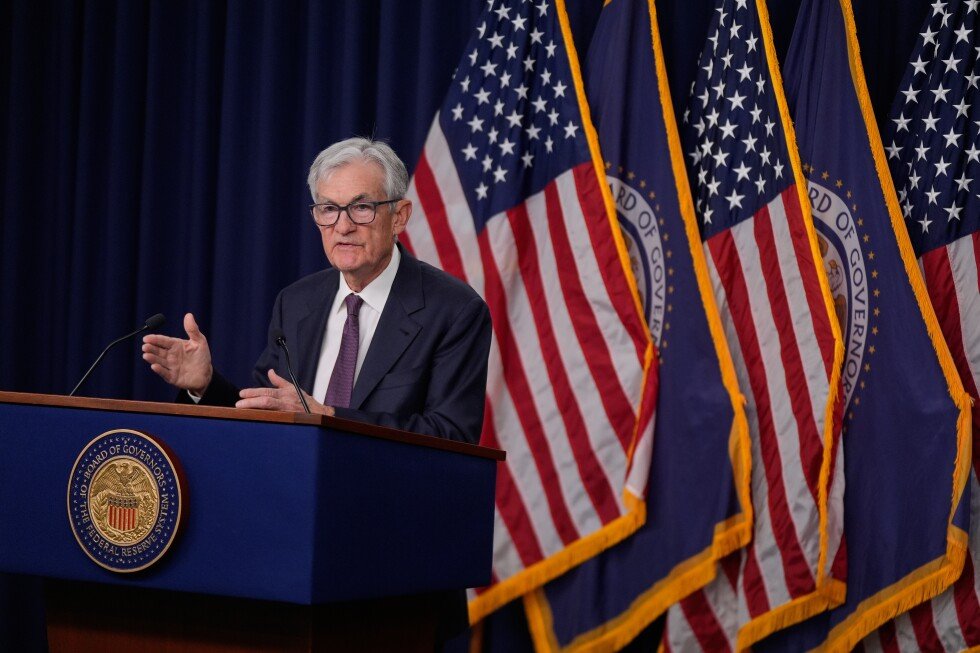
Investors also continued to digest the U.S. central bank’s update from Wednesday, when the Fed lowered borrowing costs by 25 basis points and chair Jerome Powell signalled a pause on further easing. However, investors were relieved that the Fed still had some rate cuts on its dot plot as it balanced still-elevated inflation with signs of labour market weakness.
The Dow Jones Industrial Average rose 646.26 points, or 1.34 per cent, to 48,704.01, vaulting above its Nov. 12 closing record. The S&P 500 gained 14.32 points, or 0.21 per cent, to 6,901.00, breaching its Oct. 28 record close. The Nasdaq Composite lost 60.30 points, or 0.25 per cent, to 23,593.86.
The S&P/TSX Composite Index ended up 169.88 points, or 0.5 per cent, at 31,660.73, surpassing its record closing high on Wednesday.





![i’m-nervous,-too!-[part-2]](https://10xwealthreport.com/wp-content/uploads/2026/03/177042-im-nervous-too-part-2-1568x784.jpg)