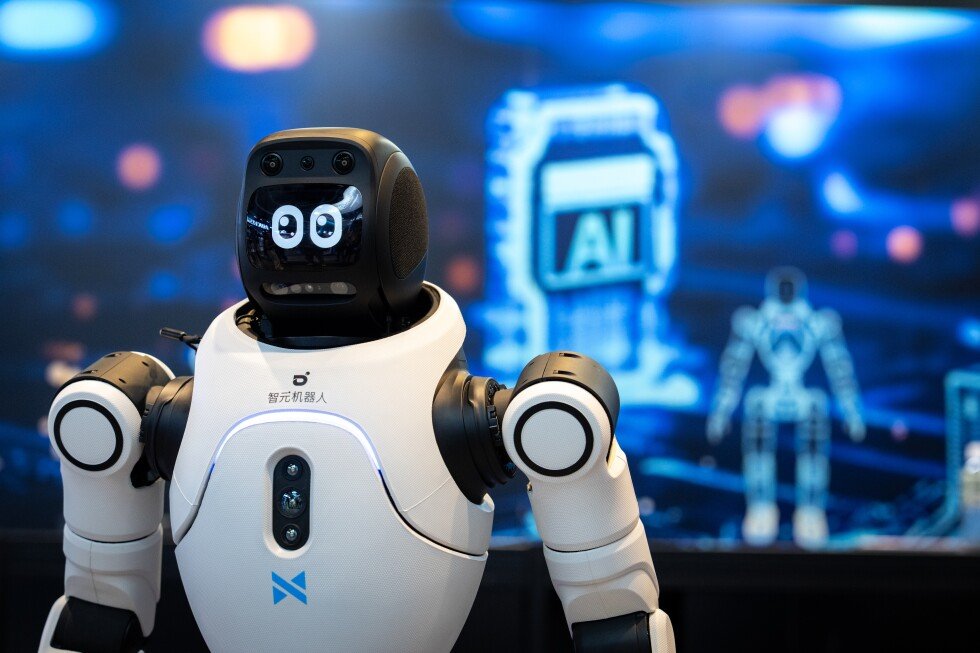
HONG KONG (AP) — A humanoid robot about the size of a primary school student had something to share in Hong Kong — it sang songs and spoke to people in Mandarin and English, answering whatever questions they posed and delighting the audience around it.
More than 100 robots were showcased at two exhibitions starting Monday at the Hong Kong Convention and Exhibition Center. The X2 Ultra robot from China’s prominent humanoid robot manufacturer AGIBOT Innovation (Shanghai) Technology Co. was among them.
When asked about its hobbies, the robot’s list went from doing sports and dancing to studying technology and listening to music. Describing the people in front of it is no challenge either: “a woman holding a phone, a woman holding a bag and a phone, a man holding a camera,” it said at one point.
Calvin Chiu, the chief operating officer of Novautek Autonomous Driving, AGIBOT’s agent in Hong Kong, said that the robot can provide emotional satisfaction to humans through conversations and serve as a teacher to older adults and children. Different robots can be programmed with different personalities, too.
“It would be like a friend,” Chiu said.
Chinese manufacturers among leading players
In China, technology has evolved into an area of competition with the U.S., with national security implications. Beijing’s latest five-year plan vows to “target the frontiers of science and technology.” Speeding up the development of products like humanoid robots and their applications is part of the 2026-2030 plan for the world’s second-largest economy.
Official data showed China had more than 140 humanoid-robot manufacturers and more than 330 models in 2025.
London-based technology research and advisory group Omdia recently ranked three of them — AGIBOT, Unitree Robotics and UBTech Robotics Corp. — as the only first-tier vendors in its global assessment in terms of shipment numbers. They all shipped more than 1,000 units of general-purpose embodied intelligent robots last year, with the first two companies shipping more than 5,000 units, the report said.
In February, humanoid robots were among the highlights of the CCTV Spring Festival gala in China, a television show celebrating the Lunar New Year. A martial arts performance by children and robots stole the spotlight.
Diverse applications and manufacturing advantages
Some Chinese exhibitors flexed their advances at the Hong Kong Convention and Exhibition Center on Monday, showing robotic capabilities that ranged from talking to humans, punching and sand painting to doing backflips and catching suspects with nets during security patrol demonstrations.
Robert Chan, global strategy officer at EngineAI, based in Shenzhen, brought its PM01 robot to showcase its mobility, including doing a front flip. His company plans to launch two factories in China for mass production this year.
He said that China enjoys advantages in certain areas, such as low-cost engineering. He also pointed to the pattern of sharing know-how between companies, unlike in the United States and Europe, where companies typically shield their own technology.
Human-looking robots
Chan foresaw that the next stage of robotics would move toward robots featuring bodies looking like people, with more emotional exchanges and facial expressions, or even looking like they can breathe. That is about plugging the gap in robots’ interactions with humans, he said.
“The warmth and emotion exchange with the human being. Besides, helping humans to make the decision and helping humans to complete their task,” he said.
One company in the exhibition appears to be moving toward that direction.
From a distance, three women appear to be greeting guests at an exhibition booth at one corner. Up close, they turn out to be humanoid robots that could be the future of customer service and museum tour guides.
Wang Zuhua, business director at Shenzhen DX Intech Technology Co., said that the company sold more than 400 robots designed with female features and soft synthetic faces. Some are already working in museums and government venues on the mainland, where they can lead guests to washrooms and offices or provide venue tours, he said.
Malaysian visitor Russel Lupang was amazed by their appearances and movements.
“It’s beautiful, but not real feeling,” he said.