OIAPOQUE, Brazil (AP) — On a recent morning, Reginaldo Nunes Fonseca smoked cigarettes from the porch of his friend’s wooden shack, watching the rain come down hard in an area now known as Nova Conquista — New Conquest — where pristine rainforest in Brazil’s Amazon stood a year ago.
The rain meant he couldn’t work on building his own house or do odd jobs for others in the area, but the weather wasn’t the only thing holding him back. Like thousands of others who have moved to the small city of Oiapoque, in Brazil’s northern state of Amapa, Fonseca is waiting for an economic boom that may or may not come.
The area is experiencing a rush of migrants since Petrobras, Brazil’s state-run oil company, last year secured environmental licensing for offshore drilling in the Equatorial Margin near the mouth of the Amazon River, about 180 kilometers (112 miles) off Amapa’s coast.
“I thought, well, that’s good — the city is going to grow, there will be a lot of job opportunities,” said Fonseca, who saw a television report about the licensing in January and decided to move from the northeastern state of Maranhao. “So I started calling friends and said: ‘I’m going there because here I’m unemployed and not doing anything.’”
Reginaldo Nunes Fonseca sits on a balcony of the house he occupies in an area known as Nova Conquista or “new conquest” in Oiapoque, Amapa state, Brazil, Wednesday, March 11, 2026. (AP Photo/Eraldo Peres)
Reginaldo Nunes Fonseca sits on a balcony of the house he occupies in an area known as Nova Conquista or “new conquest” in Oiapoque, Amapa state, Brazil, Wednesday, March 11, 2026. (AP Photo/Eraldo Peres)
Amapa is one of Brazil’s poorest and underdeveloped states. Oiapoque’s economy relies on fishing, illegal gold mining and visitors from neighboring French Guiana, who cross daily and spend euros, which hold their value better than the Brazilian real. While the prospect of economic opportunities is bringing hope, the impacts of unplanned urban growth in a city with already poor infrastructure are being felt.
The oil-fueled optimism highlights a broader dilemma for developing countries: how to curb their emissions of greenhouse gases like carbon dioxide, which are released from the burning of oil and cause climate change, while relying on such revenue to transform local economies.
It also raises questions about President Luiz Inácio Lula da Silva’s campaign commitment to protecting the environment. He has made stopping deforestation an important part of his government and last year Brazil hosted the U.N. climate summit known as COP30.
“We don’t want to pollute a single millimeter of water, but no one can stop us from lifting Amapa out of poverty if there is oil here,” Lula said last year during a visit to Amapa.
There is a surge of speculation ahead of drilling
Boatmen operating Catraia, a traditional boat used on the Oiapoque River, prepare for the crossing with a load of gasoline canisters filled at a Petrobras gas station in a port in the city of Oiapoque, Amapa state, Brazil, Tuesday, March 10, 2026. (AP Photo/Eraldo Peres)
Boatmen operating Catraia, a traditional boat used on the Oiapoque River, prepare for the crossing with a load of gasoline canisters filled at a Petrobras gas station in a port in the city of Oiapoque, Amapa state, Brazil, Tuesday, March 10, 2026. (AP Photo/Eraldo Peres)
On March 10, about 2 miles (3.2 kilometers) from Fonseca’s home, Petrobras met with politicians, business owners and community leaders to present its operation plans.
Company representatives said drilling for an exploratory well began in October and would last about five months. If large quantities of oil are found and the company wants to begin extracting it, that would require further government permits, a process that can take months or even years.
Environmental and Indigenous groups have sued the Brazilian government and Petrobras to halt exploration, arguing the licensing process failed to properly consult traditional communities, underestimated spill risks and did not adequately assess climate impacts. Federal prosecutors also asked IBAMA to annul or suspend the environmental license, arguing that Petrobras’ studies are insufficient and that the company is concealing the full extent of the environmental impact. No ruling has been issued.
During the meeting, officials also said Oiapoque was serving mostly as a helicopter base for offshore crews, as it’s the closest land point. Administrative operations related to the drilling were based out of Belem, a major city in the neighboring state of Para.
Children watch from the balcony of their house in an area known as Nova Conquista or New Conquest where families are building houses near the center of Oiapoque, Amapa state, Brazil, Tuesday, March 10, 2026. (AP Photo/Eraldo Peres)
Children watch from the balcony of their house in an area known as Nova Conquista or New Conquest where families are building houses near the center of Oiapoque, Amapa state, Brazil, Tuesday, March 10, 2026. (AP Photo/Eraldo Peres)
A family walks carrying tools toward an area known as Nova Conquista or New Conquest where families are building houses near the center of Oiapoque, Amapa state, Brazil, Tuesday, March 10, 2026. (AP Photo/Eraldo Peres)
Construction is visible in an area known as Nova Conquista or New Conquest where families are building houses near the center of Oiapoque, Amapa state, Brazil, Wednesday, March 11, 2026. (AP Photo/Eraldo Peres)
Trees line a cleared area known as Nova Conquista or New Conquest where families are building houses near the center of Oiapoque, Amapa state, Brazil, Wednesday, March 11, 2026. (AP Photo/Eraldo Peres)
Trees line a cleared area known as Nova Conquista or New Conquest where families are building houses near the center of Oiapoque, Amapa state, Brazil, Wednesday, March 11, 2026. (AP Photo/Eraldo Peres)
Despite open questions about future extraction and Oiapoque’s limited role in Petrobras’ operations, speculation has already reshaped the city.
The city’s population was 27,482 in 2022, according to census data, but a new count has yet to be taken, so it’s unclear how many people there are.
“In the past 18 months, Oiapoque has seen significant population growth,” said Tiago Vieira Araújo, an Oiapoque councilman who stood up and voiced concerns during the meeting. “There are already seven new neighborhoods, and social problems have come with them.”
Urban infrastructure in Oiapoque is already precarious. Less than 2% of households have adequate sewage systems, and only 0.2% are on properly structured streets, according to Brazilian Institute of Geography and Statistics.
In the new settlements — known locally as “invasions” — conditions are worse. Residents have cleared public rainforest, creating informal plots and erecting makeshift homes. Freshly cut tree stumps, wooden stakes and rough shacks rise from mud and have only the basics: a kitchen, a bed and a rudimentary bathroom.
“We know it’s not right to clear the forest. Everyone knows it’s wrong,” Fonseca said. “But space is limited.”
Some locals see Dubai as a model for the area’s development
Workers load a vehicle with supplies in front of a wall with an image of the French and Brazilian flags, representing the commercial relationship established along the Oiapoque River between French Guiana and the city of Oiapoque, Amapa state, Brazil, Wednesday, March 11, 2026. (AP Photo/Eraldo Peres)
Workers load a vehicle with supplies in front of a wall with an image of the French and Brazilian flags, representing the commercial relationship established along the Oiapoque River between French Guiana and the city of Oiapoque, Amapa state, Brazil, Wednesday, March 11, 2026. (AP Photo/Eraldo Peres)
Yuri Alesi, 34, a lawyer who advocates for land rights in new settlements and a former city councilman, is running for vice mayor in a special election set for April. He envisions Oiapoque as an “Amazonian Dubai,” fueled by oil revenues.
“Dubai is in the middle of a desert, an unlikely place to grow,” he said. “The industry that drove its development was oil.”
Brazil’s offshore Equatorial Margin, from the Suriname border to the country’s northeast, is believed to hold significant oil and gas reserves. Preliminary estimates suggest they could hold up to 10 billion barrels, with a potential value of about 3.8 trillion reais ($719.7 billion). Alesi said royalties could generate roughly 100 million reais ($19 million) a month for Oiapoque, about the equivalent of the city’s total goods and services produced each year, according to Brazil’s statistics institute.
The Amazon, which is crucial to regulating the global climate because forests store carbon dioxide, is constantly under pressure from deforestation driven by agriculture, cattle ranching and mining. That pressure has been less intense in Amapa, where about 82% of the land remains forested, according to MapBiomas, a nonprofit that tracks land use.
The state’s isolation, bordered by rivers and the sea and lacking road connections to the rest of Brazil, has helped protect it from the deforestation seen in the southern Amazon.
Previous booms have not ended in prosperity
Vehicles move on an unpaved part of the BR-156 highway that connects the state capital Macapa with the city of Oiapoque, Amapa state, Brazil, Friday, March 13, 2026. (AP Photo/Eraldo Peres)
Vehicles move on an unpaved part of the BR-156 highway that connects the state capital Macapa with the city of Oiapoque, Amapa state, Brazil, Friday, March 13, 2026. (AP Photo/Eraldo Peres)
While some point to Dubai as a model for Oiapoque’s future, nearby cities that once benefited from oil offer a warning for Oiapoque.
Petrobras has explored oil and gas in the state of Coari, also part of the Amazon, since the 1980s. Yet the city ranks among Brazil’s poorest, with about 72% of its residents living in extreme poverty, according to a recent study by Agenda Publica, a nonprofit focused on public policy.
Other cities in Amapa have also seen boom and decline cycles tied to mining. Pedra Branca, about 280 miles from Oiapoque, grew between 2007 and 2014 during an iron ore boom.
Prosperity in Pedra Branca drew Selma Soares, 46, who moved from Maranhao to Amapa in 2008 and opened a grocery store.
In 2013, a collapse at a port operated by mining company Anglo American killed six workers and disrupted iron ore production. India’s Zamin Ferrous later took over the mine and suspended operations.
“People who had shopped with us for years struggled to eat,” Soares said.
In the past few years, she heard growing rumors that Oiapoque was booming. After visiting the city last year, she moved with her husband and son. The family now runs a small supermarket on the outskirts of town. Soares said many others have followed.
“People are waiting for drilling to begin,” she said. “They believe everything will improve.”
Amid enthusiasm there is also concern
Fishers unload their catch from a boat at a trading port on the banks of the Oiapoque River in the city of Oiapoque, Amapa state, Brazil, Tuesday, March 10, 2026. (AP Photo/Eraldo Peres)
Fishers unload their catch from a boat at a trading port on the banks of the Oiapoque River in the city of Oiapoque, Amapa state, Brazil, Tuesday, March 10, 2026. (AP Photo/Eraldo Peres)
At the river separating Oiapoque from French Guiana, a small port hums with boats linking Brazil, its neighbor and nearby communities. Green-and-yellow stickers read: “Oil yes! Development yes!,” a message promoted by local politicians.
Just 20 minutes away by boat, members of the Indigenous Galibi Kali’na community are wary. Some see economic opportunity, but leaders oppose exploration, warning of environmental risks and threats to their way of life.
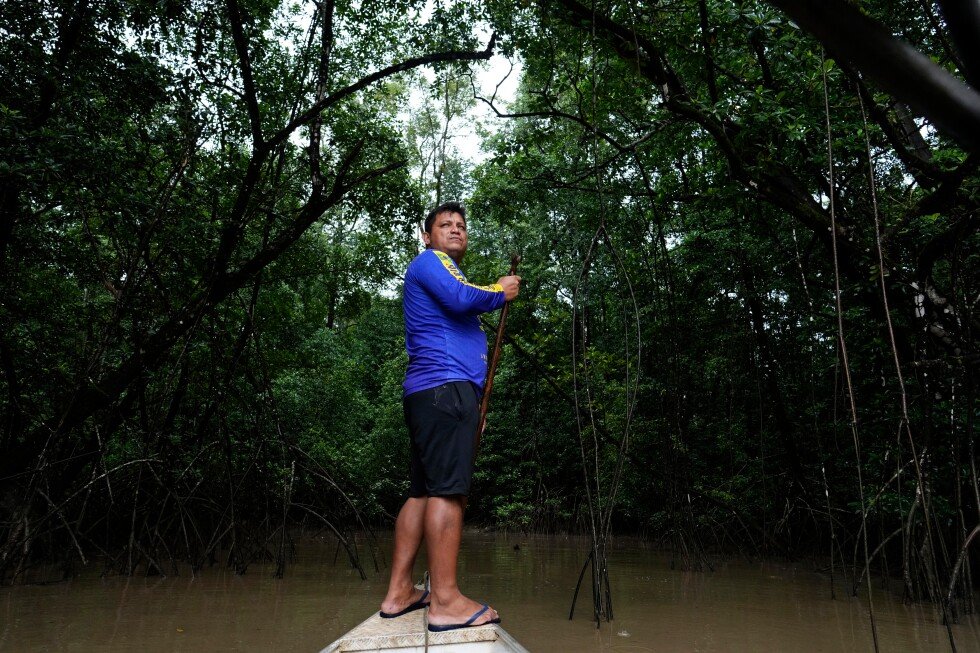
A fisherman’s boat sails at the mouth of the Uaca River, in the Uaca Indigenous Territory region, near the mangrove and biodiversity conservation area of Cabo Orange, in Oiapoque, Amapa state, Brazil, Thursday, March 12, 2026. (AP Photo/Eraldo Peres)
A fisherman’s boat sails at the mouth of the Uaca River, in the Uaca Indigenous Territory region, near the mangrove and biodiversity conservation area of Cabo Orange, in Oiapoque, Amapa state, Brazil, Thursday, March 12, 2026. (AP Photo/Eraldo Peres)
Mangrove area in the biodiversity conservation area of Cabo Orange, in Oiapoque, Amapa state, Brazil, Thursday, March 12, 2026. (AP Photo/Eraldo Peres)
Mangrove area in the biodiversity conservation area of Cabo Orange, in Oiapoque, Amapa state, Brazil, Thursday, March 12, 2026. (AP Photo/Eraldo Peres)
“Petrobras arrived with strong political backing, promising progress as if we would go to sleep one way and wake up like Dubai,” said Renata Lod, a representative on Oiapoque’s Indigenous council. “But what we have actually seen is completely disorganized population growth, invasions of Indigenous lands.”
Lod listed several frequent complaints among Oiapoque residents, both Indigenous and non-Indigenous, including overcrowded schools and the city’s only hospital operating at full capacity.
There is also fear of potential oil spills.
“Most Indigenous lands are flooded wetlands. How do you clean a wetland? Once oil enters the rivers, there’s no way to remove it,” Lod said.
Renata Lod, Galibi representative on Oiapoque’s Indigenous council, at her home on Galibi indigenous land, in Oiapoque, Amapa state, Brazil, Thursday, March 12, 2026. (AP Photo/Eraldo Peres)
Renata Lod, Galibi representative on Oiapoque’s Indigenous council, at her home on Galibi indigenous land, in Oiapoque, Amapa state, Brazil, Thursday, March 12, 2026. (AP Photo/Eraldo Peres)
An oil spill could quickly carry pollutants to nearby coasts and rivers, threatening ecosystems and communities that depend on fishing and mangroves. Petrobras said it conducted spill modeling to secure the environmental license and has been deploying drifting devices to monitor ocean currents since it began exploration in October.
In January, Petrobras reported a drilling-fluid leak that briefly halted operations. IBAMA, the environmental regulator, fined the company 2.5 million reais ($470,500).
At the community meeting, Petrobras officials sought to ease concerns, defending the safety of its operations. They also pointed to everyday items, from clothing to air conditioning, to underscore oil’s economic importance.
“People here see Petrobras as an economic remedy,” said Araújo, the city councilman. “But even a remedy has side effects. And we’re already experiencing the side effects before seeing any of the benefits.”
View of the Franco-Brazilian Binational Bridge, over the Oiapoque River, connecting the city of Oiapoque, in the background, with French Guiana, during sunrise in the city of Oiapoque, Amapa state, Brazil, Tuesday, March 10, 2026. (AP Photo/Eraldo Peres)
View of the Franco-Brazilian Binational Bridge, over the Oiapoque River, connecting the city of Oiapoque, in the background, with French Guiana, during sunrise in the city of Oiapoque, Amapa state, Brazil, Tuesday, March 10, 2026. (AP Photo/Eraldo Peres)
___
Photographer Eraldo Peres and video journalist Felipe Campos Mello contributed to this report.
___
The Associated Press’ climate and environmental coverage receives financial support from multiple private foundations. AP is solely responsible for all content. Find AP’s standards for working with philanthropies, a list of supporters and funded coverage areas at AP.org.