Oil traded at more than $110 a barrel on Tuesday, before dipping in volatile trading, after Donald Trump said all of Iran could be “taken out” in one night.
Brent crude, the international benchmark for oil prices, rose by 1% to $111 a barrel, before slipping back to $109.40 as traders watched for developments in the Middle East.
New York light crude rose 2.6% to $115.3 a barrel, before slipping to $112.72, up just 0.25%.
Investors are growing increasingly anxious as Trump escalates his threats against Iran, demanding it reopen the strait of Hormuz as part of any deal to stop the war.
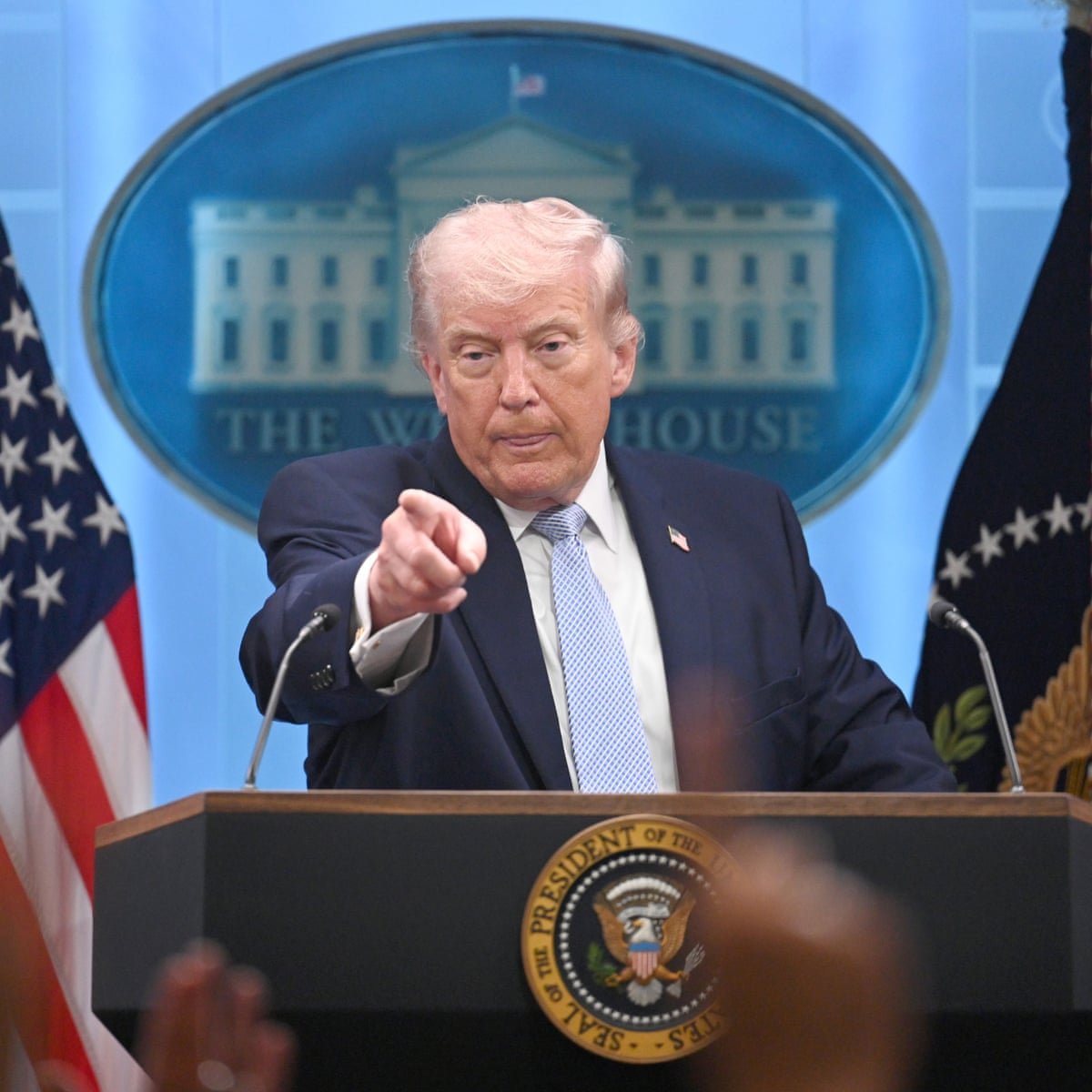
The US president, speaking to reporters at the White House on Monday, set a deadline of Tuesday 8pm ET (1am BST Wednesday) for Iran to agree a deal with Washington or face fresh attacks on civil infrastructure, including power plants.
“The entire country can be taken out in one night, and that night might be tomorrow night,” he said.
Trump said that passage through the strait – a vital shipping channel through which a fifth of the world’s oil and gas supplies normally passes – was a “very big priority” and should be part of any ceasefire deal.
Stock markets in Asia were mixed on Tuesday, with Japan’s Nikkei flat and South Korea’s Kospi rising by 1.1%. Hong Kong’s Hang Seng dropped by 0.7%.
In Europe, the UK’s blue-chip FTSE 100 index dipped in early trading before turning positive, up 33 points or 0.3% by mid-morning to 10,467 points. France’s Cac 40 rose by 1.2%, with Germany’s Dax 30 up 0.7% after an early drop. The Stoxx Europe 600, which tracks the biggest companies on the continent, gained 0.6%.
Markets have been choppy since the US-Israel attack on Iran in February, as the effective closure of the strait of Hormuz has fed fears around inflation and rattled investor confidence.
On Monday, Kristalina Georgieva, the head of the International Monetary Fund, warned the war was likely to lead to higher inflation and slower global growth.
Georgieva told Reuters that before the war began the IMF had expected a small upgrade in its expectation for global growth of 3.3% in 2026 and 3.2% in 2027. Instead, she said, “all roads now lead to higher prices and slower growth”. The IMF is expected to publish its report on the world economic outlook next week.
“We are in a world of elevated uncertainty,” Georgieva said, citing geopolitical tensions, climate shocks, demographic shifts and advancements in technology. “All of this means that after we recover from this shock, we need to keep our eyes open for the next one.”




![i’m-nervous,-too!-[part-2]](https://10xwealthreport.com/wp-content/uploads/2026/03/177042-im-nervous-too-part-2-1568x784.jpg)