
(Image credit: Getty Images)
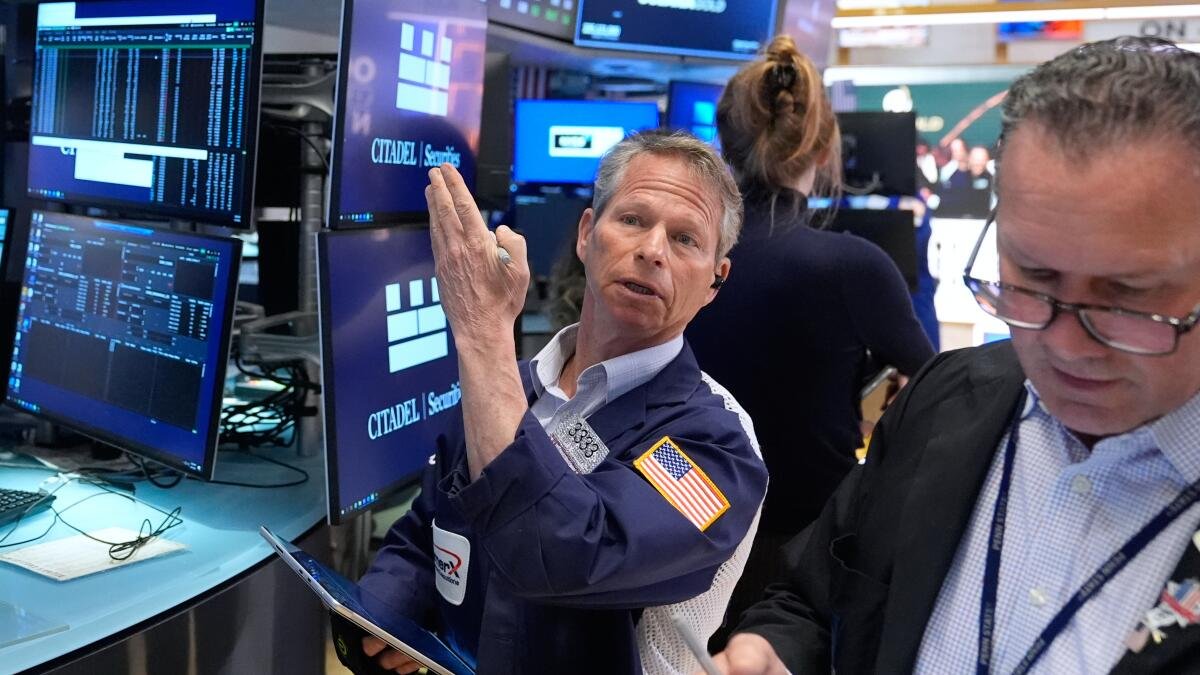
It was a choppy end to a strong week for stocks as market participants parsed a mixed inflation report, while keeping a cautious eye on headlines related to this weekend’s negotiations between the U.S. and Iran. The start of first-quarter earnings season was also top of mind, with several big banks slated to report next week.
At the close, the blue-chip Dow Jones Industrial Average was down 0.6% at 47,916 and the broader S&P 500 was 0.1% lower at 6,816. The tech-heavy Nasdaq Composite gained 0.4% to finish at 22,902.
All three indexes notched notable weekly gains, with the S&P 500 (+3.6%) and Nasdaq (+4.7%) posting their best weeks since November.
Sign up for Kiplinger’s Free Newsletters
Profit and prosper with the best of expert advice on investing, taxes, retirement, personal finance and more – straight to your e-mail.
Profit and prosper with the best of expert advice – straight to your e-mail.
Oil prices, meanwhile, edged lower on Friday, with front-month West Texas Intermediate crude futures falling 1.5% to settle at $96.37 per barrel. Oil prices suffered a more than 13% weekly decline after the U.S. and Iran announced a two-week ceasefire.
The two sides will hold negotiations in Pakistan this weekend, though “the nations remain far apart on a plethora of issues,” says José Torres, senior economist at Interactive Brokers. “A continued ceasefire leading to an official end to the war will likely require some acquiescence from both sides.”
Spiking energy costs boost inflation
Soaring energy prices as a result of the ongoing conflict in the Middle East are accelerating inflation, according to the latest Consumer Price Index (CPI) report.
Ahead of the opening bell, the Bureau of Labor Statistics said the CPI rose 0.9% from February to March, and was 3.3% higher year over year. This marked the highest annual increase since May 2024.
The March CPI came in much higher than February’s figures of 0.3% and 2.4%, and exceeded economists’ estimates for a 0.8% monthly increase and a 3.1% annual rise.
Rising energy costs were the main reason behind the hot headline number. “The index for energy rose 10.9 percent in March, led by a 21.2-percent increase in the index for gasoline which accounted for nearly three quarters of the monthly all items increase,” explained the BLS.
Looking for more timely stock market news to help gauge the health of your portfolio? Sign up for Closing Bell, our free newsletter that’s delivered straight to your inbox at the close of each trading day.
Shelter costs also increased in March, as did prices for airfare, apparel, household furnishings and new vehicles.
However, core CPI, which excludes volatile food and energy prices, rose 0.2% from February to March, matching economists’ expectations. Year over year, core inflation came in at a slower-than-expected 2.6%.
“As expected, March inflation jumped notably from a surge in gasoline prices stemming from the conflict in Iran,” says Vinny Amaru, global investment strategist at J.P. Morgan Wealth Management. “Outside of energy, the picture was more benign. Contained increases in housing costs, along with weakness in car prices, were a welcome sign.”
Still, Amaru notes that “energy price shocks historically take time to feed through the economy,” and with the Middle East conflict not yet resolved, “uncertainty regarding future inflation should keep the Federal Reserve in a wait-and-see mode.”
Nvidia’s on its best winning streak in years
In single-stock news, Nvidia (NVDA) climbed 2.6% today, bringing its daily win streak to eight – its longest stretch since November 2023, according to Dow Jones Market Data.
Today’s upside came amid a strong day for tech stocks, with fellow chipmakers Advanced Micro Devices (AMD, +3.6%) and Broadcom (AVGO, +4.7%) also gaining ground.
Organon pops 28% on M&A buzz
Elsewhere, Organon (OGN) soared 27.8% on reports that Mumbai-based pharmaceutical firm Sun Pharmaceutical Industries has offered to buy the women’s health care company for $12 billion.
Today’s gain marks OGN’s best day ever and brings the health care stock back into positive territory for the year to date. But it’s been tough sledding over the long term, with Organon down more than 73% since it was spun off from blue chip drugmaker Merck (MRK, -1.0%) back in 2021.
And Wall Street has remained on the sidelines amid this underperformance. Of the eight analysts covering OGN who are tracked by S&P Global Market Intelligence, one says it’s a Buy rating, three have it at Hold and four say it’s a Sell. This works out to a consensus Hold rating.