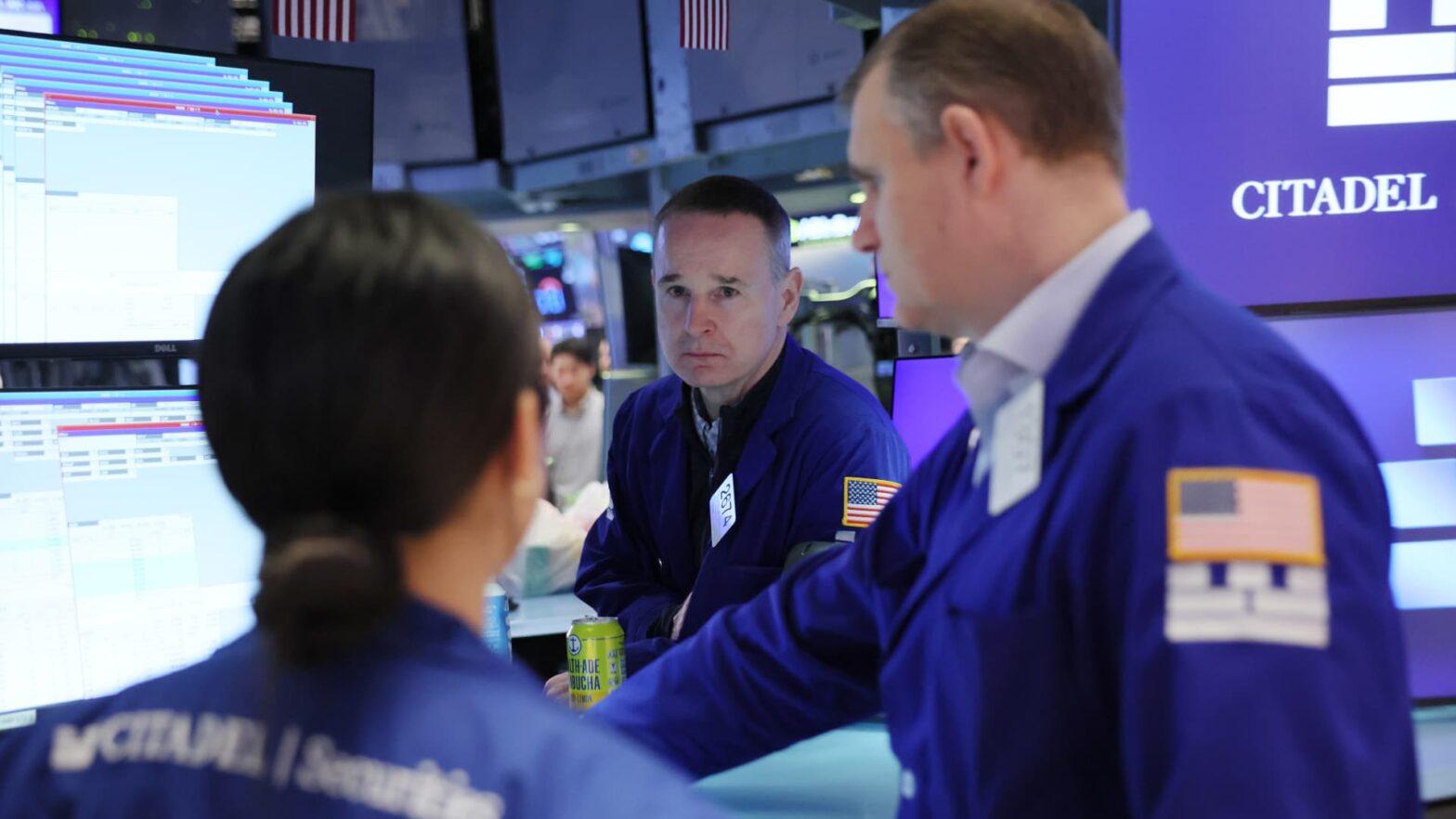
Traders work on the floor of the New York Stock Exchange during morning trading on March 10, 2026 in New York City.
Michael M. Santiago | Getty Images
Stock futures rose slightly as Wall Street tried to recover from another losing week, with investors monitoring oil prices and the latest developments from the U.S.-Iran war.
Dow Jones Industrial Average futures added 153 points, or 0.3%. S&P 500 futures rose 0.3% and Nasdaq-100 futures gained 0.3%.
The moves come after the S&P 500 notched its third losing week in a row and closed at its lowest level of the year on Friday. The benchmark index ended the week down 1.6%, while the Dow and Nasdaq shed about 2% and 1.3%, respectively.
Oil prices rallied last week, with Brent crude settling above $100 per barrel for the first time since 2022. Crude soared as traffic in the Strait of Hormuz, a critical shipping route, has been effectively halted since the war began.
In early trading, WTI crude oil rose 1% to $100.06 a barrel, while Brent crude rose 2.2% to $105.37.
President Donald Trump ordered on Friday strikes on Iran military assets located on Kharg Island. While the attack didn’t impact oil infrastructure, Trump said the U.S. would consider hitting those structures if Iran continues to block the Strait.
Trump also told NBC over the weekend that Iran wants to make a deal, but he is not ready yet.
Perhaps helping sentiment a bit as the week began was a Wall Street Journal report stating that the U.S. will announce soon a coalition of countries to escort ships through the Strait of Hormuz, citing officials.
The stock sell-off has been relatively tame despite the geopolitical tensions, however. The S&P 500 remains just 5% below its all-time high set earlier this year.
“The apparent resilience in the S&P 500 is attributable to the increasing bullishness of industry analysts’ consensus estimates for earnings per share in 2026 and 2027,” wrote Ed Yardeni, president of Yardeni Research. “Apparently, they did not get the memo about the possible negative consequences of a protracted war and closure of the Strait.”
Along with oil and the war, investors will keep an eye on Nvidia, as the chipmaker’s GTC conference begins Monday. The Federal Reserve is also set to hold its second monetary policy meeting of the year, though no change to interest rates is expected.
Nvidia GTC conference a potential catalyst for Wall Street
Nvidia’s GTC conference kicks off on Monday, with investors turning to it for a potentially positive catalyst.
“Nvidia is moving aggressively to dominate AI inference. OpenClaw and Nvidia’s NemoClaw mark the first major step into consumer-scale agentic AI,” Rothschild & Co. Redburn analyst Timm Schulze-Melander wrote in note. “At next week’s GTC keynote, we expect Nvidia to reveal more of its strategy for dominance of AI inference. While the market obsesses over chips, the real story is Nvidia’s ‘five-layer stack’ designed to squeeze hyperscaler margins and lock-in the generation of agentic AI.”
Read more here.
— Sean Conlon
U.S. crude tops $100 per barrel
U.S. crude prices topped $100 per barrel Sunday evening, as the Trump administration weighs military strikes on OPEC member Iran’s key oil export facilities on Kharg Island.
U.S. crude oil rose 1.68% to $100.37 per barrel. Brent prices, the international benchmark, were up 2.15% to $105.36 per barrel.
President Donald Trump ordered strikes Friday against Iranian military assets on Kharg Island. Trump said the strikes had left oil infrastructure unscathed. But he warned that the U.S. would consider hitting crude infrastructure on the island if Iran continued to block the critical Strait of Hormuz.
— Spencer Kimball