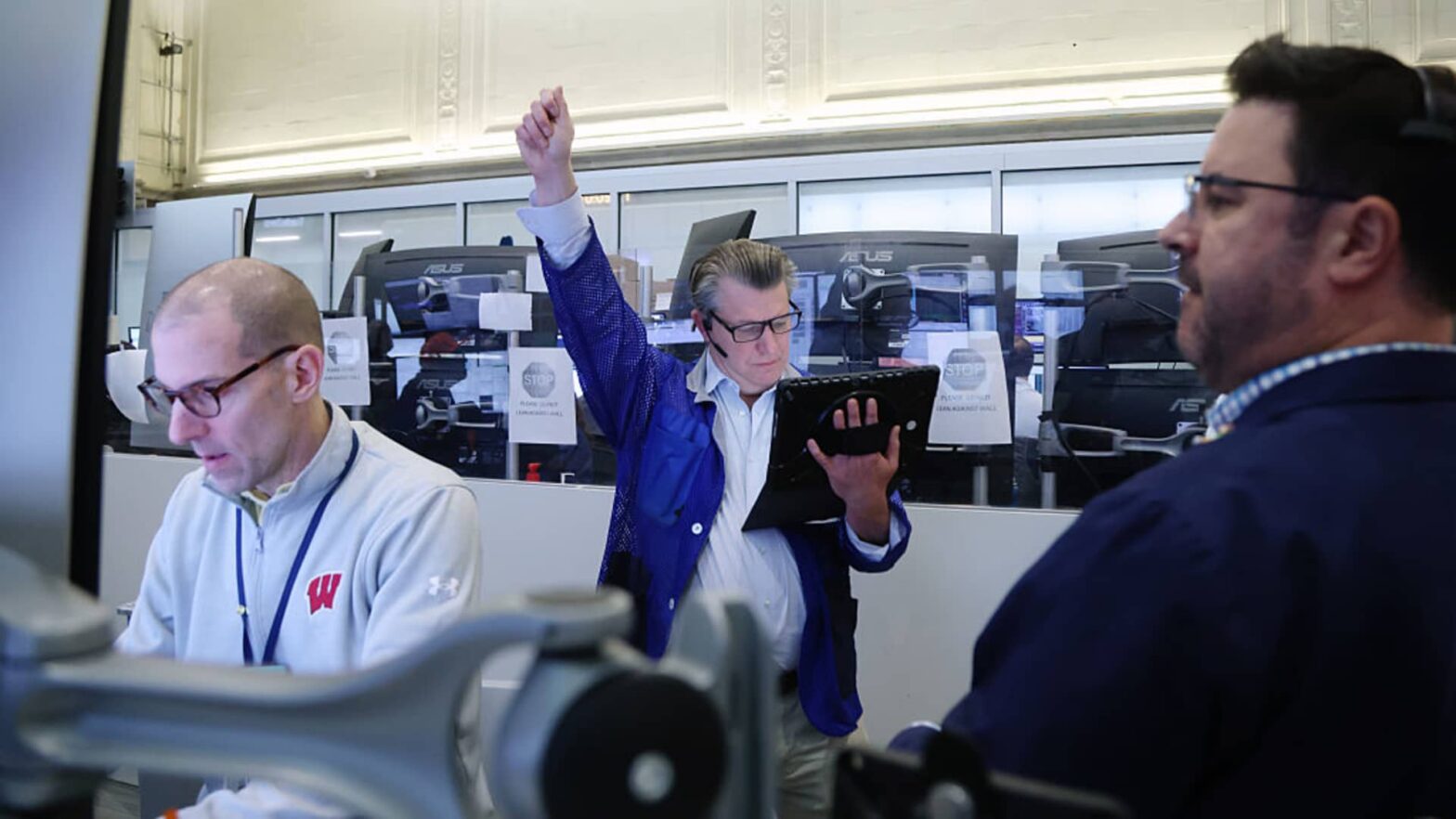
Traders work on the floor of the American Stock Exchange (AMEX) at the New York Stock Exchange (NYSE) in New York, US, on Monday, March 9, 2026.
Michael Nagle | Bloomberg | Getty Images
Stock futures slipped Monday night after major averages swung sharply in a volatile session and traders kept a close eye on the latest developments out of Iran.
Futures tied to the Dow Jones Industrial Average lost 142 points, or 0.3%. S&P 500 futures fell 0.3%, while Nasdaq 100 futures slid 0.3%.
President Donald Trump on Monday evening said, “We’re achieving major strides toward completing our military objective,” reinforcing his comments from earlier in the session that the military campaign could soon end. Speaking at a press conference at his golf club near Miami, Trump also said, “We are also focused on keeping energy and oil flowing to the world.”
In regular trading, stocks staged a stunning comeback from their session lows. The 30-stock Dow added about 239 points, or 0.5%, rebounding from a loss of nearly 900 points. The S&P 500 closed 0.8% higher after falling as much as 1.5% during the regular session. The Nasdaq Composite similarly reversed course and finished higher by nearly 1.4%.
The swift turnaround in the regular session came after Trump told CBS’ senior White House correspondent Weijia Jiang that “the war is very complete, pretty much.” The president also told CBS News that the U.S. is “very far” ahead of his previously stated timeframe of four to five weeks and that he is “thinking about” taking over the Strait of Hormuz.
Following Trump’s comments, West Texas Intermediate crude fell to $81 a barrel, after hitting above $100 per barrel in overnight trading to more than $119. The price for a barrel of Brent crude, the international standard, pulled back to $84 a barrel. Oil prices were last above $100 in 2022, when Russia launched a full-scale invasion of Ukraine.
“This is just a real clear indication that oil’s in the driver’s seat in the near term. Just from peak to trough, in one day, we saw oil prices correct down 30%, and risk assets, and specifically the stock market, rally throughout the news,” Matt Stucky, Northwestern Mutual chief portfolio manager, said Monday.
On Tuesday morning, energy ministers from the Group of Seven nations — namely, Canada, France, Germany, Italy, Japan, the United Kingdom and the U.S. — are set to meet virtually to discuss a potential release of strategic oil reserves.
In economic news, traders are watching for inflation data due this week. February’s consumer price index reading is due Wednesday, and January’s personal consumption expenditures price index will be out Friday. Both reports will not reflect the recent surge in oil prices caused by the war with Iran.
“We may see a bit of an uptick in for CPI inflation over the coming quarter based on what we saw happen this month, but I don’t think that derails, for example, the case for the Fed to actually cut interest rates,” Stucky said.
“In fact, if this continues — which, again, is not the base case — then the spike in oil is a consumption tax, and it does negatively impact financial market,” he added. “So I would expect the Fed to provide easing … or at least look through it, rather than hiking interest rates.”
Separately, earnings on deck this week include Oracle out Tuesday and Adobe due Thursday.
Asia markets rebound as oil plunges after Trump signals Iran war might end ‘soon’
South Korea’s Kospi opened more than 5% higher Tuesday, leading a rebound in the region, after oil prices fell and Wall Street bounced back as U.S. President Donald Trump signaled the conflict with Iran could be nearing its end.
Oil prices fell more than 10% after Trump said he was considering seizing control of the Strait of Hormuz, a critical chokepoint for crude flows. Trump also told a CBS News reporter, who shared the comments in a post on X, that “the war is very complete, pretty much.”
International Brent crude was down 10% at $89.03 per barrel at 9.10 p.m. ET Monday. U.S. crude oil fell more than 9% to $86.05 per barrel. The declines came after oil surged past $100 on Monday.
Other Asia stock indexes also gained. The small-cap Kosdaq added over 4%.
Australia’s S&P/ASX 200 rose 1.35% in early trade.
Japan’s Nikkei 225 jumped 1.66%, while the Topix gained 1.3%.
Hong Kong’s Hang Seng index rose 1.56%, while the CSI 300 gained 0.9%.
—Lee Ying Shan
Vail Resorts, Vertex Pharmaceuticals, HPE moving in after-hours trading Monday
Take a look at the stocks moving in extended trading Monday:
- Vail Resorts — The ski resort’s stock price slid 1.2% on the back of weak earnings results. Vail reported $5.87 per share in earnings on $1.08 billion in revenue, while analysts polled by LSEG expected $6.10 per share on $1.11 billion in revenue. The company also lowered its guidance “due to the persistent, historically challenging weather conditions in the Rockies.”
- Hewlett Packard Enterprise — The technology company saw shares rise 1% in the after-hours session. HPE earned 65 cents per share, on an adjusted basis, for its first quarter. That exceeded analysts’ estimate of 59 cents per share, according to LSEG. The company’s $9.30 billion in revenue fell slightly short of the $9.33 billion expected, meanwhile.
- Vertex Pharmaceuticals — Vertex Pharmaceuticals shares popped more than 5% after the biotech company said its drug met its goals in a late-stage trial for IgA nephropathy, a chronic condition that can lead to kidney failure.
— Pia Singh
WTI April crude oil futures open lower around $85 per barrel
WTI April crude oil futures on Monday evening opened lower by more than 9% at $85.60, after settling the regular session at $94.77 per barrel. The move lower comes after U.S. President Donald Trump said in an interview with a CBS News reporter that the Iran war is “very complete, pretty much.”
— Pia Singh