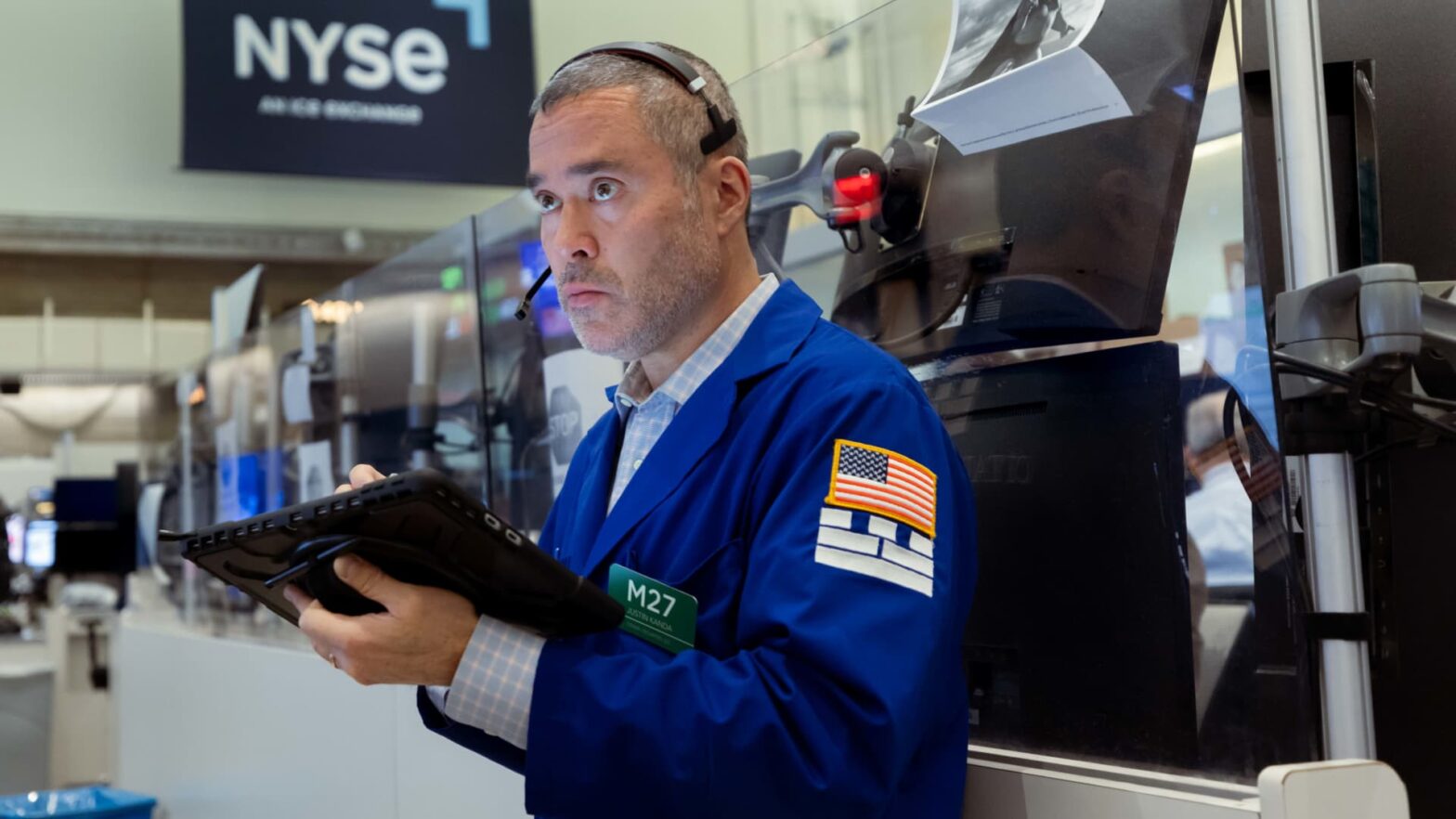
Traders work at the New York Stock Exchange on March 3, 2026.
NYSE
Stock futures fell Tuesday night after a volatile session for U.S. equities.
Futures tied to the Dow Jones Industrial Average declined 0.33%. S&P 500 futures lost 0.34%, while Nasdaq 100 futures dropped 0.45%.
Major stock averages closed the previous session in the red, albeit far off of their lows of the day. The S&P 500 slipped about 0.34%, while the Dow lost roughly 403 points, or 0.8%. At one point, the Dow Industrials fell more than 1,200 points. The Nasdaq Composite closed down 1%.
Each of the S&P 500’s 11 sectors closed lower. Materials was the worst-performing sector, dropping 2.7%, followed by industrials, down nearly 2%. Investors throughout the session weighed concerns about how rising oil prices could potentially affect the U.S. economy and future monetary policy decisions.
President Donald Trump said on Tuesday that the U.S. would provide risk insurance to all maritime trade through the Persian Gulf, in an effort to get tankers moving through the Strait of Hormuz. Tanker traffic through the Strait — the world’s most vital transit route for crude oil — came to a halt after the Iranian Revolutionary Guard commander threatened to set fire to ships attempting the route.
Brent crude oil futures settled up 4.71%, while West Texas Intermediate crude futures advanced 4.68%. Both ended Tuesday’s trading off their session highs.
“Amid all the noise we might be seeing some opportunities start to emerge in markets for longer term investors, in our view, especially if we start to see energy prices stabilize and potentially moderate in days and weeks ahead,” said James McCann, senior economist at Edward Jones, in a note.
Heading into Wednesday, traders will be watching the ADP private payrolls report. The Dow Jones consensus calls for 48,000 jobs added in February, up from 22,000 in January.
On the earnings front, traders will look for quarterly results from Abercrombie & Fitch, Broadcom and Okta.
South Korea’s Kospi plunges 12% putting it on track for its worst day in decades as Iran conflict rages
South Korea’s Kospi plunged over 12% Wednesday, putting it on track for its worst day in decades, and extending a steep sell-off from the previous session amid an escalating war in the Middle East.
The Korea Exchange temporarily halted trading for the Kospi index on Wednesday. A circuit breaker was also activated on the Kosdaq, which also fell about 13%.
Kospi index heavyweights SK Hynix and Samsung Electronics fell 5% and 7%, respectively.
The South Korean market had been on a tear last year, soaring more than 75%, and extending gains into the new year as well, with the Kospi hitting new highs on the back of chip heavyweights that have seen their shares surge on strong memory chip demand.
—Lee Ying Shan
Iran war likely to push inflation gauge higher, Goldman says
The U.S.-Iran war could push inflation substantially higher if it becomes more drawn out than expected, according to Goldman Sachs.
In a baseline scenario, the boost to energy prices raises inflation as measured by the consumer price index to 2.7% in May, from its January level of 2.4%, the firm’s economists said in a note. However, the pace then would recede and hit 2% by the end of this year, meeting the Federal Reserve’s target.
A more persistent oil shock would take headline CPI to 3% in May and would “remain elevated relative to our baseline forecast for the remainder of the year,” Goldman added.
The Fed’s preferred inflation measure, the Commerce Department’s personal consumption expenditures price index, was already at 2.9% for headline and 3% for core in December.
—Jeff Cox
Stock outlook remains favorable, UBS says
The stock outlook remains favorable even with renewed fears of a prolonged conflict spurring investors to drop equities, according to a note from UBS Global Wealth Management.
“In the current conflict, we expect only minimal or a brief disruption to global energy supplies. We think President Trump’s comments today reinforce this view. We therefore stick with our base case that US equities will produce good gains this year,” read the note. “Our year-end S&P 500 price target of 7,700 remains unchanged.”
The target represents 11% upside from where the S&P 500 closed Monday at 6,881.62.
— Sarah Min
CrowdStrike Holdings, Ross Stores, Box see post-earnings moves in late Tuesday trading
Check out the companies making headlines in after-hours trading.
- CrowdStrike Holdings — Shares of the beaten-down cybersecurity company slipped 1% in the extended session. CrowdStrike beat fourth-quarter expectations on top and bottom lines, but gave an underwhelming outlook for the first quarter. The company sees adjusted earnings ranging between $1.06 and $1.07 per share, while analysts polled by LSEG sought $1.06 per share.
- Box — The company, a content management provider, beat fourth-quarter earnings and revenue expectations and gave strong guidance for the current quarterly period. Box reported earnings of 49 cents per share, on an adjusted basis, and revenue of $306 million for the fourth quarter. Analysts polled by LSEG expected fourth-quarter earnings of 34 cents per share on $304 million in revenue. Shares advanced more than 2%.
- GitLab — The software stock dipped 8% after GitLab’s fiscal 2027 guidance came out lower than was expected. GitLab. The company guided its fiscal year revenue to between $1.099 billion and $1.118 billion, compared to the $1.12 billion estimate from analysts polled by LSEG. It said it sees fiscal year adjusted earnings ranging between 76 cents and 80 cents per share, falling short of the $1.05 per share estimate, per LSEG.
- Ross Stores — The off-price retailer beat Wall Street’s quarterly expectations and authorized a 10% increase in its quarterly cash dividend to about 45 cents per share. Ross reported earnings of $2 per share on revenue of $6.64 billion for its fourth quarter, exceeding analysts’ forecast of $1.90 per share in earnings and $6.41 billion in revenue, per LSEG. Shares were last up 6%.
— Pia Singh