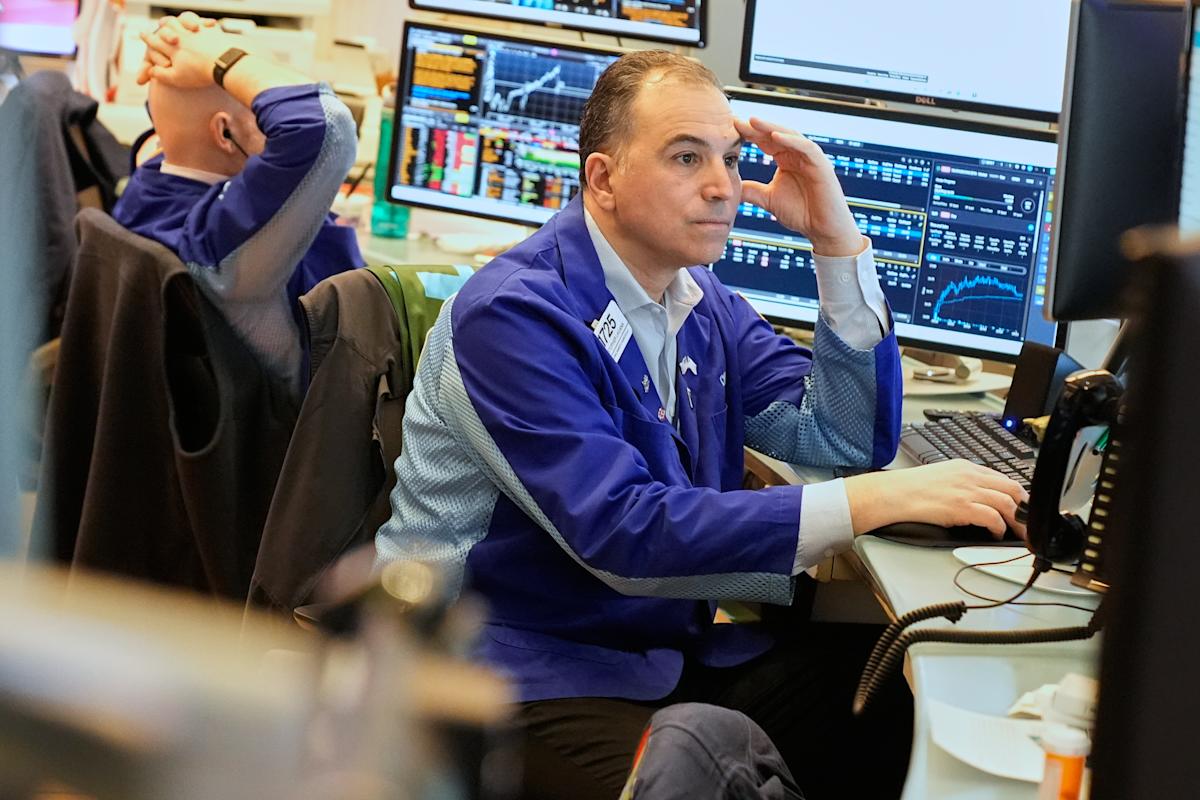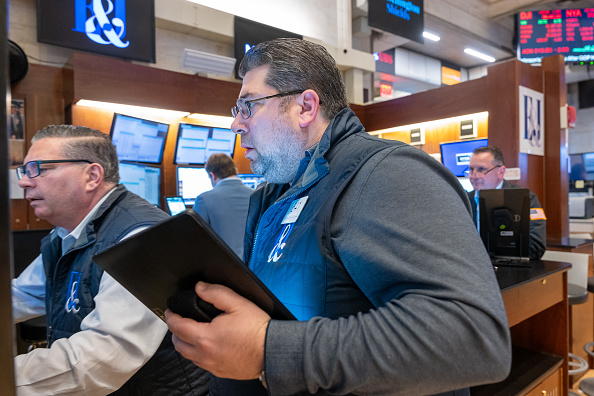
U.S. stocks on Wednesday erased early gains to hit session lows, as market participants waded through a host of quarterly reports. Meanwhile, some stability returned to the bond market following a sell-off driven by a dent to interest rate cut expectations.
The tech-heavy Nasdaq Composite (COMP:IND) was last down 0.62% to 15,767.40 points in morning trade, while the benchmark S&P 500 (SP500) slipped 0.37% to 5,032.95 points. The blue-chip Dow (DJI) retreated 0.31% to 37,681.15 points.
Of the 11 S&P sectors, seven were in the red.
Wall Street ended mixed in the previous session after Federal Reserve Jerome Powell at a moderated conference said that recent data showed a lack of progress on inflation. Markets have now pushed out their expectations of the first 25 basis point rate cut by the Fed to September.
Treasury yields were lower on Wednesday, as a three-day bond sell-off finally eased up. The longer-end 30-year yield (US30Y) was down 4 basis points to 4.73%, while the 10-year yield (US10Y) was down 5 basis points to 4.62%. The shorter-end more rate-sensitive 2-year yield (US2Y) was also down 5 basis points to 4.95%.
“Treasury yields across the curve have drifted higher, culminating in an interest rate breakout, all within long-term uptrends in yields. After similar breakouts, yields tended to rise over the medium term, pressuring stocks,” SentimenTrader noted on X (formerly Twitter).
See live data on how Treasury yields are doing across the curve at the Seeking Alpha bond page.
“The equity move, driven mostly by multiple re-rating, is disconnected from the significant increase in bond yields and repricing of the Fed following a streak of hot inflation prints. Persisting inflation forces raise the risk that rates will need to stay higher for longer than expected, which could in turn weigh on economic activity and equity valuations,” JPMorgan’s Marko Kolanovic said.
“For a market reliant on immaculate disinflation, a dovish Fed reaction function, and diminishing tail risks on growth, the continuation of hot growth and inflation data can bring us to a tipping point where a tighter stock vs bond risk premium finally produces a market correction,” Kolanovic added.
On Wednesday, quarterly earnings took the spotlight with a few major names on tap. United Airlines (UAL) provided a lift to the S&P 500 (SP500), surging more than 13% and topping the list of percentage gainers. The U.S. airline provided better-than-feared results for a quarter that saw a significant headwind in the form of the grounding of its Boeing (BA) 737 Max fleet. Other carriers such as American Airlines (AAL) and travel-related stocks such as Norwegian Cruise Line (NCLH) received a lift.
Conversely, Travelers (TRV) slid ~8% and was a top percentage loser on both the S&P 500 (SP500) and the Dow (DJI). The insurer posted a quarterly top and bottom line miss largely due to elevated catastrophe losses caused by wind and hail storms.
Trucking and freight logistics stocks slipped after J.B. Hunt Transport Services (JBHT) and Knight-Swift Transportation (KNX) provided soft reads on demand and pricing with their respective earnings and guidance updates.
Abbott Laboratories (ABT) lost ground. Strong sales of the company’s medical devices helped offset a plunge in COVID-19 testing-related revenue.
Turning to the economic calendar, MBA mortgage applications rose in the past week. Additionally, The Atlanta Fed’s business inflation expectations inched lower in April.
The Fed’s Beige Book report on regional activity will arrive later in the afternoon.