By Jennifer Sor
Follow Jennifer Sor
Every time Jennifer publishes a story, you’ll get an alert straight to your inbox!
By clicking “Sign up”, you agree to receive emails from Business Insider. In addition, you accept Insider’s Terms of Service and Privacy Policy.
Mario Tama/Getty Images
- The stock market could see more than a third of its value erased in the next year, Larry McDonald says.
- The famed trader pointed to several headwinds that could weigh on markets, like higher inflation.
- The risk-reward profile for the S&P 500 looks “poor,” he said, advising traders to sell rallies.
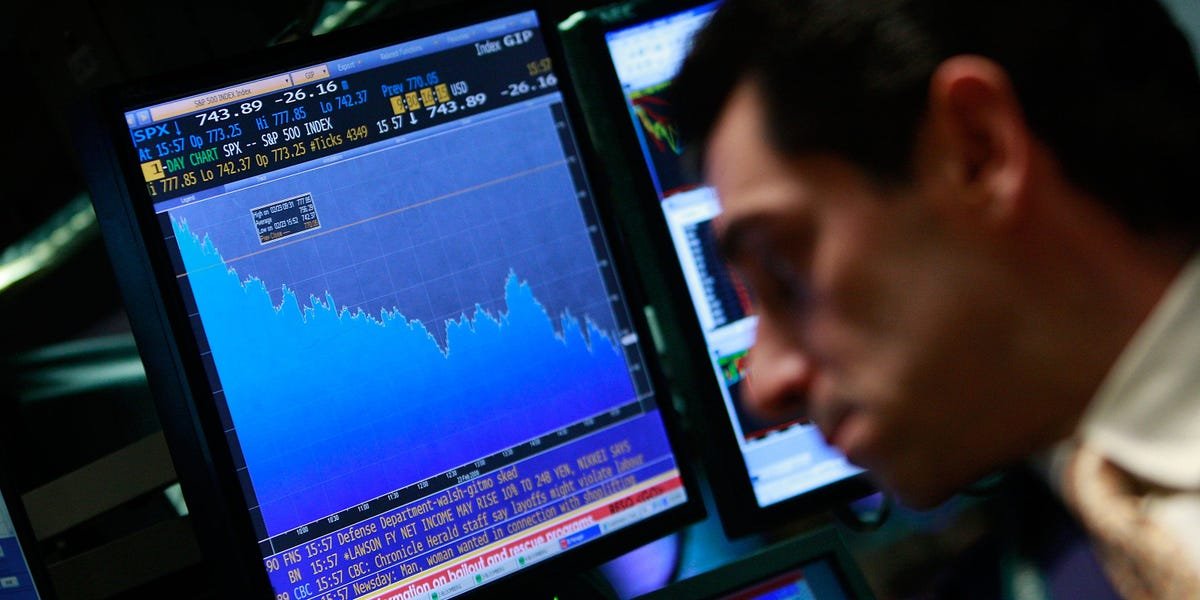
A Wall Street veteran says US stocks could be headed for a correction more painful than the market’s historic “Liberation Day” sell-off.
Larry McDonald, the longtime strategist and famed former Lehman Brothers trader, said he sees the potential for the stock market to experience more downside over the medium term. He said that’s because of a cocktail of risks building up in the market.
He told Business Insider in an interview this week that, through the first quarter of next year, he wouldn’t be surprised if the S&P 500 dropped 20% to 35% from current levels.
“Your risk-reward is really poor,” McDonald said, adding that he would advise investors to sell any rallies in the index. “Big parts of the market are kind of rolling over already,” he said, pointing to the 11% decline in the Magnificent Seven names off their 2025 peaks.
The S&P 500 has been challenged already this year, with the benchmark index falling 3%. The bearish end of McDonald’s price target implies the index sliding to around 4,365, a level investors haven’t seen since late 2023.
Here are the reasons behind McDonald’s gloomy forecast:
1. Surging oil prices could take lower rates off the table

David McNew/Getty Images
Markets have been fretting over the impact of higher oil prices stemming from the war in Iran. The fear is that more expensive crude will raise inflation, which could throw cold water on the market’s hopes for Fed rate cuts.
Investors haven’t taken in any inflation data that would have captured the inflationary impact of supply disruptions in the Middle East yet, but Americans are already paying higher prices at the pump. The national average price for a gallon of gas rose to $3.84 on Wednesday, according to the AAA, up from $2.92 a month ago.
Investors are also beginning to price in a slower pace of easing than they did at the start of the year. The odds that the Fed won’t cut rates any further this year rose to 40% as of Wednesday, up from just a 5% probability priced in a month ago, according to the CME FedWatch tool.
2. Higher rates increase risks in the credit market
Spencer Platt/Getty Images
The Fed keeping rates higher for longer would be bad news for many types of loans, including those in commercial real estate and private credit.
Many loans that were originated when interest rates were ultra-low during the pandemic are also approaching maturity, McDonald said. When those loans finally mature in a higher-rate environment, that will introduce new credit risk in financial markets, something that could impact bonds and, eventually, the outlook for stocks, he suggested.
“There’s just a lot of garbage loans that were sold when rates were 1%,” he said of what could weigh on the market. “And so there’s the interest rate risk component, and then there’s a credit risk component.”
3. AI disruption will likely keep spreading across the market
Every day, there’s a “new victim” in markets as investors fret about the long-term business outlook of various industries with AI, McDonald said. He pointed to how fears of AI dismantling the business model for software firms largely hammered tech stocks before spreading to industries like insurance brokers, wealth managers, real estate, and trucking.
“The beast in the market’s going to keep taking those victims out and going after them,” he said.
4. The US could see peak AI layoffs this summer
B.S.P.I./Getty Images
Job losses are likely to accelerate heading into the second-half of the year, something that’s likely to hit the economy and markets, McDonald suggested.
The US jobless rate has held steady around 4%, but McDonald speculated that it could rise to near 6% by the end of the year as AI adoption picks up steam. The economy could potentially see as many as 100,000 to 200,000 job losses a month from April to July, he said, citing his “educated guess” for how quickly business leaders will adopt AI.
He pointed in particular to Block, the fintech giant run by Jack Dorsey that recently axed 40% of its workforce due to its ability to supplement work with AI.
“Going from a three-, four-handle unemployment to a five, six in an AI world this year, to me, that’s pretty realistic,” he said.
The job market is already a key concern for investors, given how hiring has trended lower and layoffs have trended higher over the past year. The US lost a staggering 92,000 jobs in the month of February, badly missing estimates and raising concerns about the risk of a recession.
Read next



![i’m-nervous,-too!-[part-2]](https://10xwealthreport.com/wp-content/uploads/2026/03/177042-im-nervous-too-part-2-1568x784.jpg)