Here are the top stories to read ahead of Tuesday trading:
Latest Updates
Markets wrapped up a strong third quarter for stocks and bonds, as investors ended September seeming more convinced that the Federal Reserve may pull off a “soft landing” for the U.S. economy after all.
“There’s more confidence that we’re going to stick the soft landing,” said Michael Arone, chief investment strategist for State Street Global Advisors, in an interview on Monday. But soft landings are “rare,” and gold’s outperformance suggests skeptical investors are still hedging against risks to the economic outlook, he said.
SPDR Gold Shares, an exchange-traded fund that invests directly in physical gold and tracks spot prices of the yellow metal, has soared 27.1% this year, including a slightly more than 13% gain in the third quarter, according to FactSet data.
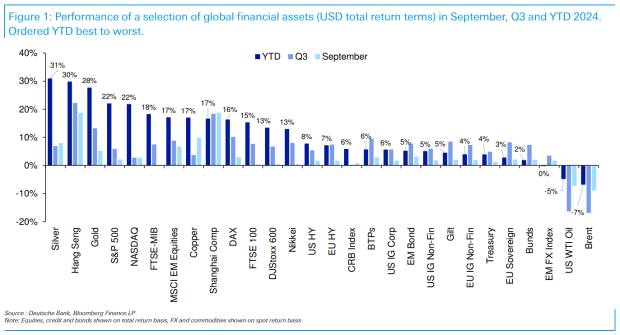
Silver, gold, Chinese stocks and the S&P 500 were top performers in the third quarter, according to Deutsche Bank. (DEUTSCHE BANK)
The third quarter has just ended, and a team of analysts at Deutsche Bank are back with their roundup of how global markets fared.
The latest three-month stretch proved to be an eventful one for investors, as volatility returned to the U.S. stock market, culminating with the Cboe Volatility Index tapping its highest level intraday since March 2020 on Aug. 5.
But notable moves abounded in bonds, currencies, commodities and international stocks as well.
Deutsche Bank’s commentary was replete with interesting factoids. MarketWatch has shared some of the highlights below (text quoted directly from their commentary):
“The S&P 500 has now posted its strongest YTD performance of the 21st century so far, having already advanced by more than 20% at the end of Q3.”
“The usual poor September seasonals weren’t the case this time. In fact, the S&P 500 posted its first September advance (2.1%) since 2019, and Bloomberg’s global bond aggregate was up for the first September (1.7%) since 2016.”
“Chinese equities catapulted up the leaderboard thanks to the stimulus announcements. The Shanghai Comp is now up 16.7% YTD in USD total return terms, having risen by 18.8% in September alone.”
“Tech stocks lost some of their shine, and Q3 was the first quarter since Q4 2022 that the S&P 500 (5.9%) outperformed the Magnificent 7 (5.4%). Instead, there was a significant rotation, and Utilities (19.4%) were the top performing sector in the S&P 500.”
“With the Bank of Japan hiking rates and the Fed launching faster cuts than expected, the Japanese Yen (12.0%) had its strongest quarter against the US Dollar since Q4 2008, at the height of the GFC.”
“US Treasuries advanced for a 5th consecutive month in September for the first time since 2010.”
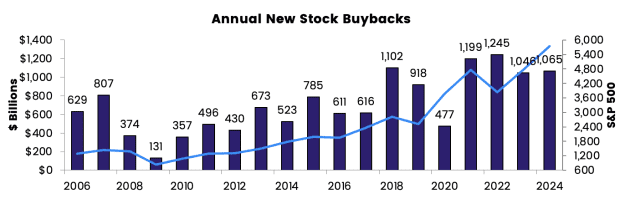
Corporate executives are feverishly announcing stock repurchase programs this year as stock climb to record highs and policy makers roll out plans to increase the 1% buyback tax. (EPFR)
Companies this year already have announced more than $1 billion of planned stock buybacks, a pace that likely eclipses the previous yearly record set in 2022.
The flurry has been led by cash-rich big tech companies and others planning to repurchase their own shares despite a stock market that’s been pushing deeper into record territory and a 1% buyback tax in place since last year.
BlackRock CEO Larry Fink contends the argument over a so-called soft landing or hard landing for the U.S. economy is misplaced amid signs of robust growth overall. “I don’t see any landing,” he told Bloomberg Television in an interview Tuesday.
And that means bets on further rate cuts by the Federal Reserve, as reflected in the swaps market, are too aggressive. “The amount of easing that’s in the forward curve is crazy. I do believe there’s room for easing more, but not as much as the forward curve would indicate,” Fink said.
The swaps market shows traders have priced in a roughly one-in-three chance of another rate cut of 50 basis points when the Fed meets in November and around 190 basis points of cuts by the end of 2025, according to Bloomberg data.
Investors around the world are wondering how much longer the latest face-ripping rally in Chinese stocks can last. One longtime China analyst might have some answers.
Assuming all goes according to plan, Chinese stocks’ blistering advance over the past week could be just the beginning of a “megarally” that would deliver gains of up to 100%, according to Thomas Gatley, a China-based analyst at Gavekal Dragonomics. Gatley shared his analysis, which is based on how Chinese stocks have performed over the past 20 years, in a report provided to MarketWatch on Monday.
However, whether the rally can continue will likely depend on whether or not policymakers in Beijing can deliver the combination of monetary and fiscal stimulus that international investors have come to expect.
If they do, more gains are pretty much guaranteed, Gatley said.
“This combination of monetary, fiscal and direct market support, assuming it is actually delivered, pretty much guarantees that the rise in equities will continue,” he said.
Walt Disney Co.’s stock fell 0.9% in premarket trade Tuesday, after Raymond James downgraded it to market perform from outperform, and said a number of headwinds, notably its park division, will keep it range-bound for the next 12 to 18 months.
Analysts Ric Prentiss and Brent Penter said feedback from 20 Disney super fans, travel agents, and local business owners, and as Disney confirmed on its fiscal third-quarter earnings call, park attendance and pricing power is slowing meaningfully.
“Demand is moderating after a strong post-COVID surge, consumers are still digesting price increases taken in the past ~4 years, and a questionable consumer outlook further complicates the picture,” the analysts wrote in a note to clients.
Oil futures kicked off October and the fourth quarter on a down note, feeling pressure from expectations for increased supply as traders continued to look past an escalation of tensions in the Middle East as Israel began operations in southern Lebanon in its latest offensive against Iran-backed Hezbollah.
Iran, which supports Hezbollah in Lebanon financially and militarily, has not so far mounted or indicated a retaliatory attack. “It appears that Iran is not interested in a military confrontation with Israel at present. It is also consistent with this that there has not yet been a retaliatory attack in response to the killing of a high-ranking Hamas leader in Tehran at the end of July, for which Israel is being blamed,” said Carsten Fritsch, commodity analyst at Commerzbank, in a note.
”Provided that there is no direct confrontation between Iran and Israel, the impact on oil supply should remain limited. Consequently, there is no reason to add a larger risk premium to the oil price,” he wrote, while noting the situation could change suddenly.
Boeing Co.’s stock fell 2.6% early Tuesday, after a Bloomberg report that the aerospace giant is considering raising at least $10 billion by issuing new shares, as it works to bolster cash reserves that have been depleted by a strike.
Citing people familiar with the talks, Bloomberg said Boeing is working with advisers to explore its options. The capital raise is unlikely to happen for at least a month, and assumes the company can end the strike by its machinists, a 33,000-strong group that has downed tools over pay. Boeing wants a full grasp of the financial fallout from the strike, the people told Bloomberg.
Boeing declined to comment to Bloomberg. The company did not immediately respond to a request from MarketWatch for comment.
Deutsche Bank has shifted its stance on the timing of the next cut in borrowing costs by the European Central Bank, saying that falling inflation and meek economic activity in the eurozone means there’s no reason for the ECB to wait until its December meeting and should pull the trigger in October.
The ECB last reduced its deposit rate by 25 basis points to 3.50% on September 18.
In a note published Tuesday, a team of Deutsche Bank economists led by Mark Wall said they previously had the ECB cutting by 25 basis points in December and at each of its meetings in the first half of 2025.
However, headline inflation was expected to fall below the ECB’s 2% target in September – this was confirmed by data released Tuesday, which showed inflation at 1.8% – and with fast declining energy prices the central bank is likely to further ratchet down its inflation forecasts, says Deutsche.
The Deutsche team also say that evidence of slowing economic activity from the region’s purchasing managers’ indices give more leeway in justifying an easing of policy. Indeed, ECB President Christine Lagarde on Monday said the eurozone economy is “facing headwinds“.
“With policy rates still arguably above neutral and restrictive even with a 25bp policy rate cut in October, there is little risk in accelerating the next rate cut. A cut in October would better balance the risks to the path of inflation in 2025-2026 while leaving the Governing Council will all options open to it in December when a full reassessment of the inflation forecast will be available,” says Deutsche Bank.
As traders increased bets of a rate cut in October the yield on the 10-year German bund fell 7 basis points to 2.058%, a low for 2024, and the euro slipped 0.4% to $1.1085.
Here are some of the potential market catalysts due Tuesday for traders to consider:
Paychex, McCormick & Co., Acuity Brands and United Natural Foods will present results before the stock market opens.
9:45 a.m. Eastern. S&P final U.S. manufacturing PMI for September.
10:00 a.m. U.S. ISM manufacturing for September.
10:00 a.m. U.S. construction spending for August.
10:00 a.m. U.S. job openings (JOLTS) for August.
11:10 a.m. Federal Reserve Governor Lisa Cook speaks at Federal Reserve technology conference.
Nike and Lamb Weston will release earnings after the market close.
6:15 p.m. Richmond Fed President Tom Barkin, Atlanta Fed President Raphael Bostic and Boston Fed President Susan Collins on a joint panel about technology-enabled disruption


![i’m-nervous,-too!-[part-2]](https://10xwealthreport.com/wp-content/uploads/2026/03/177042-im-nervous-too-part-2-1568x784.jpg)