Here are the top stories to read ahead of Monday trading:
Latest Updates
Activist shareholder and billionaire Carl Icahn was taking somewhat of a victory lap Monday, after a judge dismissed a proposed class-action lawsuit against his company, finding it did not make material misrepresentations or omissions as alleged in a report by short seller Hindenburg Research.
The report, published last May, alleged that Icahn’s investing arm, Icahn Enterprises L.P. had overstated the value of certain assets and was unable to afford its at-that-time quarterly dividend of $2 a share.
It also revealed that Icahn himself had made billions of dollars worth of personal loans against shares, or units, that he owned in Icahn Enterprises.
Strategists at BMO Capital Markets have identified the level at which market-implied expectations for a half-percentage-point rate cut on Wednesday would need to reach in order for such a move to come to greater fruition.
“While we’re still in the 25 bp camp, we’ll concede that the more aggressively the market prices in 50 bp, the more compelled the Fed will be to follow-through with such a move,” said strategist Ian Lyngen.
Fed-funds futures traders were pricing in a 59% likelihood of a 50-basis-point cut from the Federal Reserve on Wednesday, according to the CME FedWatch Tool. If those expectations rise to more than 80%, a 50-basis-point cut might help prevent a sharp selloff in risk assets, Lyngen and strategist Vail Hartman wrote in a note.
Experts have waffled over whether the Federal Reserve will cut interest rates by 25 bps or 50 bps at its September FOMC meeting this week. But regardless of the size of this first rate cut, Thierry Wizman, global FX and rates strategist at Macquarie, believes the Fed’s tone during the meeting will be the same.
“Regardless of which of -25bps or -50bps the FOMC goes with on Wednesday, we do think that the Fed’s messaging will be ‘dovish’. That’s insofar as the Fed (through Jay Powell) will assure traders that its aim is to avoid a further widening of the unemployment rate (the output gap), and that such a widening would be inconsistent with its mandate,” Wizman wrote in a note.
“If we get a -25bp cut, that is, it will be a ‘dovish’ cut that anticipates between -50bps and -75bps additional cuts this year (i.e., in the November and December meetings), perhaps through the ‘dot’ plot,” he continued.
The tone of the Fed and its chair Jerome Powell will be important in reassuring markets that it has everything under control. Recently, softening economic data has left traders feeling uneasy and led to increased volatility. This means traders will be paying close attention to the sentiment of the FOMC meeting to determine whether the Fed is behind the curve with its cuts.
Apple’s stock is one of the weakest performers in the S&P 500 early Monday after prominent analyst Ming-Chi Kuo signaled lackluster iPhone 16 Pro demand based on the first weekend of preorders.
“The delivery times of the iPhone 16 Pro series are significantly shorter than those of the 15 Pro series,” he wrote.
Apple’s stock is down 3.3% in Monday morning trading. It’s the biggest decliner in the Dow Jones Industrial Average, with its decline having a 46-point negative impact on the index.
The U.S. dollar was weakening Monday, ahead of an expected interest rate cut this week by the Federal Reserve.
The U.S. Dollar Index, a measure of the greenback against other major currencies, was down 0.4% Monday morning at 100.69, according to FactSet data, at last check. That brought the index’s decline so far this year to around 0.6%.
The Fed will announce its policy decision on interest rates on Wednesday.
The Dow Jones Industrial Average jumped higher at the opening bell Monday, trading above its record close from Aug. 30, while the S&P 500 and Nasdaq lost ground.
“For weeks, market expectations favored a 25-basis-point cut, but now they appear to have shifted to 50 basis points,” said Chris Larkin, managing director for trading and investing at E-Trade from Morgan Stanley, in a note.
He noted stocks are coming off another volatile week,” but at least this one featured the kind of volatility people like—to the upside.”
“The S&P 500 notched its biggest up week of the year one week after its biggest down week since March 2023. The direction this week takes will be dictated by the Fed’s decision, and to what Fed Chair Jerome Powell says in his post-announcement press conference,” Larkin said.
The Dow was up 265 points, or 0.6%, at 41,659, on track to best its record finish of 41,563.08 set on Aug. 31.
The S&P 500 was off 0.1%, while the Nasdaq Composite dropped 0.9%.
U.S. households saved money at record rates during the COVID-19 pandemic. In the years since, there’s been a dramatic reversal.
The personal saving rate hit 2.9% in July. Besides a brief slip to 2.7% in June 2022, this saving rate is close to the lowest level since before the 2008 recession.
Although a low personal saving rate could point to U.S. households feeling squeezed, that’s not always the case. Paul Ashworth, chief North America economist at Capital Economics, believes this isn’t a cause for major concern.
“The continued decline in the saving rate, which is now close to a 16-year low, is not a major concern given the recent surge in household net wealth. Furthermore, as the saving rate is calculated from two different sources — with consumption estimated from expenditure surveys and income estimates based on tax receipts — the data can be heavily revised,” Ashworth wrote in a note.
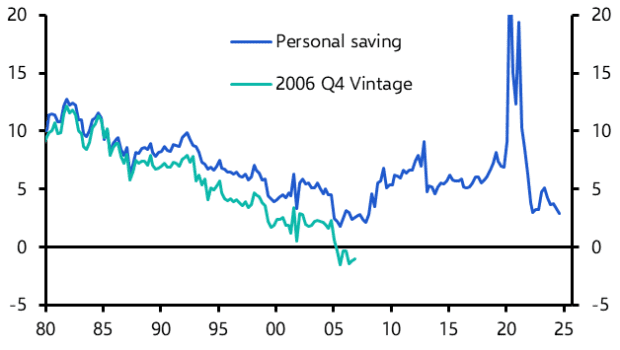
The personal saving rate (dark blue) has dropped dramatically since 2020. (Capital Economics)
Treasury yields continued to fall Monday morning, led by rates in the shorter-term of the curve, as fed-funds futures traders priced in a 65% chance of a half-percentage point rate cut on Wednesday.
The policy-sensitive 2-year yield fell 2.6 basis points to 3.549%, from Friday’s closing level of 3.575% or the lowest since Sept. 12, 2022.
What a difference a week makes.
Market-based expectations for the size of the Federal Reserve’s upcoming interest-rate cut — what would be the central bank’s first since 2020 — have shifted dramatically over the past few days. The central bank is expected to announce a cut to its interest-rate target after its September policy meeting ends on Wednesday.
As of early Monday, traders now see a 50 basis point cut as the most likely outcome, although the debate on Wall Street continues. As investors work to parse potential outcomes for both scenarios, Renaissance Macro’s Neil Dutta on Monday rattled off a couple of reasons why the central bank should opt for the larger move.
Perhaps the most salient: a smaller cut would risk causing financial conditions — an aggregate of market-based indicators that purports to gauge how “tight” access to money is in the economy — to tighten. That would be counterproductive, considering that Fed Chairman Jerome Powell last month said the central bank would take proactive steps to protect the labor market.
“Tighter financial conditions should be avoided when the balance of risks between growth and inflation have shifted as they have now. If the downside risks to employment outweigh the upside risks to inflation, then the Fed should be leaning against tightening financial conditions, all else equal,” Dutta said.
Of course, not all loans are linked to market-based rates. Small business loans, as well as auto loans and other forms of consumer lending, are linked to the prime rate, which is tied to the Fed funds rate. As the chart below shows, actual interest rates paid by small businesses are higher than they have been in decades.
This is another reason a larger cut would help signal that the Fed is serious about staving off further weakness in the labor market.
“…[A] big upfront move is a signal that the Fed means business about getting back on sides while a 25-basis point move with rates still far from neutral implies they are willing to leave a restrictive policy in place for a long time,” Dutta said.
For months now, Dutta has been warning that the Fed has risked falling behind by not cutting interest rates sooner.
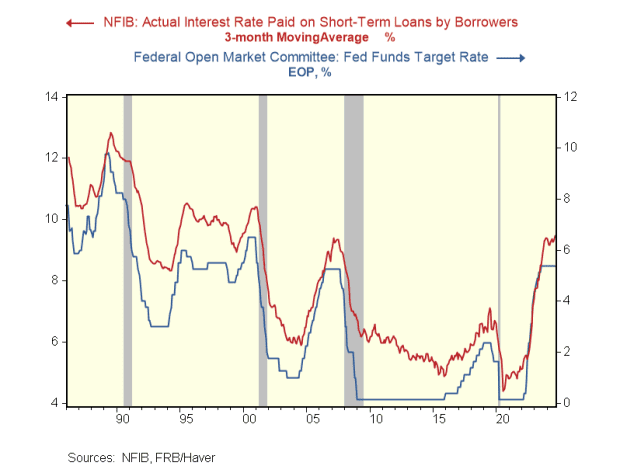
(RENMAC)
Speak now or forever hold your peace?
The probability of a 50 basis point rate cut, as reflected by pricing in the fed-funds futures market, now stands at 65% (versus 35% for a 25 basis point cut) in Monday morning trade. That’s up from a roughly 50-50 outlook at the end of last week.
Strategists at Deutsche Bank argued in a Monday note that continued silence from the Federal Reserve on the subject would be taken as a tacit endorsement of market pricing. While the Fed is in the blackout period that precedes Fed policy decisions, the central bank has on occasion used leaks to news organizations to help steer policy expectations.
Deutsche Bank Fed watchers believe “we’ll either see further press-led communications that steer the market back to 25bps today or that ultimately the Fed will deliver 50bps on Wednesday,” strategist Jim Reid wrote in a Monday note.
“So the conclusion is that a quiet day today in terms of informed Fed speak in the press will likely tip the scales toward 50bps on Wednesday,” Reid wrote. “So the next 12 hours are crucial in terms of press watching and will probably cement final pricing.”

![i’m-nervous,-too!-[part-2]](https://10xwealthreport.com/wp-content/uploads/2026/03/177042-im-nervous-too-part-2-1568x784.jpg)