Private Companies
No results found
- All News
- Articles
- Video
- Podcasts
Here are the top stories to read ahead of Monday trading:
Latest Updates
Treasury yields were slightly higher amid low volumes Monday morning, with traders awaiting the next major U.S. inflation update in two days.
The policy-sensitive 2-year yield moved about 2 basis points above Friday’s closing high of 4.054%, the highest since Aug. 1, according to Dow Jones Market Data. Strategists at BMO Capital Markets described Monday’s price action as being “a slow start to the week” with volumes at less than a third of the 10-day moving average.
A sense of calm has returned to the U.S. stock market following the most volatile week of the year. But the coming days could hold new challenges as investors cast a wary eye toward Iran.
The threat of an Iranian attack on Israel was “top of mind” heading into Monday’s session, according to Fundstrat’s Tom Lee. Other concerns included the July CPI report, due out Wednesday, and the level of the Cboe Volatility Index, otherwise known as the VIX or the market’s “fear gauge,” which remained elevated early Monday following its Aug. 5 surge.
“The obvious implication of an attack is that equities become ‘risk-off’ as investors wait for clarity of the scope of the resulting conflict expansion,” Lee said in a client note shared with MarketWatch on Monday.
So far, tensions surrounding a potential Iranian strike have mostly affected crude-oil and gold prices. Both were climbing on Monday, moving toward their highs from early August.
“There are growing expectations that Iran is preparing for a direct attack on Israel, on top of Hamas launching missiles against northern Israel almost on a daily basis. Should this move take place, it would constitute a proper escalation of the conflict,” said Achilleas Georgolopoulos, an investment analyst at XM, in a note shared with MarketWatch.
U.S. stocks looked set to pick up modest gains at the open as futures contracts pointed higher.
KeyCorp.’s stock jumped 19% early Monday, after the regional bank said it agreed to sell a 14.9% stake in itself to The Bank of Nova Scotia for about $2.8 billion.
The price for the KeyCorp stake of $17.17 a share is a premium over its closing price on Friday of $14.61.
ScotiaBank said the deal will provide “attractive near-term returns to our shareholders and creates future optionality for Scotiabank in the North American corridor.”
KeyCorp Chief Executive Chris Gorman said the bank approached KeyCorp “with a unique opportunity to raise capital on attractive terms,” according to a statement.
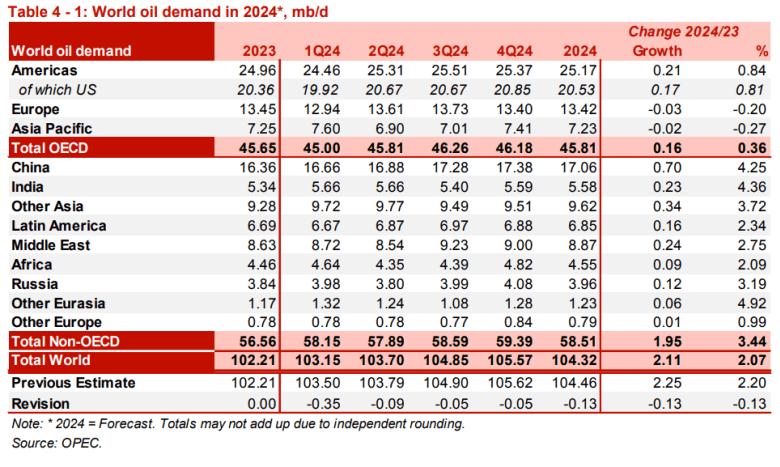
(OPEC)
Oil futures were holding solid gains early Monday, buoyed in part by continued fears Iran may soon launch strikes against Israel in a move that could lead to a wider conflict capable of affecting crude flows from the Middle East.
Futures remained higher after the Organization of the Petroleum Exporting Countries, in its monthly report, slightly trimmed its forecast for crude-oil demand growth in 2024, citing softness in Chinese demand, and also slightly pulled back on its 2025 forecast.
A group of trend-following investors active in futures markets has pared its bets against the Japanese yen by the widest margin in years, according to the latest data from the Commodity Futures Trading Commission.
Leveraged funds rolled back a net-short position in futures contracts tied to the Japanese currency by more than 46,000 contracts during the week ended Aug. 6, or 65% of the amount from the prior week, according to weekly CFTC data released on Friday.
The reduction — believed to have been spurred by the unwind of the yen carry trade, which caused the yen to rapidly appreciate last week, sending a shockwave through global markets — was the biggest in at least 10 years, according to CFTC data collected by FactSet.
As of Tuesday, the day after the big move in the yen on Aug. 5, these traders were sitting on a net-short position of about 24,000 contracts, the smallest since February 2023, according to the latest data.
The week-over-week reduction was the largest going back at least 10 years, according to CFTC data collected by FactSet. Each contract is worth 12.5 million yen. At Monday’s exchange rate of about 147.5 yen to the dollar, the position was equivalent to about $2.1 billion.
The leveraged funds category is mostly made up of commodity trading advisors, or CTAs, a type of speculative fund that typically employs trend-following strategies to place bets across financial markets using futures contracts. Brad Bechtel, global head of foreign-exchange at Jefferies, told MarketWatch last week that these positions represented a tiny fraction of bets against the yen. But the size of the change could offer some insight into the magnitude of the carry trade’s unwind.
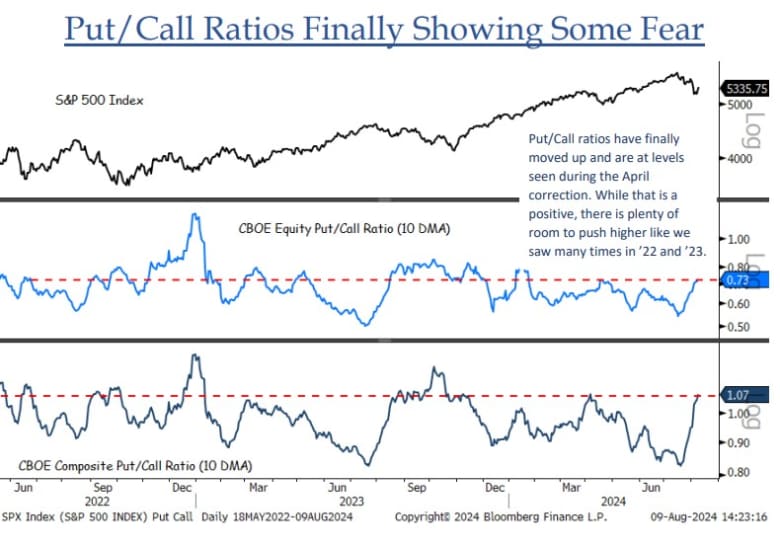
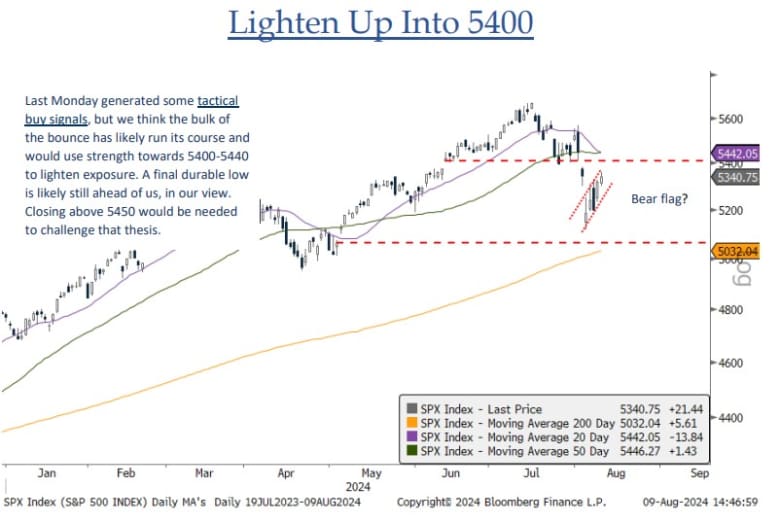
The S&P 500’s rally off last Monday’s intra-session low has been stoic. Yet Jonathan Krinsky, chief technical strategist at BTIG, thinks it’s going to get harder for the rally to continue much more.
Sure, there are some positive technical signs. The put/call ratio is back to levels seen during April, Krinsky notes. When the ratio is low it points to investors buying many more call options (the right to buy stocks) than put options (the right to sell) and suggests they are complacent about a possible sell-off.
However, Krinsky adds that though last Monday generated some tactical buy signals “we think the bulk of the bounce has likely run its course and would use strength towards 5400-5440 to lighten exposure.”
“A final durable low is likely still ahead of us, in our view,” he says in a new note.
(BTIG)
(BTIG)
Stocks making notable moves in Monday’s premarket action:
KeyCorp‘s share are jumping nearly 5% after the regional bank said Bank of Nova Scotia will invest about $2.8 billion, equal to a 14.9% stake, for $17.17 a share.
Shares of MicroStrategy, the bitcoin investor, are down 3% and stock of Coinbase Global, the crypto currency dealing platform, is off 2% as the price of bitcoin fell back below $60,000.
Hawaiian Electric Industries shares are down 7 after the company last week said it swung to a steep loss in its latest quarter, reflecting expenses and liabilities as well as a tentative deal to resolve lawsuits tied to the Maui wildfire.
Here are some of the companies presenting earnings on Monday:
Before the opening bell.
Barrick Gold
monday.com
Orla Mining
After the close.
Sun Life Financial
DHT Holdings
TeraWulf
Rumble
How are stock-index futures trading:
S&P 500 futures are up just 0.1%.
Dow Jones Industrial Average futures are barely changed.
Nasdaq 100 futures are gaining 0.2%.
On Friday, the Dow Jones Industrial Average rose 51 points, or 0.13%, to 39,498, the S&P 500 increased 25 points, or 0.47%, to 5,344, and the Nasdaq Composite gained 85 points, or 0.51%, to 16,745.
Early Monday futures action shows stocks greeting the opening bell little changed.
It’s a welcome reprieve from the volatility of last week, which started with the biggest daily retreat since late 2022, and contained the best advance of a similar vintage.
There are few fresh catalysts on Monday, but top of traders minds over the next several sessions will be inflation reports and indicators of consumer health, including U.S. retail sales data and earnings from the likes of Walmart.
“The current calm may not last long with inflation readings due on both sides of the Atlantic as well as U.S. retail sales data,” says Russ Mould, investment director at AJ Bell.
“Concern about the risks of a recession in the U.S. could be either compounded or somewhat alleviated by the retail number given it is the primary marker of consumer spending which, in turn, accounts for the majority of overall economic activity. Mould adds.
and subject to
Historical and current end-of-day data provided by
FACTSET. All quotes are in local exchange time. Real-time last sale data for U.S. stock quotes reflect trades reported through Nasdaq only. Intraday data delayed at least 15 minutes or per exchange requirements.