Latest Updates
The U.S. dollar was weakening on Monday morning as financial markets pared their bets on a victory for Republican candidate Donald Trump in this week’s presidential election.
The ICE U.S. Dollar Index, which gauges the greenback’s strength against a basket of six rivals, was falling 0.6% on Monday, putting it on pace for its biggest daily decline since Aug. 23, according to FactSet data.
Last month, growing expectations of a Trump victory, along with strong economic data, drove the U.S. dollar to score its best month since April 2022, according to FactSet data.
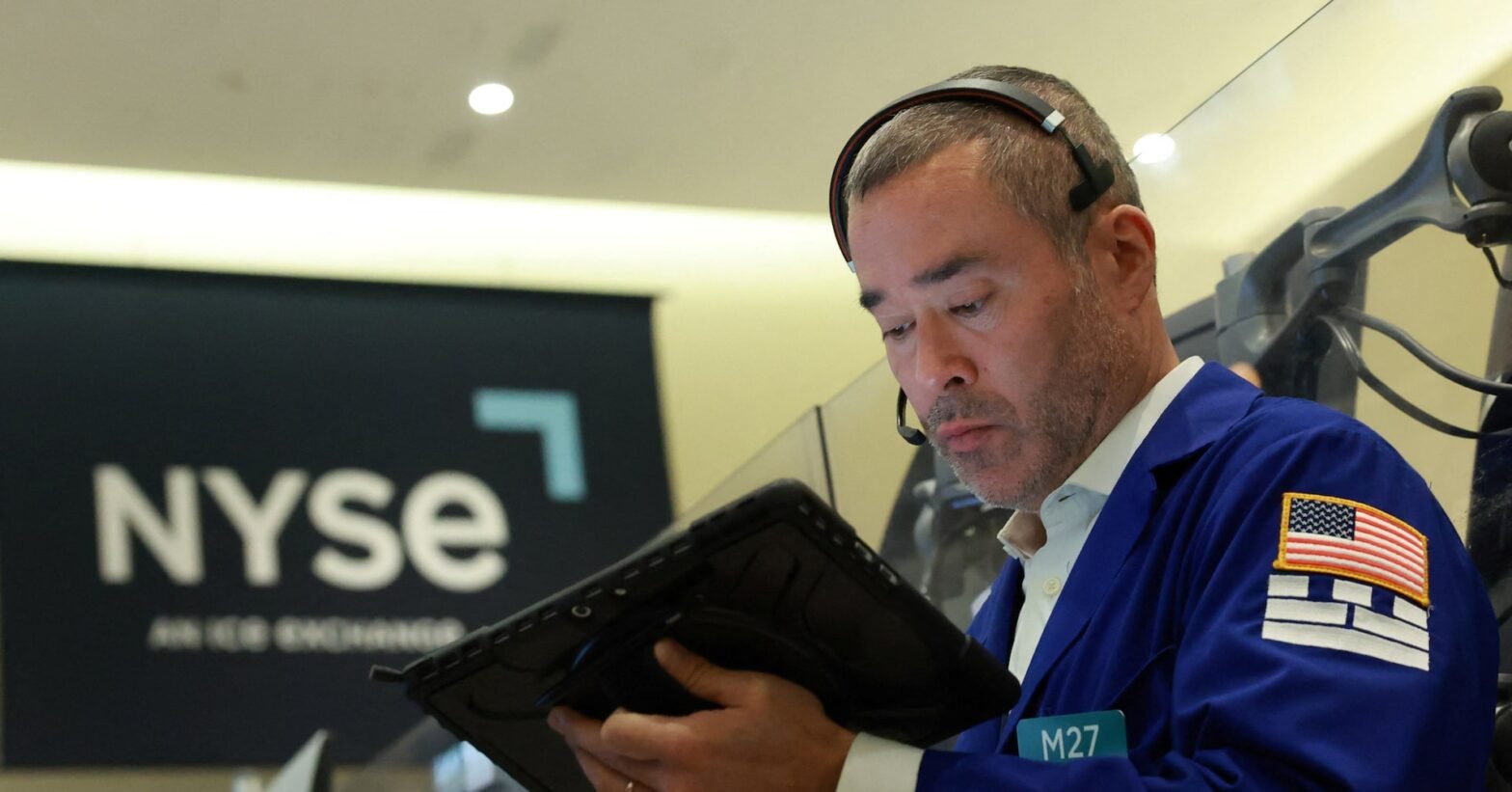
Stocks opened flat to slightly lower to kick off the week, with investors expected to take a wait-and-see approach ahead of Tuesday’s too-close-to-call presidential election.
The real fireworks were seen in the bond market, with Treasurys rallying and dragging down yields as betting markets reflected a decreased probability of a victory by Donald Trump. The yield on the 10-year note was down more than 9 basis points.
The Dow fell 83 points, or 0.2%
The S&P 500 was off 1 point, or less than 0.1%
The Nasdaq Composite dropped 0.3%
The stock market’s volatility gauge was rising Monday, the day before U.S. election day.
“With the polls so close between two completely different candidates, it’s understandable to see elevated levels of uncertainty in the market,” Bespoke Investment Group said in a note Monday.
The Cboe Volatility Index, which trades under the ticker symbol VIX, was up almost 3% on Monday ahead of the stock market’s opening bell, at around 22.5, according to FactSet data, at last check. “For all years since 1990, the median level of the VIX on the day before Election Day was 18.4.”
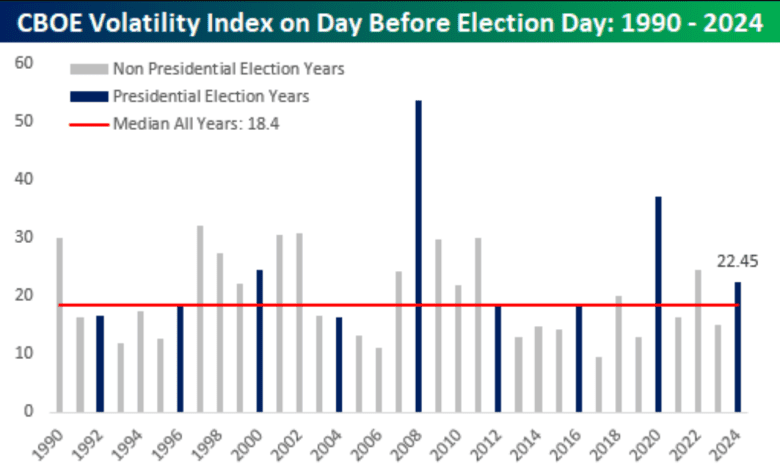
(BESPOKE INVESTMENT GRROUP)
The VIX’s trading level Monday morning was “the fourth highest of the nine Presidential Election years since 1990,” according to Bespoke’s note. “Regarding equity market performance, the S&P 500 tends to see positive returns to close out the year after Election Day.”
U.S. government debt rallied sharply Monday morning, sending yields broadly lower, as traders pulled back on the so-called Trump trade that tilted toward higher-inflation prospects.
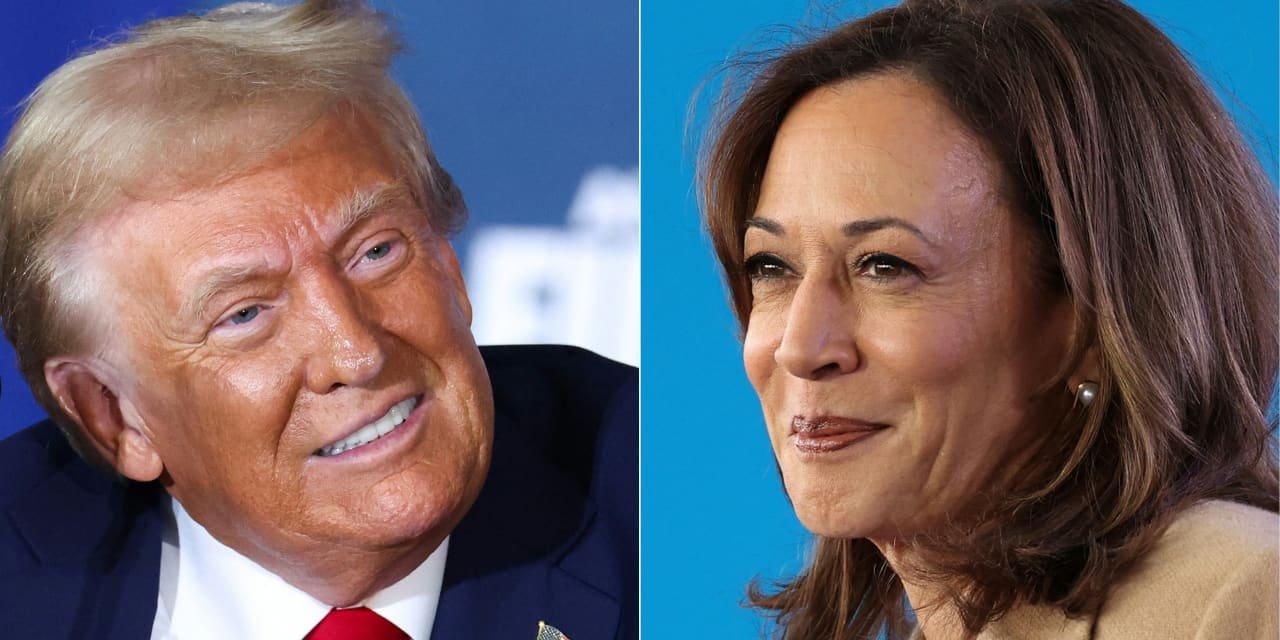
The 10-year fell to 4.274% as the Treasury curve bull flattened, meaning that government debt was rallying more in the long-dated maturities and sending corresponding yields down at a faster rate than in the shorter-end. The moves come after a Des Moines Register poll showed Vice President Kamala Harris leading former President Donald Trump in Iowa, reversing what had been expected to be a certain victory for the latter.
“While investors remain skeptical of the polls as a general theme, the fact that the price action had previously been so one-way in favor of the Trump trade speaks to the market’s willingness to buy the dip. After all, there is no question that it is a close race that could go in a variety of different directions,” said BMO Capital Markets strategists Ian Lyngen and Vail Hartman.
Shares of Phunware Inc., the mobile-advertising company with ties to former President Donald Trump’s 2020 re-election campaign, are down 7.7% in premarket trading.
The stock is down after the company said that CFO Troy Reisner is stepping down and following a recent poll that put Vice President Kamala Harris ahead in the battleground state of Iowa.
Freshpet Inc.’s stock rose 3.6% early Monday, after the maker of “real food” for pets posted stronger-than-expected third-quarter earnings as sales rose more than 25% for a 25th straight quarter.
The Bedminster, N.J.-based company had net income of $11.4 million, of 24 cents a share, for the quarter, after a loss of $7.2 million, or 15 cents a share, in the year-earlier period. Sales rose 26.3% to $253.4 million from $200.6 million a year ago.
The FactSet consensus was for EPS of 15 cents and sales of $248 million.
With one day left until the U.S. election, some Wall Street strategists are already trying to parse what might be next for markets once the voting has concluded.
Chris Montagu, global head of quantitative research at Citigroup, said in a report shared with MarketWatch on Monday that investors appear to be bracing for a year-end rally. After all, history shows stocks tend to trudge higher during the final two months of an election year. The notion that stocks will climb after the vote has become something of a consensus view on Wall Street.
But there are risks, and the biggest one that Montagu sees is further upward pressure on Treasury yields.
“The near-term risk to equity outperformance post-election is higher rates. Equity markets are leveraged to a lower 10yr Yield environment so any substantial bond sell-off is likely to put downward pressure on equities,” Montagu said.
Treasury yields moved sharply lower on Monday, dragging the U.S. dollar down with them, following fresh polling data released over the weekend showing Democratic candidate Kamala Harris may have gained some momentum.
Viking Therapeutics stock soared 21% in early trade Monday after the biotech posted data on its oral weight-loss drug showing better-than-expected results from a Phase 1 trial.
The study of VK2735 among obese adults found those taking the highest dosage of 100 milligrams had an average weight loss of 8.2% from baseline over a four-week period. The 100 mg dose also produced weight loss of up to 6.8% compared with placebo.
Oil futures jumped Monday after members of OPEC+ — made up of the Organization of the Petroleum Exporting Countries and its allies — said they would wait yet another month before beginning to unwind 2.2 million barrels a day in production cuts.
In a news release posted Sunday, OPEC said that Saudi Arabia, Russia, Iraq, the United Arab Emirates, Kuwait, Kazakhstan, Algeria, and Oman, would extend voluntary cuts totaling 2.2 million barrels a day of production until the end of 2024.
The cuts had initially been scheduled to be phased out beginning in October, but were previously extended to the end of November. The continued delays come as oil futures have tumbled sharply since midyear.