Latest Updates
A sobering thought for a Monday: Spending to fuel advances in artificial intelligence could reach $76 billion in 2024 and about $121 billion next year, according to Vanguard.
That’s far below the much ballyhooed $1 trillion mark being tossed around by industry enthusiasts in terms of anticipated spending over the next couple of years. A spending boom could also be complicated by an expected slowdown in the U.S. economy.
“Even if investment in AI suddenly nearly doubled this year and next — mirroring the near doubling of NVIDIA Corp.’s data center revenues in recent years — AI spending would amount to ‘only’ about $129 billion in 2024 and $248 billion in 2025,” according to Joe Davis, global chief economist at Vanguard.
“Those would be tremendous outlays, to be sure,” he wrote in a recent client note. “But $1 trillion in AI investment by 2025 would require 286% growth. That’s probably not going to happen, which means we’re unlikely to experience an AI-driven economic boom in 2025.”
The Dow Jones Industrial Average was trimming its earlier gain on Monday as a sharp selloff in the technology sector weighed on stocks.
The Dow was up about 125 points, or 0.3%, trading near 41,293 but off the session’s high of 41,420.05, according to FactSet data.
The S&P 500 was off 0.2%, while the Nasdaq Composite was 0.8% lower, weighed down sharply falling tech stocks.
Nvidia Corp. shares were 2.5% lower, ahead of the company’s earnings on Wednesday, while those of Tesla Inc. were down 3.4%.
Oil moved sharply higher on Monday, with global benchmark prices touching their higher in nearly two weeks, supported by news that Libya’s eastern government has halted crude production and exports. Rising tensions between Israel and Hezbollah in the Middle East have also contributed to concerns about global oil supplies.
Agence France-Presse reported that the eastern government, based in Benghazi and led by warlord Khalifa Haftar, controls most of the country’s oil fields. The move comes amid a dispute with the internationally recognized western government, based in Tripoli, over control of the nation’s central bank, Bloomberg reported Monday. Libya exported 1.024 million barrels of oil in 2023, according to data from the Organization of the Petroleum Exporting Countries.
October Brent crude, the global benchmark, climbed $2.21, or 2.8%, to $81.22 a barrel on ICE Futures Europe after trading at a nearly two-week high of $81.58. U.S. benchmark West Texas Intermediate crude saw its October contract trade at $77.12 a barrel on the New York Mercantile Exchange, up $2.29, or 3.1%.
At least one major stock-market barometer is poised to reverse all of its losses since mid-July.
The Dow Jones Industrial Average was poised for a fresh record closing high on Monday, what would be its first since July 17, and its 23rd of 2024, according to Dow Jones Market Data.
The blue-chip average was up 186 points, or 0.5%, at 41,355 in recent trade, according to FactSet data. It needs to finish above 41,198.08 to reach the new record.
The S&P 500 wasn’t far behind, and continued to trade within 1 percentage point of its July 16 record, although the index was in the red in recent trade. The S&P 500 was down 5 points, or 0.1%, at 5,629, according to FactSet data. It needs to finish north of 5667.20 to tally a fresh record high — what would be its 39th this year.
The Dow was on pace for back-to-back gains on Monday, but the other two major equity indexes were edging lower as shares of technology companies slipped.
The Dow Jones Industrial Average was up 213 points, or 0.5%, near 41,387, while the S&P 500 and Nasdaq Composite Index were 0.1% and 0.7% lower, respectively, according to FactSet.
The S&P 500’s information technology and communication services sectors were both lower Monday morning, off 0.9% and 0.3%, respectively.
Of the “Magnificent Seven” megacap tech stocks, shares of all but Alphabet Inc. were lower Monday.
Stocks and bonds are increasingly reflecting two mutually exclusive scenarios for the U.S. economy, according to Unlimited’s Bob Elliott. At least one of them will likely be disappointed.
Bond traders expect aggressive Fed rate cuts, with nearly 200 basis points in under a year already priced in. Meanwhile, stocks are trading near record highs as Wall Street forecasts double-digit earnings growth in 2025.
Indeed, both stocks and bonds are priced for perfection, said Elliott, who fleshed out his thinking in a series of posts on X. They could receive a reality check instead.
Unfortunately for investors, the only scenario that would justify such extreme rate cuts by the Fed would be an “acute recession.” Of course, this likely wouldn’t bode well for corporate profits.
“While a cut is the next step, it is very unlikely that 200bps of cuts and mid-double digit earnings growth will come together in the next [12 months],” Elliott said in a post on X.
Furthermore, signs of sluggishness in the global economy likely mean earnings expectations for large-cap stocks are already too high.
And even if profit growth meets Wall Street’s lofty targets, this might not be enough. To continue pushing stocks higher, companies would likely need to exceed expectations, not just meet them. The same holds true for the pace of Fed rate cuts, Elliott said.
“Investors going all in on a soft landing are likely to be disappointed as it’s unlikely to be nearly as perfect as currently priced in,” Elliott said.
MarketWatch has previously highlighted the growing discrepancy between Treasurys and stocks. Readers can find that report here.
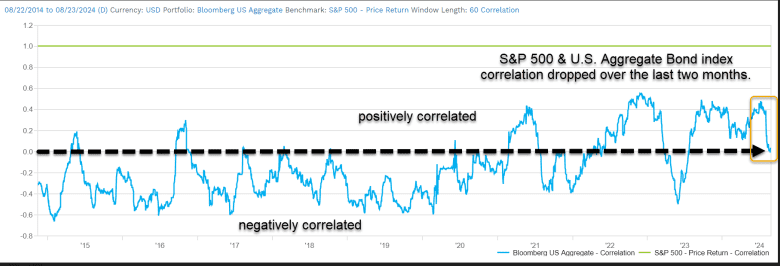
Stocks and bonds were positively correlated as inflation was rates were both moving higher, but their relationship looks to be returning to a more traditional relationship, according toJ ohn Hancock Investment Management (John Hancock Investment Management)
High inflation and an era of low rates threw cold water on the usual relationship between stocks and bonds.
Fixed income typically serves as an offset to declining equity prices, but both asset classes fell in the wake of the pandemic as the Federal Reserve raised rates to battle inflation.
The relationship, however, has been reverting to its old ways, according to Emily Roland and Matt Miskin, co-chief investment strategists at John Hancock Investment Management.
The duo charted the rolling 60-day correlation between the S&P 500 index and the U.S. Aggregate bond index, finding “another correlation wave” that started in 2024 as inflation fears reared back up, which eventually gave way to another drop to a “zero” correlation this summer.
While they expect a bumpy path yet ahead, the team noted the S&P 500’s roughly 19.20% gain this year and the U.S. Aggregate’s near 3.6% advance as positive developments.
Mizuho said Monday its August consumer survey found low-income consumers, those who earn less than $50K a year and account for 22% of total U.S. household spending, continued to struggle. The cracks were also starting to show for consumers in higher brackets.
The middle-income cohort, for example, or people who earn $50K to $100K a year and account for 25% of all household spending, remained solid financially and continued to spend.
“But strikingly high numbers report elevated credit balances and some signs for potentially tighter spending through year-end (restaurants, electronics, and even children/pet care); risks have likely risen from stock market volatility (wealth effect) and election season uncertainty (tax policy, etc.),” analyst John Baumgartner wrote in a note to clients.
The Dow was moving higher in morning trading Monday as investors looked forward to Nvidia earnings midweek and an update on inflation on Friday.
The Dow was up about 175 points, at last check, or 0.4%, to trade near 41,350, according to FactSet.
The S&P 500 index was up 0.2%, while the Nasdaq Composite Index was off about 0.1%.
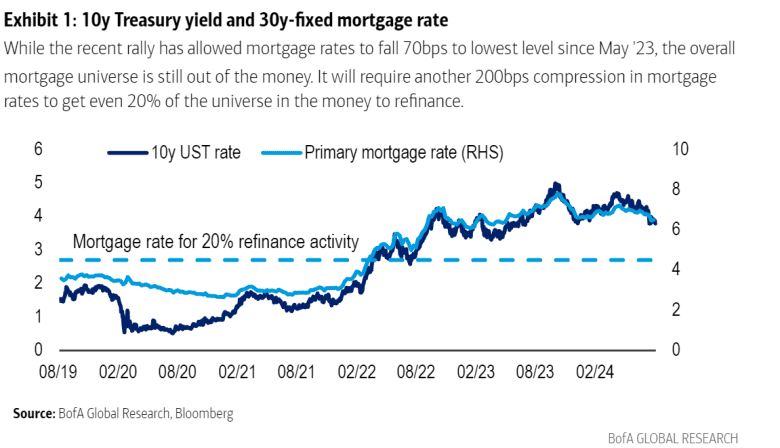
Mortgage rates would need to tumble to 4.5% for even 20% of the mortgage market to be ripe for refinancing, according to BofA Global
Tumbling Treasury yields in recent weeks have helped dramatically lower 30-year fixed mortgage rates to about 6.5%, the lowest since May 2023, according to BofA Global.
But even if mortgage rates fell another 200 basis points to 4.5%, that only makes 20% of the market ripe to refinance, a rates team led by Meghan Swiber wrote in a Monday client note.
Furthermore, a steep drop in rates would have only a limited impact on the Federal Reserve’s large holdings of mortgage bonds.
“For example, while 68% of mortgage holders pay less than 4%, that number is higher at 78% with respect to the Fed’s portfolio,” the team wrote. “As a result, Fed paydowns are even less likely to react to the recent rally than the MBS universe.”


![i’m-nervous,-too!-[part-2]](https://10xwealthreport.com/wp-content/uploads/2026/03/177042-im-nervous-too-part-2-1568x784.jpg)