1 min read
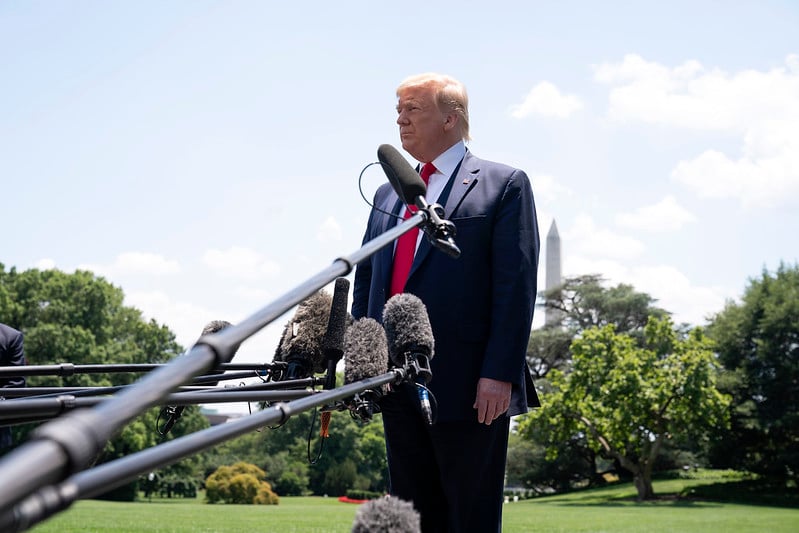
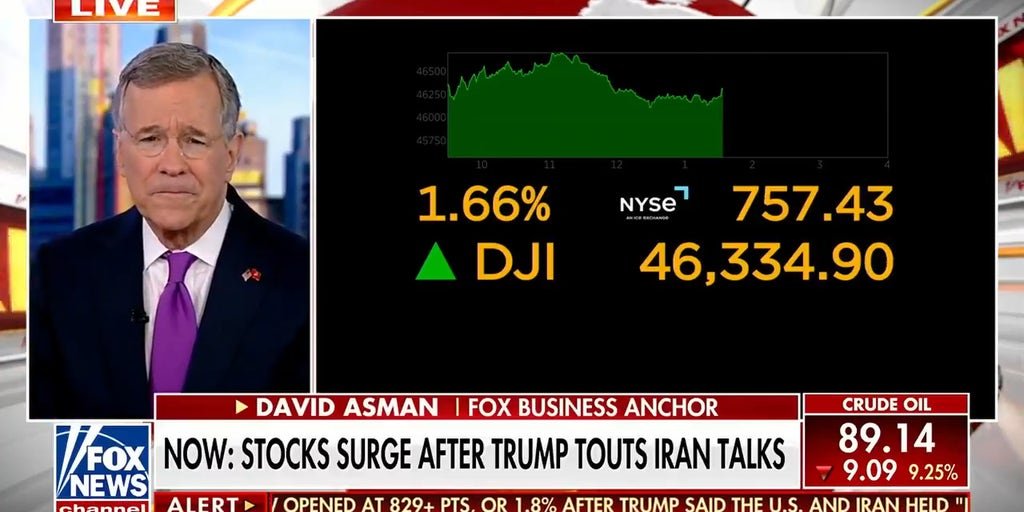
US stocks surged on Monday, shaking off earlier losses as President Trump eased fears of an escalation in the Middle East war by postponing threatened strikes on Iran’s power plants.
The Dow Jones Industrial Average (^DJI) rose 1.4%, or over 600 points. The S&P 500 (^GSPC) and tech-heavy Nasdaq Composite (^IXIC) jumped around 1.2% and 1.4%, respectively.
Markets became upbeat after Trump said early Monday that he gave instructions to postpone military strikes on Iran’s energy infrastructure, thanks to “very good and productive” talks between the US and Tehran that will continue throughout the week.
That eased market fears stoked by an intensifying exchange of violent rhetoric over the weekend. Trump gave Iran an ultimatum on Saturday, saying that if the Strait of Hormuz remained closed after 48 hours, he would order attacks on Iran’s power facilities. On Monday, Tehran launched fresh attacks in the region.
Oil prices dived after Trump’s post, pulling back from early morning gains. West Texas Intermediate (CL=F) crude futures sank 10% to trade near $89 a barrel, while global benchmark Brent (BZ=F) crude pulled below $100 after topping $113 premarket.
LIVE 19 updates
-
Dow, S&P 500, Nasdaq rebound as Trump raises hopes of Iran talks
Stock jumped on Monday after President Trump postponed military strikes against Iranian power and energy infrastructure for five days while the US and Iran engage in talks.
The Dow Jones Industrial Average (^DJI) surged 1.3%, while the S&P 500 (^GSPC) climbed 1.1% and the tech-heavy Nasdaq Composite (^IXIC) rose 1.3%.
Oil futures plunged 10% after Trump indicated the US and Iran had “productive” conversations. He later told reporters the Strait of Hormuz could open very soon “if this works,” referring to the talks.
Trump suggested a Strait of Hormuz that will be “jointly controlled” by the US and whoever is in charge of Iran at the end of the war.
-
3% inflation ‘here to stay’ says BNP economist
Surging oil prices have pared back expectations that the Federal Reserve will be able to cut rates this summer, with some economists expecting one or two starting in the fall, and others none at all this year.
“While the Iran backdrop remains fluid, we think the threshold has been crossed for the energy shock to spread to retail prices,” wrote Andy Schneider, senior economist at BNP Paribas.
“Our oil pass-through estimates are based on the current futures curve – if the Middle East conflict proves more prolonged than priced, our forecasts could rise further,” he added.
The firm raised its fourth-quarter 2026 headline and core CPI forecasts to 3.3% and 3.2%, respectively, on an annualized basis.
-
Goldman Sachs nudges up recession risk to 30%
Goldman Sachs economists nudged up their recession risk to 30% on Monday, up from 25% just last week, amid rising oil prices and their impact on the global economy.
Chief economist Jan Hatzius noted that the firm’s upward revision to oil and gas prices will increase global headline inflation by about 1% and subtract 0.4% from global GDP growth.
“While the energy hit to US growth is likely on the smaller side, it coincides with tighter financial conditions and a waning fiscal boost in H2,” wrote Hatzius.
“Thus, we now expect below-trend growth and a rising unemployment rate, and have nudged up our 12-month recession probability to 30% (where it stood in 2025H2),” he added.
The economist foresees Fed cuts in September and December, but pushed Bank of England cuts to 2027 while now anticipating European Central Bank hikes in April and June.
-
Bitcoin jumps 3% on hopes of Iran deescalation
Bitcoin (BTC-USD) jumped 3% to trade near $71,000 on Monday as broader markets rose after President Trump said he had “productive” conversations with Iran and postponed planned attacks on the country’s power infrastructure.
The world’s largest cryptocurrency has shown resilience amid the US -Iran conflict. While broader markets have declined since the fighting began and gold (GC=F) has plummeted, bitcoin has risen roughly 7%.
Inflows into exchange-traded funds as well as purchases from digital asset Treasury giant Strategy (MSTR) have helped build a more resilient capital base for the token, according to Bernstein analysts.
“We believe the combination of Strategy’s treasury model and ETFs has transformed Bitcoin’s ownership structure,” the analysts in a recent note.
-
Elon Musk’s Terafab is here: What it is, and why it’s important for Tesla and SpaceX
Yahoo Finance’s Pras Subramanian reports:
-
Oil tanks 11% as Trump touts Iran talks, suggests Strait of Hormuz could open under joint control with US
Oil futures accelerated losses on Monday morning, dropping more than 11% after President Trump said he had “productive” conversations with Iran and postponed attacks on the country’s power infrastructure.
The president also suggested the Strait of Hormuz, which has been at a near standstill since the war broke out, could be reopened very soon under joint control between the US and Iran “if it works.”
West Texas Intermediate (CL=F) crude futures sank to below $87 per barrel, while global benchmark Brent (BZ=F) crude pulled back to around $98 after topping $113 during earlier trading.
Trump’s comments raised optimism about a potential truce in the US-Israel conflict with Iran, following a weekend threat in which Trump warned that Tehran had 48 hours to “FULLY OPEN, WITHOUT THREAT, the Strait of Hormuz,” or face strikes on its power infrastructure.
Oil analysts remained cautious amid recent headlines until more certainty emerges about the Strait of Hormuz, a critical oil passageway.
“That said, downside is likely to remain somewhat capped,” said Rebecca Babin, CIBC Private Wealth senior energy trader.
“There is still significant uncertainty around when flows through the Strait of Hormuz can fully resume, and each day that passes represents a meaningful volume of supply,” she added.
-
Treasury yields tumble after Trump walks back Iran ultimatum
The bond market took a breather from a massive sell-off on Monday morning after President Trump said the US would postpone strikes on Iranian energy infrastructure and that Tehran and Washington were engaged in “productive talks.”
The 10-year yield (^TNX) fell 7 basis points to 4.31%. On Friday, the 10-year yield reached its highest level since July 2025 after Trump issued an ultimatum, threatening to “obliterate” power plants in Iran if it did not reopen the Strait of Hormuz within 48 hours.
The escalation added to investors’ concerns about the war in Iran and its implications for inflation and the Fed’s interest rate cuts. Similarly, the deescalation on Monday morning took some of the pressure off bonds, which are on track for their biggest monthly loss in three years in March.
The 30-year Treasury yield (^TYX) fell by 6 basis points to 4.89%, while the shorter-duration 5-year yield (^FVX) declined to 3.93%. Bond yields and prices have an inverse relationship, meaning yields fall when prices rise and vice versa.
-
Energy Sec. Chris Wright: Iran war is a ‘short-term disruption’ that could end ‘a decades-old problem’
As the war in Iran continues to wrack the global energy market, Energy Secretary Chris Wright said at a major industry event on Monday that the conflict will be a “short-term disruption right now but … lead to the end of a decades-old problem.”
Since the US and Israel began striking Iran, setting off a conflict that has engulfed the Middle East, oil prices have skyrocketed. Futures on Brent crude, the international pricing benchmark, and US benchmark West Texas Intermediate (WTI) are up more than 40% and 30%, respectively.
In his comments on Monday, Wright said that the conflict was something the White House “simply couldn’t kick down the road one more administration,” pointing to the 1979 Tehran hostage crisis, Iran’s funding for global terrorism, and the regime’s aims for nuclear enrichment.
As oil prices have rallied — both products climbed as high as $119 per barrel earlier in the conflict before pulling back — Wright called the administration’s moves to release 400 million barrels of oil from the US’s strategic petroleum reserve and temporarily waive sanctions on Russian and Iranian crude oil at sea “mitigants of a [disruption] that is temporary.”
-
DraftKings, Flutter stocks jump on report that lawmakers plan to ban sports bets on prediction markets
Sports betting stocks popped on Monday after the Wall Street Journal reported that a pair of senators plan to introduce legislation on Monday that would ban prediction market operators from listing event contracts tied to sporting events.
Sen. Adam Schiff, a Democrat from California, and Sen. John Curtis, a Republican from Utah, are co-sponsoring the bill, which seeks to regulate prediction market entities, such as Kalshi and Polymarket, and prevent them from listing sports bets as well as “casino-style games.” (Disclosure: Yahoo Finance has a partnership with Polymarket.)
Sen. Schiff told the Wall Street Journal that Congress needs to step in because the Commodity Futures Trading Commission, which currently regulates prediction markets, “is greenlighting these markets and even promoting their growth.”
Scrutiny of prediction markets has intensified alongside the industry’s explosive growth since the Supreme Court struck down a federal ban on sports betting in 2018. While prediction markets offer contracts on a range of events, from politics to award shows, most contracts are tied to professional and college sports, competing with sports betting companies, like DraftKings (DKNG) and FanDuel parent Flutter (FLUT).
Shares of DraftKings and Flutter jumped 4% and 6%, respectively, in early trading.
-
Synopsys stock rises after Elliott Investment Management builds stake
Activist investor Elliott Investment Management has built a multibillion-dollar stake in Synopsys (SNPS), the Wall Street Journal reported on Sunday, sending Synopsys shares up as much as 4% after the market open.
Citing people familiar with the matter, the Journal reported that Elliott is seeking to elevate Synopsys’s importance in the semiconductor ecosystem.
Synopsys provides software and tools for chip design to companies such as Nvidia (NVDA) and Intel (INTC).
Elliott Managing Partner Jesse Cohn told the Journal that Syopsys can benefit from the growth in the global chip industry. Cohn said Elliott plans to engage the company to increase its profitability and “more fully reflect the value it delivers.”
-
Stocks open higher on hopes of deescalation with Iran
Stocks jumped at the start of trading, offering a respite from last week’s brutal sell-off amid war and heightened inflation concerns.
The Dow Jones Industrial Average (^DJI) surged 1.6% at the open, while the S&P 500 (^GSPC) climbed 1.3% and the tech-heavy Nasdaq Composite (^IXIC) rose 1.4%.
Equities rallied after President Trump announced on Truth Social that the US would delay strikes on power and energy infrastructure for the week. However, Iran’s Foreign Ministry denied that Iran was in talks with the US, saying the two sides have had “no dialogue.”
Bonds were more muted at the start of trading, with the 10-year Treasury yield (^TNX) falling slightly to 4.37%.
West Texas Intermediate (CL=F) crude futures sank 7% to $90 a barrel, while global benchmark Brent (BZ=F) fell to $102 per barrel.
Gold (GC=F) also dropped 3% to $4,421 per ounce, and bitcoin prices (BTC-USD) rose 2% to $70,727.
-
S&P 500 rebalancing highlights AI tilt in market
Vertiv (VRT), Lumentum (LITE), Coherent (COHR), and EchoStar (SATS) stocks all jumped more than 2% premarket after joining the S&P 500 index (^GSPC) before trading began on Monday, continuing a theme of AI concentration in the benchmark index.
The four companies — which operate in the data center, optical networking, and satellite communications space — replaced Match Group (MTCH), Molina Healthcare (MOH), Lamb Weston Holdings (LW), and Paycom Software (PAYC) on the index as part of the S&P’s quarterly rebalancing.
The S&P 500 undergoes a quarterly rebalancing to ensure its composition reflects the current market and the 500 largest publicly traded companies. The rebalancing can influence stock prices in the short term through the “index effect,” but these effects are usually minimal over the long run.
Vertiv, Lumentum, and Coherent have seen particularly large run-ups year to date, with their stocks rising 37% (Coherent) to 91% (Lumentum) since the beginning of the year. All three companies have partnerships with Nvidia (NVDA) — the AI leader that makes up about 7% of the S&P 500’s valuation.
These three, along with satellite communications provider EchoStar, highlight the growing tilt in the market toward the artificial intelligence theme.
-

The market is fading the TACO trade
Stock futures surged, and energy futures tumbled after President Trump said early Monday that strikes on Iranian energy targets would be paused while the US and Iran engage in talks.
Markets betting that Trump chooses to deescalate the war in Iran from here is a militarized version of the trade-related TACO trade (betting “Trump Always Chickens Out”) that became so popular among investors last summer. This time around, however, investors don’t seem to have as much faith in the TACO thesis, with a good chunk of Monday’s knee-jerk move having already been given up.
Take oil futures — the price of WTI crude oil fell from around $100 a barrel to closer to $86 almost instantly on these headlines. An hour later, we’re back at $92.
Stock futures surged as much as 2.5% following Trump’s comments. Near 8:20 a.m. ET, stock futures were up closer to 1.4%.
Trump turning down the temperature on US military action in the Middle East is positive for markets, but the message from last week that will take more than one post on Truth Social to shake is that the economic consequences of Trump’s war in Iran will be greater than nothing.
-
Stock futures jump after President Trump postpones energy infrastructure strikes for 5 days
Stock futures jumped after President Trump said he instructed the Department of Defense to postpone military strikes against Iranian power and energy infrastructure for five days while the US and Iran engage in talks.
The president posted on Truth Social that the two sides have been engaged in “very good and productive conversations regarding a complete and total resolution of our hostilities in the Middle East.” Over the weekend, Trump issued an ultimatum to the Iranians, telling them via social media that if they didn’t reopen the Strait of Hormuz by Monday evening, the US would “obliterate their various power plants.”
Futures on the Dow (YM=F), S&P 500 (ES=F), and Nasdaq 100 (NQ=F) shot higher following the post, suggesting an off-ramp to the fighting, while WTI (CL=F) and Brent (BZ=F) crude oil prices dropped about $8 per barrel instantly to trade at $90 and $99 a barrel, respectively.
-
Goldman raises oil forecasts on largest-ever supply shock
Bloomberg reports:
-
Bonds lose $2.5 trillion in Iran war wipeout that mirrors 2022
From Bloomberg:
“Markets are beginning to price what I think is going to be a stagflationary impulse manifested very soon,” Kathryn Rooney Vera, chief market strategist at StoneX Group Inc., said in an interview on Bloomberg Television. “The longer this goes on, the higher oil prices can rise.”
-
Oil pushes higher as clock ticks on Trump’s Hormuz ultimatum
Bloomberg reports:
-
Gold winds back yearly gains after largest weekly drop since 1983
Yahoo Finance’s Ines Ferré reports:
-
Oil trades down as Trump threatens Iran power infrastructure, Goldman Sachs raises price targets
Oil traded slight below last week’s closing prices at the start of futures trading on Sunday, with roughly 24 hours to go on President Trump’s 48-hour ultimatum to Iran.
Futures prices on Brent crude (BZ=F), the international pricing benchmark, initially surged but quickly gave up gains in the minutes after the open on Sunday, trading around $106 per barrel. Those on US benchmark West Texas Intermediate crude (CL=F) changed hands around $97.90 per barrel.
In a post on Truth Social at 6:45 p.m. ET on Saturday, President Trump said Iran had 48 hours to “FULLY OPEN, WITHOUT THREAT, the Strait of Hormuz,” or else “within 48 HOURS from this exact point in time, the United States of America will hit and obliterate their various POWER PLANTS, STARTING WITH THE BIGGEST ONE FIRST!”
The threat by the US president comes after a week of attacks by the Iranian regime against energy infrastructure throughout the Gulf, including Qatar’s Ras Laffan LNG export terminal — the world’s largest such facility.
In a note to clients on Sunday evening, Goldman Sachs’ oil desk, led by head of oil research Daan Struyven, raised its price targets for oil, now looking for Brent to trade at $110 per barrel through March and April, up from a previous call for $98 per barrel over the same timeframe under the assumption that “Hormuz flows remain at only 5% of normal levels for a longer 6-week period before a gradual 1-month recovery.”
The bank is now assuming an average 2026 price of $85 and $79 per barrel, respectively, for Brent and WTI, up from previous estimate of $77 and $72 per barrel for the two benchmarks. In 2027, Goldman expects Brent and WTI to average $80 and $75 per barrel, respectively.
“In the short-run, the market is likely to require a growing risk premium to generate precautionary demand destruction to hedge against shortages in longer disruptions risk scenarios,” Goldman’s Struyven, Yulia Grigsby, and Alexandra Paulus wrote.
“A recognition of the risks from the high concentration of production and spare capacity is likely to lead to structurally higher strategic stockpiling and long-dated prices.”



![i’m-nervous,-too!-[part-2]](https://10xwealthreport.com/wp-content/uploads/2026/03/177042-im-nervous-too-part-2-1568x784.jpg)