Here are the top stories to read ahead of Wednesday’s trading:
Latest Updates
The economic fundamentals of Wednesday’s inflation report will doubtless impact stocks. But before that let’s have a chartist view from BTIG’s technical guru Jonathan Krinsky.
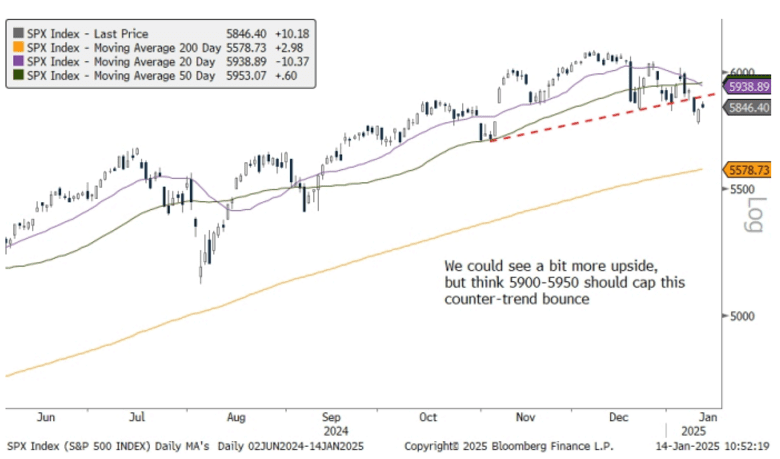
He notes that the S&P 500’s rally off this week’s lows is quite impressive and sets up the stock barometer for “a little more upside, perhaps into the 5,900 – 5,950 zone.”
However, after that he sees more downside as market breadth – the proportion of stocks rising with the index – is still poor and he remains concerned about waek sentiment in Treasurys.
Krinsky is particular concerned that the S&P 500 may at some stage have to revisit its 200-day moving average, above which it has traded for 300 days.
“That’s the longest streak since Jan. 2022 (394 days). Since 1990 the longest streak was 475 days (Oct. ’14), but we are getting up there historically speaking,” he says in a note published late Tuesday.
“2024 was the sixth year since 1990 when SPX went entire calendar year without a 200 DMA test. The prior five (’93, ’95, ’13, ’17, ’21) all tested the 200 DMA in the following year, with three of the five tests coming in Q1. A test of the 200 DMA (5578) would feel ugly, but be less than 9% off the highs,” Krinsky warns.
(BTIG)
The Japanese yen was at its strongest versus the dollar in nine days after Japan’s government bond yields hit another cycle high.
The 10-year JGB yield was up 1.5 basis points early Wednesday, trading at 1.255% for the first time since April 2011, according to Reuters, after Bank of Japan governor Kazuo Ueda made comments that left open the possibility of an interest rate rise at the monetary policy meeting later this month.
In addition, finance minister Katsunobu Kato on Wednesday reiterated the government would take action against excessive moves on forex markets. “The government has been alarmed over foreign exchange moves, including those driven by speculators.” he said.
The yen, which last summer hit a multi-decade low around 162 per dollar, strengthened by 0.7% on Wednesday to 156.80.
The USD/JPY cross is hyper-sensitive to U.S./Japan interest rate differentials and so forex traders will be keenly watching the upcoming U.S. CPI report.
The USD/JPY has tracked the increase in U.S. Treasury yields over recent weeks very closely, so any sign that U.S. interest rates may retreat again, while the BOJ considers hiking, could catch out yen bears.
There’s apparently a lot of anxiety surrounding Wednesday’s CPI inflation report.
Too hot and some fear benchmark Treasury yields could quickly approach the psychologically-significant 5% level and spark a further pullback in stocks. Much cooler and equities may bounce.
S&P 500 option traders are pricing in a 0.93% move in either direction, according to MarketWatch calculations using FactSet data on Wednesday’s zero-day to expiry options. That equates to the S&P 500 moving up or down by about 54 points.
Meanwhile, the CBOE VIX index, a measure of expected S&P 500 volatility over the next 30 days that’s known as Wall Street’s fear gauge, was little changed on the day at 18.8, below its long-run average of 19.5.
Finally, the MOVE index, a sort of VIX for the Treasury market, sits at 102, roughly the average of the past 12 months, and well below the 135 hit on the eve of the U.S. election.
The pound, London stocks and U.K. government prices bonds all rose early Wednesday after a report showed Britain’s inflation cooled at the end of last year.
The office for National statistics said the headline annual consumer price index rose 2.5% in December, down from the 2.6% seen in November and lower than the 2.6% forecast by economists.
The figure will come as welcome news to U.K. finance minister Rachel Reeves as it may improve growth prospects by allowing the Bank of England to cut interest rates.
U.K. government bonds, known as gilts, have been under pressure in recent weeks, forcing 10-year yields to their highest since 2008 on concerns a weak economy may require the Treasury to sell more debt.
However, the new inflation data saw 10-year yields fall 8 basis points to 4.185% as the chances of a 25 basis point rate cut by the Bank of England in February rose to 83%, according to LSEG data. Bond yields move inversely to prices.
The pound, which might normally have fallen at the prospect of lower rates, instead was up 0.1% to $1.2225 as traders preferred to focus on the growth benefits of easier monetary policy.
Meanwhile, interest rate-sensitive portions of the London stock market rallied, with homebuilders, real estate groups and utilities gaining ground, pushing the FTSE 100 up 0.7%.
“The U.K. inflation snapshot will come as a relief and is already acting like a balm to calm unruly markets,” said Susannah Streeter head of money and markets at Hargreaves Lansdown.
“The inflation reading will relieve pressure on U.K. Chancellor Rachel Reeves, who has been criticised for tax changes in the Budget which could lead to price rises ahead and hold back growth this year,” Streeter added.
Here are some of the companies presenting earnings on Wednesday:
Before the opening bell.
JPMorgan Chase
Goldman Sachs
Citigroup
BlackRock
Wells Fargo
Bank of New York Mellon
After the close.
Concentrix
Synovus Financial
H.B. Fuller
Home BancShares
Here are some of the potential market catalysts due Wednesday for traders to consider:
8:30 a.m. Eastern. U.S. consumer price index for December.
8:30 a.m. Empire State manufacturing survey for January.
9:00 a.m. Richmond Fed President Barkin speaks at an event in Maryland.
10:30 a.m. U.S. crude oil inventories.
11:00 a.m. New York Fed President Williams delivers keynote address at Connecticut economic summit.
12:00 p.m. Chicago Fed President Goolsbee speaks at an economic forecasting forum.
2:00 p.m. Federal Reserve Beige Book.
How are stock-index futures trading:
S&P 500 futures are up 0.1%.
Dow Jones Industrial Average futures are adding 0.1%.
Nasdaq 100 futures are gaining 0.2%.
On Tuesday, the Dow Jones Industrial Average rose 221 points, or 0.52%, to 42,518, the S&P 500 increased 7 points, or 0.11%, to 5,843, and the Nasdaq Composite dropped 44 points, or 0.23%, to 19,044.
Futures indicate stocks may open open slightly higher on Wednesday, but all that could change depending on crucial inflation data and a flurry of bank earnings before the starting bell rings on Wall Street.
The S&P 500 sits 4.1% below its record closing high registered on December 6, with the pullback mainly blamed on surging Treasury yields amid fears revived inflation will prevent the Federal Reserve cutting interest rates at the pace investors had hoped.
Consequently, the consumer price inflation report for December, released at 8:30 a.m. Eastern, is critical for investor sentiment. Too hot and benchmark Treasury yields may rise towards the 5% level, triggering anxiety among equity investors. Notably cooler and traders’ may rediscover their bullish mood, pushing yields lower and stocks higher.
“Despite Tuesday’s [producer prices] inflation report coming in cooler than anticipated, the stranglehold of high yields persists. All eyes are now on Wednesday’s consumer price index update, a pivotal indicator that could amplify or temper the prevailing inflation worries,” said Stephen Innes, managing partner at SPI Asset Management.
Wall Street caught a break on Tuesday with a benign report on wholesale inflation in December. But a bigger test comes this morning via the consumer price index for the final month of 2024.
Wall Street expects 0.3% increases in both the overall CPI and the more critical core rate that omits food and energy.
Such an unpleasant rise in core inflation in December – it would be the fifth 0.3% advance in a row – would erase the good feelings from the producer price report. It would also support a narrative of few and or even no Federal Reserve cuts in interest rates in 2025.




![i’m-nervous,-too!-[part-2]](https://10xwealthreport.com/wp-content/uploads/2026/03/177042-im-nervous-too-part-2-1568x784.jpg)