Updated 1 min read
US stock losses accelerated on Friday, while oil prices remained high, as investors weighed the possibility that the US might try to seize a key Iranian energy terminal to unblock the Strait of Hormuz.
The Dow Jones Industrial Average (^DJI) and the S&P 500 (^GSPC) fell roughly 0.9% and 1.5%, respectively. Meanwhile, the tech-heavy Nasdaq Composite (^IXIC) slid by a deeper 2% following a downbeat day on Wall Street.
Stocks are retreating as investors assess an Axios report that the Trump administration is considering plans to occupy or blockade Kharg Island, vital to Iran’s oil exports. The risky operation would aim to put pressure on Tehran to reopen the Strait of Hormuz to tanker shipping.
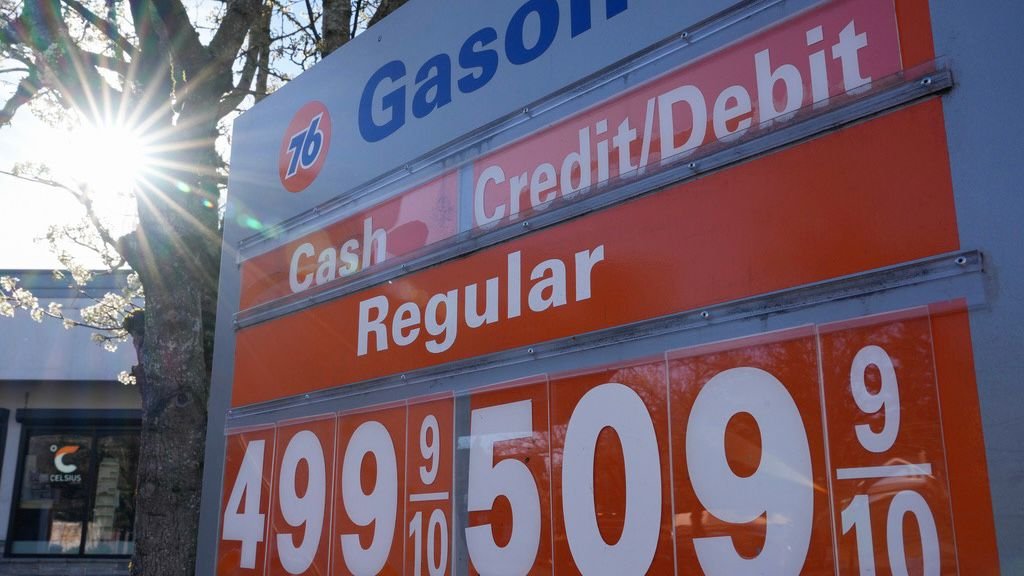
Oil prices whipsawed as markets remained on edge amid headlines about the fast-moving Middle East conflict. On Friday, Iran pressed ahead with attacks on Persian Gulf neighbors as analysts warned existing damage would keep oil prices elevated. Brent (BZ=F) futures traded near $105 a barrel after swinging between gains and losses, while West Texas Intermediate (CL=F) futures hovered at around $97.
The major US stock gauges declined for the fourth straight week, with the Dow and Nasdaq Composite both nearing correction territory.
LIVE 22 updates
-
Dow, S&P 500, Nasdaq plunge as high oil prices spur inflation fears
US stocks sold off on Friday as higher oil prices stemming from the still-raging Iran war sparked fears that inflation would keep Fed officials from cutting rates this year.
The Dow Jones Industrial Average (^DJI) lost 1%, or over 400 points. The S&P 500 (^GSPC) fell roughly 1.5%, with nearly every sector except Energy ending in the red. Meanwhile, the tech-heavy Nasdaq Composite (^IXIC) slid by a deeper 2%.
Traders pared back expectations of Fed cuts this year amid expectations that oil prices will affect inflation.
The possibility that the US might try to seize a key Iranian energy terminal to unblock the Strait of Hormuz, a key passage at a near standstill, also kept the market on edge.
-
Trump: ‘I don’t wan’t to do a ceasefire’ with Iran
Crude oil spiked and stocks fell heading into the close after President Trump said he doesn’t want a ceasefire with Iran following an escalation of attacks this week.
“We can have dialogue, but I don’t want to do a ceasefire,” Trump told reporters outside the White House. “You don’t do a ceasefire when you’re literally obliterating the other side.”
-
Energy on pace to close out week with gains of 3%
Energy (XLE) is on pace to close out the week with gains of more than 3% as oil prices have surged amid the Middle East war.
Most sectors are on track to finish the week in the red, with Materials (XLB) and Utilities (XLU) lagging the most.
The prospect of higher inflation from surging oil prices and delayed Federal Reserve rate cuts has sent the market lower for three days in a row.
-
Nasdaq, Dow near correction territory
The Nasdaq (^IXIC) is ending the week precariously close to correction territory as investors recalibrate their expectations for interest rate cuts amid stronger inflation.
The tech-heavy index is currently trading about 9.3% lower than its recent all-time closing high of 23,857, reached on Jan. 28, as tech stocks were beaten down on Friday. A pullback of 10% or more from a recent high indicates the index is in correction.
The Dow Industrial Average (^DJI) also remained a stone’s throw from a correction, with the index down 9.2% from its recent high on Feb. 10. The blue-chip index cracked the 50,000 milestone in early February and held above that level for four days before the high was overtaken by events. As of an hour before the close on Friday, the index traded at 45,552.
The S&P 500 (^GSPC), while farther from entering a correction, flashed a bearish signal on Thursday. The index fell below its 200-day moving average for the first time since June.
-
Gold prices slump, on track for third week of losses
Gold futures prices declined to about $4,500 on Friday, on track for their third consecutive week of losses.
Gold has failed to act as a safe-haven asset amid the Middle East war. A strong dollar and lowered expectations of Fed cuts this year have put pressure on bullion prices.
The precious metal is down more than 9% this week, its worst week since 1983, according to Bloomberg data.
-
Shutdown-induced travel problems may get even worse next week
Long lines at airports may get worse next week as the ongoing partial government shutdown stretches past 30 days.
Shares of major airlines Delta (DAL), American (AAL), and United (UAL) all fell more than 2% on Friday amid shutdown-induced travel delays and rising jet fuel costs from the war in the Middle East.
Yahoo Finance’s Ben Werschkul reports that Trump administration officials are warning that next week may be a crucial inflection point when travel problems begin to cascade even further.
He writes:
-
Planet Labs stock soars 25% on strong satellite demand
Planet Labs (PL) stock took off on Friday after the Earth-imaging company reported record revenue on the back of strong demand for satellite services. Shares of the San Francisco-based company rose 25% in midday trading.
Will Marshall, Planet’s CEO, called 2026 a “transformational year” for the company, adding that Planet ended the year with a $900 million backlog, representing 79% growth over the previous year.
Planet builds and operates a fleet of satellites that monitor Earth daily for a range of uses, from gathering military intelligence and building agricultural maps to tracking wildfire risk for utilities and conducting climate research. Marshall, a former NASA scientist, started the company in 2011 with peers Robbie Schingler and Chris Boshuizen.
In the fourth quarter, revenue of $86 million topped Wall Street’s estimates of $78 million. The company broke even on adjusted earnings per share, compared to a $0.05 loss per share the Street expected, according to consensus estimates from S&P Global Market Intelligence.
For the year ahead, Planet forecast revenue of $415 million to $440 million and an adjusted EBITDA profit of approximately $0 and $10 million. The company said it plans to spend $80 million to $95 million on capital investments.
“We’re leaning in and investing in the huge market opportunity in front of us,” Marshall said. “Just as satellite services were transformative last year, we expect AI to be transformative this year, enabling us to unlock massive markets even faster. In all, we’re playing to win.”
-
‘Fed’s balancing act is getting trickier’: Wall Street strategists reassess central bank’s rate cut path
Yahoo Finance’s Jake Conley reports:
-
UBS receives approval for banking license to convert local operation into fully chartered US bank
The Swiss multinational bank UBS Group AG (UBS) has been granted full approval for a US banking license as the financial firm seeks to expand its North America footprint.
Shares traded down by 2% in the minutes after the bank announced the news in a LinkedIn post.
UBS said it has received approval from the US government to convert its US branch, UBS Bank USA, into a “nationally chartered bank.”
“The charter will strengthen our US banking platform, enhance how we serve clients and Financial Advisors, and position us well for the next phase of growth—while maintaining the high standards that define UBS,” the LinkedIn post said.
The financial services firm as a whole has suffered over the past month, with one prominent ETF tracking the sector down by 6.7% over the period. Shares in US banks Citigroup (C) and JPMorgan Chase (JPM) are down by roughly 5% and 7.5%, respectively, while Bank of America (BAC) has fallen a steeper 11%.
-
Oil whipsaws as investors assess deescalatory rhetoric, continued attacks on energy infrastructure
Oil swung on Friday as investors sought to balance a mix of escalatory and deescalatory headlines.
Futures on Brent crude (BZ=F), the international pricing benchmark, and US benchmark West Texas Intermediate (WTI) crude (CL=F) both traded roughly 2% above their levels at 12 a.m. ET, to hold around $104 and $95 per barrel, respectively. Both products had surged earlier in the session before giving back those gains as investors played both sides of the trade.
In separate press conferences on Thursday, President Trump and Israeli Prime Minister Benjamin Netanyahu said that the US and Israel would halt any targeting of Iranian energy infrastructure after strikes by Israel on Iran’s South Pars gas field set off a wave of retaliatory attacks from the regime.
At the same time, Iran’s strikes against critical energy facilities throughout the Gulf have only continued.
Attacks on Qatar’s Ras Laffan LNG export terminal — the largest such terminal in the world — earlier in the week caused “extensive damage” and took roughly 17% of Qatar’s LNG capacity offline, QatarEnergy CEO Saad al-Kaabi told Reuters on Wednesday. The damage may force QatarEnergy to declare force majeure on shipments five years out, al-Kaabi said.
Though the paper market has held somewhat flat over the past few days, with Brent and WTI both within 1% of their Sunday opening prices, the cost of physical barrels has soared. Prices on barrels of Dubai and Oman crude oil for prompt delivery were trading at $158.85 per barrel, according to Bloomberg data, a roughly $50 premium over Brent futures.
-
US stocks begin Friday trading in the red
The US stock market fell into the red on Friday as oil pared gains and Wall Street weighed reports that the US may put troops on the ground to seize key Iranian energy infrastructure.
The Dow Jones Industrial Average (^DJI) fell a bit less than 1%, while the S&P 500 (^GSPC) fell roughly 0.3%. The tech-heavy Nasdaq Composite (^IXIC) fell by roughly 0.7%.
On Friday, Iran launched more attacks against energy infrastructure in the Persian Gulf, even as President Trump and Israeli Prime Minister Benjamin Netanyahu suggested deescalation in press conferences on Thursday. International benchmark Brent (BZ=F) futures fell to around $104 per barrel, while US benchmark West Texas Intermediate (CL=F) futures held around $95.
-
Financial stocks on pace for worst first quarter since 2020 as private credit cracks flash ‘yellow warning’
The S&P 500’s financial sector (XLF) was down slightly in premarket trading on Friday. The sector has fallen 11% year to date, putting it on track for its worst first quarter since 2020 as investors pull back amid growing worries over cracks in private credit.
Yahoo Finance’s Ines Ferré reports:
-
The robotaxi companies have wildly different problems, but the same goal
Top robotaxi players like Uber and Tesla face the same tech hurdles alongside challenges that are particularly their own.
Yahoo Finance’s Hamza Shaban writes:
-
Why US airlines are less worried by Iran war than overseas peers
Unlike their global peers, US airlines said they remain confident that record traveler demand will help offset the $11 billion spike in fuel costs caused by the Iran war. US carriers don’t pre-buy fuel, and they may have to pass the rise in fuel prices directly on to passengers through higher fares.
Reuters reports:
-
Iran keeps striking Gulf as Israel pledges to spare energy sites
Bloomberg reports:
-
Premarket trending tickers: Cheniere Energy, Dell, and Unilever
Cheniere Energy, Inc. (LNG) stock rose 2% during premarket hours on Friday, following the attacks by Iran on a major Middle East liquefied natural gas hub.
Dell (DELL) stock rose more than 2% during premarket hours today. The tech company’s stock is up 24% year-to-date, as the company benefits from rapid growth in its AI server business.
Unilever (UL) stock moved up 1% before the bell on Friday following the news that it’s in talks to sell its food business to McCormick & Co (MKC), transforming the owner of Hellmann’s mayonnaise into a maker of beauty and personal care products in the biggest overhaul since it was founded almost a century ago.
-
Supermicro stock dives after co-founder is charged with sending Nvidia-powered tech to China
The US has charged a Supermicro Computer (SMCI) co-founder — a US citizen — with smuggling Nvidia (NVDA)-powered servers to China, contravening restrictions on the AI technology.
California-based Supermicro is a key assembler of AI servers based on Nvidia components, and it accounts for about 9% of the chip giant’s revenue, per Bloomberg.
Shares of Supermicro plunged over 20% in premarket trading after three arrests linked to the case.
Bloomberg reports:
-
FedEx stock jumps as higher Q3 sales boost outlook
FedEx (FDX) stock rose 8% before the bell on Friday after raising its full-year outlook due to a rise in revenue and package yields in its fiscal third quarter.
The Wall Street Journal reports:
-
Wall Street faces a $5.7 trillion triple-witching jolt on Friday
From Bloomberg:





![i’m-nervous,-too!-[part-2]](https://10xwealthreport.com/wp-content/uploads/2026/03/177042-im-nervous-too-part-2-1568x784.jpg)