Updated 2 min read
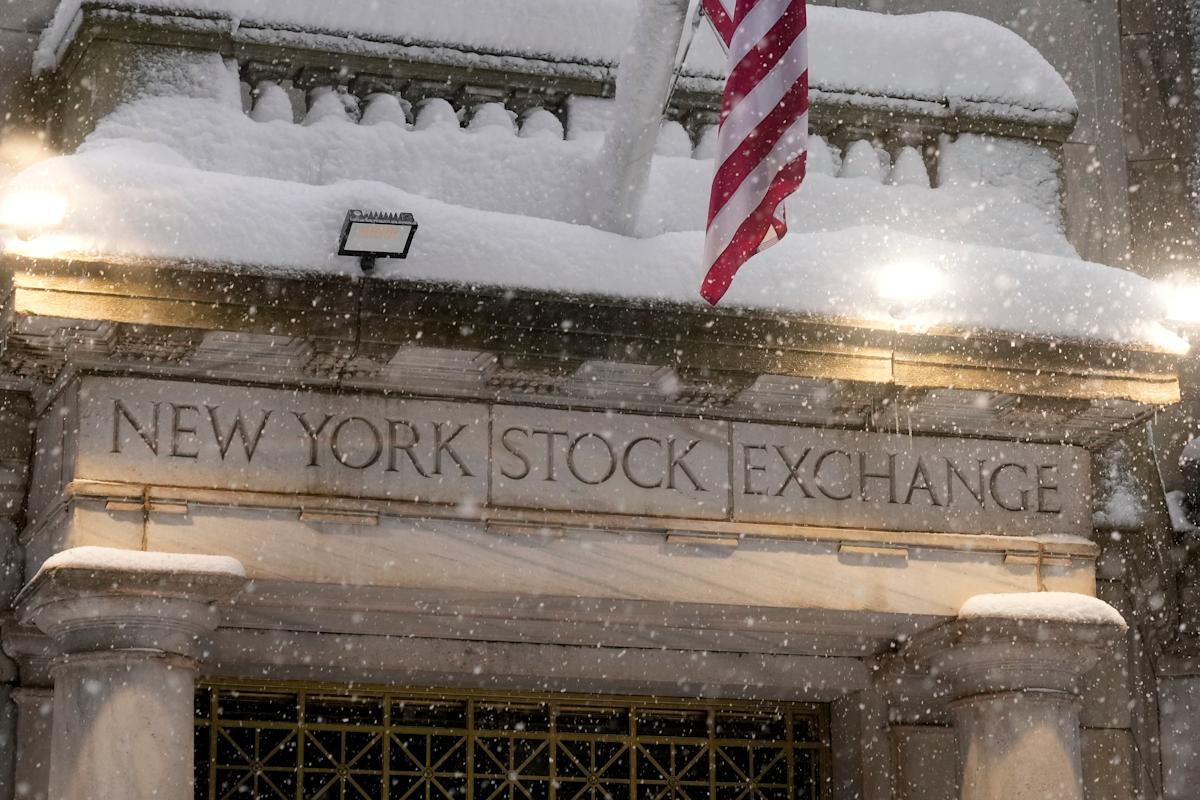
US stocks sank on Friday after a measure of wholesale inflation came in hotter than expected and Block’s (XYZ) surprise shakeup turned the spotlight on AI disruption risks.
The Dow Jones Industrial Average (^DJI) led the way down with a loss of 1.4%, or nearly 700 points. Meanwhile, the Nasdaq Composite (^IXIC) and S&P 500 (^GSPC) dropped 0.9% and 0.6%, respectively, on the heels of sharp closing losses for the tech-heavy indexes.
The downbeat end to the week put the major indexes on track to post monthly losses in February, with the Dow poised to snap its eight-month win streak. Worries that AI will wreak havoc on a swathe of service industries have already hit stocks in sectors like software, wealth management, and real estate.
Those concerns were stoked on Thursday when Block said it will cut nearly half its workforce and overhaul operations, given the promise of AI to reshape its business needs.
The fintech’s co-founder Jack Dorsey said he believes “the majority of companies will reach the same conclusion and make similar structural changes” within the next year. Shares of Block (XYZ) jumped about 20% in premarket trading on the news.
Elsewhere in corporate news, Netflix (NFLX) shares rose after the streaming giant abandoned its pursuit of Warner Bros. Discovery (WBD). That left rival Oracle (ORCL)-linked bidder Paramount Skydance (PSKY) to clinch a buy of the Hollywood studio, giving its stock a boost, too.
On the macro front, January’s producer price index rose 0.5% month over month, showing that wholesale inflation grew at a faster pace than the 0.3% rise economists expected. Core PPI — which excludes volatile food and energy prices — of 0.8% for the month also exceeded forecasts of 0.3%.
Looking ahead, Berkshire Hathaway (BRK-B, BRK-A) CEO Greg Abel is expected to publish his first annual shareholder letter on Saturday, after taking over from Warren Buffett. It will come out alongside the conglomerate’s quarterly and 2025 update.
LIVE 20 updates
-

Hard assets like gold win February, as crypto can’t shake off the winter
Gold (GC=F) is back in February, up about 11% on the month and sitting only 2% below its late-January record closing high.
Silver (SI=F) has risen from the ashes of its historic late-January washout — up 19% and extending its winning streak to 10 months. Compared to gold, it’s a bit farther from its record high (19%).
Dr. Copper (HG=F) is quietly supporting the hard-asset bid as well, up more than 1% in February and off only about 3% from its record.
Crypto is sending a different message. Bitcoin (BTC-USD) is down about 15% in February, and as Ines Ferré wrote earlier, it’s on pace for a fifth straight monthly loss — still nearly 50% below its October 2025 peak.
Ether (ETH-USD) is also down for a fifth straight month, with solana (SOL-USD) and XRP (XRP-USD) deep in the red as well.
-
Defensive stocks outperform in February as the rotation trade grinds on
Defensive sectors are leading the February scoreboard, with Utilities (XLU) up about 10% and having the sector’s best month since 2003.
Consumer Staples (XLP) are up about 8%, alongside steady gains in Energy (XLE), which remains the best-performing sector year to date (up 24%).
Rounding out the defensives, Real Estate (XLRE) and Health Care (XLV) are up about 6% and 3%, respectively.
But 2026 has not been the year for the “Magnificent Seven” and the tech trade. The three megacap sectors — Communication Services (XLC), Technology (XLK), and Consumer Discretionary (XLY) — are all down 2% to 4% in February, with finicky Financials (XLF) at the bottom.
The S&P 500 (^GSPC) might be down slightly this month, but it’s still within 1.5% of its all-time closing high in January. As the godfather of technical analysis, Ralph Acampora, has famously quipped, “Rotation is the lifeblood of a bull market.”
-
The Dow’s win streak is snapping, but transports keep trending
The Dow Jones Industrial Average (^DJI) is on course to snap its eight-month win streak, putting February on pace to be its worst month since April 2025 — even after logging three record closing highs earlier in the month.
But the Dow Jones Transportation Average (^DJT) is having its best month since May 2025 — up five straight months (its longest streak since 2020) and notching four record closes in February.
All the more impressive: Transports sit within 1% of a record closing high despite getting dragged down by the AI disruption trade twice this month.
The daily chart now looks like a clean pennant formation, with the 20-day moving average to the downside and the Feb. 6 record closing high around 19,900 to the upside.
-
More than 100 companies file lawsuits seeking tariff refunds
More than 100 companies have filed lawsuits with the Customs and Border Protection (CBP) agency seeking refunds after the US Supreme Court’s ruling that struck down the White House’s IEEPA tariff regime, according to Bloomberg.
Since the ruling, a mix of public corporations and private companies have filed lawsuits, including FedEx (FDX), Dollar General (DG), On Holding AG (ONON), L’Oreal (OR.PA), and Dyson.
The Supreme Court’s ruling, which found President Trump’s use of the International Emergency Economic Powers Act (IEEPA) to impose sweeping tariffs on a range of other nations illegal, did not provide guidance on refunds. Analysts have estimated that the total cost of refunds could exceed $170 billion.
With no guidance from the Supreme Court, judgment on refunds now goes to the US Court of International Trade. In response to press comments, Trump said about refunds, “I guess it has to get litigated,” and suggested the process could take years, according to Bloomberg.
Bloomberg noted that many of the companies suing CBP have been smaller corporations that don’t have the scale and balance sheet of major public companies to quickly reshuffle supply chains and negotiate pricing agreements.
-
Bonds are back as the stress hedge in February
Long-term US bonds are having their best month in a year, as the iShares 20+ Year T-Bond ETF (TLT) is up 4% in February.
Bond yields — which move opposite to bond prices — posted their biggest monthly drop in a year. The US 10-year yield (^TNX) is down 26 basis points, and the 30-year (^TYX) is down 23 basis points.
The catalysts boil down to two main themes: tariff uncertainty after the Supreme Court’s ruling (and the scramble to game out what comes next for trade policy) and the recurring “AI scare trade” that periodically smacks down growth narratives and prods investors toward defense.
Meanwhile, the major stock indexes are tracking small losses for the month. Overall, this is good news for the 60/40 portfolio: bonds (the 40%) are finally doing what they’re supposed to do when stocks (the 60%) stumble — rally.
-
Bitcoin falls to $66,000, on pace for 5th month of losses
Bitcoin (BTC-USD) fell back toward $66,000 on Friday, on track for a fifth month of losses as the crypto market remains volatile.
Earlier this week, the token rebounded near $70,000, but investors sold into the rally.
The world’s largest cryptocurrency is down roughly 24% year to date after tumbling from an all-time high of about $126,000 in October.
Ether (ETH-USD) has declined even more on a relative basis on Friday, sinking more than 3%. The second-largest cryptocurrency has fallen 37% year to date.
Industry watchers have been closely monitoring potential catalysts that could lift prices this year. On Polymarket, the odds of Congress passing crypto regulation, specifically the Clarity Act, have climbed to 67%.
-
Oil prices surge as US-Iran talks break with no deal, State Dept authorizes evacuations from US embassy in Jerusalem
Oil prices shot higher on Friday morning after US-Iran talks ended in Geneva on Thursday with no deal and the US began ordering evacuations from embassies in the Middle East.
Futures on Brent crude (BZ=F), the international pricing benchmark, jumped by 2.9% to change hands above $72.90, while those on the US benchmark West Texas Intermediate (WTI) crude (CL=F) rose by a stronger 3% to trade above $67.
Both energy products are trading at six-month highs.
On Thursday, the US and Iran remained far apart on key redline issues, even as Oman’s foreign minister, Badr Albusaidi, who is mediating the talks, said progress has been made. The two sides are now set for the next round of talks in Vienna, with technical teams — such as nuclear and banking experts — expected to join.
More pressingly for oil prices, the US has continued to send military firepower to the region, deploying more combat assets to the Gulf, and has begun taking security measures for Americans in the region.
On Friday, the US embassy in Jerusalem said it had authorized the evacuation of non-essential personnel and family members, noting that those persons included “may wish to consider leaving Israel while commercial flights are available.”
Reports from regional news publications also suggested that the US had ordered the evacuation of personnel from the US embassies in Baghdad, though a spokesperson for the State Department denied the claim in an X post.
Oil prices are highly sensitive to potential conflict in Iran, with the most focus on the Strait of Hormuz, a critical shipping chokepoint through which roughly 20 million barrels per day of petroleum products pass. Iran, which largely controls the strait, has threatened to close the waterway, along with threats of severe retaliation if the US strikes.
-
Nasdaq leads Wall Street stocks lower at the open
The US stock market sank at the opening bell on Friday after the latest reading of the producer price index showed wholesale inflation rose more than expected in January. Meanwhile, Block’s (XYZ) mass layoffs reignited fears of AI-led corporate disruption.
The tech-heavy Nasdaq Composite (^IXIC) saw the largest loss at the start of trading, dropping roughly 1.3%. The Dow Jones Industrial Average (^DJI) shed 1%, or just under 500 points, and the S&P 500 (^GSPC) lost roughly 0.9%.
On Thursday, Jack Dorsey’s Block said it will trim nearly half its workforce as AI reshapes operations. Shares of Block (XYZ) jumped about 20% after the bell on Friday. Elsewhere, Netflix (NFLX) shares rose after the streaming giant gave up its pursuit of Warner Bros. Discovery (WBD), leaving the way open for Paramount Skydance (PSKY) to purchase the Hollywood studio.
-
OpenAI announces $110 billion in new investments from Nvidia, Amazon, Softbank; values company at $730 billion pre-money
In a massive new funding round, OpenAI raised $110 billion from a group of investors, including Nvidia and Amazon, valuing the ChatGPT maker at $730 billion, not including the money raised.
Investments include $50 billion from Amazon, $30 billion from Nvidia, and $30 billion from Softbank, OpenAI said in a press release announcing the raise.
Shares in Nvidia and Amazon fell after the opening bell on Friday.
“We are entering a new phase where frontier AI moves from research into daily use at global scale,” OpenAI said in its press release. “Leadership will be defined by who can scale infrastructure fast enough to meet demand, and turn that capacity into products people rely on.”
The company also announced a new deal with Amazon Web Services (AWS) that will see the two companies build a “Stateful Runtime Environment” run on OpenAI’s models that “allows developers to keep context, remember prior work, work across software tools and data sources, and access compute.” The product is expected to launch “in the next few months,” according to the press release.
OpenAI is also expanding its existing partnership with Nvidia with the “use of 3GW of dedicated inference capacity and 2 GW of training on Vera Rubin systems,” the company said.
-
US producer prices advance faster than expected in January
US producer-level prices advanced faster than expected in January, according to data released Friday by the Bureau of Labor Statistics.
Prices increased by 0.5% in January over the previous month, in line with December’s gain but above economist expectations an increase of 0.3%, according to consensus estimates. Excluding the more volatile food and energy costs, producers’ prices advanced by 0.8% over the previous month, more than double the 0.3% growth economists had predicted.
Year-on-year, headline PPI rose by 2.9% against expectations of 2.6%, while prices ex-food and energy rose 3.6% against expectations of 3%.
Services led all price inflation in January, with costs advancing by 0.8%, the largest monthly gain since July 2025. Meanwhile, costs for goods declined by 0.3%, tempering the much larger movement in services.
A 14.4% increase in margins for “professional and commercial equipment wholesaling” contributed 20% of the jump in services prices, according to BLS data.
In goods, prices of “nonferrous metals,” including copper and aluminum, grew by 4.8%, while gasoline fell by 5.5%. Commercial and industrial electric power prices also fell, the BLS said.
-
10-year yield slips below 4% ahead of wholesale inflation data
Treasury yields slipped on Friday morning as investors awaited data on wholesale inflation from the January producer price index.
The 10-year bond (^TNX) briefly fell to 3.99%, marking its first time below 4% since November. The shorter-run five-year yield (^FVX) declined to 3.58%, while the longer-run 30-year yield (^TYX) dropped to 4.66%.
The Bureau of Labor Statistics will release the producer price index this morning. The Street expects headline demand increased 0.3% in January. While continued easing in wholesale inflation would likely push yields lower, some strategists see higher yields remaining sticky.
“We’re seeing a lot of instability in the market right now, whether it’s concerns over the federal funds rate, higher debt levels at the federal side,” Schwab Center for Financial Research fixed income strategist Cooper Howard told Yahoo Finance, adding, “that should really keep that term premium elevated going forward and therefore probably put a floor on how much lower longer term yields could potentially go.”
-

Anthropic says it won’t agree to Pentagon’s AI demands
Anthropic (ANTH.PVT) CEO Dario Amodei issued a statement Thursday evening, saying his company won’t submit to the Department of Defense’s demands that it be allowed to use its AI technology as it sees fit, within the law.
The Defense Department and Secretary of Defense Pete Hegseth have threatened to force Anthropic to give the Pentagon full use of its models under the Defense Production Act — or, conversely, declare it a supply chain threat and force other Pentagon vendors who work with the AI company to stop using its software.
“These threats do not change our position: we cannot in good conscience accede to their request,” Amodei said in his statement.
Anthropic and the Pentagon have been in an ongoing standoff about how the DOD will use its Claude AI. The company says that while it already works with the Defense Department, including within the government’s classified networks and by advocating for strong chip export controls to China, it wants assurances that the DOD will not use its models for the mass surveillance of Americans or for fully autonomous weapons.
Duolingo shares sink after issuing poor 2026 guidance
Duolingo Inc (DUOL) shares sank 25% before the bell on Friday after reporting fourth quarter earnings, which beat analyst expectations, but issued disappointing guidance for 2026. The company said it is changing its strategy to prioritize user growth over near-term profitability.
Investing.com reports:
Netflix stock jumps after it drops Warner Bros. deal, leaving Paramount the winner
Netflix (NFLX) has walked away from the battle to buy Warner Bros. Discovery (WBD), leaving rival bidder Paramount Skydance (PSKY) free to clinch a $111 billion deal for the storied Hollywood studio.
Shares in Netflix jumped over 8% before the bell on Friday, a sign investors were glad its pursuit had ended. WBD stock fell 2%, while Paramount shares were up 9%.
Bloomberg reports:
Premarket trending tickers: Intuit, NCR, and Rocket Cos
Intuit (INTU) stock fell 3% before the bell on Friday after reporting stronger-than-expected results for its second quarter revenue, but its outlook for the current quarter missed analyst estimates.
NCR Atleos (NATL) stock jumped 15% during premarket trading after Brinks Co (BCO) announced on Thursday that it will acquire NCR in a cash-and-stock deal valued at $6.6 billion.
Rocket Companies, Inc. (RKT) stock rose 7% during premarket hours after quarterly earnings beat analysts estimates.
CoreWeave slides as surging capex, backlog risks overshadow small revenue beat
CoreWeave (CRWV) stock fell 9% before the bell on Friday after announcing that it expects its capital expenditure to double in 2026. The AI cloud computing company said it will spend in order to scale up its AI cloud platform in order to manage the computing power that its customers need.
Reuters reports:
Block stock soars after Jack Dorsey goes all-in on AI, cuts nearly half of workforce
Block (XYZ) shares surged more than 24% in premarket trading after Jack Dorsey announced the payments company would lay off nearly half of its staff. The move was part of a major bet in artificial intelligence that came alongside the release of its fourth quarter earnings report.
“Today we’re making one of the hardest decisions in the history of our company: we’re reducing our organization by nearly half, from over 10,000 people to just under 6,000. that means over 4,000 of you are being asked to leave or entering into consultation,” Dorsey wrote in a post on X on Thursday.
“Something has changed,” Dorsey wrote, framing the decision as a risk intended to position the company for long-term growth. He cited new artificial intelligence tools that can automate work as the reason for the shift, noting that AI is “enabling a new way of working which fundamentally changes what it means to build and run a company.”
In the fourth quarter, Block reported adjusted earnings per share of $0.65, in line with Wall Street estimates. Revenue of $6.25 billion slightly beat expectations of $6.21 billion, according to S&P Global Market Intelligence.
Block also raised its full-year guidance. The company, which supports the CashApp and Square platforms, said it expects gross profit growth of 18% year over year in 2026 and adjusted operating income of $3.20 billion or 26% margin.
Dell stock surges after revenue forecast tops estimates on rising AI server demand
Dell (DELL) forecast fiscal 2027 revenue above Wall Street estimates on Thursday, betting on growing demand for its artificial intelligence-optimized servers. Its shares rose over 12% in premarket trading.
Reuters reports:
Zscaler stock drops on Q2 losses from high expenditure
Reuters reports:
Netflix shares leap 13% after hours after dropping bid for Warner Bros.
Bloomberg reports:


Stay Ahead of the Curve: Subscribe Now to Receive Instant Breaking News Alerts Directly to Your Inbox!
- Latest
- Popular



![i’m-nervous,-too!-[part-2]](https://10xwealthreport.com/wp-content/uploads/2026/03/177042-im-nervous-too-part-2-1568x784.jpg)