Updated 1 min read
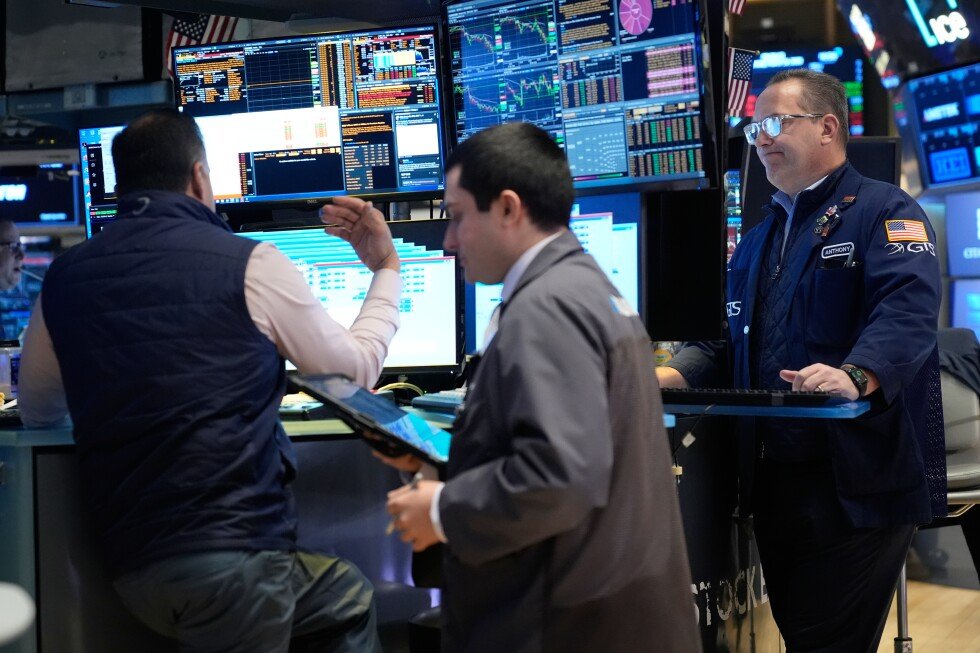
US stocks retreated on Monday as investors grappled with the fallout from the Supreme Court’s rebuff of President Trump’s most sweeping tariffs, while AI disruption fears gripped markets once again.
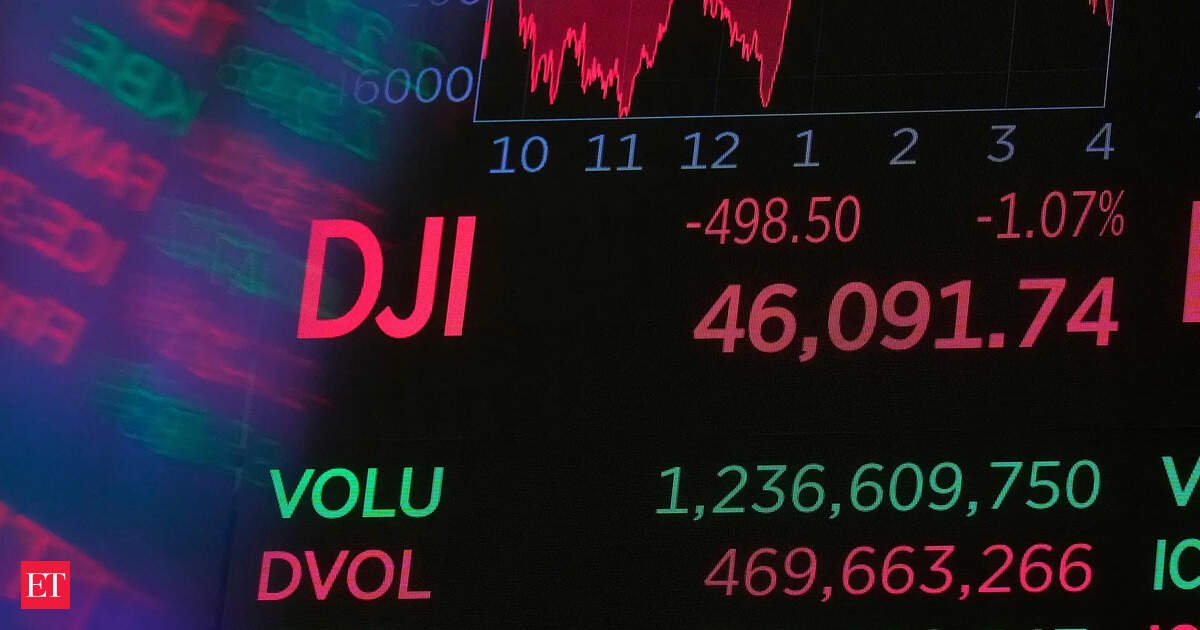
The Dow Jones Industrial Average (^DJI) led the way down, losing roughly 1.7%, or over 800 points. Meanwhile, the S&P 500 (^GSPC) fell 1.1%, and the tech-heavy Nasdaq Composite (^IXIC) dropped 1.3%, coming off a volatile but winning session on Friday.
Growing uncertainty about the global trade landscape is unsettling markets. The Supreme Court’s invalidation of many US tariffs on Friday initially fueled trade hopes and buoyed stocks. But Wall Street is reassessing after Trump said Saturday that the US will lift the baseline tariff rate on imports to 15%, effective immediately.
In a strong response, the EU rejected any hike in tariffs, saying “a deal is a deal” and calling on Washington to clarify the steps it will take.
Meanwhile, the “AI scare trade” resumed on Monday, after Anthropic announced an AI tool designed to automate analysis and tasks typically done by expensive consulting teams. Shares of IBM (IBM) shares sank 11%, while Accenture (ACN) and Cognizant Technology (CTSH) also fell.
Industries across the board, including software, real estate and logistics, have gotten hit over the past several weeks over concerns that AI tools will disruption business models and squeeze margins.
Looking ahead, AI chipmaker Nvidia’s (NVDA) results on Wednesday are the earnings highlight as the season continues to wind down, and as AI disruption fears swirl. Nvidia shares were a rare green spot for the market on Monday.
LIVE 24 updates
-
BofA: ‘Misinformation’ around Blue Owl makes the stock an attractive buy
Blue Owl Capital’s (OBDC) shares have been punished over the last week after news that the firm was suspending redemptions from one of its private credit funds. The move prompted a renewed surge in worries around private credit markets, and shares have dropped roughly 8% over the past month.
But Bank of America says “misinformation” around the stock and recent news has made Blue Owl an attractive buying opportunity for investors.
“There is a significant level of misinformation weighing on OWL and the private credit industry,” BofA analysts wrote in a client memo Monday morning, creating a “particularly attractive buying opportunity for OWL and the credit heavy Alts.”
The bank’s analyst noted that Blue Owl’s investment history “is solid to strong across all of its strategies,” while its credit quality “remains above average.” Current conditions, the analysts said, remind them of similar sell-offs in shares of alternative investment firms Blackstone (BX), Apollo Global Management (APO), and Ares Management Corporation (ARES), which “led to 80%-190% total returns within 12 months from the lows.”
Blue Owl’s shares currently trade around $11.50. BofA’s price target of $24 implies a return of more than 100%.
“Despite misinformation that has weighed on recent fundraising/redemptions, we believe gatekeepers and the majority of financial advisors are sticking to the facts which includes +12% 3Y annualized returns” for Blue Owl and its business development company Blue Owl Credit Income Corp., the analysts wrote.
“We continue to view private credit as an attractive contributor to a US retirees’ portfolio given the high returns, downside protection and monthly dividends and it has even outperformed most equity strategies over the last three years.
-
Gold climbs to three week high, silver jumps on tariff uncertainty
Gold (GC=F) on Monday, reaching a three-week high as the precious metal continued to outperform the broader market.
Gold hovered near $5,230 per ounce after President Trump raised global tariffs to 15% over the weekend, following the Supreme Court’s decision striking down the administration’s emergency tariff policy announced last year.
Bullion is up 19% year to date after a sharp late-January drawdown sent contract prices tumbling from an all-time high of about $5,600 per ounce.
Wall Street strategists have reaffirmed their bullish outlook on gold while urging caution on silver (SI=F), which reached $87 per ounce on Monday.
Silver futures have climbed 12% over the past five sessions but are still about 28% off all-time high of $121 reached on January 29.
-
Treasury yields fall as investors turn to bonds amid flight to safety
As US stocks sold off across the board on Monday driven by tech weakness and artificial intelligence concerns, investors took cover in US Treasurys and safe havens like gold (GC=F). The rise in bond prices drove Treasury yields lower throughout the day.
The 10-year yield (^TNX) fell 1.6%, or 6 basis points, to 4.01%, while the 30-year yield (^TYX) dropped 4 basis points to 4.68%. The five-year yield (^FVX) declined by 7 basis points to 3.57%.
Meanwhile, the US dollar (DX-Y.NYB) index declined slightly to 97 as confusion surrounding President Trump’s 15% blanket tariff following the Supreme Court’s overturning of the “reciprocal” tariffs reverberated through the markets.
-

Payments stocks get dragged into the risk-off wave
Payments and e-commerce stocks are getting hit hard as the sell-off broadens, with some desk chatter still pointing to the Citrini Research doom-and-gloom research note from the weekend.
The tape is ugly across the group, as investors assess the possibility of AI slicing through the payments friction that these companies monetize:
PayPal (PYPL) is an industry standout, up over 7%.
Before we take Citrini’s crystal ball at its word, the proposed payment disrupters in the crypto universe are decidedly not catching a bid. Bitcoin (BTC-USD), ethereum (ETH-USD), solana (SOL-USD), and cardano (ADA-USD) are all trading down over the prior 24 hours.
-
Apple escapes punishing Big Tech sell-off as company holds back on capex commitments
Apple (AAPL) has spent much of the past year under pressure from investors and analysts who said the company was falling behind peers in the AI arms race. But over the past month, Apple shares have been rewarded for the company’s decision not to pour hundreds of billions of dollars into AI capital expenditures.
Yahoo Finance’s Dan Howley reports:
-
Goldman: Oil prices to decline less than expected through 2026 as inventories remain lower than estimated
Oil prices are likely to decline by less than previously expected in both the international and US markets in the fourth quarter, Goldman Sachs strategists said over the weekend, raising their earlier price targets from markedly lower estimates.
Brent crude (BZ=F), the international pricing benchmark, is now expected to decline to $60 per barrel in the fourth quarter, Goldman said, compared to previous estimates of $54 per barrel. Prices on US benchmark West Texas Intermediate (WTI) crude (CL=F) are expected to fall to $56, up from the firm’s previous call of $48.
Brent and WTI currently trade hands at around $71.40 and $66.60, respectively, as inventories have failed to build as much as previously expected. Both products have seen their prices rally by roughly 15% year-to-date on a host of geopolitical risk premiums that have counteracted a deeply oversupplied global market.
“Brent has rallied $11 YTD to $71 as Iran-related supply concerns have driven a recovery in positioning from low levels and the risk premium while inventories in OECD pricing centers have not built,” the strategists wrote.
“This stability in OECD stocks (against consensus expectations of large builds) reflects supply disruptions in January, especially in Kazakhstan, and that much of the global surplus continues to materialize as rising inventories of sanctioned crude ‘stuck at sea.'”
While landed stocks have failed to build as much as previously expected, the amount of crude oil that is “stuck at sea” on tankers — primarily Russian and Iranian oil that cannot be landed under US sanctions — has grown, meaning there is less pressure at the on-land storage hubs where much of physical pricing is determined.
While Goldman’s estimate includes a prediction of no supply disruptions in Iran, the strategists wrote, “a potential [1 million barrel per day] supply disruption — which corresponds to half of Iran’s crude exports —for 12 months would boost the fair value of oil by $8 (although prices could rise more as escalation risks are reassessed).”
-
Airline, travel stocks take a hit as winter storm slams Northeast
Airline and travel stocks fell on Monday as the broader market declined and a winter storm disrupted the Northeast region of the US, causing thousands of flight cancellations.
American Airlines (AAL), United (UAL), and Delta (DAL) all declined roughly 4%. Domestic carriers were also hit with JetBlue (JBLU) and Southwest (LUV) also trading lower.
Travel platform companies Booking Holdings (BKNG) and Airbnb (ABNB) fell 6% and 5%, respectively.
More than 5,500 flights were canceled, and another 12,000 were delayed on Monday, including domestic, inbound, and outbound flights. New York’s JFK airport and LaGuardia saw the most cancellations.
Meanwhile, New York City declared a local state of emergency with nonessential traffic prohibited until 12 noon on Monday.
-
Hedge funds sell global stocks at fastest pace since ‘Liberation Day’ meltdown
Hedge funds sold global stocks in the week ended Feb. 19 at the fastest pace since April 2025, according to data from Goldman Sachs first reported by Bloomberg.
While the sales preceded Friday’s Supreme Court decision striking down much of President Trump’s tariff regime and sparking renewed uncertainty throughout the global trade landscape, the selling activity “underscores doubts among some investors that gains in stocks linked to economic growth can be sustained,” according to Bloomberg.
Over the past month, several sectors — from software and logistics to financial services and real estate — have been wracked by fears of AI-driven competition that could cut margins and steal business from once-stalwart names such as Charles Schwab (SCHW) and C.H. Robinson (CHRW).
“All major regions were net sold, led by North America and Europe,” Goldman Sachs’ prime brokerage desk said. “Single stocks and macro products were both net sold and made up 58% and 42% of the total notional net selling, respectively, both led by short sales.”
-
SaaSpocalypse déjà vu as software gets decimated again
Software is getting hit hard again today as the SaaSpocalypse narrative rears its head. Investors were chewing over a Citrini Research note this weekend amid the broader doom-and-gloom backdrop — hard to gauge its direct impact, but it’s clearly in the mix as sentiment turns darker.
The iShares Expanded Tech-Software Sector ETF (IGV) is back testing its post–Liberation Day low from April 7, 2025, with the sector heat map a sea of red.
Several high-multiple names are sliding into multiyear price territory. Take Atlassian (TEAM) back near 2018 levels, Adobe (ADBE) nearing 2019 prices, or Worday (WDAY) entering deep 2020 pandemic territory. The first two are on track for their worst months ever — the kind of no-bid action that tends to show up when investors start re-litigating the fundamentals of an entire industry.
Tech overall is only off modestly, as the Philly semiconductor index (^SOX) flirts with its record closing high. For software, IGV needs to hold $76-$77 — otherwise, a break could turn into a down elevator as stops get tripped below that April floor.
-
Natural gas prices jump in Monday trading as massive blizzard hits northeast US
Natural gas (NG=F) prices rallied through Monday morning as a major winter storm coursed through the northeast US, dropping a foot or more of snow through the New York City metropolitan area.
Prices on the energy product rose roughly 2.5% early Monday morning before paring gains, ultimately trading just under $3.
Natural gas is the dominant source of heating throughout the US, responsible for fueling 47% of heating demand, according to the Energy Information Administration. Gas also makes up a significant chunk of electrical generation power. Cold weather kicks up natural gas demand from both direct heating and electricity use, such as electrical system backups.
However, the price action for this storm has been so far much more contained than that of the previous Winter Storm Fern, which saw prices soar by as much as 75%. During Winter Storm Fern, an Arctic weather pattern kept temperatures depressed into the single and low-double digits for a week or more, exacerbating fears of freezing conditions and prompting large withdrawals of natural gas stores.
This time around, in what has been named Winter Storm Hernando, while the storm is dropping massive amounts of snow in a blizzard that prompted a travel ban in New York City, temperatures are not expected to remain as cold for as long.
-
US stocks open mixed as Wall Street grapples with trade uncertainty
US stocks opened Monday’s trading session on a mixed footing as Wall Street digested the Supreme Court’s rebuff of President Trump’s most sweeping tariffs, adding a new wave of uncertainty to global trade deals.
The S&P 500 (^GSPC) and Dow Jones Industrial Average (^DJI) both moved up less than 0.1% after initial losses, coming off a volatile but winning session on Friday. The tech-heavy Nasdaq Composite (^IXIC) remained below the flatl ine, shedding 0.1%.
Growing uncertainty about the global trade landscape is scrambling markets after the US Supreme Court’s decision to strike down much of the president’s tariff regime on Friday. The EU rejected any hike in tariffs, saying “a deal is a deal” and calling on Washington to clarify the steps it will take following the court rebuff.
AI chipmaker Nvidia’s (NVDA) results on Wednesday take the earnings spotlight for the week, while Salesforce (CRM) — whose stock was hit by AI disruption fears — reports the same day. Before that, Home Depot (HD) will provide its quarterly update on Tuesday.
-
Federal Reserve’s Waller: Rate cuts will depend on the labor market
Federal Reserve Governor Christopher Waller said in comments on Monday that his thinking on rate cuts will be determined by the state of the labor market.
“Assuming underlying inflation continues to signal we are close to our 2% goal, the key to setting appropriate policy will be my view of the labor market,” Waller said. “As things stand today, I rate these two possible outcomes as close to a coin flip,” Waller said in a speech on Monday in Washington at the National Association for Business Economics conference.
The Fed governor also cautioned that if the strong reading on the job market for January is revised lower — the Labor Department reported a gain of 130,000 jobs, more than in the previous nine months combined — that would reinforce January’s rate cut and signal the need for another cut in March.
Waller dissented with the no-change vote at the Fed’s January meeting, advocating instead for a quarter-point reduction in rates.
“If the labor market data for February are consistent with the stronger job creation and low unemployment rate initially reported in January, indicating that downside risks to the labor market have diminished, it may be appropriate to hold the FOMC’s policy rate at current levels and watch for continued progress on inflation and strength in the labor market,” Waller said.
-
Hedge funds that piled into US bitcoin funds are the first to exit
The hedge funds that helped fuel a boom in US exchange-traded funds holding bitcoin (BTC-USD) beat a rapid retreat in recent months, according to new data.
Bloomberg reports:
-
The AI boom is helping Samsung and coming for Apple
Samsung (005930.KS) is using the massive memory chip shortage to juice its margins. That could hurt smartphone archrival Apple (AAPL), notes Yahoo Finance’s Francisco Velasquez.
He writes:
-
European stocks fall, Indian stocks rally as global trade confusion returns
The Supreme Court’s decision to strike down President Trump’s “reciprocal” tariff authority sent European stocks lower and Indian stocks higher on Monday as the US’s trade partners searched for a new status quo amid Trump’s new tariff threats.
Following reports on Monday that the European Union may delay the ratification of its trade deal with the US, the pan-European Stoxx 600 (^STOXX) dropped 0.3%, while Germany’s DAX (^GDAXI) fell 0.6%. The CAC (^FCHI) in Paris was 0.1% lower.
At the same time, Indian stock market indexes, the Nifty 50 (^NSEI) and the BSE Sensex (^BSESN), both gained 0.5%. Indian trade officials postponed a trip to the US and said they would reschedule their visit to firm up an interim agreement.
Bloomberg reports:
-
Domino’s stock pops on Q4 revenue beat, though earnings miss slightly
Domino’s (DPZ) posted mixed fourth quarter and fiscal 2025 results as the chain doubles down on growing sales, store count, and profits while consumers home in on value.
The pizza chain posted revenue of $1.54 billion for the fiscal fourth quarter on Monday morning. That was up 6.4% year over year and a tick above the $1.52 billion Wall Street forecast, per Bloomberg consensus data. The bump was driven by higher order volumes and an increase in the company’s food basket pricing to stores.
Adjusted earnings came in at $5.35 per share, just below estimates of $5.37.
Shares in Domino’s rose around 6% before the bell. The stock is down 16% over the past year, compared with the S&P 500’s (^GSPC) 15% gain.
CEO Russell Weiner said the chain’s “MORE strategy” delivered higher sales and profits.
He said in the release: “These strong results flowed through to increased franchisee profits, showcasing our ability to drive store level profitability while providing incredible value for our customers.”
US same-store sales grew 3.7%, above the 3.3% jump forecast, while international stores of 0.7% were lower than the expected 1.1% tick up.
For the fiscal year, revenue came in at $4.9 billion, alongside adjusted earnings of $17.57.
Same-store sales for US stores grew 3%, more than the 2.85% forecast. For the year, international stores’ same-store sales growth missed expectations, rising 1.9% versus the estimated 2.14%.
In 2025, the company added 776 stores, slightly more than the Street anticipated, bringing the total to 22,142 globally.
-
Premarket trending tickers: Arcellx, Fortune Brands, and Domino’s
Cancer therapy developer Arcellx (ACLX) stock soared 77% before the bell on Monday following the news that Gilead Sciences (GILD) will be acquiring the company for $7.8 billion.
Fortune Brands Innovations (FBIN) stock rose 4% during premarket hours on Monday after investor Ed Garden built a stake in the company, according to the Wall Street Journal.
Domino’s Pizza (DPZ) stock rose 4% before the bell on Monday after beating analysts expectations for revenue, but falling short on earnings.
-
Novo’s stock falls as obesity drug falls short against Lilly’s in trial
-
Markets roundup: Stocks, dollar, gold, bitcoin, and oil
The fallout from President Trump’s tariff defeat on Friday has gone far and wide, and the markets have started to react to the news.
Stocks: US stock futures slipped on Monday as Wall Street digested the latest news on Trump’s tariff defeat. Dow Jones Industrial Average futures (YM=F) dropped 0.3%. Contracts on the S&P 500 (ES=F) fell roughly 0.3%, while those on the tech-heavy Nasdaq 100 (NQ=F) sank 04%.
Chinese stocks got a boost from tariffs, as investors weighed the impact on the current deal the US has with China and whether China’s leader Xi Jinping would seek to renegotiate it. The Hang Seng index (^HSI) closed 2% up on Monday.
US dollar: The dollar (DX=F) fell on Monday, trading 0.1% lower.
Gold: Gold (GC=F) futures rose 1%, and silver (SI=F) gained 4% as investors poured into safe-haven assets following Trump’s tariff defeat.
Bitcoin: Bitcoin (BTC-USD) fell below $66,000 and was down 3% on Monday.
Oil: Brent (BZ=F) and West Texas Intermediate (CL=F) both fell 0.7% on Monday.
-
Wall Street reacts to tariff ruling
Here are some assorted thoughts from Wall Street on the Supreme Court’s tariff ruling on Friday and President Trump’s 15% global tariff imposed in reaction.
Goldman Sachs:
Jefferies:



![i’m-nervous,-too!-[part-2]](https://10xwealthreport.com/wp-content/uploads/2026/03/177042-im-nervous-too-part-2-1568x784.jpg)