Updated 2 min read
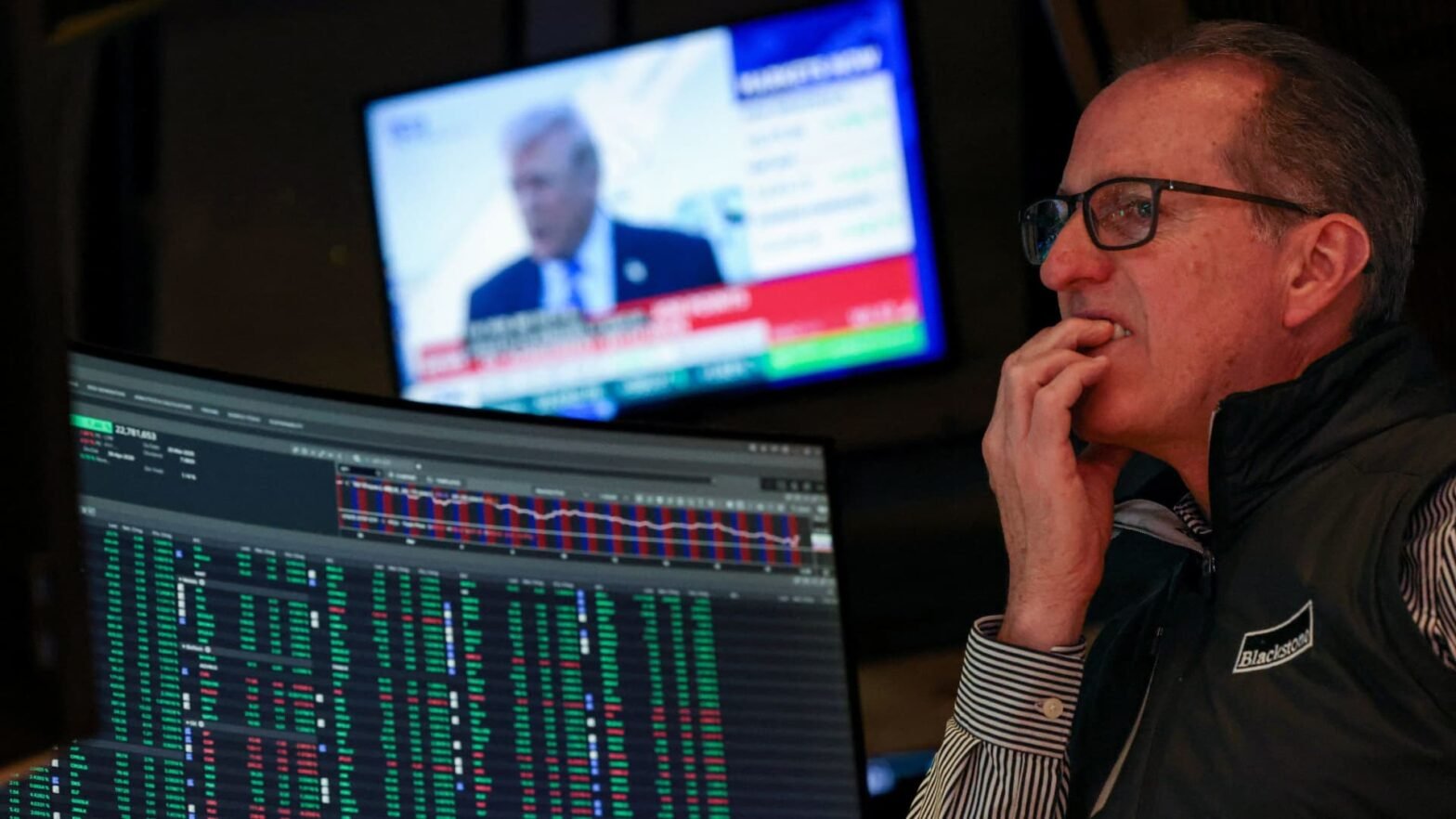
US stocks sank on Tuesday but finished off their session lows, kicking off what is historically the worst trading month of the year as Wall Street looked ahead to a crucial jobs report that could shape expectations for interest-rate cuts.
The Dow Jones Industrial Average (^DJI) fell around 250 points, or 0.6%, while the S&P 500 (^GSPC) dropped about 0.7% for its worst day in over a month. The tech-heavy Nasdaq Composite (^IXIC) tumbled roughly 0.8%, marking a sour start to September after another winning month for major Wall Street stock indexes.
Nvidia (NVDA) led declines in the “Magnificent Seven” stocks, down around 2% after the chipmaker pushed back against media reports suggesting its AI chips were “sold out.”
Treasury yields rose, with the 30-year (^TYX) jumping 5 basis points to trade around 4.97%, eyeing the key 5% level for the first time since July. That level is typically viewed as a headwind for stocks.
Similarly, the benchmark 10-year (^TNX) yield rose to near 4.3%.
Wall Street kicked off the holiday-shortened week — after Monday’s Labor Day closure — bracing for a potentially tumultuous month, with legal drama around President Trump’s tariffs and concerns over Federal Reserve independence in focus.
Gold (GC=F) topped the all-time highs seen earlier this spring, trading around $3,600 an ounce on expectations the Fed will cut rates this month after Chair Jerome Powell signaled openness to a move.
Those bets face a key test in Friday’s August jobs report, with job openings and private payrolls due ahead of it. Meanwhile, an update Tuesday showed U.S. manufacturing contracted for the sixth straight month in August.
Markets are currently pricing in roughly 90% odds of a 25 basis point rate cut in September, but this week’s data could help make the case for deeper easing.
Investors are also watching Washington, where a court hearing on whether Trump can fire Fed Governor Lisa Cook ended without a ruling, even as he seeks to reshape the Board of Governors.
And in a major blow to Trump’s trade agenda, a federal appeals court ruled most of his global tariffs unconstitutional. Trump blasted the decision as “highly partisan” and vowed to appeal to the Supreme Court as soon as Tuesday.
LIVE 24 updates
-
Stocks fall as rising Treasury yields pressure markets
US stocks fell Tuesday but closed off their lows, opening what is historically the toughest month for equities on a cautious note. Investors are focused on Friday’s August jobs report, which could influence expectations for Federal Reserve rate cuts.
The Dow Jones Industrial Average (^DJI) fell around 250 points, while the S&P 500 (^GSPC) dropped about 0.7%. The tech-heavy Nasdaq Composite (^IXIC) tumbled roughly 0.8%.
Treasury yields rose, with the 30-year (^TYX) jumping 5 basis points to trade around 4.97%, eyeing the key 5% level for the first time since July. That level is typically viewed as a headwind for stocks.
Similarly, the benchmark 10-year (^TNX) yield rose to near 4.3%.
-
Nvidia stock falls as chipmaker pushes back on supply chain concerns
Nvidia (NVDA) shares dropped around 2% on Tuesday, part of a broader pullback in AI names, after the chipmaker pushed back against media reports suggesting its AI chips were “sold out.”
In a post on X, Nvidia said chatter claiming supply constraints on its H100 and H200 processors was “erroneous,” reiterating comments from its earnings call last week that customers can continue to rent the chips through cloud providers and that new orders are being filled without delay.
“The rumor that H20 reduced our supply of either H100/H200 or Blackwell is also categorically false — selling H20 has no impact on our ability to supply other NVIDIA products,” the company wrote.
Even so, Nvidia CEO Jensen Huang appeared to acknowledge some speculation last week, telling investors on the call, “The buzz is everything’s sold out. H100 is sold out, H200s are sold out.”
Nvidia reported 56% growth in data center revenue in Q2, which fell short of Wall Street’s lofty expectations.
Analysts said the shortfall suggests that demand for Nvidia’s chips continues to far outpace supply, raising questions about whether production can scale fast enough to meet orders.
-
Tariffs in legal limbo as Trump presses Supreme Court for emergency hearing
President Trump said Tuesday his administration will seek an immediate Supreme Court hearing after a federal appeals court ruled that most of his global tariffs were unlawful. He called the case “an economic emergency.”
“If we don’t win that decision, you’ll see a reverberation like maybe you’ve never seen before,” Trump said on CNN commentator Scott Jennings’ radio show.
The appeals court on Friday found Trump exceeded his authority by using emergency powers to impose sweeping tariffs, affirming an earlier ruling from the Court of International Trade. The judges allowed the tariffs to remain in place while the case proceeds.
Trump blamed Tuesday’s market sell-off on investor concerns over the tariff uncertainty: “Without tariffs, we have an entirely different country,” he said.
While the ruling adds legal uncertainty, some Wall Street strategists said it does little to change the broader investment outlook.
“All told, the tariff-related news flow, as of now, does not really change our playbook into year-end,” Citi strategist Scott Chronert wrote in a Monday note to clients, noting the legal outcome remains unclear.
Chronert said fewer tariffs would likely ease margin pressure for companies, but striking them down would also remove a revenue stream investors have seen as a partial offset to the federal deficit, a shift that could revive fiscal concerns even as earnings improve.
Reflecting those worries, long-term Treasury yields moved higher on Tuesday, with the 30-year (^TYX) climbing about 5 basis points to 4.97%, approaching the 5% threshold often viewed as a headwind for stocks.
-
What to watch as Congress returns
Yahoo Finance’s Ben Wreschel reports:
-
AI revolution could lift S&P 500 to 7,750 next year: Evercore
One Wall Street strategist is turning more bullish on the S&P 500 (^GSPC) as the benchmark index continues to soar to record highs.
Evercore ISI strategist Julian Emanuel boosted his 2025 year-end price target on the index to 6,250 from 5,600 and now sees the S&P 500 climbing about 20% to 7,750 by the end of 2026, powered by what he calls a once-in-a-generation technological shift from artificial intelligence.
The near-term call represents a modest pullback from current levels. Emanuel’s longer-term outlook is more optimistic, underscoring his view that AI adoption will drive both earnings and valuations higher.
His bull case goes further: Emanuel envisions the S&P 500 rising to 9,000 if an ‘AI-driven asset bubble’ takes hold, a scenario he warns could be fueled by an overly accommodative Fed even as inflation pressures linger.
Emanuel said corrections of 10% or more are possible along the way but views them as buying opportunities within a structural bull market.
“Twice in a lifetime,” Emanuel wrote in a Sunday note, comparing today’s AI-driven rally to the internet boom of the 1990s. The difference this time, he argues, is that AI adoption is unfolding more quickly, cutting across a wider swath of industries and creating broader investment opportunities.
In addition to his new S&P targets, the strategist raised his earnings forecasts to $264 EPS for 2025 from $255 and $287 for 2026 from $272, citing both resilience to tariffs and the productivity lift from AI.
-
China’s AI capex is ‘quickly catching up with US’: Analyst
Jefferies analyst Edison Lee wrote in a note to clients over the weekend that capital expenditures from China’s three big cloud service providers — Tencent (0700.HK), Alibaba (BABA), and Baidu (BIDU) — as well as ByteDance, are “quickly catching up” with the US.
Although spending by those cloud players was only 15% of spending by their US peers, according to Jefferies, the ratio of the Chinese companies’ capital expenditures to cloud revenue has exceeded that of their American peers since the fourth quarter of 2024.
“That indicates Chinese CSPs [cloud service providers] are likely becoming even more aggressive than their US peers in AI/cloud capex,” Lee wrote.
-
Gold hits record as central bank holdings top US treasuries for first time since 1996
Yahoo Finance’s Ines Ferré reports:
-
Tesla stock slides as demand issues challenge the automaker in Europe, China, and now India
Tesla stock (TSLA) sank 1.6% on Tuesday morning after reports from around the globe showed persistent demand weakness in August, including in India, a new growth region for the EV maker.
Yahoo Finance’s Pras Subramanian reports:
-
US manufacturing activity contracts for 6th straight month in August
Yahoo Finance’s Jake Conley reports:
-
Nvidia falls 3%, extending last week’s losses
Nvidia (NVDA) stock fell roughly 3% Tuesday, extending a decline last Friday.
Nvidia shares dropped more than 3% Friday and shed about 2% for the week.
Friday’s drop came after server maker Dell (DELL), a customer of Nvidia, gave a third quarter earnings outlook below Wall Street’s estimates, while a new report said Chinese tech giant Alibaba (BABA) is testing a new chip to compete with Nvidia and AMD in China.
Shares of Nvidia have been under pressure amid fears of an AI bubble and after its latest quarterly earnings report showed its data center revenue falling short of Wall Street’s expectations.
-
Bonds sell off amid Fed, tariff uncertainty
Bonds, like stocks, kicked off September under pressure as tariff uncertainty, concerns over Federal Reserve independence, and a looming jobs report weighed on markets.
The 30-year US Treasury yield (^TYX) rose 4 basis points to 4.95%, just shy of the key 5% level. Meanwhile, the benchmark 10-year (^TNX) yield also rose 4 basis points to 4.26%, and the 5-year yield (^FVX) increased 3 basis points to 3.73%.
Bond yields and prices have an inverse relationship, so rising yields suggest investors were selling bonds.
Elsewhere, European long-dated bond yields in France, Germany, and the Netherlands also increased, rising to their highest levels in years amid fiscal concerns. But Japan’s 10-year bonds fell on Tuesday after a strong auction.
There’s also a seasonality factor. According to a Bloomberg analysis, long-dated government bonds typically perform poorly in September as pensions and fund managers rebalance portfolios and central bank policy changes tend to occur.
-
CoreWeave tumbles nearly 8%
AI data center operator and cloud provider CoreWeave (CRWV) saw shares drop 7.8% Tuesday morning.
CoreWeave shares are still up 135% since the company’s IPO in March, but the stock is down roughly 49% since its high above $183 in late June, putting its $9 billion all-stock deal to acquire Core Scientific (CORZ) at risk.
CoreWeave stock had plunged in early August after the company reported a disappointing quarterly outlook for its operating income, and fears of an AI bubble tested the tech trade.
Adding pressure to the stock, insiders including CEO Mike Intrator made moves to sell off shares last week, according to SEC filings.
-
Amazon leads Mag 7 down amid market sell-off
Amazon (AMZN) led a decline in the “Magnificent Seven” Big Tech stocks on Tuesday morning.
Shares of the cloud and e-commerce giant were down 2.2%, while Alphabet (GOOGL, GOOG) stock dropped over 2.1%. AI chipmaker Nvidia (NVDA) pared earlier losses to fall roughly 1.3% Tuesday morning after leading the Mag 7 down in premarket trading.
Overall, tech led broader losses in stocks Tuesday, with the Nasdaq down 1.3% shortly after the market open.
-
Stocks tumble at the open
US stocks sank on Tuesday to start September, which is historically the worst trading month of the year.
The Dow Jones Industrial Average (^DJI) fell roughly 1%, while the S&P 500 (^GSPC) dropped 1.3%. The Nasdaq Composite (^IXIC) plunged 1.8%, with Nvidia leading losses among the “Magnificent Seven” Big Tech stocks.
The sour start to September comes after a another winning month for major Wall Street stock indexes.
-
Natural gas prices fall 3% after Russia announces major pipeline deal with China
Natural gas futures fell by more than 3% early Tuesday after Russia said it signed a major agreement for a natural gas pipeline with China that will more closely tie the two countries’ energy industries together.
Russia’s state-owned Gazprom announced Tuesday morning in comments from top executive Alexei Miller that the corporation, among the largest energy players in Russia, signed a legally binding agreement with Beijing to build the long-delayed Power of Siberia 2 pipeline, which will move natural gas from the Siberian region of Russia to northern China via Mongolia.
Beijing has not yet confirmed details of the announcement.
Power of Sibera 2 is projected to allow Gazprom to ship as much as 50 billion cubic meters of gas annually for 30 years, Miller said, according to Bloomberg.
The project has long been eyed by Russian president Vladimir Putin as a key step toward backfilling funds that once came from Europe before the continent drastically reduced its purchases of Russian gas in the wake of its invasion of Ukraine.
Russia accounted for 45% of Europe’s gas imports in 2021; today, it accounts for just 18%, according to Reuters.
Prior to Russia’s invasion, Europe had been buying as much as 150 billion cubic meters per year of Russian gas. The EU is currently considering moves that would ban Russian gas from short-term contracts starting in June 2026 at the latest, and ban shipments under existing long-term deals by the end of 2027.
It is unclear how much China would pay for the gas pumped in via the new pipeline, but it will be a lower price than what Europe pays, Miller said.
The fall in gas prices adds to a drop of more than 26% since the start of the year as a combination of weak demand and quickly increasing stores have pushed prices consistently downward.
-
Nestlé stock dips after CEO dismissed
Nestlé Swiss-listed stock dipped just over 1% on Tuesday following the dismissal of CEO Laurent Freixe. He was fired after an investigation into an “undisclosed romantic relationship with a direct subordinate,” the food giant said.
Nestlé chairman Paul Bulcke said in a statement: “This was a necessary decision. Nestlé’s values and governance are strong foundations of our company.”
Replacing Freixe is Philipp Navratil, who was serving as CEO of Nestlé Nespresso.
Shares of the Swiss food and beverage company were down 18% over the past year heading into Tuesday’s trading session.
-
Nio stock rises on better-than-expected adjusted net loss, Q3 delivery outlook
US-listed shares of Nio (NIO) rose 1.6% in premarket trading on Tuesday after the Chinese electric vehicle maker reduced its adjusted net loss amid fierce competition in China, where EV makers have been slashing prices.
The company reported an adjusted net loss of 4.12 billion yuan ($576.1 million), or a loss of 1.85 yuan ($0.25) per share, compared to expectations for a loss of 4.26 billion yuan ($597 million), or a 2.25 yuan ($0.32) loss per share.
The company delivered 72,056 vehicles in the second quarter, compared to 57,373 vehicles in the same quarter a year ago. It expects to deliver 89,000 vehicles in the third quarter, which would represent a record number of deliveries for the company.
Other US shares of Chinese EV makers were down in premarket trading, including BYD (BYDDY) and XPeng (XPEV).
-
Pepsi stock gains 5% after activist investor takes $4 billion stake
PepsiCo (PEP) stock jumped 5% in premarket trading on Tuesday after the Wall Street Journal reported that activist investor Elliott Investment Management built a $4 billion stake in the company.
According to the report, Elliott plans to use its position, which makes it one of Pepsi’s top five shareholders excluding index funds, to angle for changes at the company and boost the share price.
Pepsi shares have underperformed this year as consumers drink less soda and eat fewer snacks, and as scrutiny over ingredients increases. Year to date, the stock is down 2%, compared to a nearly 10% rise in the S&P 500.
Pepsi has aimed to reverse some of these trends by leaning into other categories, such as energy drinks. Last week, the company announced it boosted its stake in energy drink maker Celsius in a $585 million deal.
-
Kraft Heinz to split into two companies in bid to revive growth
Kraft Heinz (KHC) is splitting into two companies a decade after a massive merger created one of the biggest food giants in the world.
Its stock ticked up in premarket trading on Tuesday, as the company confirmed The Wall Street Journal’s report last week that it was closing in on a break-up. Its share price has lagged this year, down about 9%, as its core products struggled.
Reuters reports:
-
Premarket trending tickers: Nvidia, Amazon and Newmont
Here’s a look at some of the top stocks trending in premarket trading:
Nvidia (NVDA) stock slid 2% premarket on Tuesday after dropping more than 3% Friday. The AI chip maker’s projected $54 billion Q3 revenue disappointed investors, sparking concerns about slowing AI spending.
Amazon.com, Inc. (AMZN) stock fell 1% before the bell on Tuesday following the news that the tech giant’s sign-ups in the US failed to meet last year’s total and even the company’s own target, according to internal company data reviewed by Reuters.
Newmont (NEM) shares rose almost 2% on Tuesday as gold (GC=F) hit a record high, fuled by bets the Fed will cut rates later this month.



![i’m-nervous,-too!-[part-2]](https://10xwealthreport.com/wp-content/uploads/2026/03/177042-im-nervous-too-part-2-1568x784.jpg)