Updated 1 min read
US stocks recovered from steep losses on Monday, flipping firmly into the green after President Trump hinted the war with Iran could be over soon. Crude fell quickly after surging past $100 per barrel.
The tech-heavy Nasdaq Composite (^IXIC) rose more than 1.3%, recovering from steep losses earlier in the day. The Dow Jones Industrial Average (^DJI) jumped 0.5%, or about 240 points, recovering from a loss of more than 800 points. The benchmark S&P 500 (^GSPC) gained 0.8%.
The broader market turned green in afternoon trading after Trump indicated the conflict with Iran could end soon as the US was “very far” ahead of its four-to-five week timeline.
“I think the war is very complete, pretty much. They have no navy, no communications, they’ve got no Air Force,” he told a CBS reporter.
Meanwhile, oil prices tumbled after easing from 2022 highs on Monday.
Crude futures briefly topping $100 per barrel overnight, prompting ministers from the G7 top economies to consider tapping the International Energy Agency’s strategic petroleum reserves if necessary, given the standstill of tanker traffic through the Strait of Hormuz. Trump also suggested on Monday he has “a plan” to curb surging oil prices.
Looking at domestic economic reports, investors will be watching closely for Wednesday’s Consumer Price Index and Friday’s Personal Consumption Expenditures index readings, though neither will capture the effect of oil’s dramatic recent surge on price pressures just yet.
On the corporate front, earnings season continues, with Oracle (ORCL) and Adobe (ADBE) the highlights this week.
LIVE COVERAGE IS OVER 25 updates
-
Stocks stage dramatic comeback as Trump indicates US ahead of schedule with war
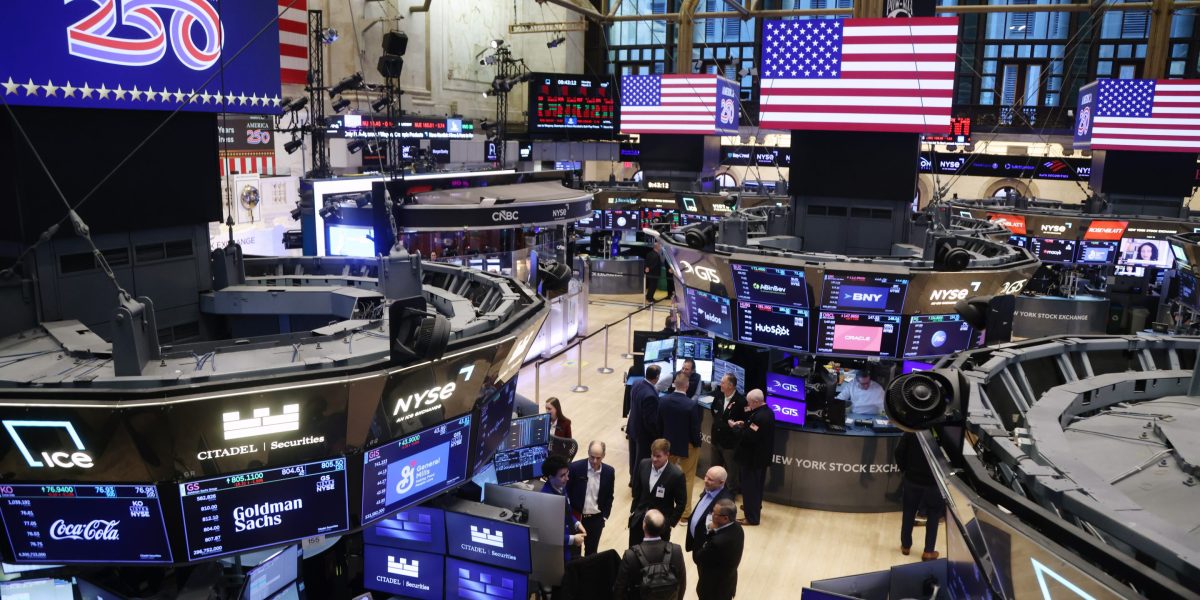
The Dow, S&P 500, and Nasdaq rebounded on Monday, with all three major averages closing firmly in green territory and reversing course in the last hour of trading.
The Dow Jones Industrial Average (^DJI) gained nearly 0.5%. The tech-heavy Nasdaq Composite (^IXIC) jumped 1.3%, while the S&P 500 (^GSPC) rose 0.5%.
The turnaround came after President Trump told CBS News that the war with Iran could end soon, sending oil prices plummeting.
“I think the war is very complete, pretty much. They have no navy, no communications, they’ve got no Air Force,” he told a CBS News correspondent.
-
Dow, S&P 500, Nasdaq rebound as Trump hints war with Iran over soon
The broader market rebounded sharply on Monday in afternoon trading after President Trump hinted to CBS News that the war with Iran could come to end soon.
“I think the war is very complete, pretty much. They have no navy, no communications, they’ve got no Air Force,” he told a CBS News correspondent.
He said the US is “very far” ahead of its initial 4-5 week estimated time frame.
-
Oil prices ease as Trump hints at plan to bring down surging energy costs
Oil prices eased from their 2022 highs on Monday as President Trump and allied countries hinted at measures to lower crude prices.
Earlier Monday morning, G7 nations met to discuss potential drawdowns from member countries’ strategic petroleum reserves, but ultimately decided to hold off.
President Trump told The New York Post on Monday he has “a plan” to bring down oil prices, which surged past $100 per barrel overnight amid fears of a prolonged Middle East conflict.
The president announced he will hold a conference at 5:30 p.m. today.
Brent crude (BZ=F) futures trimmed their gains to close more than 6% higher, above $98 per barrel. West Texas Intermediate crude (CL=F) rose 4% to settle above $94 after briefly topping $119 per barrel in overnight trading on Sunday.
-
Iran oil price shock scrambles Fed outlook, rate discussions
-
Bitcoin bounces to $69,000 as crypto shows resilience
Bitcoin (BTC-USD) climbed 2% on Monday as strategists noted crypto’s resilience amid the ongoing war in the Middle East and its potential impact on the broader market.
The token was last trading above $69,000, a level higher than when the Middle East war broke out on Feb. 28. Though the world’s largest cryptocurrency dropped after the US and Israel initially struck Iran, it has since bounced, nearing $74,000 mid-last week.
Digital assets Treasury giant Strategy (MSTR) bought 17,994 bitcoin between March 2 and March 8, the company revealed.
“With issuance fixed and large holders continuing to accumulate during volatility, sustained downside would likely require broader deterioration in liquidity conditions,” wrote Iliya Kalchev, analyst at crypto platform Nexo.
Other digital assets also jumped on Monday, with ether (ETH-USD) rising 4% to a top $2,000 per token.
-

A macro trader warns bond market stress could get ‘nasty quickly’ — and hit stocks harder
Macro strategist Alfonso Peccatiello is waving a red flag about the bond market.
In a LinkedIn note and substack, Peccatiello warned that markets may be entering another phase of forced deleveraging, as leveraged Treasury trades start to unwind.
As he put it, “When you start attacking the very foundation of financial markets — the bond market — things can get nasty very quickly.”
The issue centers on popular hedge-fund trades like swap spreads and Treasury basis trades, which involve buying Treasurys using repurchase market financing and hedging them with futures or swaps. Because those trades rely heavily on leverage, even small market moves can trigger margin calls and forced selling.
That selling may already be showing up in the price action. Long-term Treasury yields (^TNX, ^TYX) have been rising, even as investors would normally seek safety during geopolitical shocks. It’s a sign that investors may be unwinding their positions entirely rather than calmly rotating into safe havens.
Peccatiello’s broader point: When a big shock hits, markets tend to go after crowded positions first.
There may also be a political pain point. He argued that the odds of a geopolitical deal increase as the S&P 500 (^GSPC) approaches a 10% drawdown — roughly 6,280, and about where the index traded last July.
If that framework is right, the recent volatility may be less about fundamentals and more about the market clearing out leverage, with more downside in stocks to come.
-
McDonald’s french fry supplier Lamb Weston targeted by activist investor Starboard
Activist investor Starboard Value sent a letter to Lamb Weston (LW) on Monday after building a stake in the company, saying the major french fry maker should further cut costs and improve operations.
“In our view, the Company is well positioned to enter a new phase of value creation, one defined not only by normalization of industry conditions, but by a structural improvement in margins, capital allocation, and earnings power,” the letter read. “Specifically, we believe you should expand the already announced cost reduction program and conduct a strategic review of certain international operations, particularly within Asia Pacific.”
Lamb Weston’s stock rose marginally as of midday trading. The Idaho-based company is the largest french fry producer in North America and supplies fries to major fast food chains, including McDonald’s (MCD) and Chick-fil-A.
The company had previously faced activist pressure from Jana Partners. At the beginning of 2025, Michael Smith took over the CEO role as part of a leadership shakeup aimed at revamping operations.
Starboard said that while the initial $250 million cost reduction program was a “welcome first step,” an additional $250 million in cost cuts is necessary.
-
Software’s recent rally may be more short covering than comeback
Software stocks are slipping a bit today after the industry posted its best week since last April’s rebound. But this still looks more like a short-covering bounce than the start of a durable software comeback.
Since bottoming on Feb. 23, the iShares software ETF (IGV) has been positive in eight of the last nine sessions.
The problem for bulls is that the leadership beneath the surface of this market looks more consistent with de-risking than fresh risk appetite.
The sectors that got hit hardest last week in large-caps — Materials (XLB), Consumer Staples (XLP), Health Care (XLV), and Industrials (XLI) — are largely the same group that had held up best since software peaked last September.
In other words, investors appear to be selling their winning longs and buying back one of their biggest shorts, software.
The lone exception is Energy (XLE), which keeps catching a bid as crude oil and energy prices surge.
Software will eventually have its day in the sun, but for now, IGV still looks vulnerable. If it picks up again from here, watch any rebounds with suspicion — especially into key levels like the 50-day moving average near 93 or even the old breakdown area near the November lows of around 101.
-
G7 nations will not yet tap strategic petroleum reserves, France says after meeting
The Group of Seven (G7) nations will not yet collectively tap into their strategic petroleum reserves to attempt to put a lid on global oil prices, France said after a meeting of the countries on Monday morning.
“We agreed on following the situation very closely,” France’s finance minister Roland Lescure said after a virtual meeting of G7 finance ministers, according to Bloomberg. “We are ready to take all necessary measures, including using strategic reserves to stabilize the market.”
Futures on Brent crude (BZ=F), the international pricing benchmark, and US benchmark West Texas Intermediate (WTI) crude (CL=F) had both pulled back from $119 per barrel on the news early Monday that the G7 nations would meet to potentially discuss tapping their SPRs.
Oil prices on both Brent and WTI, which had temporarily slipped back below $100, began climbing again after The Wall Street Journal reported that an Iranian military commander said oil would hit $200 per barrel if airstrikes on the country’s infrastructure didn’t stop.
Over the weekend, Tehran was engulfed in black smoke and oil-infused rain following airstrikes on fuel depots outside of Tehran and other cities across the country. Outside of Iran, Bahrain’s Bapco Energies refinery and Qatar’s Ras Laffan LNG complex have declared force majeure, while Saudi Arabia’s Ras Tanura refinery has been taken offline.
Iraq, Kuwait, the UAE, and Saudi Arabia have all announced production cuts as storage has filled up with nowhere to offload oil.
-
Why a steeper yield curve isn’t helping banks this time
Big banks and regional lenders are getting hit even as the US yield curve steepens, with the 10-year yield (^TNX) up about 8 basis points over the past three days.
The Financial Select Sector SPDR Fund (XLF) is down about 4.5% over this time frame, while the SPDR S&P Regional Banking ETF (KRE) is off roughly 7% — its worst three-day slide since the April 7 washout last year.
That says this is not a simple net interest margin story. A steeper curve would normally help banks, but the market looks more focused on credit risk and a broader growth scare — especially around private credit, where recent stress around Blue Owl and BlackRock withdrawal limits and broader worries about private credit exposure have kept investors on edge.
In other words, the curve is getting friendlier, but the market is still trading financials like a credit-stress proxy. If banks cannot catch a bid on a steeper curve, that is the warning.
-
Dow Transports taking the down elevator
The Dow Transports (^DJT) are now on track for a 9% loss over the last three trading days — the biggest three-day slide since the post-“Liberation Day” wipeout last April, when they fell about 13%.
The other Dow index recently failed to clear the 20,000 level after roughly two weeks of trying — carving out a classic pennant chart formation. Now it’s breaking down hard from that wedge, shedding roughly 1,000 points — about 3% — in each of the last three sessions.
The weakness is showing up across this energy-sensitive group, in both consumer-facing and business-to-business names — from United Airlines (UAL), down over 6%, to Uber (UBER), down 3.5%, to freight and logistics name XPO (XPO), also down 3.5%.
This is still one of the clearest canaries in the coal mine. Until the transports can stabilize, it’s hard to make the case that the broader growth scare is really easing.
-
What Brent and WTI trading at parity signals for oil market
Futures on international benchmark Brent (BZ=F) and US benchmark West Texas Intermediate (WTI) crude (CL=F) both jumped up to highs of $119 in the minutes after the oil futures market reopened, and spent the evening trading at the same price point.
That the world’s two main pricing benchmarks began trading in parity marked an uncommon market dynamic.
As a general rule, WTI typically trades at a roughly $3 to $7 discount to Brent. The spread reflects differences in logistics and market access.
Brent is priced off oil produced in the North Sea and represents the global seaborne crude market — barrels that can easily be loaded onto tankers and shipped to major refining centers in Europe and Asia. Because it reflects globally traded supply, Brent typically commands a premium.
WTI, by contrast, is priced at storage hubs in Cushing, Okla. While the crude itself is high quality, the pricing point is landlocked and tied more closely to the North American pipeline system. That logistical constraint usually leaves WTI trading slightly cheaper than Brent.
When the two benchmarks trade at the same price, it typically signals that global supply risks are lifting prices across the board and overwhelming the normal logistics premium embedded in Brent. Buyers who would primarily book shipments of Brent are now looking to WTI for backfill while Brent remains unavailable — right now, locked in the Persian Gulf behind the Strait of Hormuz, where shipping has dropped to near-zero as the conflict in Iran continues to burn.
In other words: When WTI trades in parity to Brent, it’s a clear sign the global oil market is under an immense amount of stress.
-
Stocks fall at the open as oil squeeze spooks markets
US stocks opened lower on Monday as oil’s rise above $100 per barrel unleashed fears of a more severe economic impact from the war in the Middle East.
The Dow Jones Industrial Average (^DJI) sank 0.8% at the open. The tech-heavy Nasdaq Composite (^IXIC) dropped roughly 0.7%, and the S&P 500 (^GSPC) fell 0.7%.
Futures for West Texas Intermediate (CL=F) and Brent (BZ=F) crude oil traded at $99 and $102 per barrel, respectively, after spiking above $110 briefly on Sunday evening.
Treasury yields also rose, with the 10-year yield (^TNX) up 2 basis points
-
Oil volatility index hits pandemic panic levels
Overnight, WTI crude (CL=F) and Brent crude (BZ=F) briefly surged to within a hair of $120 a barrel — the highest level for both since mid-2022, in the aftermath of Russia’s invasion of Ukraine. They’ve since pulled back to around $100, but they’re still on pace for huge monthly gains with more than three full trading weeks left in March.
WTI is up more than 50% this month, a move not seen since April 2020, when oil was rebounding from negative prices. That’s also the last time the oil VIX (^OVX), calculated from USO options, traded at a higher level and above 100. Unlike the stocks VIX (^VIX), which typically rises when stocks fall, commodity volatility gauges — gold included — often climb alongside the underlying price.
Brent, meanwhile, is up more than 40% on the month, which would mark its biggest monthly gain in data going back to late 2007.
My first line in the sand was $8, which cracked on Friday. Now the key question is whether crude can hold above $100, which truly changes every playbook around the world.
-
Hims & Hers shares soar after news of deal that Novo Nordisk will distribute drugs on Hims platform
Shares in Hims & Hers Health (HIMS) soared Monday morning, picking up more than 50% in premarket trading after reports that a longstanding feud with Novo Nordisk (NVO) has ended and that the drugmaker agreed to distribute its products through the Hims platform.
Novo Nordisk shares gained 1%.
Hims and Novo Nordisk could announce a formal partnership as soon as Monday, according to Bloomberg, which broke the news. The reported deal comes after Novo Nordisk sued Hims in February, accusing the platform of distributing copycat versions of its Wegovy weight-loss pill and violating patent protections.
This marks the second time the companies have reportedly entered into a partnership of this kind. Novo Nordisk exited the first deal within two months after accusing Hims of refusing to stop distributing copycats of Novo Nordisk’s drugs.
“The big issue with Hims is that we had an agreement that the mass compounding would stop and unfortunately it didn’t stop,” Ludovic Helfgott, executive vice president of product and portfolio strategy at Novo, said in an interview quoted by Bloomberg. “That’s why we ended the partnership.”
-
Airline stocks sink amid spike in oil prices, expectations of higher ticket prices
Airline stocks sold off on Monday as spiking crude oil prices over the weekend pointed to higher jet fuel costs.
Shares of Delta Air Lines (DAL) dropped 3.1%, American Airlines (AAL) declined 3.8%, and United Airlines (UAL) fell 2.8% before the opening bell on Monday.
Airlines no longer hedge fuel prices, which account for between a quarter to one-fifth of their overall costs. On Friday, United Airlines CEO Scott Kirby said the impact of higher fuel costs on airfare would “probably start quick.”
Over the past month, the US airlines have seen stock drawdowns of between 20% and 26%.
European air carriers Lufthansa (LHA.DE) tumbled roughly 5%, while British Airways and Aer Lingus parent company International Consolidated Airlines Group (IAG.L) slid 3%. Air France-KLM (AF.PA) also declined by 3%.
-
Global bond rout grows as oil jump upends interest-rate outlook
Bloomberg reports:
-
Europe’s blue chips head for correction as oil soars
From Bloomberg:
-
Stagflation trades sweep markets as Trump signals widening war
Optimism for a quick resolution of the conflict in the Middle East is rapidly ebbing in financial markets.
Bloomberg reports:
-
G7 to discuss joint release of emergency oil reserves
The Financial Times reports:
Read more here (premium subscribers)