1 min read
US stocks sank on Thursday, with Big Tech and semiconductor stocks leading the sell-off. Conflicting messages from the US and Iran fueled mounting uncertainty over the Middle East conflict as oil hovered above $100.
The tech-heavy Nasdaq Composite (^IXIC) fell by 2.3% and entered correction territory after falling more than 10% from its all-time high. The S&P 500 (^GSPC) sank 1.7%, while the Dow Jones Industrial Average (^DJI) dropped 1% on the heels of Wednesday’s rebound for Wall Street stocks.
Big Tech was under pressure after a landmark ruling against Meta (META) and YouTube, while chip stocks tumbled amid concerns about demand following new AI algorithm developments from Google.
Markets continue to be driven by the US-Israeli war with Iran, as Tehran and Tel Aviv launched fresh strikes on Thursday amid growing warnings about the economic cost of the conflict. The sides remain at odds over a potential ceasefire, and President Trump amped up his rhetoric on Thursday, warning Iran to “get serious” and make a deal before it is “too late.”
Oil prices jumped, with Brent crude futures (BZ=F) holding firmly above $102. West Texas Intermediate (CL=F) crude moved above $94 before slightly pulling back.
Meanwhile, fears of a US recession are building as the oil rally threatens higher prices for already rattled consumers and markets assess how the Federal Reserve will approach the oil spike in its policy deliberations. Data from the Bureau of Labor Statistics published on Thursday morning showed initial jobless claims were in line with expectations.
LIVE 20 updates
-
Oil pulls back slightly after Trump extends deadline for talks with Iran for a second time
Oil prices fell on Thursday after President Trump said he was extending his deadline for Iran to make a deal with the US and reopen the Strait of Hormuz by an additional 10 days to April 6.
In a Truth Social post shortly before 4:15 p.m. ET on Thursday, Trump said he is “pausing the period of Energy Plant destruction by 10 Days to Monday, April 6, 2026, at 8 P.M., Eastern Time.”
The president added, “Talks are ongoing and, despite erroneous statements to the contrary by the Fake News Media, and others, they are going very well.”
Futures on Brent crude (BZ=F), the international pricing benchmark, fell by roughly 3% to trade below $100 per barrel in the minutes after the president’s Truth Social post announcing the extension before re-crossing the threshold. Those on US benchmark West Texas Intermediate (WTI) crude (CL=F) fell to trade below $91 per barrel before climbing back up to roughly $92.90 per barrel.
In a post last weekend, President Trump had said Iran had 48 hours to reach a deal and reopen the Strait of Hormuz, the world’s most critical global energy chokepoint, or the US would launch large-scale attacks against the country’s domestic power infrastructure.
The president extended that initial deadline by five days on Monday, with the window set to run out on Friday, writing that the US and Iran had “very good and productive” conversations.
In a post earlier on Thursday, Trump said the Iranian regime is “‘begging’ us to make a deal, which they should be doing since they have been militarily obliterated, with zero chance of a comeback.” The Iranian leadership has denied that it is considering a ceasefire with the US.
-
Nasdaq enters correction territory as tech stocks slide
The Nasdaq Composite (^IXIC) entered correction territory after dropping more than 2% on Thursday.
The tech-heavy index has dropped more than 10% from its Oct. 29 record high of 23,958.47.
Big Tech was hit on Thursday after a ruling against social media giants Meta and YouTube’s parent, Google. The S&P 500 (^GSPC) and Dow Jones Industrial Average (^DJI) fell 1.7% and 1%, respectively.
Chip stocks also got hit following Alphabet’s Google’s published research on a new algorithm designed to reduce AI memory usage, a development that rattled memory and semiconductor stocks.
Growth stocks have also come under pressure in recent weeks as rising oil prices fueled inflation expectations, reducing the likelihood that the Federal Reserve will cut interest rates this year if oil prices remain elevated.
-
‘Magnificent 7,’ chip stocks sink as tech leads market lower
Most of the “Magnificent Seven” group took a hit on Thursday as a ruling against social media giants Meta and Google weighed on the growth sector, while Google’s AI developments raised questions about demand for chip memory storage.
A recent court ruling against Meta (META) and YouTube parent Alphabet (GOOG, GOOGL) regarding social media addiction weighed on the tech giants’ shares.
Chip stocks were also taking a hit after Alphabet’s Google published research on a new algorithm designed to reduce AI memory usage, a development that rattled memory and semiconductor stocks.
Sandisk (SNDK) declined by more than 10%, while Micron (MU) also fell by 7%.
AI chipmaker Nvidia (NVDA) sank 3%.
Apple (AAPL) was the only Magnificent Seven component not in the red on Thursday.
Shares of the iPhone maker rose less than 1% after a Bloomberg report indicated that the company plans to open Siri to external AI assistants as part of an overhaul of the Apple feature.
-
10-year Treasury yield rises to 4.42% as stocks sink
The 10-year Treasury yield rose to 4.42% on Thursday as Wall Street searched for clues on the prospects of negotiations between the US and Iran, amid a spike in oil prices above $100.
Investors went risk-off during the session, as stocks sank while bond yields rose. Gold (GC=F) also sank.
Higher oil prices put upward pressure on the greenback, making assets invoiced in dollars more expensive for foreign buyers.
Strategists have noted that countries have had to sell dollar-denominated assets to protect their currencies, a move that has sent bond prices lower.
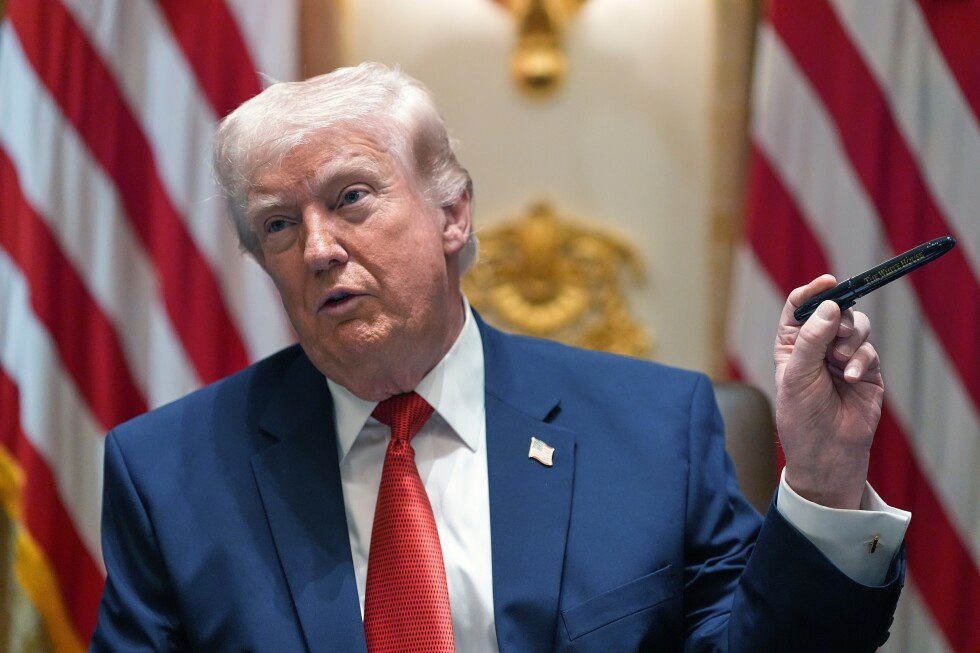
President Trump said on Thursday during a Cabinet meeting that the Iranians are “lousy fighters, but they’re great negotiators, and they are begging to work out a deal.”
He also threatened to deepen military action if talks with Iran failed.
-
‘Magnificent 7’ stocks are seeing a shocking run: Chart
Every “Magnificent Seven” stock is down double-digit percentages from its 52-week high, Yahoo Finance’s Brian Sozzi reports.
He writes:
-
Gold sinks 3% as precious metal continues to get hit
Gold (GC=F) on Thursday, extending its decline since the start of the war, as the precious metal came under pressure from expectations that central banks may need to adopt a more hawkish stance amid elevated oil prices.
Gold has dropped roughly 15% since the Iran war began, nearly wiping out its year-to-date gains.
Rising oil prices have pushed up inflation expectations, dampening optimism that the Fed and other central banks can maintain a dovish policy stance.
Amid the sharp sell-off, some analysts see a potential buying opportunity.
Read more here.
-
Jack Daniel’s owner Brown-Forman surges on report of merger talks with Pernod Ricard
Shares in Jack Daniel’s owner Brown-Forman (BF-A, BF-B) surged by more than 20% before paring gains on Thursday after Bloomberg reported that the French beverage giant Pernod Ricard (PRNDY) is in talks with the American company about a potential acquisition.
Shares in Pernod traded down by roughly 6%.
While nothing is set in stone, Pernod has had conversations with Brown-Forman leadership about a potential merger of the two companies that would see Pernod acquire the Jack Daniel’s owner, Bloomberg reported.
Brown-Forman’s portfolio encompasses a wide variety of spirits brands, including Herradura tequila, Woodford Reserve whiskey, Diplomatico rum, and Ford’s Gin, among others. Pernod’s portfolio includes Jameson whiskey, Beefeater gin, Absolut vodka, and Glenlivet scotch.
A merger of the two companies would represent a major tie-up in the alcoholic beverage industry. The move from Pernod comes as beverage distributors have been struggling with slowing sales growth as younger consumers purchase an increasingly smaller amount of alcohol.
In a major report published in August 2025, Gallup reported that only 54% of Americans say they consume alcohol, the lowest level since Gallup began conducting the poll roughly 90 years ago.
-
Trump says war-driven market pullback ‘hasn’t been nearly as severe’
Stocks continued to drift lower on Thursday afternoon after President Trump stated that the current market turmoil isn’t as punishing as he expected.
“Frankly, I thought the oil prices would go up more, and I thought the stock market would go down more,” Trump said in a Cabinet meeting on Thursday. “[The market reaction] hasn’t been nearly as severe as I thought.”
In the meeting, Trump touted that the Dow surpassed 50,000 and that the S&P 500 hit 7,000 earlier this year.
But those milestones were extremely brief: The S&P never closed above the 7,000 intraday high, and the Dow spent just four days above its high-water mark.
Currently, the S&P 500 is trading about 6.5% off its intraday high of 7,002 reached in late January. It entered a pullback — a 5% drawdown from recent highs — two weeks ago and came closer to entering a correction — a 10% decline — last Friday. The Dow is trading 7.9% off its all-time closing high of 50,188.
Still, when Trump said Thursday that market pullback would be a “short-term hit” leading to higher stock prices in the future, history suggests he has a point.
Argus analysts pointed out in a note on Thursday (premium users can download it here) that pullbacks occur frequently, and the average time for the market to recover has been one month. For a correction, the analysts said, it may take four months — however, it depends on the market fundamentals at the time.
Although the Iran war clouds the market outlook in the near term, Argus expects oil prices and interest rates to fall once the conflict ends.
“Overall, we remain optimistic that stocks can post gains in 2026,” the analysts wrote, “though our base case outlook calls for single-digit returns, not the 15%-25% returns investors have enjoyed for the past three years.”
-
Meta stock tumbles after court loss
Meta (META) stock, the biggest laggard among the “Magnificent Seven” tech stocks on Thursday, dropped around 6% in the aftermath of the social media company’s legal loss on Wednesday.
On Wednesday, a Los Angeles jury found Meta and Alphabet’s (GOOG, GOOGL) YouTube liable for damages to a young user in a landmark case that focused on the social media companies’ platform designs instead of content moderation. Google stock fell 1.8% on Thursday.
The unique approach and precedent set by the lawsuit are regarded as opening up the companies to future cases, as they showed the limits of the Section 230 law that has historically shielded social media companies from liability.
Meta also laid off 700 employees on Wednesday, in what could be part of a larger staffing change to come, while also awarding larger stock awards to top executives excluding Mark Zuckerberg. If Meta’s market cap tops $9 trillion, executives will earn nine-figure stock awards.
-
Fannie Mae set to begin accepting crypto-backed mortgages with Better Home and Coinbase product
Mortgage-backed securities giant Fannie Mae (FNMA) is set to soon begin accepting cryptocurrency-backed mortgages, according to an announcement on Thursday from mortgage originator Better Home & Finance (BETR) and the crypto exchange Coinbase Global (COIN).
Shares in Better Home surged as much as 12% following the announcement, while Coinbase traded down by roughly 1.1%. Fannie Mae traded slid by roughly 4.6% in the over-the-counter market, according to Yahoo Finance data.
A new product launched by the two companies will allow individuals to originate mortgages with Better Home that conform to Fannie Mae standards while using bitcoin (BTC-USD) or USD Coin (USDC-USD) as collateral for the loan, the companies said in a press release on Thursday.
The launch of the “token-backed mortgage product marks the first time an AI-native mortgage lender has used secured digital asset loans and the platform of a major crypto exchange to create a direct pathway from digital wealth to homeownership,” Better said.
The products “empower Americans who own digital assets but lack sufficient downpayment funds, or prefer to keep downpayment funds liquid, to secure a home loan by pledging their tokenized assets as collateral,” the company said.
While the offering is not the first cryptocurrency mortgage product to reach the market, the Wall Street Journal reported, the involvement of Fannie Mae brings crypto products more into the mainstream financial system, as Fannie is backed by the federal government and managed by the Federal Housing Finance Agency.
A survey by Redfin in 2025 found that more than 10% of millennial and Gen Z homebuyers sold crypto holdings to help fund their down payments, the Journal reported.
-
Wave stock sinks as results for weight-loss drug fall below expectations
Shares in the pharmaceutical company Wave Life Sciences (WVE) fell nearly 60% after the opening bell on Thursday on disappointing results that showed higher doses of its signature weight-loss drug were less effective than expected.
The drop in the company’s share price was its largest on record, according to Bloomberg.
Wave, which produces the weight-loss drug WVE-007, positions itself as a competitor to the pharmaceutical giants Novo Nordisk (NVO) and Eli Lilly (LLY). Novo Nordisk makes Ozempic and Wegovy, while Eli Lilly produces Zepbound — all highly popular GLP-1 weight-loss drugs.
Wave’s WVE-007 is intended to achieve the same weight-loss results as the drugs made by Novo Nordisk and Eli Lilly, but with far less frequent treatments and without the GLP-1 side effect of muscle loss alongside fat loss.
Previous studies of WVE-007 showed that a 240-milligram dose reduced total fat mass by 5% without loss of lean mass. Test results released by Wave on Thursday, however, showed that a larger 400 milligram dose cut total fat mass by less than 1% and less than a 0.2% loss in lean mass, performing below analyst expectations for the higher dosage.
The company partially attributed the difference to the fact that the 400 milligram cohort “had a leaner baseline body composition, with lower BMI and more participants … with healthy levels of visceral fat,” which “emphasize the impact of baseline body composition on therapeutic effect and support expectations that evaluating individuals with higher BMI and visceral fat at baseline will lead to greater improvements in body composition and weight loss,” the company said.
-
Jobless claims increase slightly
US claims for unemployment benefits rose slightly in a sign that the labor market continues to hold steady.
Initial jobless claims increased by 5,000 to 210,000 for the week ending March 21, the Labor Department reported Thursday. That was in line with economists’ expectations for 210,000 initial claims.
Continuing claims, which track the unemployed population still seeking work, decreased to 1.82 million from a revised level of 1.85 million the week before. That was the lowest level for continuing claims since May 25, 2024, the Labor Department said.
The data suggested little change to softened labor conditions, which have been marked by low job gains but not widespread layoffs in recent months.
-
US stock market turns down at the opening bell
The US stock market turned red on Thursday as uncertainty surrounding the war in Iran continued to drive investor fears.
The S&P 500 (^GSPC) slid by roughly 0.8%, while the Dow Jones Industrial Average (^DJI) fell a slimmer 0.4%. The tech-heavy Nasdaq Composite (^IXIC) moved roughly 1% lower.
The war in Iran continues to drive markets, as each update from President Trump and subsequent responses from the Iranian leadership swing investor sentiment. Brent crude futures (BZ=F) held above $100 as the mixed signals dampened earlier hopes for an imminent easing in hostilities. West Texas Intermediate (CL=F) crude moved above $94 before slightly pulling back.
Data from the Bureau of Labor Statistics published on Thursday morning showed 210,000 initial jobless claims, in line with expectations and slightly above last week’s 205,000 initial claims.
-
JetBlue considering a sale: Report
JetBlue’s (JBLU) stock fell as much as 4% in premarket trading on Thursday after a 13% gain the day before.
The airline is reportedly considering a sale and has asked advisers to evaluate how an acquisition by United Airlines (UAL), Alaska Airlines (AAL), or Southwest Airlines (LUV) would go over with regulators in Washington, Semafor reported on Wednesday. Those three airlines were down about 2% on Thursday.
JetBlue, considered the sixth-largest airline in the US, has been working to turn around its business after its planned merger with Spirit Airlines fell through in 2024 when regulators blocked it on antitrust grounds.
The airline has struggled with profitability as more cost-conscious travelers fly Frontier (ULCC) or Spirit Airlines, while Delta’s (DAL) and United’s premium offerings have drawn travelers at the higher end of the income scale.
-
Premarket trending tickers: Olaplex, SSR Mining, Newmont, and AppLovin
Olaplex (OLPX) stock soared 50% before the bell on Thursday, following the news that German company Henkel (HEN3.DE) will acquire the hair-care brand for around $1.4 billion.
SSR Mining (SSRM) and Newmont (NEM) stocks fell roughly around 3% during premarket hours today. Mining stocks have suffered some volatility over recent weeks due to the war in Iran and the fluctuations in the price of gold (GC=F), which was down 2% today.
AppLovin (APP) stock fell 7% before the bell on Thursday. So far this year, the mobile company’s shares have risen over 20%.
-
Fed’s Miran favors looking through oil price spike, says concern is about job market
-
Google memory breakthrough prompts global chipmaker sell-off
Bloomberg reports:
-
BlackRock’s Kapito warns investors are mispricing Iran risks
From Bloomberg:
-
Super Micro Computer sued by shareholders over fraud
Reuters reports:



![i’m-nervous,-too!-[part-2]](https://10xwealthreport.com/wp-content/uploads/2026/03/177042-im-nervous-too-part-2-1568x784.jpg)