Here are the top stories to read ahead of Friday trading:
Latest Updates
Signs that consumers’ outlook on the economy has started to improve contributed to stocks’ jubilant mood on Friday, one strategist said.
“The consumer sentiment was really good this morning, so some of the jitters around the economy going into recession are starting to recede,” said Chris Zaccarelli, chief investment officer at Independent Advisor Alliance, during an interview with MarketWatch.
This has helped to boost stocks, setting the S&P 500 up for a fifth straight daily advance.
Investors also appeared to be reacting favorably to the prospect of a 50 basis point interest-rate cut by the Federal Reserve, although some have said that such a dramatic move could rattle markets. The Fed is expected to cut interest rates for the first time since 2020 next week.
“The jury is still out on that,” Zaccarelli said, about how stocks might react to a larger cut.
Here is where stocks stood in recent trade:
The S&P 500 was up 27 points, or 0.5%, at 5,623.
The Nasdaq Composite was up 106 points, or 0.6%, at 17,675.
The Dow was up 275 points, or 0.7%, at 41,370.
Treasury yields may be falling alongside the U.S. dollar on Friday as traders amp up bets on a 50 basis point interest-rate cut by the Federal Reserve next week. But so far, stocks appear unfazed.
Instead, investors are capping off what has been a strong rebound this week with a broad-based rally. The Dow was up 300 points in recent trade while all 11 S&P 500 sectors were in the green, according to FactSet data.
Rising crude-oil prices helped boost shares of energy and materials stocks, which were leading the S&P 500 higher on Friday. Meanwhile, shares of the Magnificent Seven group of Big Tech stocks were mixed, with shares of Nvidia Corp. lower on the session.
A drop in shares of Adobe was also helping to weigh on information-technology stocks. The sector was the worst performer in the S&P 500 on Friday.
Here is where stocks stood in recent trade:
The S&P 500 was up 19 points, or 0.4%, at 5,615.
The Nasdaq Composite was up 49 points, or 0.3%, at 17,618.
The Dow Jones Industrial Average was up 258 points, or 0.6%, at 41,351.
Each of the S&P 500’s sectors was rising Friday morning, on track to potentially all book back-to-back gains for the first time this year as the U.S. stock market broadly advanced.
The last time all 11 of the S&P 500’s sectors saw back-to-back daily gains was at the end of October, according to Dow Jones Market Data. The S&P 500 was up 0.5% Friday morning, with its healthcare sector posting the smallest gain at around 0.3%, FactSet data show, at last check.
As for other major U.S. stock benchmarks, the Dow Jones Industrial Average was climbing 0.7% Friday morning, while the technology-heavy Nasdaq Composite increased 0.6%.
Former Federal Reserve economist Claudia Sahm said the Federal Reserve should cut interest rates by 50 basis points next week as the U.S. labor market has weakened. Although data don’t yet support the notion that the economy has entered a recession.
Her namesake “Sahm rule,” an early recession indicator, triggered over the summer. But Sahm disputed the notion that this means the U.S. is already in a recession, as the rule has suggested in the past.
Instead, the data are pointing to a slowdown. But there is still time for the Fed to act to prevent a more pronounced downturn. Demand for workers is weakening, and this should be enough to convince the Fed to take more dramatic action, she said.
“We’ve already seen enough weakening in demand for workers that it ought to jumpstart the Fed into action. The Fed doesn’t typically wait for a recession to start acting” Sahm said told CNBC on Friday.
Adobe’s stock is down 9.8% in Friday action to pace S&P 500 laggards, after the software company came up short with its quarterly outlook an afternoon earlier. Still, many analysts were upbeat about the company’s positioning.
“Despite the moving parts on guidance, commentary on in-quarter trends was still bullish, with the company seeing strength in Creative Cloud driven by new subscriptions, Education, demand for Express offerings, early monetization of Firefly services and customers stepping up to higher-value creative plans at renewal, all of which bode well for future growth,” Deutsche Bank’s Brad Zelnick wrote.
William Blair’s Jake Roberge added that “while this was not the cleanest quarter for Adobe, we remain positive on the long-term trajectory of the business, especially as it relates to the company’s ability to capitalize on the opportunity” with generative artificial intelligence.
Shares of RH, formerly known as Restoration Hardware, soared 22% early Friday to put them on track for their biggest one-day gain in four years, as Stifel said the company’s latest earnings are another check for the bull case.
RH said late Thursday it has seen an acceleration in demand for its furniture and home furnishings through the year with demand perking up anew in July and August, even as the broader housing market remained challenging.
The update was better than feared “while illuminating a consistent/robust demand acceleration that is a clear point of differentiation amid mixed premium furnishings trends and negative investor sentiment,” Stifel analyst W. Andrew Carter wrote in a note to clients, as he reiterated his buy rating on the stock.
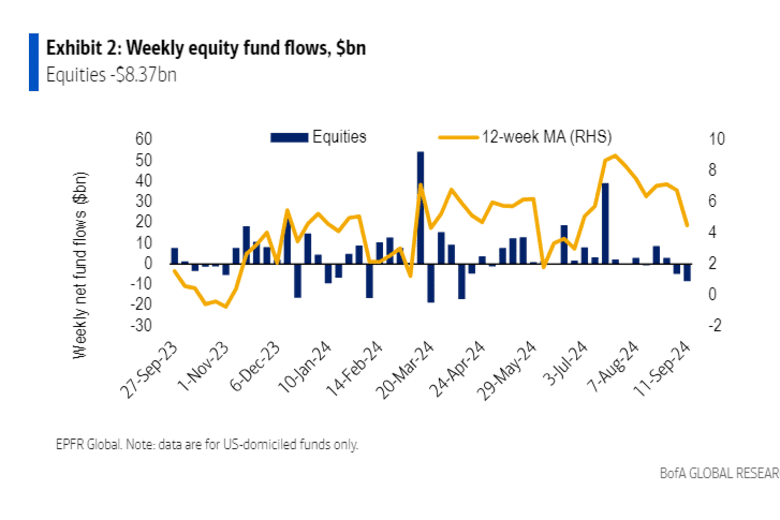
Flows out of U.S. equity funds reached $8.37 billion in the past week, according to BofA Global (EPFR Global, BofA Global)
Investors pulled another $8.4 billion out of U.S.-based stock-market funds in the past week, according to BofA Global.
Flows into stocks have been weak since last month, but turned negative over the past two weeks, when looking at activity through Sept. 11.
U.S. equities whipsawed in the past week on jitters about whether the Federal Reserve might be behind the curve on cutting rates. Investors remained locked in debate about whether an ordinary cut of 25 basis points is needed at next week’s Fed meeting, as opposed to something bigger.
In the past week, U.S. stock funds logged their biggest outflow in five months, while bond funds that invest in highly rated corporate debt brought in $5.75 billion, according to BofA Global.
Wells Fargo & Co.’s latest regulatory ding was met largely with shrugs from a couple of Wall Street analysts, but the bank provided no clue on other bigger challenges it faces with federal bank cops.
Wells Fargo continues to work through eight existing consent orders issued by the Office of the Comptroller of the Currency (OCC) as well as a $1.95 trillion asset cap imposed in 2018 by the U.S. Federal Reserve, Jefferies analyst Ken Usdin said in a research note.
“We still do not have a clear view of when asset-cap removal would come in any event, much less if additional actions like today’s could alter the path further,” Usdin said in a research note. “We believe WFC continues to work hard on all the outstanding orders.”
U.S. stocks opened higher on Friday, as the S&P 500 headed for a fifth-straight daily gain.
The Dow, S&P 500 and Nasdaq Composite have risen sharply this week, shaking off their latest pullback. All three were on track to tally their biggest advance since the week ended Aug. 16, according to Dow Jones Market Data.
Here is where stocks stood in recent trade:
The S&P 500 was up 13 points, or 0.3%, at 5,610.
The Dow was up 170 points, or 0.4%, at 41,255.
The Nasdaq Composite gained 26 points, or 0.2%, at 17,596.
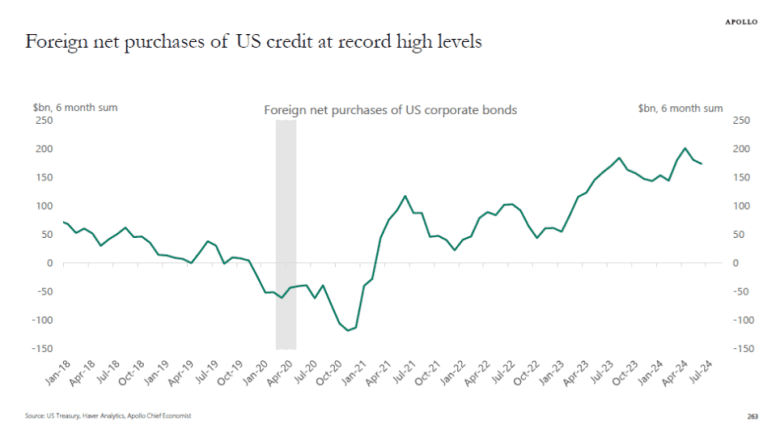
Investors are back big in U.S. credit, bond issued by American companies, as the Federal Reserve gears up to cut rates for the first time in four years. (U.S. Treasury, Apollo Chief Economist)
Investors outside of the U.S. have been snapping up a near record amount of corporate bonds as the Federal Reserve gears up to cut interest rates for the first time in four years.
Net buying by foreign investors of U.S. corporate bonds, or “credit,” tumbled into negative territory during the pandemic, but it also reached a nearly record high of about $200 billion earlier this year, according to Torsten Slok, chief economist at Apollo Global Management.
Wall Street has been trying to convince investors clinging to cash earning roughly 5% in recent years to lock in bond yields before rate cuts occur.
At the same time, U.S. corporations issued a deluge of new debt to kick off September, largely avoiding the jitters seen in the stock market. Equities have whipsawed ahead of the Fed’s expected pivot to rate cuts at next week’s central bank meeting.


![i’m-nervous,-too!-[part-2]](https://10xwealthreport.com/wp-content/uploads/2026/03/177042-im-nervous-too-part-2-1568x784.jpg)