Updated 1 min read
In This Article:
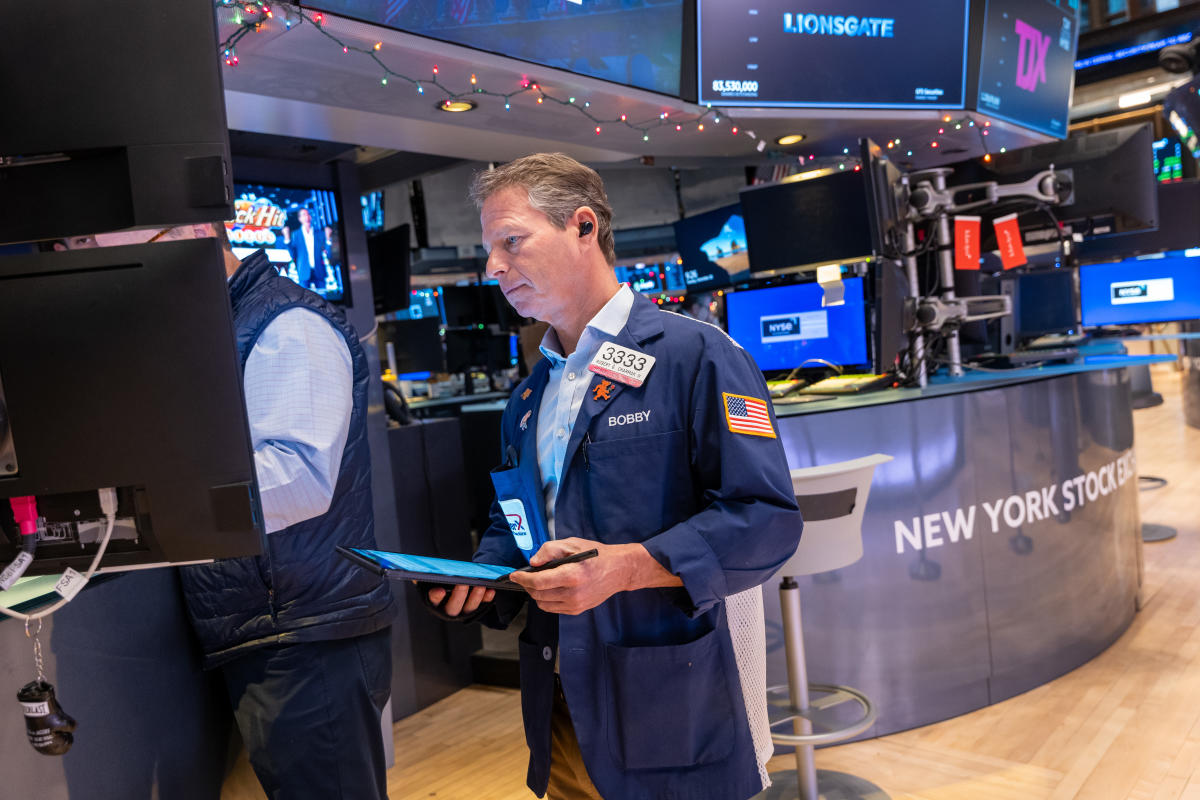
US stocks rallied in the final, shortened trading session before the Christmas holiday. The benchmark S&P 500 (^GSPC) finished the session up over 1.1%, while the tech-heavy Nasdaq Composite (^IXIC) rose roughly 1.4%. The Dow Jones Industrial Average (^DJI) climbed around 0.9%.
Wall Street successfully entered its Christmas break rejuvenated, after tech stocks including AI chip giant Nvidia (NVDA) led the march higher. Markets closed at 1 p.m. ET and are off tomorrow for Christmas Day.
Sizable gains in the past three trading sessions have put the indexes back on the path toward their record highs, from which they took a Fed-fueled nosedive last week.
Wall Street is reassessing the path of interest rates next year as it grapples with the reality that the Fed mostly pulled off a so-called soft landing — but couldn’t fully shake the US economy’s inflation problem. According to the CME FedWatch tool, most bets are on two coming holds at the Fed’s January and March meetings, followed by a toss-up in May.
Meanwhile, many eyes continue to be trained on Nvidia, which ticked up again Tuesday after a 3.5% gain on Monday. As Yahoo Finance’s Dan Howley writes, 2024 was Nvidia’s year, with the stock up some 180%. But 2025 could contain plenty of challenges.
LIVE COVERAGE IS OVER 9 updates
-
Stocks rally to cap off Christmas Eve trading
US stocks leaned into the start of the “Santa Claus” rally in the final, shortened trading session before the Christmas holiday.
The benchmark S&P 500 (^GSPC) finished the session up 1.1%, while the tech-heavy Nasdaq Composite (^IXIC) rose roughly 1.4%. The Dow Jones Industrial Average (^DJI) climbed around 0.9%.
-
Wall Street is concerned about an inflation resurgence
Inflation has been one of the top concerns for the US economy in 2024. And it looks like fears over sticky prices will continue in 2025.
“We expect a gradual deceleration from where we are, but to levels that are still uncomfortably high for the Fed,” Deutsche Bank chief economist Matthew Luzzetti told Yahoo Finance in an interview.
So far this year, inflation has moderated but remains stubbornly above the Federal Reserve’s 2% target on an annual basis, pressured by hotter-than-expected readings on monthly “core” price increases, which strip out volatile food and energy costs.
In November, the core Personal Consumption Expenditures (PCE) index and the core Consumer Price Index (CPI), both closely tracked by the central bank, rose 2.8% and 3.3%, respectively, over the prior-year period.
“Inflation is primarily going to be driven by the services side of the economy,” Luzzetti said, calling out core services like healthcare, insurance, and even airfares. “Shelter inflation is also still high, and although it’ll come down over the next year, it’s likely that it could remain somewhat elevated.”
According to updated economic forecasts from the Fed’s Summary of Economic Projections (SEP), the central bank sees core inflation hitting 2.5% next year, higher than its previous projection of 2.2%, before cooling to 2.2% in 2026 and 2.0% in 2027.
This largely aligns with Wall Street’s current projections. Out of the 58 economists surveyed by Bloomberg, the majority see core PCE moderating to 2.5% in 2025. Still, they do expect less of a deceleration in 2026, with the bulk of economists anticipating a higher 2.4% reading compared to the Fed.
“The risks are certainly tilted in the direction of higher inflation,” Nancy Vanden Houten, lead US economist at Oxford Economics, told Yahoo Finance. “A lot of the risk comes from the possibility of certain policies being implemented under the Trump administration on tariffs and on immigration.”
President-elect Donald Trump’s proposed policies, such as high tariffs on imported goods, tax cuts for corporations, and curbs on immigration, are considered potentially inflationary by economists.
Those policies could further complicate the Federal Reserve’s path forward for interest rates, with the central bank now seeing just two rate cuts next year.
-
Spotify stock’s massive run-up didn’t happen by accident. Here’s how it got there.
At the end of 2022, Spotify (SPOT) stock was trading below $80 a share after a disastrous year for investors that erased over $35 billion from the company’s market cap.
Today, shares are trading at just under $500. The audio giant is on track to hit full-year profitability for the first time ever. And its market cap? About $100 billion, up from just $15 billion two years ago.
The company’s colossal run-up in stock price follows an intense business overhaul that’s included everything from mass layoffs and C-suite shakeups to a major strategic shift away from podcasts, an area it had aggressively pursued.
At the company’s 2022 Investor Day, Spotify set seemingly lofty objectives that included long-term gross margin targets between 30% and 35%. At the time, the company had been struggling to turn a profit, with its gross margin stuck at around 25%.
In the most recent quarter, Spotify said its gross margin increased to 31.1% from the prior year’s 26.4%.
“We’ve never been in a stronger position, thanks to what’s really been an outstanding execution by the Spotify team,” CEO Daniel Ek said during the company’s fiscal third quarter earnings call in November. He added, “We are where we set out to be, if not a little bit further, and on a steady path toward achieving our long-term goals.”
-
Biden set to decide fate of US Steel sale
President Biden is set to decide the fate of Japanese-owned Nippon Steel’s (NISTF, 5401.T) $15 billion bid for US Steel (X).
The Committee on Foreign Investment in the US (CFIUS) referred the deal to Biden on Monday after failing to reach a consensus. The president has 15 days to review the deal, which he has long opposed.
Despite the deal’s uncertainty, shares of US Steel Corporation edged higher on Tuesday, rising just under 1%.
-
Bitcoin prices rise to trade above $98K
Bitcoin (BTC-USD), one of the biggest beneficiaries of the post-election rally, rose over 5% to trade above $98,000 a coin. Although the cryptocurrency lost some momentum after hitting above $100,000 earlier this month, investors and analysts remain mostly bullish heading into 2025.
Trump’s win in November pushed bitcoin prices to all-time highs in the immediate aftermath of the election, with the administration viewed as generally more friendly to the alternative asset class.
In July, Trump attended a bitcoin conference in Nashville and has since pledged to usher in more supportive regulation. His promises also included appointing a crypto Presidential Advisory Council and firing current SEC Chair Gary Gensler, who announced he would step down on Jan. 20.
Other cryptocurrencies and crypto-adjacent names echoed bitcoin’s moves to the upside. Ethereum (ETH-USD) rose about 7% to trade around $3,500 a coin.
Meanwhile, shares of MicroStrategy (MSTR), which owns nearly 280,000 bitcoins, rose around 6%. The company recently announced the purchase of an additional 51,780 bitcoins for $4.6 billion. MicroStrategy now holds $16.5 billion worth of bitcoin.
Coinbase (COIN), which allows crypto trading on its platform, saw shares rise nearly 3%.
-
The start of the ‘Santa Claus’ rally
It’s the start of the so-called Santa Claus rally.
Historically, the stock market has seen gains from the last five trading sessions of December through the first two trading days of January.
So far, markets are embracing the Christmas spirit, with all three major indexes trading firmly in the green.
The tech-heavy Nasdaq led the way higher in late morning trade, up about 1%. Tesla (TSLA), Arm Holdings (ARM), and Broadcom (AVGO) saw the largest gains within the index, rising 5%, 4%, and 3%, respectively.
Most sectors also traded in the green, with Consumer Discretionary (XLY), Energy (XLE), and Tech (XLK) the three biggest gainers of the morning session. Health care (XLV) was the biggest laggard, dragged down by drug manufacturer Viatris (VTRS) and insurance company Cigna (CI).
-
Crisis averted: American Airlines stock recovers after flights briefly grounded
American Airlines (AAL) briefly grounded all flights nationwide due to a technical issue earlier this morning.
The FAA lifted the ground stop at around 8 a.m. ET. American Airlines said in a statement that “a vendor technology issue briefly affected flights this morning. That issue has been resolved, and flights have resumed.”
The ground stop lasted for about an hour. Shares initially fell over 5% in premarket trading on the news. They’ve since recovered most of those losses, but are still down a little over 1% shortly after the opening bell.
The development comes during a busy holiday travel day with the TSA expecting to screen nearly 30 million people from Dec. 19 through Jan. 2.
-
Stocks open higher to kick off shortened trading day
In the final sprint to the Christmas holiday, markets added to gains.
The tech-heavy Nasdaq Composite (^IXIC) led the way higher, rising roughly 0.3%. The benchmark S&P 500 (^GSPC) edged up about 0.2%, while the Dow Jones Industrial Average (^DJI) hugged the flatline.
Markets close at 1 p.m. ET today and are off tomorrow for Christmas Day.
-
Good morning. Here’s what’s happening today.




![i’m-nervous,-too!-[part-2]](https://10xwealthreport.com/wp-content/uploads/2026/03/177042-im-nervous-too-part-2-1568x784.jpg)