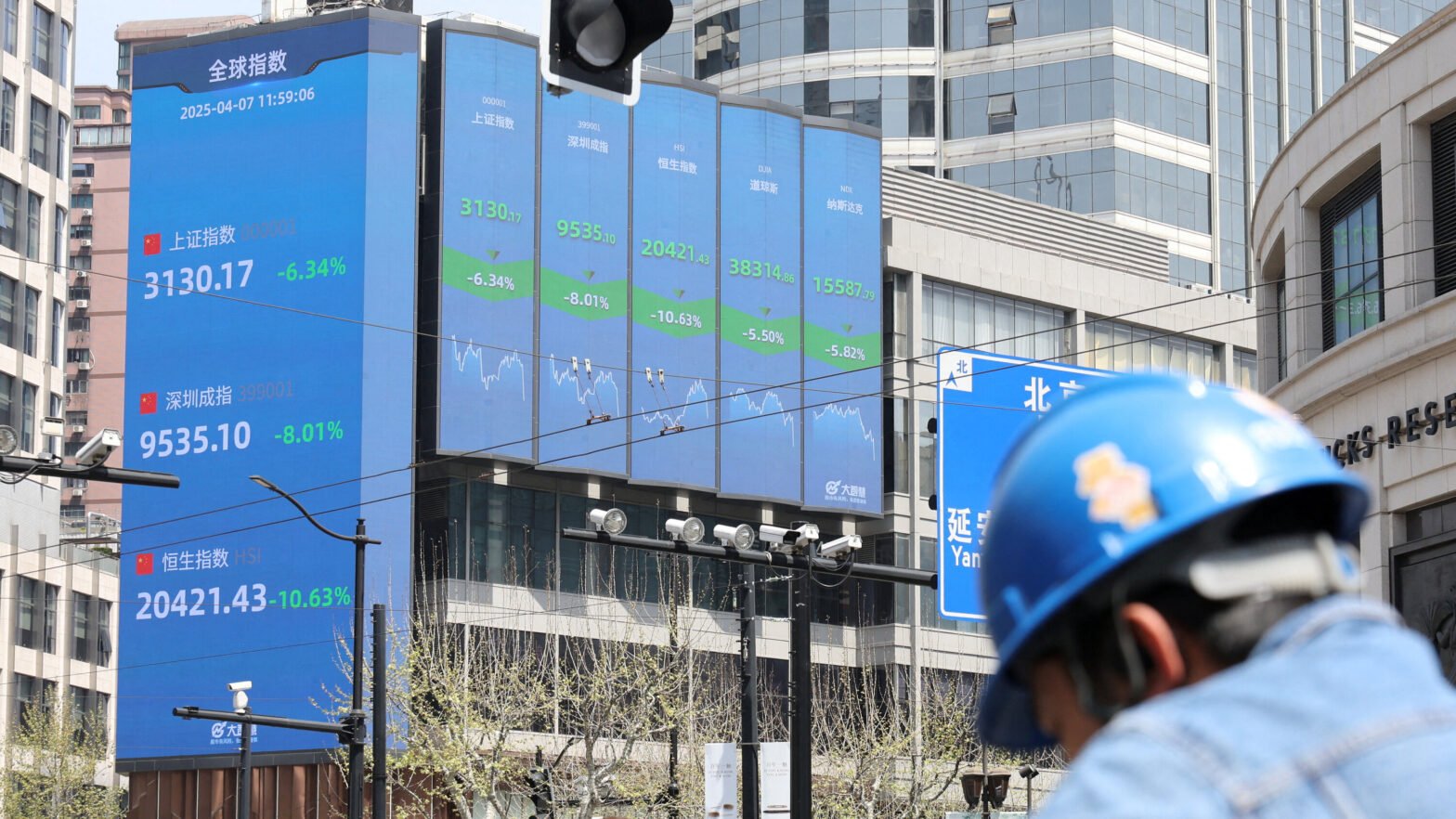

Stocks around the world nose-dived on Monday, and the S&P 500 was poised to drop again, as President Trump’s trade war makes investors increasingly pessimistic about the economy. Mr. Trump defended his global tariffs, saying they were bringing the United States billions of dollars in revenue.
Asian and European markets extended their sell-off, and Wall Street was bracing for more chaos when trading opened. The S&P 500, which is already 17.4 percent below its February peak, was nearing a bear market, defined as a drop of 20 percent or more from a recent high. The benchmark U.S. index was set to open about 2 percent lower on Monday, according to futures trading.
The rout in global markets reflected deepening concern that Mr. Trump’s significant new taxes on U.S. imports could disrupt global supply chains, cause inflation to accelerate and spark a severe economic downturn. “There’s no sign yet that markets are finding a bottom and beginning to stabilize,” analysts at Deutsche Bank wrote in a note.
Mr. Trump showed no sign of pulling back from his tariffs, saying in a social media post on Monday morning that the Federal Reserve should cut interest rates, a move that the Fed chairman has warned could fuel inflation. Earlier, Mr. Trump had dismissed concerns that his steep new taxes on imports would lead to higher prices, calling them “a very beautiful thing.”
Here’s what else to know:
-
Asia and Europe: The main stock index in Hong Kong, where many mainland Chinese companies trade, plunged over 12 percent. In Taiwan, a hub for global technology, stocks lost nearly 10 percent of their value. The benchmark pan-European index, the Stoxx Europe 600, was down about 4 percent.
-
Oil prices: U.S. oil prices briefly dipped below $60 a barrel on Sunday, their lowest level in almost four years, in another sign of concern about a slowing economy. Cheaper oil is generally good for consumers and businesses that use gasoline, diesel and jet fuel. But if prices remain around these levels or fall further, American oil and gas companies are likely to slow drilling, cut spending and lay off workers.
-
Cryptocurrency: Since Mr. Trump announced his global tariffs last week, the price of Bitcoin has plunged 10 percent, dropping below $78,000 on Sunday night. The decline shows that Bitcoin, often pitched as a stable long-term source of value, is still subject to market gyrations.
-
Girding for a trade war: China’s leaders, after retaliating against Trump’s tariffs on Friday, said on Sunday that they were prepared for a trade war with the United States, and that China could potentially come out stronger as a result. The commentary highlights how Beijing hopes to project strength while presenting itself as a responsible global power championing fair trade.
-
Your money: The market turmoil has caused worry for many people, not least those nearing retirement who may need to access funds in the near future. But timing the market on this or any other basis is hazardous, experts say.

Kevin Hassett, the head of the White House National Economic Council, said on Monday morning that the White House had been entertaining offers for deals to ease President Trump’s expansive tariffs. But Hassett, who appeared on Fox News, sought to set a high bar for the sort of deal that the administration would be willing to accept. “If they come to us with really great deals that advantage American manufacturing and American farmers, I’m sure he’ll listen,” Hassett said, referring to the president and saying that the administration had heard from about 50 countries. Asked if any of those nations had proposed attractive terms, Hassett said he had “seen some deals that are great,” but added of the president: “After decades and decades of mistreating American workers, it’s going to be tough to get him to decide to really come to the table and sign on the dotted line.”
Image

The billionaire oil trader Andrew Hall, in a post on Instagram, takes aim at other financiers for their silence. “I am no fan of Mr. Ackmann,” he writes, referring to hedge funder and Trump backer Bill Ackman, who has called on the president to pause the tariffs, “but at least he is willing to reverse himself and call out this stupidity. Where are the other ‘financial titans’? Why aren’t they speaking up?”
Tracking Trump’s Tariffs
-
“Reciprocal”
60+ countries
Note: Goods imported from Mexico and Canada covered under the USMCA trade pact received a temporary reprieve from new tariffs.

Image
The British government eased rules on carmakers requiring them to shift toward selling electric vehicles, as officials sought to blunt some of the pain caused by new auto tariffs on foreign cars sold in the United States.
British officials said on Sunday that they would keep the requirement to stop the sale of new gasoline and diesel cars by 2030, but gave carmakers more flexibility to meet annual targets on electric vehicle sales between now and the 2030 deadline, so they could sell more cars in later years when demand is expected to be higher and face lower penalties. Officials also said that hybrid cars could be sold until 2035.
Last month, President Trump announced a 25 percent tariff on imported cars and auto parts, upending the complex supply chains that underpin the global auto industry. The tariffs on cars imported into the United States came into effect last week and a levy on parts is set to begin next month.
“Global trade is being transformed so we must go further and faster in reshaping our economy,” Keir Starmer, Britain’s prime minister, said in a statement.
On Saturday, the British luxury automaker, Jaguar Land Rover, said that it was pausing shipments to the United States this month, as it assessed the altered trading conditions. The United States is the largest single-country export market for British cars, with 6.4 billion pounds’ ($8.3 billion) worth of vehicles shipped there in 2023. That’s about a tenth of Britain’s overall exports in goods to the United States.
Even before the latest tariffs by the Trump administration, Britain’s car industry was struggling. Last year, car production dropped to its lowest level in seven decades.
The Society of Motor Manufacturers and Traders, an industry group, welcomed the government’s changes to the electric-vehicle mandate but said that more action was probably needed to increase consumer demand for these cars.
“Industry remains committed to decarbonizing road transport,” Mike Hawes, the chief executive of the group, said in a statement. The targets in the electric vehicle mandate “are incredibly challenging, especially with a paucity of consumer demand and geopolitical upheaval,” he added.
The government also exempted small-volume, high-end manufacturers, such as McLaren and Aston Martin, from the rules. And vans with an internal combustion engine will also be allowed to be sold until 2035, alongside hybrid vans.
So far, the British government has resisted hitting back with retaliatory tariffs on goods it imports from the United States. The Trump administration imposed a “base line” 10 percent tariff on goods from Britain, but not additional “reciprocal” levies that apply to many other countries. Mr. Starmer has said that he remained “calm” and was working toward negotiating a trade deal with the United States, focused on technology.
But the government was ready to intervene where needed to “shelter British business from the storm,” the prime minister wrote in The Sunday Telegraph.
One hedge fund manager, Ricky Sandler of Eminence Capital, is kinda-sorta-maybe beginning to see a bottom to the market fall. He wrote in a late night post on X that his fund began adding to its positions in some stocks such as Amazon that he saw as oversold. He cautioned: “I don’t think stocks broadly are some amazing bargain yet so I am not making an overly bullish call”
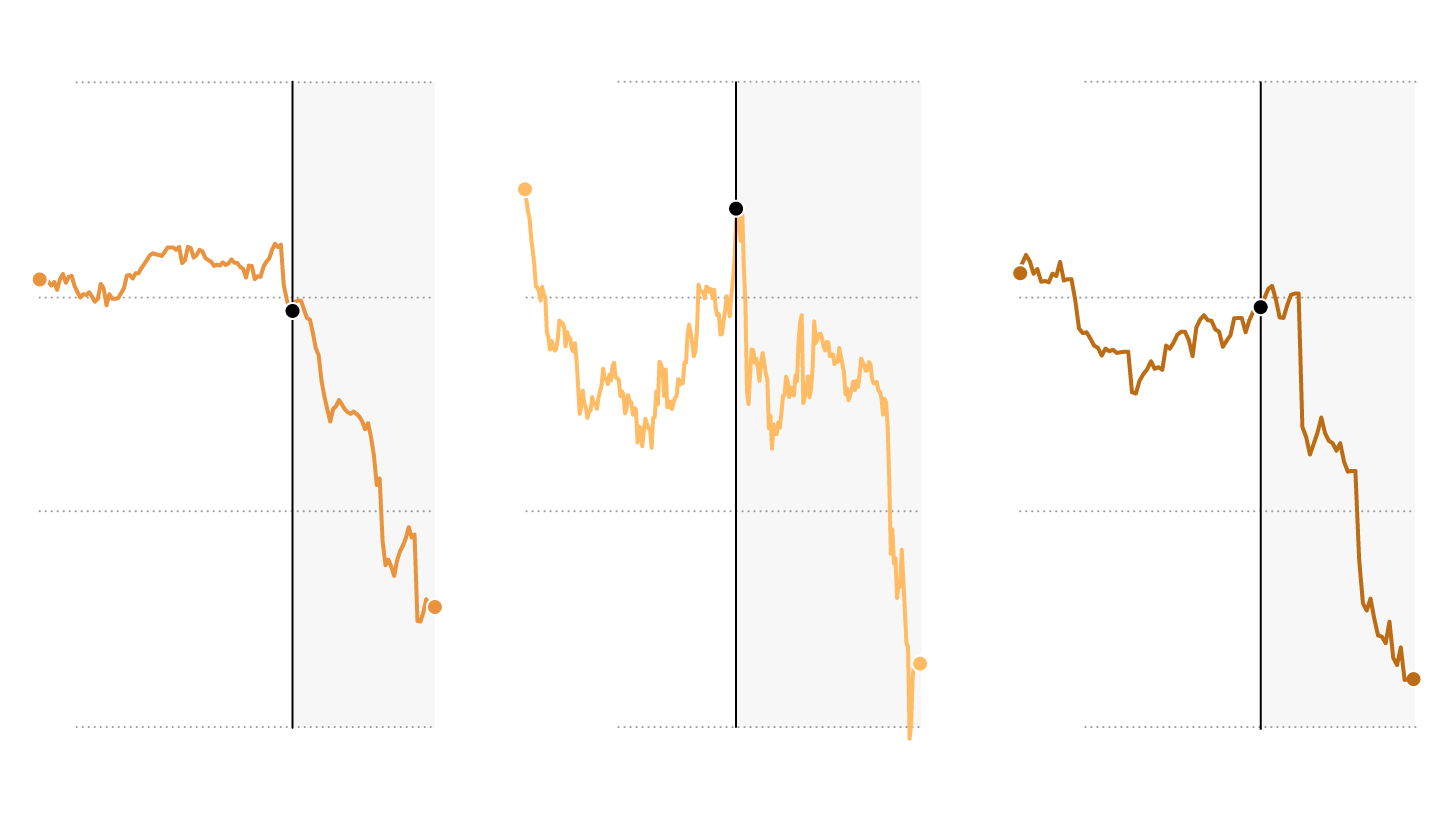
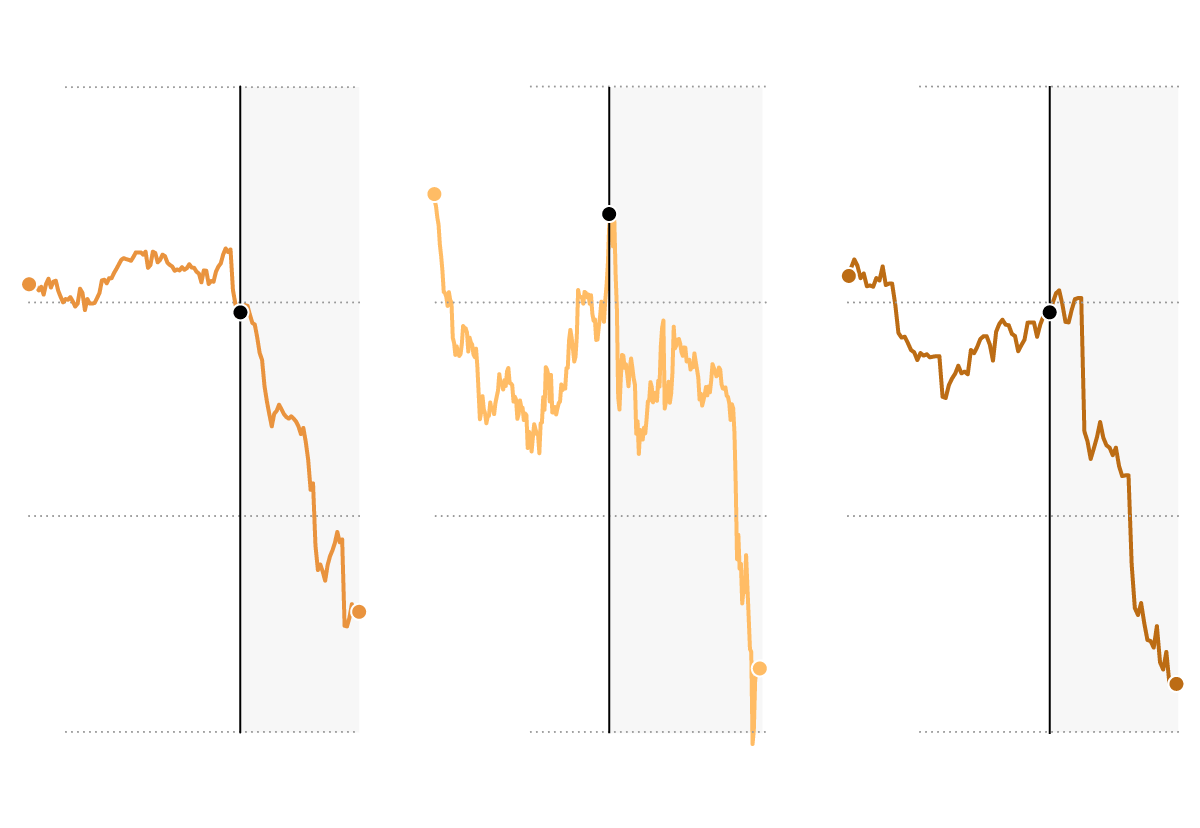
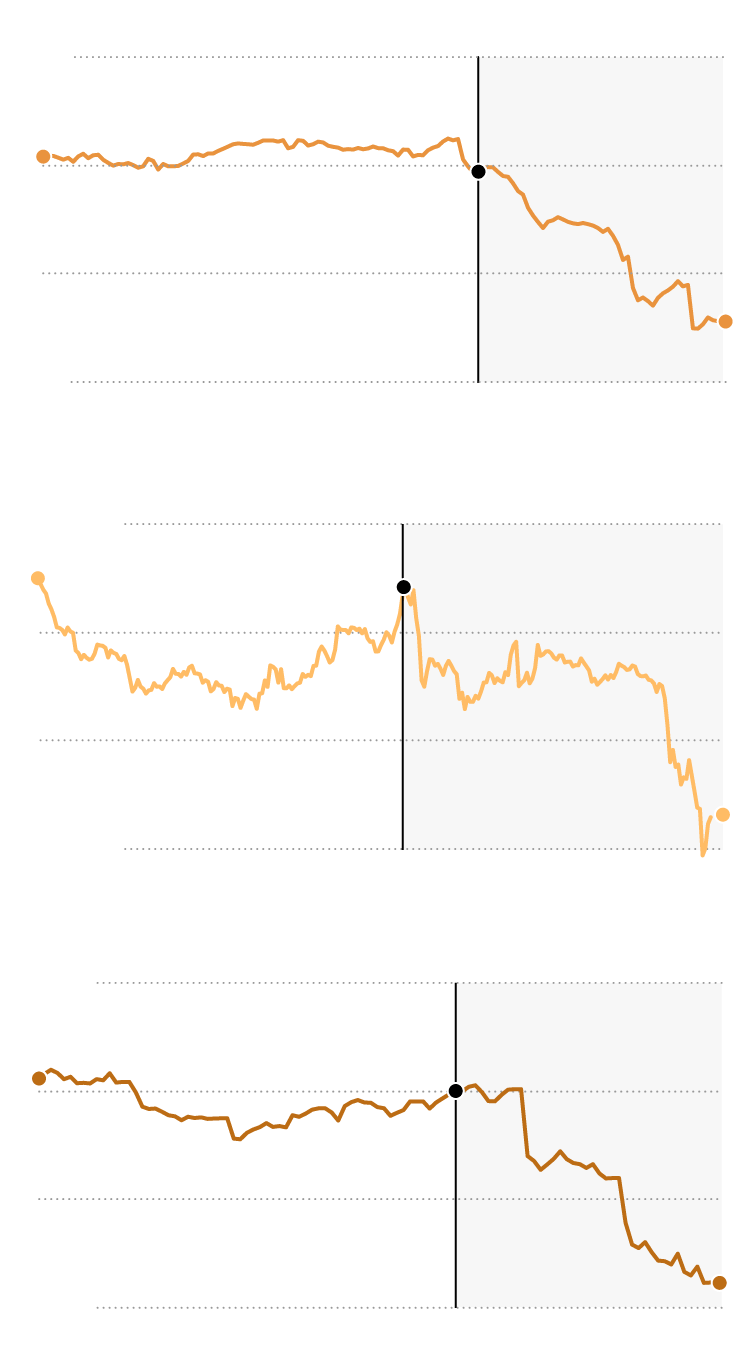
A wide range of markets have sharply declined since President Trump announced global tariffs last week. This chart shows the declines in oil, bitcoin and the S&P 500 as of Monday morning, before markets open in the United States.
Oil
Bitcoin
S&P 500 (U.S.)
$80
$90,000
6,000
$87, 359.81
5,705.34
$73.88
$63.05
$76,493.94
5,074.08
$60
$75,000
5,000
March
Oil
Bitcoin
S&P 500 (U.S.)
$80
$90,000
6,000
$87,359.81
5,705.34
$73.88
$63.05
$76,493.94
5,074.08
$60
$75,000
5,000
Oil
$80
$73.88
$63.05
$60
Tariff announcement
Bitcoin
$90,000
$87,359.81
$76,493.94
$75,000
Tariff announcement
S&P 500 (U.S.)
6,000
5,705.34
5,074.08
5,000
Tariff announcement

Robert Habeck, Germany’s economy minister, called on Monday for his European partners to stand together to take clear, decisive action against the U.S. tariffs. He rejected the idea that they are in any way reciprocal, saying the calculation used to draw them up was “nonsense.”
Video

Habeck stressed Europe’s position of strength, if the 27 member states are successful in acting as a bloc. “I can only say to the European partners, we have to stay united,” he said.
Video

President Trump said again that the Federal Reserve should cut interest rates. In a recent Truth Social post, he said: “Oil prices are down, interest rates are down (the slow moving Fed should cut rates!), food prices are down, there is NO INFLATION.”
Mr. Trump also said the United States was bringing in “billions of dollars a week” from tariffs already in place. He said China did not acknowledge “my warning for abusing countries not to retaliate.” He posted: “They’ve made enough, for decades, taking advantage of the Good OL’ USA! Our past “leaders” are to blame for allowing this, and so much else, to happen to our Country.” The Federal Reserve is under pressure to respond to the turmoil in markets and traders are betting that interest rates will be cut at least four times this year. But Jerome Powell, the Fed chair, has said that the bar is high for rate cuts because of the potential inflationary impact of tariffs.
The selloff in stock markets is still widespread, but some indexes have come off their lows. Futures are now pointing to the S&P 500 falling about 2 percent when trading begins in New York, a somewhat smaller decline than earlier in the day. The Stoxx Europe 600 was down about 4 percent; earlier it had fallen more than 6 percent.
Ellen Pollock
Business editor
The United States economy is “facing considerable turbulence,” Jamie Dimon, the chief executive of JPMorgan Chase, said in his annual letter to shareholders, citing multiple factors. “The recent tariffs will likely increase inflation and are causing many to consider a greater probability of a recession. And even with the recent decline in market values, prices remain relatively high. These significant and somewhat unprecedented forces cause us to remain very cautious.”

In his letter, Dimon also noted that stock prices were still high even after the recent sell-off. “No matter how you measure it, equity valuations are still well above their historical averages,” he wrote. “Markets still seem to be pricing assets with the assumption that we will continue to have a fairly soft landing. I am not so sure.”


Image
The domestic arm of China’s sovereign wealth fund, Central Huijin Investment, said on Monday that it boosted its holdings in Chinese stocks to “resolutely safeguard” the country’s capital markets.
The move appeared to be a response to a slide in share prices triggered by the Trump administration’s unveiling of sweeping global tariffs last week.
In a statement, Central Huijin did not identify the stocks it purchased, other than that they were exchange-traded funds, which are baskets of stocks that track indexes. The company said it would continue to increase its holdings in the future.
Stock benchmarks in Hong Kong, Shanghai and Shenzhen plunged on Monday, and shares of some of China’s biggest consumer technology and app companies suffered drastic losses.
Xiaomi, a smartphone maker that has branched out into electric vehicles, plummeted over 20 percent.
The e-commerce company Alibaba dropped 18 percent and Tencent, the company behind China’s most ubiquitous app, WeChat, fell 13 percent.
In a note on Monday, analysts at Morgan Stanley forecast that U.S. tariffs could have a “far greater growth drag” on China’s economy than more limited levies did in Trump’s first term. “The deflation loop is still alive,” they wrote.

The Philippines will reduce tariffs on goods coming from the United States, its trade secretary said on Monday in Manila. “We’re meeting soon — with the economic team,” said Cristina Roque, the trade secretary, adding that she had requested a meeting several weeks ago. The Trump administration placed tariffs of 17 percent on the Philippines, one of the lowest rates of any country in Asia.
Image
There was little rest on Wall Street this weekend. There was plenty of anger, anxiety, frustration, and fear.
Anger at President Trump for a brash and chaotic rollout of tariffs that erased trillions of dollars in value from the stock market in two days. Anxiety about the state of the private equity industry and other colossal funds with global investments. Frustration among Wall Street’s elite at their sudden inability to influence the president and his advisers.
And fear of what may come next.
In conversations with The New York Times over the weekend, bankers, executives and traders said they felt flashbacks to the 2007-8 global financial crisis, one that took down a number of Wall Street’s giants. Leaving out the brutal, but relatively short-lived market panic that erupted at the start of the coronavirus pandemic, the velocity of last week’s market decline — stocks fell 10 percent over just two days — was topped only by the waves of selling that came as Lehman Brothers collapsed in 2008.
Few companies have discussed their outlooks publicly since last week’s tariff announcements, but major banks including JPMorgan and Wells Fargo will begin holding investor calls to address their earnings (and prospects) on Friday.
The uncertainty was neatly exemplified by Daniel S. Loeb, a billionaire hedge fund manager, who on Saturday wrote on X: “Sometimes market bottom when things look most bleak.”
“Not a prediction,” he added, “but keeping an open mind.”

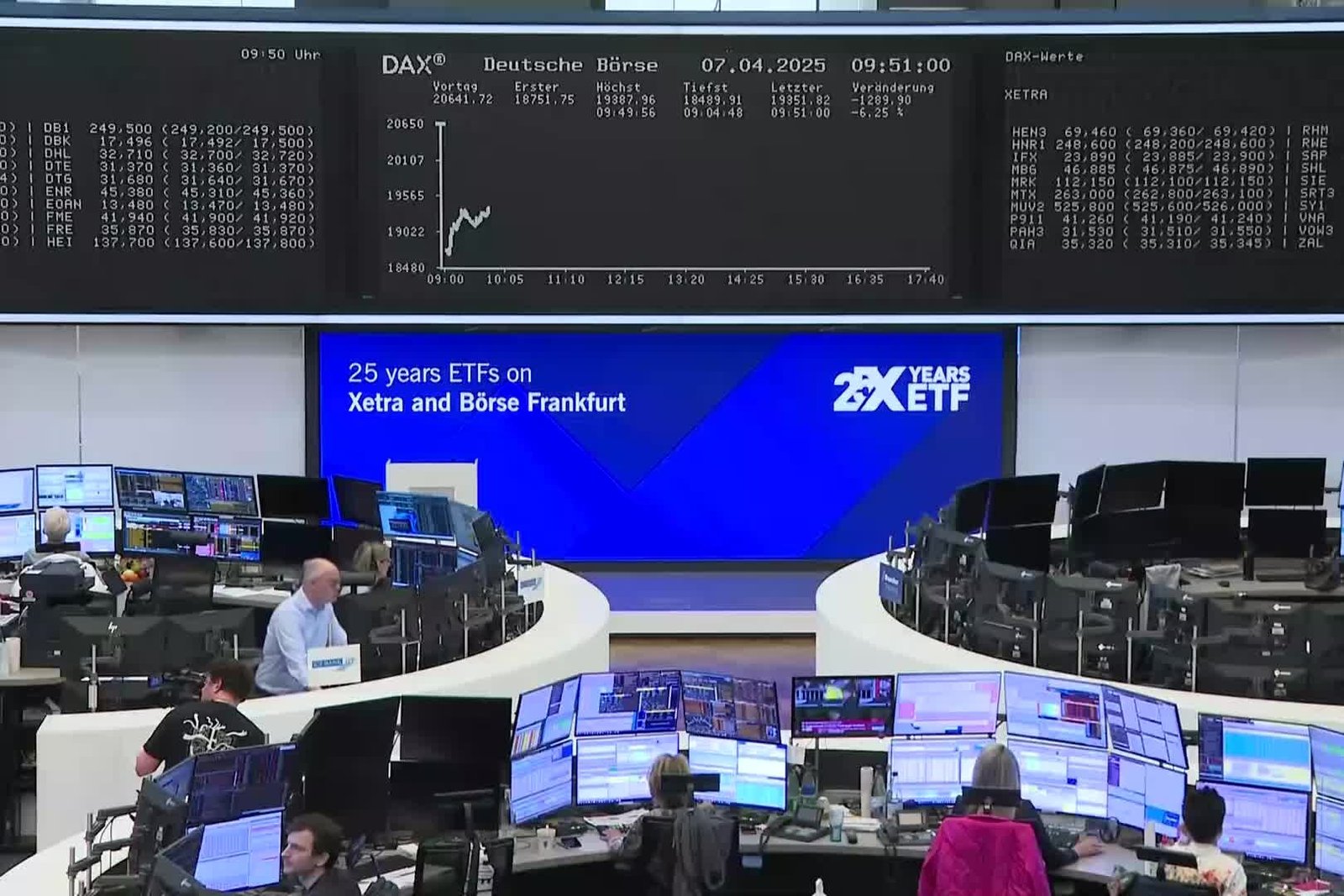
This was the scene this morning on the trading floor of the Frankfurt Stock Exchange, where stocks opened sharply lower after the Trump adinistration doubled down on global tariffs.
Video

South Korea’s trade minister, Cheong In-kyo, plans to visit Washington this week to try to lower the blanket 25-percent tariff that the Trump administration imposed on goods from South Korea. During his two-day trip, Cheong is expected to meet with administration officials, including U.S. Trade Representative Jamieson Greer, to express South Korean concern about the new duties and seek ways to minimize their impact on South Korea’s export-driven economy, Cheong’s office said.

Image
President Trump’s global trade war has significantly raised the bar for the Federal Reserve to lower interest rates, as tariffs risk worsening an already knotty inflation problem while also damaging growth.
Jerome H. Powell, the Fed chair, drove home that message in a hotly anticipated speech that came at the end of a turbulent week as financial markets melted down after Mr. Trump’s tariff plans were revealed.
The measures would lead to higher inflation and slower growth than initially expected, Mr. Powell warned during an event in Arlington, Va., on Friday. He showed concern about the souring economic outlook, but his emphasis on the potential inflationary effect of the new tariffs made clear that it was a significant source of angst.
“Our obligation is to keep longer-term inflation expectations well anchored and to make certain that a one-time increase in the price level does not become an ongoing inflation problem,” Mr. Powell said. The Fed’s mandate includes two goals, fostering a healthy labor market and maintaining low, stable inflation.
Before Mr. Trump’s return to the White House, inflation was already proving to be stubbornly sticky, staying well above the Fed’s 2 percent target. Yet the economy had stayed remarkably resilient, leading the central bank to adopt a more gradual approach to interest rate cuts that culminated in it pausing reductions in January. At that policy meeting, Mr. Powell established that the Fed would need to see “real progress on inflation or, alternatively, some weakness in the labor market” to restart cuts.
But with inflation set to soar because of tariffs, it will take tangible evidence that the economy is weakening significantly to get the central bank going again. That could mean that rate cuts are pushed off until much later this year or even delayed until next year if that deterioration takes time to materialize.
“They will not be inclined to be pre-emptive to cut rates to avoid what may be a downturn,” said Richard Clarida, a former vice chair at the Fed who is now a global economic adviser at Pimco, an investment firm. “They’re actually going to have to see an actual crack in the labor market.”
Mr. Clarida said he would look for a “material” rise in the unemployment rate or a “very sharp slowdown, if not a contraction” in monthly jobs growth to account for what he expected would be a significant lurch higher in inflation.
The latest jobs report, which was released Friday, showed that on the eve of Mr. Trump’s latest tariff blitz, the labor market was far from cracking. Employers added 228,000 jobs in March, and the unemployment rate ticked up to 4.2 percent as participation in the labor market rose.
Any enthusiasm about the latest data was quickly overtaken by a torrent of worries about the economic outlook — concerns Mr. Trump’s top economic advisers sought to address on Sunday.
Kevin Hassett, director of the White House National Economic Council, acknowledged that the president’s approach could exacerbate inflation. “There might be some increase in prices,” he said on ABC’s “This Week.” But he insisted that Mr. Trump’s plan would ultimately reverse a long-running trend of importing lower-cost products in exchange for job losses.
“We got the cheap goods at the grocery store, but then we had fewer jobs,” he said.
Scott Bessent, the Treasury secretary, also sought to downplay the prospects of a recession, telling NBC’s “Meet the Press” on Sunday that there would be an “adjustment process.”
Economists across Wall Street are much more gloomy about the outlook. Many have sharply raised their recession odds alongside their forecasts for inflation. Those economists fear that Mr. Trump’s tariffs, which are a tax on imports, will eventually decimate consumer spending, squeeze businesses’ profit margins and potentially lead to layoffs that push the unemployment rate above 5 percent.
Many in this cohort expect the Fed to lower interest rates swiftly as a result, beginning as early as June. Federal funds futures markets reflect an even more aggressive response, with five quarter-point cuts priced in for this year.
Image
Michael Feroli, chief U.S. economist at J.P. Morgan, is calling for a recession in the second half of this year, with growth declining 1 percent in the third quarter and another 0.5 percent in the fourth quarter. Over the course of the year, he expects growth to fall 0.3 percent and the unemployment rate to rise to 5.3 percent. Even as the Fed’s preferred inflation gauge — once volatile food and energy prices are stripped out — surges to 4.4 percent, Mr. Feroli forecasts that the Fed will restart cuts in June and then lower borrowing costs at every meeting through January until the policy rate reaches 3 percent.
Jonathan Pingle, chief U.S. economist at UBS, has penciled in a percentage point worth of cuts this year even as core inflation reaches 4.6 percent. He expects the unemployment rate to shoot higher this year before peaking at 5.3 percent in 2026. Economists at Goldman Sachs projected that the Fed would deliver three consecutive quarter-point cuts beginning in July.
But there are credible risks to this outlook. The prevailing one is that the inflation shock will be just too enormous for the Fed to look past it by the summer, especially if the economy has not yet deteriorated in a meaningful way.
“The burden of proof now is higher because of the inflation situation that we’re in,” said Seth Carpenter, a former Fed economist who is now at Morgan Stanley. “They have to get enough information that convinces them that the negative effects of slowing — and possibly negative — growth outweighs the cost to them of inflation.”
Mr. Carpenter said he expected no cuts from the Fed this year but multiple next year, bringing interest rates down to between 2.5 percent to 2.75 percent. Economists at LHMeyer, a research firm, have also shelved cuts this year, assuming there is no “full-blown” recession.
Perhaps the most important determinant of when the central bank will restart rate cuts is what happens with inflation expectations. Beyond a year ahead, expectations have stayed somewhat stable, aside from some survey-based measures that are seen as less reliable than others.
If those expectations begin to wobble in a more notable way, the Fed would become even more hesitant to cut and would need to see even more economic weakness than usual, said William English, a Yale professor and a former director of the Fed’s division of monetary affairs.
Eric Winograd, an economist at the investment firm AllianceBernstein, said Mr. Powell’s inflation-focused posture on Friday would help to avoid that outcome. “The name of the game is: You talk tough,” he said. “You keep inflation expectations where they are, and, by doing that, you preserve your ability to ease later if it’s necessary.”
A higher bar for interest rate cuts could put the Fed in a tougher spot with the Trump administration, Mr. English said. Up until last week, the president had been more subdued in his criticism of the central bank, compared with his first term. He had called for lower interest rates but sought to justify them by pointing to his plans to lower energy prices, among other reasons.
But as the rout in financial markets has intensified, Mr. Trump has turned his ire back toward Mr. Powell and the Fed. On Monday, Mr. Trump said the “slow moving” Fed should cut rates. At one point, the president appeared to suggest that the market rout was part of his strategy. He circulated a video from a user on Mr. Trump’s social media network that suggested the president was “purposely CRASHING” the markets in part to force the Fed to lower interest rates.
Pressed on the matter on Sunday, Mr. Hassett of the National Economic Council responded by saying that the Fed was independent, before adding: “He’s not trying to tank the market.”
Mr. Trump has already sought to chip away at the central bank’s longstanding independence from the White House by targeting the Fed’s oversight of Wall Street. His decision last month to fire two Democratic commissioners from the Federal Trade Commission has also reverberated widely, raising important questions about what kind of authority the president has over independent agencies and the personnel who run them.
At the event on Friday, Mr. Powell said he fully intended to serve out all of his term, which ends in May 2026. He has also previously been explicit that early removal by the president is “not permitted under the law.”
“The risk to the Fed’s independence is bigger now,” Mr. English, the Yale professor, said. “It just puts them right in the firing line.”

Keith Bradsher, who has covered the Chinese economy since 2002, reported from Beijing, Shanghai and Ningbo, China.
Image
For decades, the world’s largest car factory was Volkswagen’s complex in Wolfsburg, Germany. But BYD, the Chinese electric carmaker, is building two factories in China, each capable of producing twice as many cars as Wolfsburg.
Recent data from China’s central bank shows that state-controlled banks lent an extra $1.9 trillion to industrial borrowers over the past four years. On the fringes of cities all over China, new factories are being built day and night, and existing factories are being upgraded with robots and automation.
China’s investments and advances in manufacturing are producing a wave of exports that threatens to cause factory closings and layoffs not just in the United States but also around the globe.
“The tsunami is coming for everyone,” said Katherine Tai, who was the United States Trade Representative for former President Joseph R. Biden Jr.
President Trump’s steep tariffs announced on Wednesday, which have caused stocks in Asia and elsewhere to plunge, were the most drastic response yet to China’s export push. From Brazil and Indonesia to Thailand and the European Union, many countries have already moved more quietly to increase tariffs as well.
Image
Chinese leaders are furious at the recent proliferation of trade barriers, and particularly Mr. Trump’s latest tariffs. They take pride in China’s high savings rate, long work hours and abundance of engineers and software programmers, as well as its legions of electricians, welders, mechanics, construction workers and other skilled tradesmen.
On state television Saturday night, an anchor solemnly read a government statement condemning the United States: “It is using tariffs to subvert the existing international economic and trade order” so as “to serve the hegemonic interests of the United States.”
Five years ago, before a housing bubble burst, cranes putting up apartment towers dotted practically every city in China. Today, many of those cranes are gone and the ones that are left seldom move. At Beijing’s behest, banks have rapidly shifted their lending from real estate to industry.
China is using more factory robots than the rest of the world combined, and most of them are made in China by Chinese companies, although some components are still imported. After several years of rapid growth, overall installations of new factory equipment have already jumped another 18 percent this year.
When Zeekr, a Chinese electric carmaker, opened a factory four years ago in Ningbo, a two-hour drive south of Shanghai, the facility had 500 robots. Now it has 820, and many more are planned.
As new factories come online, China’s exports are rapidly accelerating. They rose 13.3 percent in 2023 and then another 17.3 percent last year.
Lending by state banks is also financing a boom in corporate research and development. Huawei, a conglomerate making items as varied as smartphones and auto parts, has just opened in Shanghai a research center for 35,000 engineers that has 10 times as much space for offices and labs as Google’s headquarters in Mountain View, Calif.
Image
Leaders around the world are struggling to decide whether to raise trade barriers to protect what is left of their countries’ industrial sectors.
China has been rapidly expanding its share of global manufacturing for decades. The growth came mainly at the expense of the United States and other longtime industrial powers, but also of developing countries. China has increased its share to 32 percent and rising, from 6 percent in 2000.
China’s factory output is bigger than the combined manufacturing of the United States, Germany, Japan, South Korea and Britain.
Even before Mr. Trump won a second term, Biden administration officials warned during their final year in office about industrial overcapacity in China. They raised some tariffs, notably on electric cars.
But during their first three years, Biden administration officials mostly focused on tighter export controls for technologies like high-end semiconductors, citing national security concerns. They left in place tariffs of 7.5 percent to 25 percent that Mr. Trump had imposed on half of China’s exports to the United States in his first term.
It remains uncertain how the president’s much tougher approach this time will play out. Tariffs have occasionally slowed China’s growth in exports, but not stopped it. Other nations are on high alert for the possibility that Chinese exports could be diverted elsewhere, threatening the economies of longstanding U.S. allies like the European Union and South Korea.
Image
China’s automakers were preparing a push into the American car market in 2017, when Mr. Trump first took office. GAC Motor in Guangzhou, China, brought dozens of U.S. car dealers to the city’s auto show that November. The company announced plans to sell gasoline-powered sport utility vehicles and minivans in the United States by the end of 2019.
But GAC and other Chinese automakers canceled their plans after Mr. Trump included cars in his initial 25 percent tariffs several months later.
Chinese companies still sell almost no cars in the United States. That is unlikely to change: With Mr. Trump’s latest moves, Chinese carmakers now face U.S. tariffs as high as 181 percent.
Blocked in the United States, Chinese automakers have continued building factories and have pivoted their export campaigns elsewhere. Their sales have soared in Australia and Southeast Asia, taking market share from Japanese and American brands. In Mexico, Chinese carmakers held just 0.3 percent in 2017; by last year, it was over 20 percent.
Rapid sales gains in the European Union, and evidence of Chinese government subsidies, prompted E.U. officials last October to impose tariffs of up to 45 percent on electric cars from China.
China is not just building car factories. It has built more petrochemical refinery capacity in the past five years, for example, than Europe, Japan and South Korea together have created since World War II. And China is on track to build these refineries even faster this year. Petrochemicals are then turned into plastics, polyester, vinyl and tires.
Robert E. Lighthizer, who was the United States Trade Representative in Mr. Trump’s first term, said that the latest American tariffs “are long overdue medicine — the real root cause is decades of Chinese industrial policy that has created breathtaking overcapacity and global imbalances.”
China is exporting so much partly because its own people are buying so little. A housing market crash since 2021 has wiped out much of the savings of the middle class and ruined many wealthy families.
Image
Tax revenues are falling, but military spending is rising rapidly. That has left the government wary of spending on economic stimulus to help consumers. China has offset its housing debacle instead with its export campaign, creating millions of jobs to build, outfit and operate factories.
Some Chinese economists have recently joined Western economists in suggesting that the country needs to strengthen its meager social safety net. At the start of this year, the minimum government pension for seniors was just $17 a month. That barely buys groceries, even in rural China.
The country’s best-known economist, Professor Li Daokui of Tsinghua University, publicly called in January for raising the minimum monthly pension several fold, to $110. The Chinese government could afford it, he argued, and extra spending by seniors would stimulate the entire economy.
Chinese officials rejected his advice. When the budget came out on March 5, it had an increase in monthly pensions — but it was just $3, bringing it to $20 a month.
The same budget included $100 billion for investments, including ports and other infrastructure that help exporters. And there was a new program to upgrade technology used in manufacturing across 20 Chinese cities.

How bad is it? Analysts at Deutsche Bank published a chart-heavy note today with some eye-opening numbers about the recent market turmoil. “It’s no exaggeration to describe last week’s market moves as historic,” they wrote.
• The two-day drop of more than 10 percent in the S&P 500 at the end of last week was the fifth-worst since World War II.
• Last week, the S&P 500 had its ninth-worst week since World War II.
• The VIX index, a measure of volatility often called Wall Street’s “fear gauge,” rose to a level rarely matched in recent decades, with the early days of the coronavirus pandemic and banking crisis of 2008-09

Some analysts are already speculating that Trump might seek a way out by delaying some tariffs. It was not “realistic” for the Trump administration to reach “meaningful agreement” with so many trading partners in such a short window of time, Alicia García-Herrero, the chief economist for Asia at Natixis, a French financial institution, wrote in a note to clients on Monday.
Once again, investors are turning to the relative safety of government bonds, pushing their prices higher and yields lower. Germany’s 10 year bond yields are down 0.1 percentage point to 2.47 percent, a big move for bond markets. U.S. 10-year Treasury yields are holding below 4 percent.
No industry is immune to this morning’s selloff in European stocks. Even shares in defense companies are plummeting. They had been performing really well recently after European governments vowed to quickly increase their defense spending. Shares in Germany’s Rheinmetall are down 9 percent, but dropped as much as 27 percent this morning. Those shares were at a record high less than three weeks ago. Shares in Italy’s Leonardo are down 13 percent.

Image
The notion that the Federal Reserve will rush in to rescue investors in a crisis has comforted investors for decades. But in the big market downturn induced by President Trump’s tariffs, no Fed rescue is in sight.
Jerome H. Powell, the Federal Reserve chair, made that clear on Friday. The tariffs are much “larger than expected,” he said, and their immense scale makes it especially important for the central bank to understand their economic effects before taking action.
“It is too soon to say what will be the appropriate path for monetary policy,” he said at a conference in Virginia.
For days, the market momentum has been almost entirely downward, bringing a dubious distinction in sight: a bear market, which is a decline of at least 20 percent from a market top. For the S&P 500, a bear market is already within shouting distance, a scant 2.6 percentage points away.
Investors may need to be very patient, and to hope that changes in tariff policy occur rapidly enough in Washington to turn the markets around and, more important, avert a recession.

India’s government has yet to say a word against the 27 percent tariff announced last week. In March, India offered Trump a few sops – reducing tariffs on Harley-Davidsons and Kentucky bourbon – but that didn’t spare it. Indian officials are telling reporters they are trying to speed through a bilateral trade deal, discussed between Trump and Prime Minister Narendra Modi in February.
Stocks in India fell more than 4 percent after nearly ignoring the effects of the tariffs last week when the rest of Asia was crashing. Many Indian businesses were thinking the changes might give them an advantage against Asian competitors like Vietnam and Bangladesh. But the global selloff seems to have scared everyone. The $5 trillion that Wall Street has shed is worth more than all Indian stocks combined.
Stocks are down across the board in Europe. One sector hit particularly hard are banks as fears of a general economic slowdown, with fewer deals, takes hold. Barclays and Standard Chartered shares are down more than 7 percent. HSBC shares are down more 5 percent.
Stock markets in Europe have opened sharply lower. The FTSE 100 in London and the Stoxx Europe 600 are both down about 5 percent.
Image

Japan became the latest nation to say it was willing to meet with President Trump to discuss the tariffs. Prime Minister Shigeru Ishiba said on Monday that he would stress that Japan “is not doing anything unfair.” Japan’s stocks fell by more than 7 percent on Monday.

China seems to be silencing domestic criticism of its countermeasures against U.S. tariffs. The Chinese Academy of Social Sciences announced on Sunday that it had shut down a research center, after a researcher there wrote on his private social media account that China’s retaliatory tariffs were “completely wrong.”
The mayhem in Hong Kong stocks was in part a delayed reaction since the market was closed on Friday for a holiday. It was also the first chance investors had to digest China’s retaliatory move late on Friday. Bruce Pang, an associate professor at Chinese University of Hong Kong’s business school, said investors are still working through the potential fallout of the tariffs. For now, many investors are fleeing the market and heading to seemingly safer investments such as the Japanese yen and the Swiss franc. Both surged against the U.S. dollar.
Image