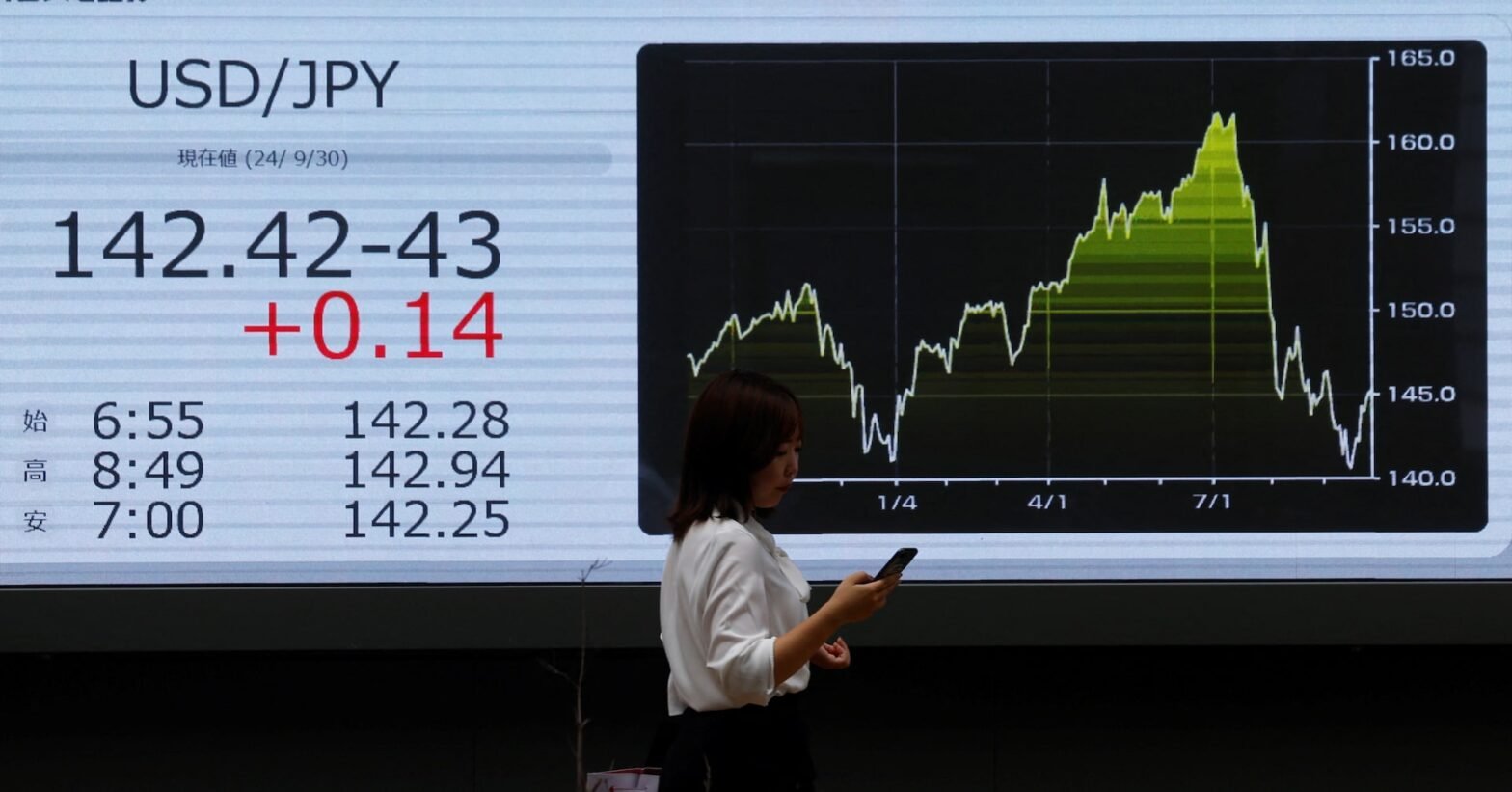

A passerby walks past an electronic screen displaying the current Japanese Yen exchange rate against the U.S. dollar outside a brokerage in Tokyo, Japan, September 30, 2024. REUTERS/Kim Kyung-Hoon/File Photo Purchase Licensing Rights, opens new tab
- Trump reiterates Canada, Mexico tariff deadline of next week
- Trump says 10% China levy is on top of existing duties
- Stocks hammered in Tokyo as safe-haven yen strengthens
- Tariff threat raises expectations of stimulus from Beijing
TOKYO, Feb 28 (Reuters) – Equities slumped across Asia on Friday and the U.S. dollar hovered near multi-week highs against the currencies of the country’s top trading partners as concerns about an escalating global trade war soured market sentiment.
Technology shares took an additional hit following a sell-off in AI darling Nvidia and other so-called “Magnificent Seven” Wall Street mega-cap stocks, as investors judged the chipmaker’s earnings report harshly a day after it was released.
The safe-haven yen and Swiss franc strengthened, with Japan’s currency getting an additional boost from lower U.S. Treasury yields. Bitcoin dipped below $80,000 for the first time in more than three months.
An overall firmer dollar weighed on commodities including gold, although oil held on to most of Thursday’s strong gains spurred by U.S. President Donald Trump’s cancellation of Chevron’s Venezuela licence.
Trump said on Thursday that 25% duties on imports from Canada and Mexico will come into effect on March 4 – not April 2 as he had suggested the day prior – and said goods from China will be subject to an additional 10% duty. He also this week promised 25% tariffs on shipments from the European Union.
“A market that had reduced its sensitivity to recent tariff headlines has had to reconsider that reaction function,” said Chris Weston, head of research at Pepperstone.
“The skew for risk in the near-term suggests the downside has further to go here.”
Japan’s Nikkei
tumbled 3.3%, buckling under the weight of a stronger yen, while South Korea’s Kospi
sank 3.2%.
Taiwanese shares
dropped 1.5%, and Australia’s stock benchmark
sagged 1.3%.
Hong Kong’s Hang Seng
slid 2.3%, although mainland blue chips
declined by a relatively small 0.8%.
Many analysts project that Trump’s trade policies raise the odds of additional stimulus from next week’s meeting on China’s National People’s Congress.
Pan-European STOXX 50 stock futures pointed 1.2% lower, after bourses around the region retreated on Thursday.
U.S. S&P 500 futures were down 0.2% following a 1.6% tumble for the cash index
overnight.
World stocks
(.MIWO00000PUS), opens new tab
are on track for their worst week since mid-December, slumping close to 2%.
The U.S. dollar index – which gauges the greenback against six major peers including the euro, yen and franc – edged up to 107.39 for the first time since February 13.
The euro dipped to $1.0380, the lowest since February 13.
The Swiss franc gained slightly to 0.8989 per dollar, bouncing off Thursday’s low of 0.9005.
The yen climbed 0.2% to 149.54 per dollar, with 10-year Treasury yields – which the currency pair tends to track – sinking as low as 4.2220% in Asian hours, a level last seen on December 11.
While the threat of escalating tariffs has spurred dollar strength, it has also stoked worries about its impact on the U.S. economy.
Recent U.S. data has been soft, and traders have reacted by pricing in at least two quarter-point Federal Reserve interest rate cuts this year, with the first as early as June and another as soon as September.
Investors will be keeping a close watch on the Fed’s preferred inflation gauge – the PCE price index – set for release later in the day. Monthly non-farm payrolls figures are due a week from now.
Bitcoin last changed hands 4.5% weaker at $80,517, after earlier touching $79,558 for the first time since November 11.
Gold sagged 0.6% to $2,856.49 per ounce, the lowest since February 10.
Oil prices slipped but remained not far from Thursday’s peaks.
The more active May Brent crude futures slipped 0.4% to $73.26 a barrel, while U.S. West Texas Intermediate crude futures were at $70.04 a barrel, also down 0.4%. Front-month Brent that expires later on Friday traded at $73.69, down 0.5%.
Sign up here.
Reporting by Kevin Buckland; Editing by Sam Holmes
Our Standards: The Thomson Reuters Trust Principles., opens new tab