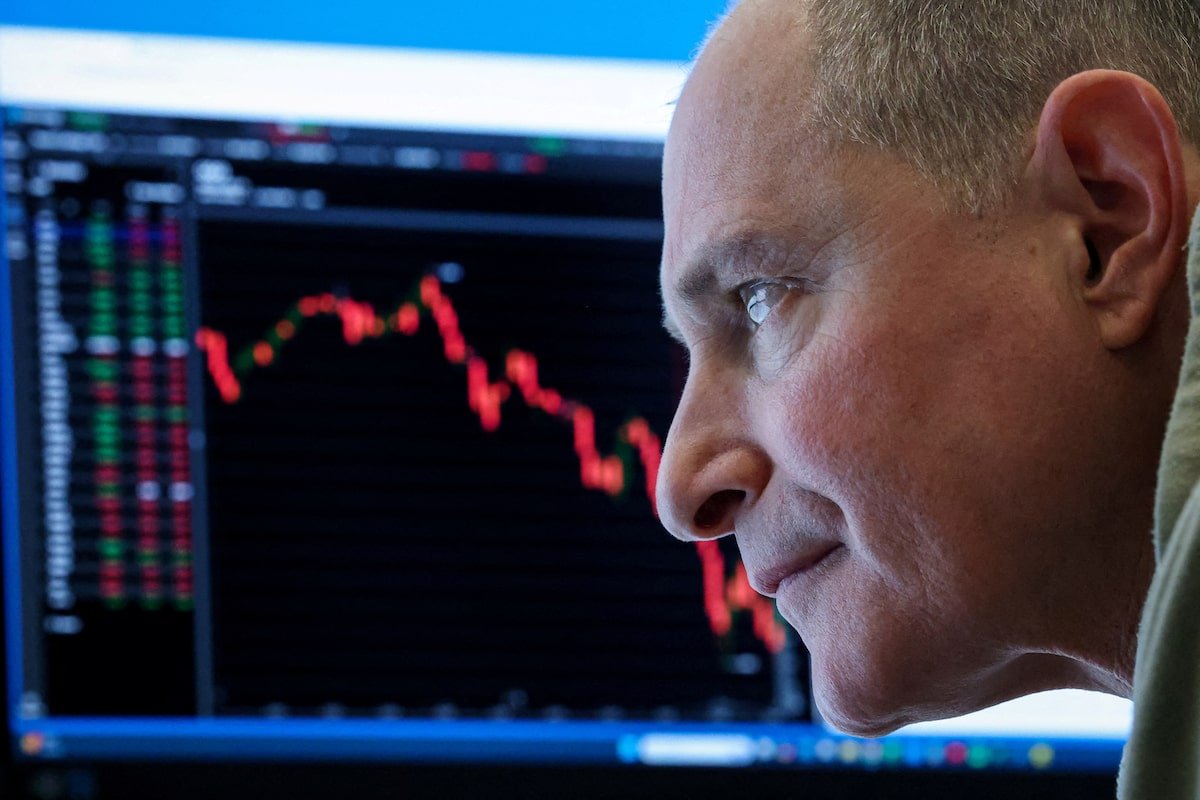

A futures-options trader works on the floor at the New York Stock Exchange on Feb. 27. DIY investing has many pluses, but the downside is the lack of guidance, writes Anita Bruinsma.Brendan McDermid/Reuters
Stock markets are shaky. Global events are dictating investor sentiment and share prices are flitting around daily.
For newer investors, this is unfamiliar ground after three straight years of gains for North American stocks. But this up-and-down market is actually a good opportunity for them: the chance to test their ability to withstand market volatility.
It’s one thing to imagine how you would feel if stocks tanked, but it’s a whole other thing to live it. If you’re a new do-it-yourself investor who is having a hard time right now – even without a bear market – you might need to reconsider your choice of managing your own accounts.
DIY investing has many pluses: you have full control over your accounts, it helps you be more engaged with your investments, and it’s cheap.
The downside is the lack of guidance. There is no one to help you pick the right investments for you, and there is no one to assuage your fears during market downturns. These are things you should expect to get when you work with a financial adviser.
Anita Bruinsma: Despite the global turmoil, you need stock market exposure for your retirement
Take advantage of the current stock market roller-coaster to reflect on your level of anxiety. Are you feeling anxious about your investments right now?
It’s normal to feel uncomfortable or disappointed when your investments go down, but if you find yourself constantly wondering what the stock market is doing, if you are checking your accounts every day or obsessing about what to do with your holdings, maybe you shouldn’t be managing your own portfolio. Not only does anxiety increase the chance of you making a rash decision to hit the sell button, it is probably also affecting your mood and quality of life.
Go further and explore why you are feeling anxious. In my experience, there are two reasons for stock market anxiety: either the investor is fearful that they haven’t made the right choice of investments, or they don’t understand how the market moves and are worried it won’t recover. You could relieve those feeling by using a financial adviser or explore the cheaper alternative, a robo-advisor.
If it’s the roller-coaster ride that’s affecting your mood and leading to poor decisions, then you might need to work with a real person, someone you can call and talk to. A good financial adviser will take the time to talk you through the market conditions and remind you why you got invested, and that the asset allocation you have is the right one for you, no matter what stocks are doing. Note the words “good adviser” here – not all will do that, so choose carefully and make sure you get a high level of service and attention.
If, however, you understand market movements and can live with the ups and downs but are worried that you aren’t properly diversified or that you have investments that inappropriate for you, then you should consider a robo-advisor. A robo-advisor service – also called managed investing – chooses your investments for you based on a series of questions that assess how much volatility you and your portfolio can bear.
This approach will ensure you are well-diversified across geographies – Canada, U.S., and international – and your holdings are in market-tracking ETFs, a strategy that has shown to result in superior long-term performance. Knowing that your investments have been purposefully chosen – by humans behind the robo-advisor – you can rest easy and get on with your life.
Having the right amount of help – whether that’s with a financial adviser or a robo-adviser – can save you from making poor decisions, like selling at a loss or trying to time the market by trading in and out of your holdings, which is detrimental to long-term returns.
Making this decision now, while the losses are still minimal, might save you a lot of pain if we hit a serious air pocket, like we did during the global financial crisis from 2007 to 2009 and the dot-com bubble between 2000 and 2002, when Canadian and U.S. markets fell by about 50 per cent.
DIY investors have not faced a test of this magnitude in nearly 20 years. That’s not to say that you cannot manage your own investments during market volatility – you certainly can – but you need a plan for turbulent times.
Anita Bruinsma is a Toronto-based certified financial planner at Clarity Personal Finance.



![i’m-nervous,-too!-[part-2]](https://10xwealthreport.com/wp-content/uploads/2026/03/177042-im-nervous-too-part-2-1568x784.jpg)