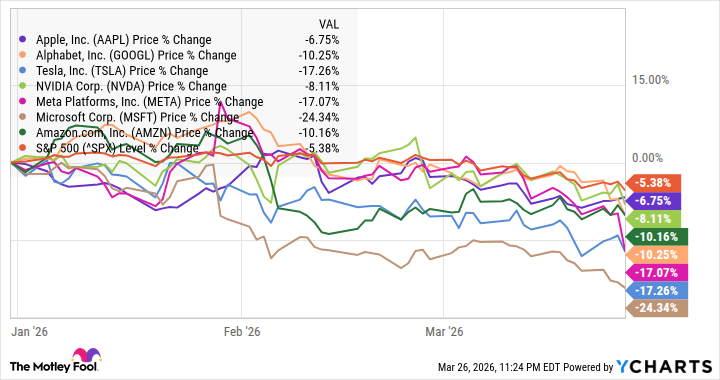
The U.S. stock market is having a dismal year. Investors are concerned about the economy, not just because President Trump’s tariffs have coincided with slower GDP and jobs growth but also because the U.S.-Iran war has pushed oil prices to a multiyear high.
Consequently, the three major stock market indices have dropped sharply from their peaks: The S&P 500 (^GSPC 1.67%) is down 7.1%, the Dow Jones Industrial Average (^DJI 1.73%) is down 8.4%, and the Nasdaq Composite (^IXIC 2.15%) is down 10.6%.
That puts the Nasdaq squarely in market correction territory. While that sounds ominous, the index has usually rebounded quickly. History says this will happen next.

Image source: Getty Images.
History says the Nasdaq Composite could soar a shocking 22% in the next year
The Nasdaq Composite tracks the performance of over 3,300 companies listed on the Nasdaq Exchange. The index is most heavily weighted toward the information technology and consumer discretionary sectors and is commonly regarded as a benchmark for growth stocks.
On March 26, the Nasdaq entered market correction territory, meaning it closed more than 10% below its most recent bull market peak. For investors curious about the specific dates, the index hit a record high of 23,958 on Oct. 29 but has since dropped to 21,408 amid economic uncertainty surrounding Trump’s tariffs and soaring oil prices.
Drawdowns are never pleasant, but corrections are more common than investors may realize. The Nasdaq has fallen at least 10% from its record high a dozen times since 2011, meaning the index has suffered corrections almost annually over the last 15 years. In most cases, the Nasdaq recouped its losses quickly.
The table shows the Nasdaq’s 12-month return following its first close in correction territory.
|
Nasdaq First Closes in Correction Territory |
12-Month Return |
|---|---|
|
Aug. 4, 2011 |
16% |
|
May 18, 2012 |
26% |
|
Nov. 14, 2012 |
40% |
|
Aug. 24, 2015 |
15% |
|
Oct. 24, 2018 |
15% |
|
June 3, 2019 |
32% |
|
Feb. 27, 2020 |
54% |
|
Sept. 8, 2020 |
41% |
|
March 8, 2021 |
2% |
|
Jan. 19, 2022 |
(24%) |
|
Aug. 2, 2024 |
22% |
|
March 6, 2025 |
24% |
|
Average |
22% |
Data source: YCharts. Table created by author.
As shown, during the last 15 years, the Nasdaq has returned an average of 22% over the 12-month period following its first close in correction territory. In other words, the index will advance 22% to 26,118 by March 26, 2027, if its performance aligns with the historical average.
Also noteworthy is that the Nasdaq has achieved a positive 12-month return following the onset of 11 of the last 12 stock market corrections. So history says the probability of a positive return during the next year is about 92%.
Of course, past performance is never a guarantee of future results. The Nasdaq Composite may decline much further if the U.S.-Iran war keeps oil prices elevated. In fact, Moody’s chief economist Mark Zandi believes sustained conflict in the Middle East could push the U.S. economy into a recession.
How investors can capitalize on potential upside in the Nasdaq Composite
The Invesco QQQ Trust (QQQ 1.95%) tracks the Nasdaq-100, a subset of the Nasdaq Composite that includes the 100 largest nonfinancial companies listed on the Nasdaq Stock Exchange. The top 10 holdings are listed by weight below:
- Nvidia: 8.7%
- Apple: 7.4%
- Alphabet: 6.5%
- Microsoft: 5.5%
- Amazon: 4.5%
- Tesla: 3.8%
- Meta Platforms: 3.5%
- Walmart: 3.3%
- Broadcom: 3%
- Costco Wholesale: 2.4%

Today’s Change
Current Price
The Invesco QQQ Trust returned 912% (16.6% annually) in the last 15 years despite the Nasdaq Composite suffering 12 market corrections during that period. Investors should set their future expectations a bit lower, but the index fund is likely to perform well in the years ahead because it is heavily invested in technology stocks well positioned to capitalize on the artificial intelligence (AI) boom.
The Invesco QQQ Trust has an expense ratio of 0.18%, meaning shareholders will pay $18 per year on every $10,000 invested. The index fund’s largest drawback is concentration risk. The five largest holdings account for nearly one-third of its performance. Nevertheless, I think risk-tolerant investors with a time horizon of at least five years should consider buying a position in the Invesco QQQ Trust today.
Trevor Jennewine has positions in Amazon, Nvidia, and Tesla. The Motley Fool has positions in and recommends Alphabet, Amazon, Apple, Costco Wholesale, Meta Platforms, Microsoft, Moody’s, Nvidia, Tesla, and Walmart and is short shares of Apple. The Motley Fool recommends Broadcom. The Motley Fool has a disclosure policy.

![i’m-nervous,-too!-[part-2]](https://10xwealthreport.com/wp-content/uploads/2026/03/177042-im-nervous-too-part-2-1568x784.jpg)