In partnership with

Happy Monday, investors. Investors continue to digest mixed messaging from the Middle East, and so far there’s little sign of a near-term resolution.
Even so, separate from the war, the usual market fears are bubbling over.
Let’s debunk one of the most popular ones.
Not so top-heavy
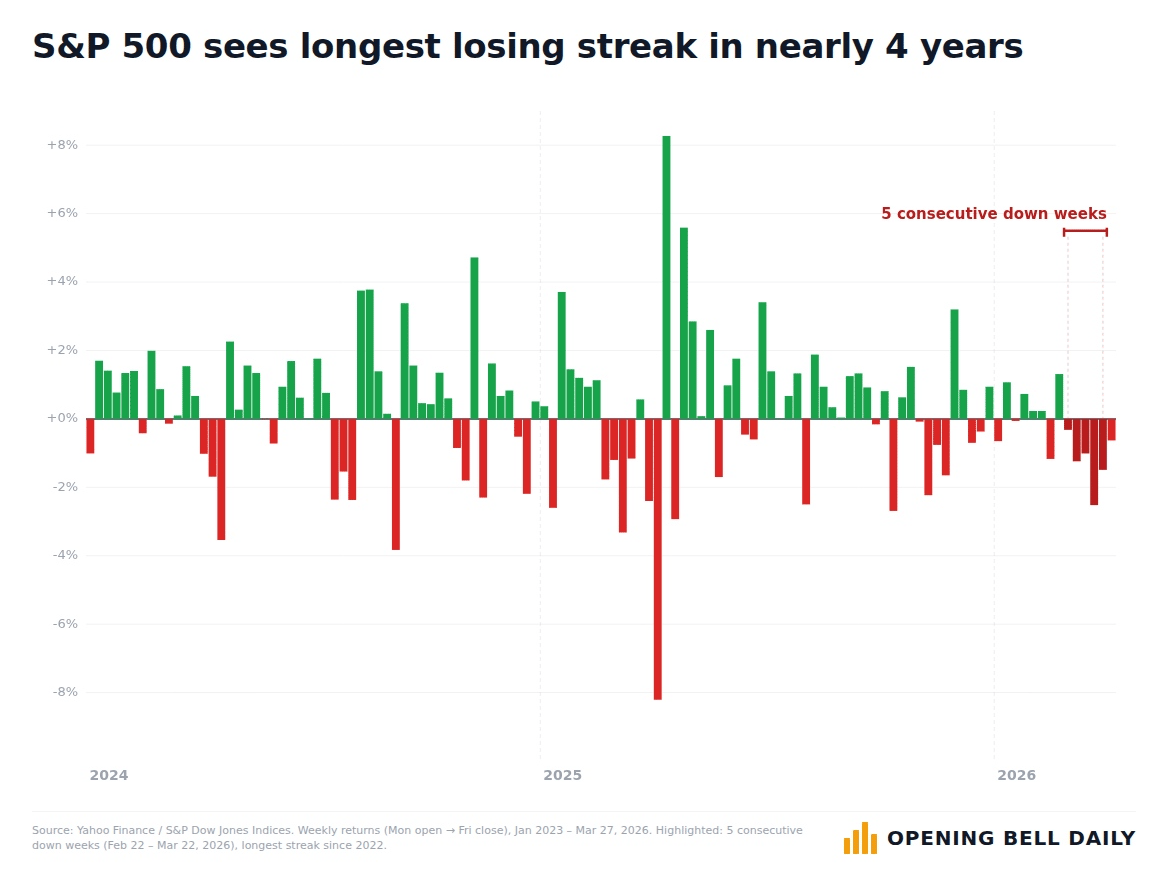
The S&P 500 has dropped five weeks in a row for the first time in nearly four years.
That’s revived the familiar argument that the stock market is too top-heavy. Yet new data from Bloomberg Intelligence suggests that this specific concern is misplaced.
Bloomberg strategists surveyed dozens of single-market ETFs globally and found that the US ranks among the least concentrated equity markets in the world.
While the top 10 holdings of the S&P 500 account for about 37% of the index, most other economies see top-10 concentrations between 50% and 70%.
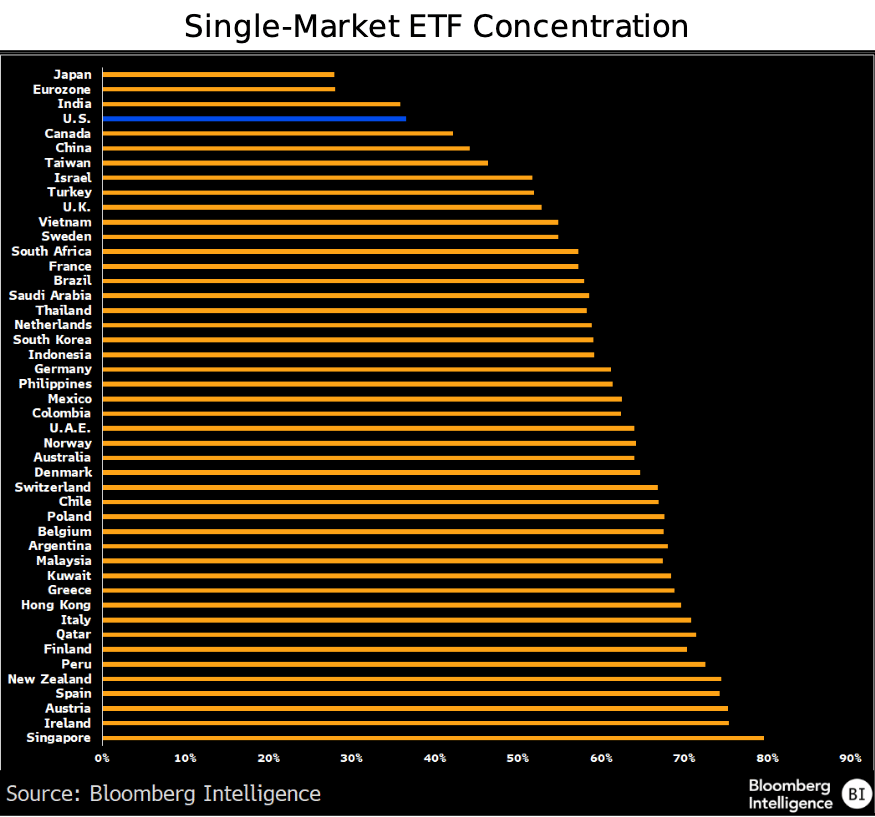
Chart courtesy of Bloomberg Intelligence
By global standards, the US lands in the middle.
It’s also worth noting the composition of those top holdings. US Big Tech, for instance, is far more diversified than its “Magnificent 7” moniker implies.
In fact, those seven companies have collectively made almost 900 acquisitions across cloud, streaming, groceries, advertising, and infrastructure.
“More like the Magnificent 70 once you count what’s under the hood,” wrote Bloomberg Intelligence analysts Eric Balchunas and Athanasios Psarofagis in a new note.
“Sprawling index-worthy platforms across dozens of businesses driving the market.”
Google alone has made some 270 acquisitions.
YouTube alone carries an estimated value of about $500 billion, weighty enough to become one of the 20 largest companies in the US if it were spun out.
The analysts also pointed out that, historically, elevated S&P 500 concentration has tended to accompany long bull markets rather than foreshadow the end of a strong run.
To be sure, the silver lining in the data do not change five losing weeks in a row.
Uncertainty with the Iran war and energy markets have pushed investors to reposition.
Oil prices, resurgent inflation and an escalating conflict are the right risks to watch.
How these variables change will tell more about the market’s next move more than any debate about concentration.
The Future of AI in Marketing. Your Shortcut to Smarter, Faster Marketing.
Unlock a focused set of AI strategies built to streamline your work and maximize impact. This guide delivers the practical tactics and tools marketers need to start seeing results right away:
-
7 high-impact AI strategies to accelerate your marketing performance
-
Practical use cases for content creation, lead gen, and personalization
-
Expert insights into how top marketers are using AI today
-
A framework to evaluate and implement AI tools efficiently
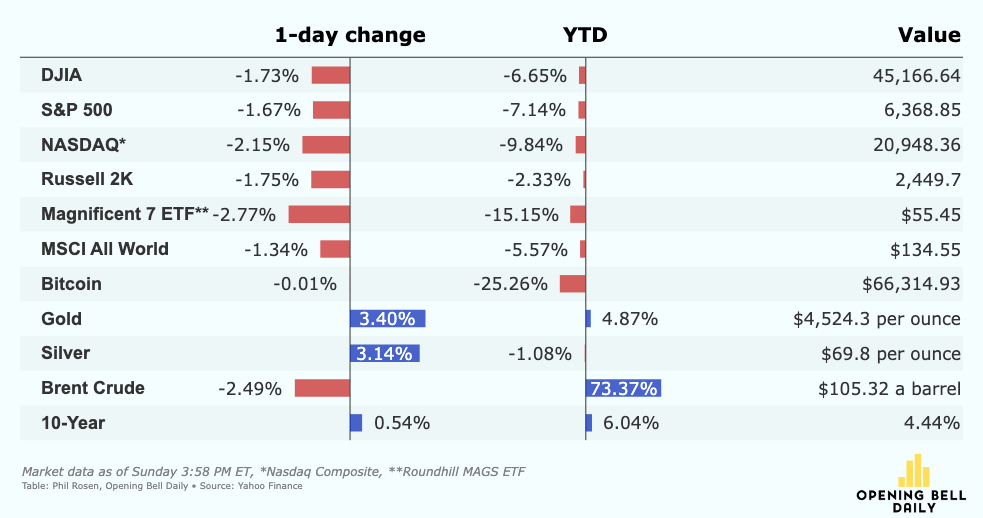
🛢 Brent crude topped $110 as Strait of Hormuz disruptions continue. The world has lost an estimated 4.5 to 5 million barrels per day of supply due to the Iran conflict, with analysts warning that number could double by mid-April. (CNBC)
📉 The S&P 500 is on track for its worst month since December 2022. The index has fallen roughly 7% in March while the Dow is also in correction territory. (Yahoo Finance)
🎯 TSA workers are expected to receive back pay after weeks without paychecks. President Trump signed an executive memo directing payment after a congressional bid to end the partial DHS shutdown collapsed on Friday. (CNBC)
-
Iran’s attack wiped out 17% of Qatar’s LNG capacity, a loss that could last three to five years (CNBC)
-
This boring consumer staples stock is perfectly set up for a bullish spike in 2026 (Best Ideas Club)
-
Private credit problems are growing but that doesn’t make this a “Lehman” moment (Barron’s)
-
Import prices jumped 1.3% in February the largest monthly gain since March 2022 (WSJ)
-
Eli Lilly reached a $2.75 billion deal with Insilico to bring AI-developed drugs to global market (CNBC)
-
The government gave bitcoin its stamp of approval for the housing market (Opening Bell Daily)
🗓 March 30, 2009: President Obama gave General Motors and Chrysler a final ultimatum to restructure or lose access to federal bailout funds, setting in motion the managed bankruptcies that would reshape the US auto industry.
📩 Want to get in front of 200,000+ investors who get this newsletter and the 350,000 professionals who can access it on Bloomberg Terminals? Reply to this email and tell us why we should work together.



![i’m-nervous,-too!-[part-2]](https://10xwealthreport.com/wp-content/uploads/2026/03/177042-im-nervous-too-part-2-1568x784.jpg)