The S&P 500 (^GSPC 1.36%) has dropped 3% from its high in 2026 over concerns about elevated valuations and economic headwinds created by President Trump’s tariffs. Last year, the U.S. economy recorded its slowest gross domestic product and jobs growth since the pandemic as businesses navigated an uncertain trade environment.
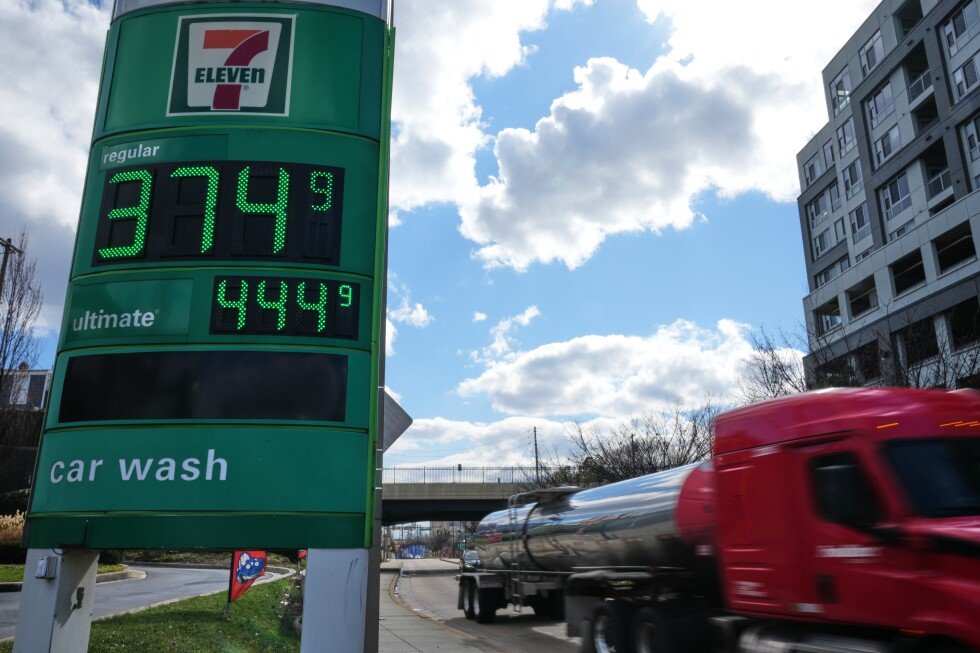
More recently, investors have turned their attention to geopolitical tensions in the Middle East. The U.S.-Iran war has driven Brent crude oil prices (an international benchmark) above $100 per barrel for the first time since 2022. And Moody’s chief economist Mark Zandi says the situation could push the U.S. economy into a recession.

Image source: Getty Images.
The stock market sounds an alarm last seen during the dot-com crash
Federal Reserve officials voiced concerns about rich valuations at the January meeting. “The staff judged that asset valuation pressures were elevated. Price-to-earnings ratios for public equities stood at the upper end of their historical distribution,” according to the meeting minutes.
Indeed, the S&P 500 recorded a cyclically adjusted price-to-earnings (CAPE) ratio of 39.2 in February, one of its most expensive valuations in history. In fact, excluding the last few months, the index has not attained a monthly CAPE multiple above 39 since the dot-com crash in 2000.
Rich valuations are always concerning, but the current situation is especially worrisome because surging oil prices could amplify headwinds created by President Trump’s tariffs, potentially dragging the S&P 500 into a correction or bear market, while also pushing the U.S. economy into a recession.
Wall Street strategists weigh in on surging oil prices
Last week, JPMorgan Chase strategists Kriti Gupta and Joe Seydl wrote, “A sustained oil price as high as $90 per barrel would likely catalyze a 10% to 15% decline in the S&P 500.” They also outlined a domino effect where every 10% drop in the U.S. stock market could reduce consumer spending by 1%, magnifying the oil shock’s impact on the economy.
Similarly, Goldman Sachs strategists recently warned that severe disruptions to global oil supplies could drag the S&P 500 down to 5,400 in 2026. That prediction represents a 22% decline from its January peak of 6,979, meaning the benchmark index would enter a bear market.
This week, Moody’s chief economist Mark Zandi warned that rising oil prices could push the economy into a recession. He referenced a machine learning model that put the odds of a recession in the next 12 months at 49% before the Iranian conflict. In the past, a recession has followed every incident where the model in question gave a reading above 50%.
“It isn’t a stretch to expect the indicator to cross the key 50% threshold amid the Iranian conflict and the resulting surge in oil prices,” Zandi explained on social media. “If oil prices remain elevated for much longer (weeks not months), a recession will be difficult to avoid.”
History says the S&P 500 could drop sharply in a recession
The following chart shows the peak-to-trough decline in the S&P 500 during every recession since the index was created in March 1957.
|
Recession Start Date |
S&P 500’s Peak-to-Trough Decline |
|---|---|
|
August 1957 |
(21%) |
|
April 1960 |
(14%) |
|
December 1969 |
(36%) |
|
November 1973 |
(48%) |
|
January 1980 |
(17%) |
|
July 1981 |
(27%) |
|
July 1990 |
(20%) |
|
March 2001 |
(37%) |
|
December 2007 |
(57%) |
|
February 2020 |
(34%) |
|
Average |
(32%) |
Data source: Truist Advisory Services.
As shown, the S&P 500 has declined by an average of 32% during recessions, meaning the index has typically dropped into a bear market. So, assuming Moody’s chief economist Mark Zandi is correct about rising oil prices pushing the economy toward a recession, investors should mentally prepare for challenging times.
Importantly, that is not a recommendation to sell every stock in your portfolio. First, there is no guarantee the economy will actually suffer a recession. Second, attempting to time the market often backfires.
Instead, the most prudent course of action is to ensure your portfolio consists only of high-conviction stocks you would feel comfortable holding through a steep drawdown. Now is also a good time to build a cash position. Doing so will allow you to capitalize on any buying opportunities that arise if the stock market falls sharply in the coming months.