From a statistical standpoint, the stock market has generally thrived under President Donald Trump. Although volatility has picked up at times, the widely followed Dow Jones Industrial Average (^DJI 0.13%), benchmark S&P 500 (^GSPC +0.11%), and tech-powered Nasdaq Composite (^IXIC +0.18%) gained 57%, 70%, and 142%, respectively, during his first, non-consecutive term. Dating back to the late 1890s, it’s among the highest annualized returns under any president.
However, Trump’s second term has been far shakier for Wall Street. Since late February, all three indexes have swooned, with the Dow and Nasdaq Composite officially entering correction territory, as of the closing bell on March 27.

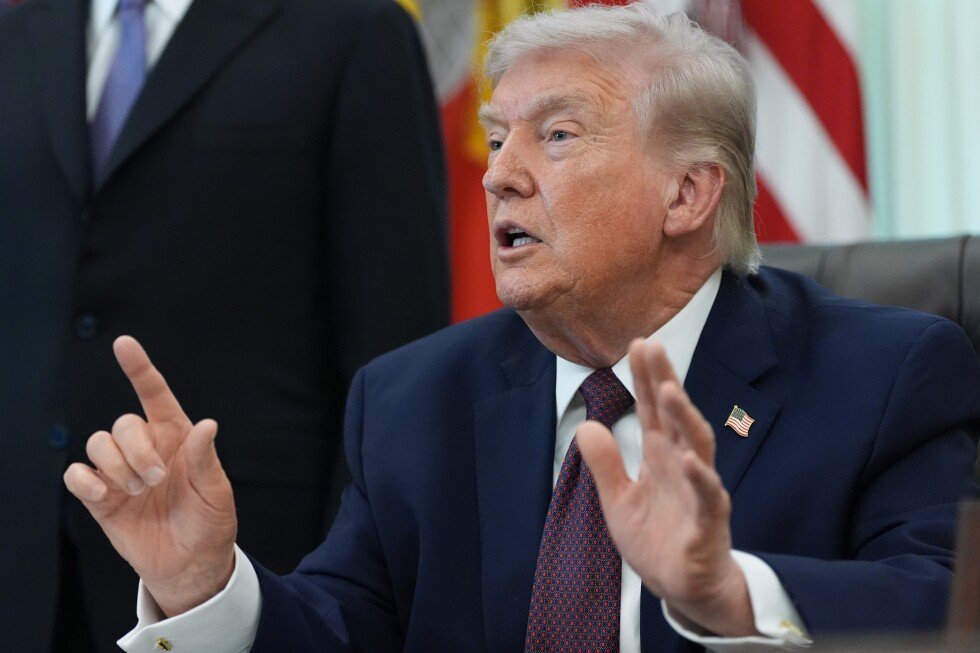
President Trump delivering remarks. Image source: Official White House Photo by Daniel Torok.
While history shows that meaningful pullbacks and stock market corrections are attractive buying opportunities for long-term investors, there’s a glaring reason to believe that the ongoing “Trump slump” in equities isn’t over.
Donald Trump’s actions may force the Fed’s hand
To be fair, the stock market entered 2026 with several headwinds, some of which have absolutely nothing to do with President Trump.
For example, the stock market began the year at the second-priciest valuation since January 1871, according to the S&P 500’s Shiller Price-to-Earnings (P/E) Ratio (also known as the Cyclically Adjusted P/E Ratio, or CAPE Ratio). The five previous times in which the Shiller P/E exceeded 30 during a continuous bull market were eventually followed by declines of at least 20% in one or more of Wall Street’s major stock indexes. In other words, history has made clear that premium valuations aren’t sustainable over long periods.
S&P 500 Shiller PE Ratio hits 2nd highest level in history 🚨 The highest was the Dot Com Bubble 🤯 pic.twitter.com/Lx634H7xKa
— Barchart (@Barchart) December 28, 2025
Additionally, there’s been concern about an artificial intelligence (AI) bubble forming and subsequently bursting. Every game-changing technology since the mid-1990s has endured an early innings bubble-bursting event, and it’s unlikely that AI is the exception to this unwritten rule.
While Donald Trump isn’t responsible for the stock market’s historical priciness or a possible AI bubble-bursting event, his actions related to the Iran war are directly influencing other variables that could spell serious trouble for Wall Street.
On Feb. 28, U.S. forces, following Trump’s command, and Israel commenced military operations against Iran. Shortly after attacks began, Iran closed the Strait of Hormuz to virtually all oil exports. The Energy Information Administration notes that approximately 20% of the world’s liquid petroleum needs pass through the Strait of Hormuz daily.
The law of supply and demand teaches that when the supply of an in-demand good is constrained, its price will rise until demand tapers off. Crude oil prices have skyrocketed since the start of the Iran war, pinching consumers’ wallets at the pump and threatening to raise production costs for businesses.
The bigger issue at hand for Wall Street isn’t that consumers are forking over extra income to fuel their vehicles. It’s the impact of a crude oil price shock on the prevailing inflation rate.
The Fed’s preferred measure of inflation (Core PCE) moved up to 3.1% in January, the highest level in 22 months. That was the 59th consecutive reading above the Fed’s 2% target level. There will be no Fed rate cut next week and one could make a strong case for a rate hike. pic.twitter.com/s3GcBZvceD
— Charlie Bilello (@charliebilello) March 13, 2026
One of the key reasons the stock market has been able to maintain its historically pricey valuation, aside from promises of rapid growth thanks to AI, is the expectation that the Federal Reserve will cut interest rates several times in 2026. But the U.S. inflation rate has been above the central bank’s long-term target of 2% for 59 consecutive months, and it’s expected to jump significantly when the U.S. Bureau of Labor Statistics releases the March inflation report on April 10.
According to the Federal Reserve Bank of Cleveland’s Inflation Nowcasting tool, the trailing 12-month inflation rate is projected to jump from a reported 2.4% in February to 3.16% in March. This increase, along with the stickiness of President Trump’s tariffs in the goods sector, could force a shift in the Fed’s monetary policy. We may be talking about interest rate hikes, which would be awful news for an already jittery stock market.
Regardless of whether the Iran war ends quickly or drags out, the inflationary effects will be felt for several quarters to come.

Image source: Getty Images.
Wall Street’s Trump slump can be long-term investors’ time to shine
While most investors aren’t thrilled to see red arrows next to their top holdings, stock market pullbacks, corrections, bear markets, and even elevator-down moves are perfectly normal and akin to the price of admission for investing on Wall Street.
Typically, investors aren’t going to be able to predict when these downturns will begin, how long they’ll last, or where the bottom will be. But the one near-constant with stock market pullbacks, corrections, and bear markets is that they’re relatively short-lived.
Stock market cycles are inevitable, but they’re not proportionate. Analysts at Bespoke Investment Group found that the average S&P 500 bull market has lasted approximately 3.5 times longer than the typical S&P 500 bear market, dating back to the start of the Great Depression in September 1929: 1,011 calendar days vs. 286 calendar days.
Additionally, a refreshed data set from Crestmont Research demonstrates the power of time and conviction on Wall Street. Crestmont examined the rolling 20-year total returns of the S&P 500, including dividends, dating to the start of the 20th century. Even though the S&P wasn’t officially incepted until 1923, analysts were still able to gather total-return data from components in other major indexes from 1900 to 1923.
Crestmont Research ended up with 107 rolling 20-year periods of annualized total return data (1900-1919, 1901-1920, and so on, through 2006-2025). Researchers found that all 107 timelines generated a positive annualized total return. Hypothetically (since index funds didn’t begin trading in the U.S. until 1993), if an investor had purchased an S&P 500-tracking index anywhere between 1900 and 2006 and simply held this position for 20 years, they made money every time.
Although inflation worries are clearly mounting for a historically pricey stock market, the long-term future for equities and the U.S. economy remains bright.



![i’m-nervous,-too!-[part-2]](https://10xwealthreport.com/wp-content/uploads/2026/03/177042-im-nervous-too-part-2-1568x784.jpg)