Key Points
-
Smithfield Foods is one of the largest producers of packaged meats.
-
The company has been around since 1936 but just went public, again, in 2025.
-
The stock is up 31% year to date.
Beta is the measure of a stock’s volatility. Stocks with high beta, over 1.0, means the stock is more volatile than the broader market. Stocks with low beta, below 1.0, means they are less volatile and have smaller price swings than the market.
Then there are stocks with negative beta, which means they move in the opposite direction of the market. Right now, with the S&P 500 and Nasdaq Composite in negative territory, that’s not a bad thing.
Will AI create the world’s first trillionaire? Our team just released a report on the one little-known company, called an “Indispensable Monopoly” providing the critical technology Nvidia and Intel both need. Continue »
Certainly, it’s a short-term snapshot, and the markets will head north again, but to navigate the market downturns, a stock with negative beta is a good diversifier to lift your portfolio when most of it is down.

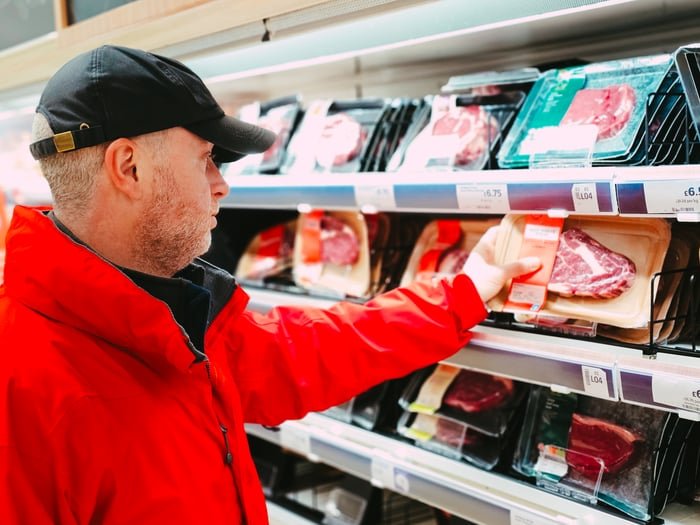
A customer at a grocery store picking up some packaged meat.
Image source: Getty Images.
There is one stock that went public about a year ago that fits that bill. It has a negative beta and is up about 31% year to date and 46% over the past 12 months. Meet Smithfield Foods (NASDAQ: SFD).
Makin’ bacon
Smithfield Foods is a leading pork processor and hog producer, making packaged meats, like hot dogs, sausages, bacon, and sandwich meats. Its brands include Nathan’s Famous hot dogs, Armour, Farmer John, Farmland, Cook’s, Carando, Eckrich, and Smithfield, among others.
Smithfield Foods’ roots date back to 1900, but it was officially founded in 1936. It went public in 1999 and traded on the New York Stock Exchange until 2013 when it went private. But in January 2025, it launched an initial public offering (IPO) and returned to the public markets.
So, its not exactly a new player. In fact, it is the largest pork processor and hog producer in the U.S. with a 23% market share. It is also the second-largest provider of packaged meats with a 20% market share.
Smithfield closed out a strong fiscal 2025 with net sales of $15.5 billion, up 10%, and earnings up 54% to $0.83 per share, year over year. Furthermore, the company had record-operating profit last year.
The performance is made all the more impressive by the headwinds the company faced in 2025 and into 2026. Tariffs impacted its business in China and forced the company to employ alternative strategies and pivot to other international markets. Also, inflation and tariffs led to higher costs for supplies. In addition, the uncertain situation in the Strait of Hormuz has led to increased expenses for fuel and packaging.
But through its “rightsizing” strategy, the company was able to shrink its internal hog production by 40%, which lowered costs, increased productivity, and led to an improvement in operating profit.
Negative beta
For 2026, Smithfield anticipates low-single-digit revenue gains and adjusted operating profit of $1.325 billion to $1.475 billion, which would be up 5% at the midpoint.
Also, Smithfield has a great dividend of $1.25 per share at a high yield of 4.25%.
In addition, it has a negative beta of -0.30, which means that if the market rises, say 1%, Smithfield stock would fall by 0.30%. But if the market falls by 1%, Smithfield stock would rise by 0.30%. Essentially, it means that the company is in an industry that allows it to perform well when the market doesn’t. Smithfield has only been public for a year, so it’s a small sample size, but it is well positioned for growth.
The stock is up 31% year to date, and it is trading at just 11 times earnings and 10 times forward earnings, so it is a great value. It also has a strong dividend with a high yield and tons of cash flow to support it. The company ended 2025 with more than $1 billion in net cash flows from operating activities, up from about $916 million the previous year.
Also, analysts are bullish on the stock. Some 88% of analysts rate it as a buy, with a median price target of $31 per share. That’s only 5% over the current price, but in this market, that might not be so bad.
If you are looking for stocks that zig when the markets zag, Smithfield Foods might be one for you to consider.
Should you buy stock in Smithfield Foods right now?
Before you buy stock in Smithfield Foods, consider this:
The Motley Fool Stock Advisor analyst team just identified what they believe are the 10 best stocks for investors to buy now… and Smithfield Foods wasn’t one of them. The 10 stocks that made the cut could produce monster returns in the coming years.
Consider when Netflix made this list on December 17, 2004… if you invested $1,000 at the time of our recommendation, you’d have $555,526!* Or when Nvidia made this list on April 15, 2005… if you invested $1,000 at the time of our recommendation, you’d have $1,156,403!*
Now, it’s worth noting Stock Advisor’s total average return is 968% — a market-crushing outperformance compared to 191% for the S&P 500. Don’t miss the latest top 10 list, available with Stock Advisor, and join an investing community built by individual investors for individual investors.
*Stock Advisor returns as of April 12, 2026.
Dave Kovaleski has no position in any of the stocks mentioned. The Motley Fool has no position in any of the stocks mentioned. The Motley Fool has a disclosure policy.