New York —
It has been a week of geopolitical uncertainty and policy whiplash. Stocks and bonds regained ground, the US dollar sank and gold is set for its best week since 2020.
While President Donald Trump backed down from his recent tariff threat, sending stocks on a sharp rebound, investors are reckoning with the unpredictability of the White House’s means of achieving its policy goals and shifts in the outlook for the global economic order.
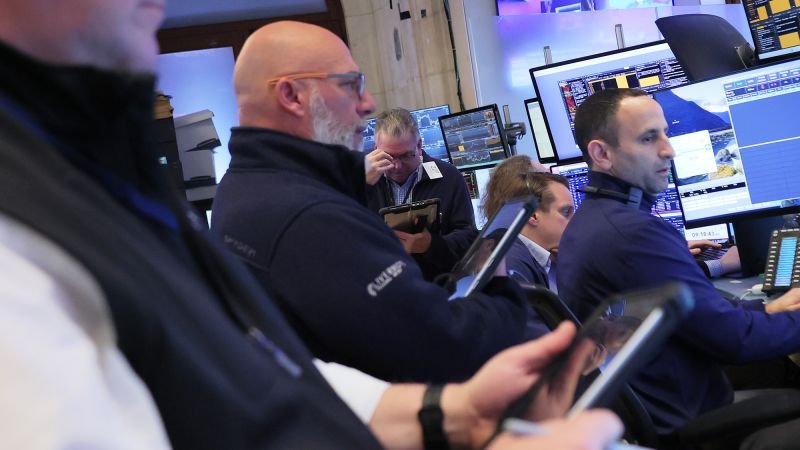
Trump’s flip-flop on tariffs, paired with volatility in Japan’s bond market, sent US stocks and bonds bouncing around. Wall Street’s fear gauge, the VIX, saw its biggest daily surge since October before reversing course.
The S&P 500 had its worst day since October on Tuesday, followed by its best day since November on Wednesday. All told, the S&P is down just 0.5% this week.
Other markets reflect lingering angst: Gold, a haven amid uncertainty, smashed through records this week and is set for its biggest weekly gain in almost six years. The US dollar — one proxy for investors’ confidence in America — is set for its worst week since June.
The Trump administration’s policy proposals are whipsawing markets this year and the Greenland saga could be another nudge for investors to seek insurance against US uncertainty.
“Despite the framework deal on Greenland and stabilization in [Japan’s bond market], the episode of coordinated US equities, bonds and dollar sell-off may have raised some fresh concerns among global money managers that are perhaps increasing their protection,” Francesco Pesole, an FX strategist at ING, said in an email.
US stocks were lower Friday. The Dow was down 260 points, or 0.53%. The S&P 500 fell 0.15%, and the Nasdaq fell 0.1%. Gold futures rose 0.6% and the dollar slightly weakened against other major currencies.
Trump on Sunday announced he would levy a 10% tariff on imports from eight European countries starting February 1 after they opposed his plans for acquiring Greenland. US markets were closed Monday in observance of Martin Luther King, Jr., Day, and the pent-up angst poured into markets Tuesday. The Dow sank 871 points, or 1.76%.
By Wednesday morning, sentiment was already improving. Trump said he opposed using “force” to take Greenland. In the afternoon, the president posted on social media that he had a productive meeting with Mark Rutte, the secretary general of NATO. The proposed tariffs were called off and stocks rallied. The Dow climbed 895 points across two days, recouping its losses.
“Just like what took place several times last year, the president fixed a problem of his own making … and the market responded with a nice advance,” Matt Maley, chief market strategist at Miller Tabak + Co, said in a note.
Meanwhile, a stunning move in Japan’s bond market earlier this week fueled volatility in US markets. Yields on Japan’s government bonds, which rise when bonds fall, spiked dramatically on Tuesday as investors reacted to Prime Minister Sanae Takaichi’s proposal to temporarily cut taxes on food and her decision to call a snap election. Investors dumped bonds amid nerves about how the government would pay for its spending plans alongside new tax cuts. Japan already has an enormous debt load.
Those nerves spilled into the US bond market on Tuesday at the same time that stocks and the dollar were sliding because of uncertainty about Trump’s tariff plan. Higher bond yields can put pressure on stocks. But Japan’s bond market stabilized Wednesday, easing nerves in global markets. That helped US bonds recover some losses on Wednesday, although yields remain slightly higher on the week.
But nerves remain: Gold this week rose above $4,700, $4,800 and then $4,900 a troy ounce all for the first time ever and is already up nearly 14% this year after surging 64% in 2025. The dollar index is down more than 1% this week, erasing its gains so far this year and leaving it down 9% across the past 12 months.
A weaker dollar can support higher gold prices, as bullion becomes relatively more affordable for international investors. Meanwhile, central banks around the globe including China continue to build up their gold reserves, easing their reliance on US assets. And momentum from regular investors is becoming a strong force in gold’s meteoric rise.
Investors’ focus now turns to a slate of earnings results for the fourth quarter. Meta (META), Microsoft (MSFT) and Tesla (TSLA) are all expected to report earnings next week. The Federal Reserve on Wednesday will hold its first policy meeting of the year.
And the rally in US stocks is broadening out. The Dow is outpacing the tech-heavy Nasdaq so far this year. The Russell 2000, an index of smaller companies, is up a whopping 9.5% this year.
But volatility will likely remain elevated, said Larry Adam, CIO at Raymond James, noting stocks’ high valuations, investors’ “overoptimism” and the US midterm elections later this year.
Steve Sosnick, chief strategist at Interactive Brokers, told CNN that the market whipsaw can be great for traders who seek opportunities to profit amid dips in the market. Nonetheless, it might leave a sense of heightened uncertainty.
“When it comes to major economic policies or major geopolitical, diplomatic policies, it’s not always easy to deal with if you’re getting these comings and goings basically spuriously,” Sosnick said.
“I do think that these policy 180s, it’s not necessarily in the markets’ best interest long term,” he said.



![i’m-nervous,-too!-[part-2]](https://10xwealthreport.com/wp-content/uploads/2026/03/177042-im-nervous-too-part-2-1568x784.jpg)