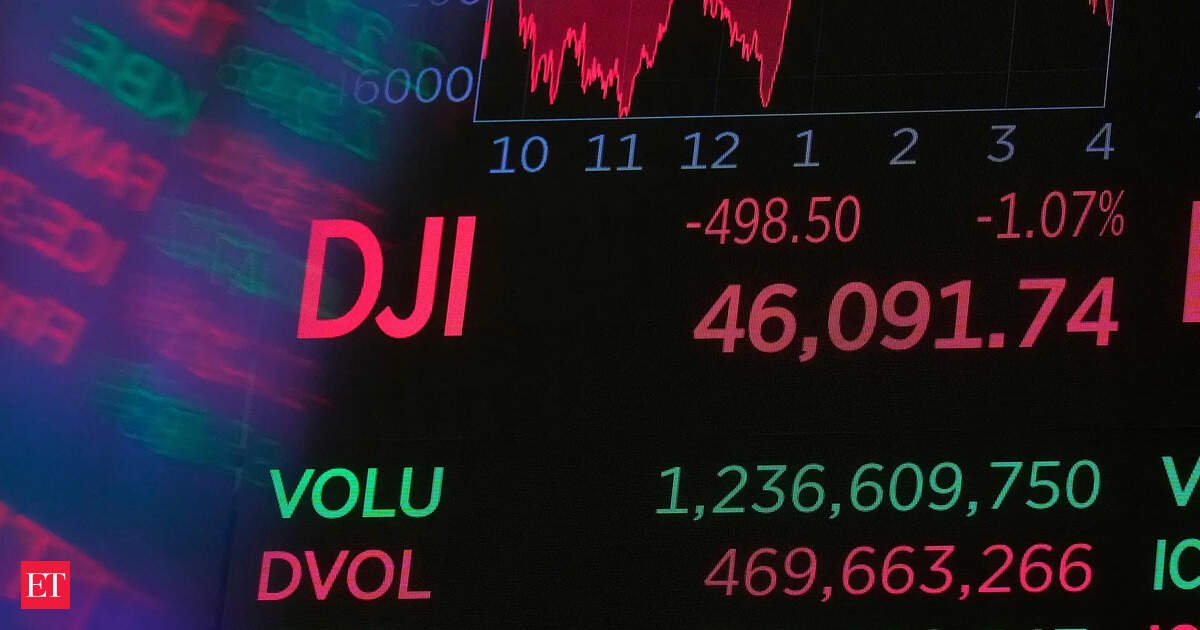
US stock market crash today sent shockwaves across Wall Street as the Dow Jones dropped 234 points to 45,787.01, the S&P 500 slid 0.85% to 6,550.12, and the Nasdaq plunged 1.26% to 21,812.80. Within hours, investors moved into risk-off mode, reacting to escalating geopolitical tensions and rising global uncertainty. This sharp sell-off didn’t just come out of nowhere—it built up as fresh developments in the US-Iran conflict triggered fear across global markets.
Right now, the US stock market crash today reflects more than just numbers on a screen. It signals a deeper shift in investor sentiment. With military activity intensifying in the Middle East, bond yields surging globally, and energy markets turning volatile, traders are stepping back. The big question investors are asking is simple: is this just another dip, or the beginning of a bigger correction?
Why did the US stock market crash today as Dow, S&P 500, Nasdaq fall sharply?
The US stock market crash today started with one major trigger—geopolitical escalation. Overnight strikes between Iran and Israel changed the tone of the market almost instantly. Investors hate uncertainty, and this situation added a lot of it in a very short time.
At the same time, reports confirmed that the US is deploying thousands of additional Marines to the region. That move raised concerns about a prolonged conflict. Historically, whenever the risk of war increases, equity markets react negatively. Investors start pulling money out of stocks and move toward safer assets.
On top of that, attacks on energy infrastructure in the Gulf added another layer of stress. Even though headline oil prices didn’t spike dramatically, the underlying risk of supply disruption remains high. That uncertainty alone is enough to push markets lower, which is exactly what we saw in the US stock market crash today.
How far did Dow, S&P 500, Nasdaq fall in the US stock market crash today?
The scale of the US stock market crash today becomes clear when you look at the numbers closely. The Dow Jones Industrial Average dropped by 234.42 points, though intraday losses stretched close to 279 points. That tells you selling pressure remained strong throughout the session.
The S&P 500, which reflects the broader market, fell 56.37 points. A 0.85% decline might not sound extreme at first glance, but in a high-valued market, that’s a significant move. It shows that weakness spread across multiple sectors rather than staying isolated.
The Nasdaq took the biggest hit, falling 277.89 points. That 1.26% drop highlights how sensitive tech stocks are to uncertainty. Growth stocks usually lead declines when risk increases, and today was no different. Altogether, the numbers confirm one thing clearly—the US stock market crash today hit across the board.
Top gainers today in US stock market
AleAnna, Inc. Class A (ANNA) led the rally with a massive surge of +79.42%, closing at $6.80. The stock saw heavy volume of 43 million shares, signaling strong buying interest.
Planet Labs PBC (PL) followed with an impressive gain of +28.12%, ending at $34.54. With 31 million shares traded, the stock showed strong momentum and investor confidence.
AT&T Inc. (T) also moved higher, gaining +2.72% to close at $28.50, supported by steady volume of 28 million shares.
Top losers today in US stock market
Super Micro Computer, Inc. (SMCI) was the biggest loser, crashing -27.64% to $22.28. It recorded the highest volume of the day at 118 million shares, indicating heavy selling pressure.
Ondas Holdings Inc. (ONDS) dropped -5.63%, closing at $10.14, with around 29 million shares traded.
Co-Diagnostics, Inc. (CODX) slipped -2.08% to $2.60, while Intel Corporation (INTC) declined -1.99% to $45.26.
NVIDIA (NVDA) and Tesla (TSLA) also remained under pressure, falling -1.46% and -1.52%, respectively, reflecting broader weakness in tech stocks.
How oil prices and bond yields intensified the US stock market crash today?
If you want to fully understand the US stock market crash today, you need to look beyond equities. Energy markets and bond yields played a huge role in shaping investor behavior.
WTI crude traded at $96.01, up slightly by 0.48%, while Brent crude stayed almost flat at $108.6. But the real story came from Murban crude, which surged 14.18% to $141.7. That sharp jump signals underlying tension in oil markets, even if headline prices look stable.
Meanwhile, natural gas dropped 3.38% to $3.059, showing mixed signals in the energy space. This kind of inconsistency makes it harder for investors to predict inflation trends, which increases uncertainty.
At the same time, UK bond yields surged past 5%, hitting levels not seen since the 2008 financial crisis. Rising yields mean higher borrowing costs, and that directly impacts stock valuations. When bonds start offering better returns, investors often rotate out of equities. This dynamic added serious pressure during the US stock market crash today.
Gold (GC00) slipped -0.86% to $4,566.00, with 151K volume, as rising bond yields reduced its safe-haven appeal.
Silver (SI00) fell sharper, down -1.87% to $69.89, tracking weakness in precious metals and broader risk sentiment.
Which stocks are rising despite the US stock market crash today on Wall Street?
Even during the US stock market crash today, not every stock moved lower. Some companies actually stood out, showing strength despite the broader sell-off.
Chevron is one of them. HSBC upgraded the stock to a “buy” and raised its price target to $215. Analysts believe Chevron has less exposure to Middle East risks compared to its peers. At the same time, it benefits from rising oil prices. The stock has already gained around 32% this year, and analysts still see more upside.
FedEx also surprised the market. The stock jumped more than 7% in premarket trading after strong earnings. Bank of America maintained its “buy” rating and lifted its price target to $440. Analysts pointed to improved operations, better pricing strategies, and major market share gains.
These examples show that even in a US stock market crash today, strong fundamentals can still attract investors. Not everything moves in the same direction, even on red days.
What happens next after the US stock market crash today for Dow, S&P 500, Nasdaq?
After a move like the US stock market crash today, investors naturally want to know what comes next. The answer depends heavily on how the geopolitical situation unfolds.
If tensions between Iran and Israel continue to rise, markets could face more downside. Prolonged conflict could push oil prices higher, increase inflation, and slow down global growth. That combination usually creates more pressure on stocks.
However, if the situation stabilizes, markets could recover quickly. Historically, geopolitical sell-offs tend to be sharp but short-lived. Once uncertainty fades, investors often return to equities.


![i’m-nervous,-too!-[part-2]](https://10xwealthreport.com/wp-content/uploads/2026/03/177042-im-nervous-too-part-2-1568x784.jpg)