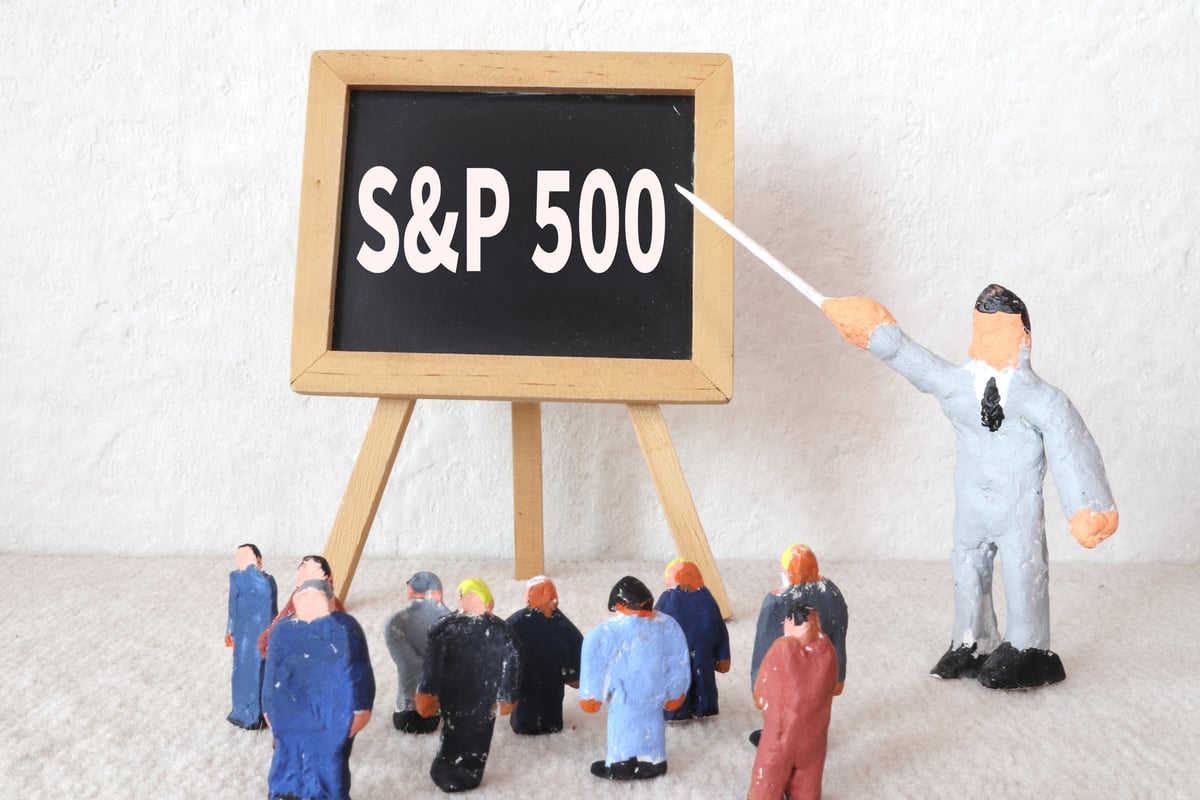
US stock market crash narrative is gaining momentum after a sharp sell-off wiped out billions in value in a single session. The S&P 500 dropped 1.74% to 6,477.16, the Dow Jones fell 469 points, and the Nasdaq Composite slid 2.38%, marking one of the weakest stretches in recent months. At the same time, WTI crude oil surged to $96.76, the 10-year Treasury yield climbed to 4.46%, and the Cboe Volatility Index (VIX) jumped nearly 9% to 29.88. These numbers clearly signal rising stress across financial markets.
The S&P 500 Equal Weight Index is flashing fresh warning signals as it struggles around its key 200-day simple moving average near 7,690. After briefly bouncing from support earlier in the week, the index is now threatening to close below this level again, pointing to weakening momentum. While it has managed to stay above last week’s intraday low of 7,652, repeated tests of support typically signal fragility rather than strength. With other major indices already trading below their 200-day averages, the near-term technical outlook for SPXEW is turning decisively bearish.
In the crypto market, weakness is also evident. The Bitcoin is down around 6% week-over-week, while Ethereum has slipped 7%, reflecting broader risk-off sentiment. Despite this short-term decline, long-term adoption trends remain strong. Data shows bitcoin adoption has grown at a median annual rate of 17% since 2017, though that pace has slowed to nearly 4% by mid-2025. While narratives around institutional inflows following regulatory clarity continue to support sentiment, actual adoption growth appears to be moderating as the asset matures.
Market breadth data paints a mixed but cautious picture. The percentage of stocks trading above their 200-day moving averages remains subdued across major indices. The S&P 500 stands at 47.29%, slightly down from last week, while the Nasdaq Composite holds near 35.74%, showing limited improvement. Meanwhile, the Russell 2000 has edged up to 48.57%. This indicates that despite headline declines, underlying participation remains weak, reinforcing concerns that the broader market is still in a fragile and corrective phase.
Will the US stock market crash ahead? How will Dow Jones Industrial Average, S&P 500 and Nasdaq Composite move
The biggest factor fueling US stock market crash fears right now is the sharp spike in oil prices. With Brent crude moving above $110 per barrel and WTI nearing $100, the cost pressure on the global economy is intensifying. Higher oil prices increase transportation and production costs, which eventually hit corporate earnings and consumer spending.
At the same time, volatility is rising fast. The VIX near 30 shows that investors are actively hedging against downside risks. This is not typical behavior during stable markets. Instead, it reflects uncertainty and fear.
Another key driver is geopolitical tension. Ongoing conflict risks are keeping markets on edge. Investors dislike uncertainty, and when it persists, they shift away from equities. This shift is already visible in declining stock prices and rising demand for safer assets.
Are rising oil prices and bond yields signaling a US stock market crash ahead?
There is a strong historical link between rising oil prices and US stock market crash scenarios. When oil approaches or crosses $100, it acts like a brake on economic growth. Businesses face higher costs, and consumers reduce discretionary spending. This slows down the economy.
At the same time, bond yields are climbing. The 10-year Treasury yield at 4.46% reflects tighter financial conditions. Higher yields reduce the present value of future earnings, which puts pressure on stock valuations—especially in tech-heavy indexes like the Nasdaq.
This creates a policy dilemma. On one side, rising oil prices push inflation higher. On the other, slowing growth may require rate cuts. This conflict makes it harder for the Federal Reserve to act decisively, increasing uncertainty in markets. If yields continue to rise and oil stays elevated, the probability of a US stock market crash ahead increases significantly.
Why are Dow, S&P 500 and Nasdaq showing hidden signs of a deeper correction?
The headline numbers only tell part of the story. Beneath the surface, the US stock market crash may already be unfolding in slow motion. The S&P 500 has seen a maximum drawdown of around 7%, but the average stock in the index is down about 17%.
The situation is even worse in the Nasdaq Composite, where the average stock has dropped nearly 31%. This indicates that many stocks are already in bear market territory, even if the index itself hasn’t fully reflected it.
Technically, the S&P 500 is trading well below its 200-day moving average of 6,633. This is a key bearish signal. If the index breaks below support levels near 6,200, selling pressure could accelerate. The rising VIX also confirms that investors are preparing for more downside, not less.
Could Federal Reserve policy and economic data trigger a US stock market crash?
Federal Reserve policy is another critical factor influencing US stock market crash fears. Earlier this year, markets expected multiple rate cuts. Now, expectations have shifted, with some probability of rate hikes returning.
This sudden shift matters. Markets tend to react sharply when expectations change quickly. Rising yields also reflect weaker demand for U.S. government debt, partly due to concerns over increasing fiscal spending and a national debt nearing $40 trillion.
Economic data is also showing mixed signals. Manufacturing activity has improved slightly, but services activity has slowed to an 11-month low. Consumer sentiment has dropped, and inflation expectations are rising. These signals suggest that the economy is losing momentum while inflation risks remain.
If upcoming data, such as the nonfarm payrolls report, shows further weakness, it could amplify US stock market crash concerns. Markets are highly sensitive to economic surprises right now.
What are investors searching: Is a US stock market crash coming or just a correction?
This is the most important question investors are asking: Is this a US stock market crash or just a temporary correction? The answer lies in how key factors evolve in the coming days.
If geopolitical tensions ease and oil prices fall, markets could rebound quickly. Stocks are already in oversold territory, which often leads to short-term rallies. A ceasefire or de-escalation could act as a strong catalyst for recovery.
However, if oil prices remain high and yields continue rising, the downside risk remains significant. In that case, what looks like a correction today could turn into a deeper crash.
Right now, the market outlook is best described as volatile. There are strong forces pulling in both directions. Investors should closely watch oil prices, bond yields, and volatility levels. These indicators will likely determine whether the US stock market crash fears fade—or intensify further.


![i’m-nervous,-too!-[part-2]](https://10xwealthreport.com/wp-content/uploads/2026/03/177042-im-nervous-too-part-2-1568x784.jpg)