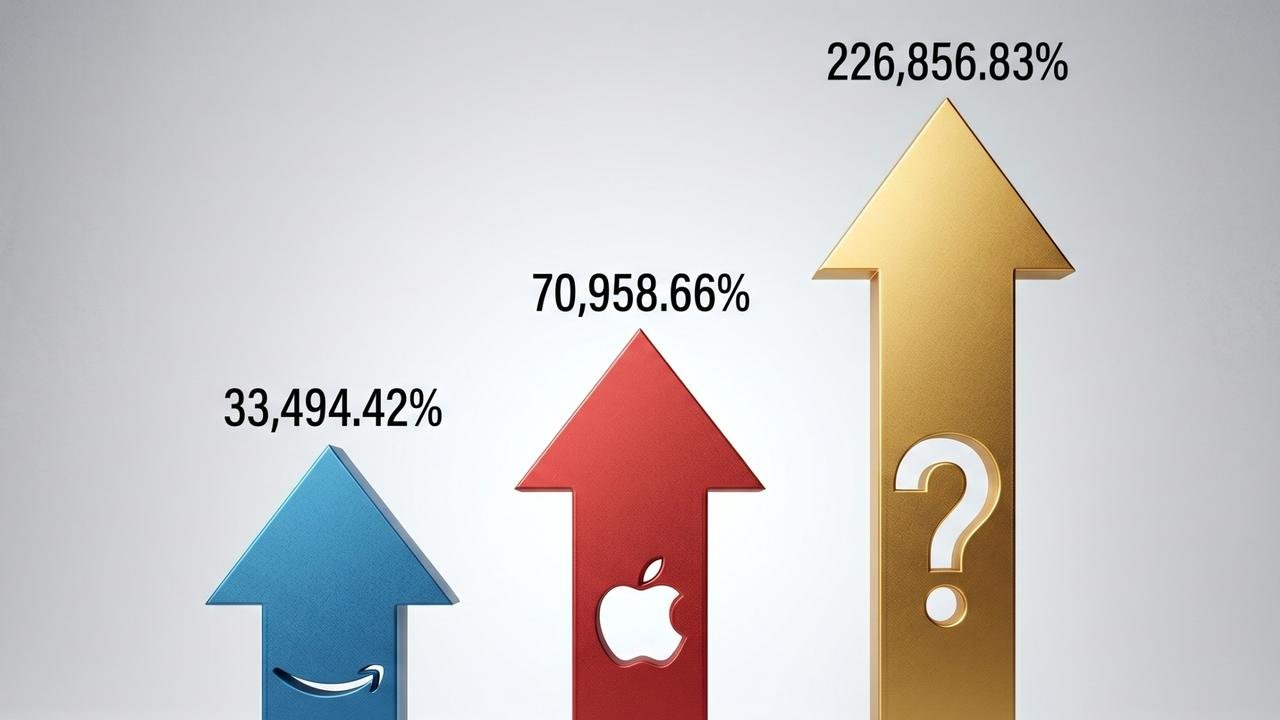

Ask any investor who won the last 25 years, and you’ll hear the usual suspects — Amazon, Apple, Tesla, maybe Meta. YCharts just dropped the numbers, and the actual winner? Not even close to what you’d guess. Photo: Getty

Sure, Apple (#2) and Amazon (#8) cracked the top 10. But while everyone was busy worshipping Silicon Valley, one company from a totally different corner of the economy quietly smoked them all. Photo: Gemini AI

It’s not a software company. It doesn’t make microchips. It doesn’t build electric cars. Photo: Gemini AI

It sells aluminium cans filled with caffeine and sugar. Photo: Canva

Meet the king of ROI: Monster Beverage Corporation. Photo: Canva

Sorry, Jeff. Turns out flogging energy drinks to skaters and gamers was a better trade than reinventing global retail. Photo: Canva

A $10,000 investment in Amazon back in 2001 is worth $3.3 million today. Nothing to sneeze at. Photo: Canva

The same $10,000 in Monster, though? A casual $22.7 million. Yes, really. Photo: Canva

Monster didn’t start in some Silicon Valley garage or a science lab. It had humble beginnings in 1935 as Hansen’s Fruit Juices, hand-delivering fresh juice to Hollywood film studios in LA. Photo: Monster Beverage Corporation

For decades, the company stood for wholesome, all-natural ingredients. Basically, the polar opposite of what’s in a Monster can now. Photo: Monster Beverage Corporation

In 1992, two South Africans (lawyer Rodney Sacks and finance guy Hilton Schlosberg) bought the struggling Hansen Natural Company for $14.5 million (A$20.1 million). Spoiler: it would become one of the greatest acquisitions in stock market history. Photo: Business Tech

Their first crack at energy drinks in the late ‘90s was a huge flop. The market wasn’t biting on another tiny premium can like Red Bull. Photo: YouTube

So in 2002, they tried again and launched Monster Energy. The pitch was simple: double the size of a Red Bull, same price. Tradies, students and gamers couldn’t grab a can fast enough. Photo: Monster Corporation

While Red Bull was schmoozing in nightclubs and Formula 1, Monster was sponsoring dirt bikes, skateparks and metal festivals. They locked down the edgy crowd and never let go. Photo: Roadracing

They didn’t do any flashy Super Bowl ads either. Monster built a grassroots empire by paying athletes and brand ambassadors directly. Cheaper, cooler, more loyal. Photo: Getty

Then came 2015, when Coca-Cola bought a 16.7 per cent stake, plugging Monster straight into the world’s most powerful drinks distribution network. Game over. Photo: Coca-Cola

Monster taking the number one spot is wild enough, but take a look at second place. Comfort Systems USA, which is an HVAC company. The two best-performing stocks of the last 25 years are caffeine and airconditioning. Photo: YCharts

And right now in 2026, it’s old-school hardware that’s having a moment. Sandisk (+361 per cent) and Intel (+156 per cent) are leading the YTD pack. Photo: Sandisk/Intel

Zoom in on just the last 10 years (2016–2026) and a different beast takes the crown. NVIDIA, with a brain-melting 22,841 per cent return. Photo: NVIDIA

The energy drink market is now a $24 billion (A$33.6 billion) juggernaut. Red Bull still sells the most cans globally, but Monster is breathing down its neck. Photo: Gemini AI

The landscape’s shifting, though. Brands like Celsius (CELH) are crushing it by chasing the gym-bro and wellness crowd. Photo: Pinterest

Even Costco wants in. They’ve launched a Kirkland-brand energy drink to undercut everyone. Photo: Costco

Monster’s response has been to buy the competition (it scooped up Bang Energy), pump out zero-sugar Ultra lines, and push hard into hard seltzers and flavoured alcohol. Photo: Monster Beverage Corporation

The lesson here is that the biggest returns usually come from getting in early on a niche that goes mainstream. Heating, cooling and caffeinating regular people built generational wealth. Photo: iStock

You didn’t need fat cash upfront either. Drip-feeding $250 a month into NVIDIA since 2001 ($75K total contributed) would be worth over $35 million today. That’s a four-figure habit becoming an eight-figure retirement. Photo: YCharts

Monster’s stock wasn’t a smooth ride; there were brutal crashes along the way. The market is unpredictable. But over 25 years, human nature isn’t. We love our phones, we love our aircon, and we really, really love caffeine. Photo: iStock

Hang on … Where’s Microsoft? Where’s Google? Surely they made the top 10? Well, percentage returns are all about the starting line. By the time these giants went public or hit their stride, they were already too big to multiply 10,000x. Photo: Gemini AI

Microsoft is the ultimate slow-and-steady compounding machine. Massive wealth creator over 25 years, but it never had that small-stock-to-titan rocket ride. By 2001, it was already a corporate giant. You simply can’t multiply a behemoth fast enough to outrun a nimble underdog like Monster. Photo: YCharts

Google didn’t IPO until August 2004, so it was disqualified from the 25-year list (which starts May 2001). And by the 10-year window (2016–2026), it was already a trillion-dollar giant — way too big to deliver the 3,000 per cent-plus returns needed to beat semiconductor rockets like AMD and Micron. Photo: YCharts

Same story with Meta. It IPO’d in 2012, missed the 25-year cut-off entirely. It had a huge 2010s, but the recent 5- and 10-year windows have favoured the AI hardware super-cycle (NVIDIA, Arista Networks, Vertiv) over social media stocks that hit volatility and maturity. Photo: Forbes

Tesla had an absolutely legendary run between 2019 and 2021. But across the strict 5-year (2021–2026) and 3-year (2023–2026) lookbacks, Tesla’s been hit with cooling demand, price cuts and margin squeezes — knocking it well off the leaderboard while names like Palantir (PLTR) and AppLovin (APP) surged. Photo: Tesla

The stock market is unpredictable. But if you’re looking to invest for long-term gain, the biggest winners aren’t the stocks everyone’s talking about — they’re the ones quietly compounding over time. Photo: iStock