I’ve earned a reputation for being an optimist because I often say that the stock market usually goes up.
But just because I think the stock market is likely to trend higher in the long run doesn’t mean that I think everything is sunshine and rainbows.
There are some things I think that are arguably cynical that, for better or worse, are things that I’d argue are bullish for stocks.
Some of us are better at responsible spending. Some of us can’t afford to be wasteful. But many of us just buy too much stuff. We buy clothes we don’t wear, food we don’t eat, toys we don’t play with, kitchenware we don’t use, home decor we don’t put out, subscriptions to newspapers we don’t read, and memberships to gyms we don’t go to.
I’m not one to judge. Just in the past two months, I’ve arguably spent far too much money on World Cup memorabilia and soccer jerseys that are destined for a box in the back of a closet. But I think it all makes me happy or something. And I think I can afford it.
That said, this behavior is bullish because all this spending keeps a lot of people employed at the companies selling all this stuff. That means those employees will have money to buy stuff, and many of the companies selling stuff are publicly traded in the stock market we invest in.
I was surprised by how quickly cruising and airline travel recovered and broke records after the COVID-19 pandemic had many of us grounded. Generally speaking, I’m surprised by how quickly we return to our pursuits of happiness after some incredibly horrible news.
Of course, everything is relative. We all have our own way of dealing with things. And when a tragedy hits closer to home for you than for others, you’ll probably take more time than others to return to your normal life.
To be fair, there are many good reasons to move on quickly. Your children won’t stop growing, and your body won’t stop aging. We can’t put our lives on hold forever. We only have so much time on earth to enjoy it with each other. And at the end of our journeys, I’m sure we’re less likely to regret moving on too quickly.
And similar to what I said earlier, taking your kids to Disney World, celebrating that birthday party, and going to that after-work happy hour all put money back into the economy, which puts people to work. And when people work, they have money to spend. Maybe the Disney employee or bartender will even buy the products from whatever company employs you.
Big, publicly traded companies make pretty good products. But while a publicly traded company might sell more hamburgers than any other restaurant on the planet, I think many of you would agree that the best burger isn’t made by a multi-billion-dollar corporation. It’s made at that local hotspot most people don’t know about. Or maybe you make the best burger.
There are many products and services sold by publicly traded companies, which I’m sure you know can be improved on significantly while still being profitable. But there’s a big difference between being profitable and being increasingly profitable. And publicly traded companies aim to be the latter, as their priority is to increase shareholder returns, not to sell the best product.
So this means pushing the limits of changing a product to appeal to the largest possible audience while cutting costs in every possible way. Eventually, you’re left with a product you’re almost certain to complain about, but you buy it anyway. I’m sure that sounds familiar.
But hey, if you own a big diversified portfolio of stocks, you’ve at least been cashing in on the earnings of the companies making these less-than-best products.
No matter how good things are, I think most of us think things could be better. We could have more stuff. And that stuff could be better and cheaper.
As long as there is demand for better and cheaper stuff, there will be entrepreneurs innovating and eventually supplying this stuff.
The businesses providing better and cheaper stuff will see revenue grow. Some get big enough to get listed in the stock market. As revenue continues to grow, earnings will go up, driving stock prices higher.
This is the story of the stock market. New companies from new industries emerge, and they help drive the stock market higher. Over time, many of these companies go from leading to lagging. But by then, new companies and new industries emerge again, and the endless cycle continues.
These are just my opinions.
And there are complex feelings I have about other big issues, including inequality, healthcare costs, retirement, executive compensation, white-collar crime, economic policy, and social safety nets. But I’m still working on how to articulate them.
Ultimately, I see a lot of forces — some bleaker than others — incentivizing people across the wealth spectrum to innovate, work, earn, and spend in ways that fuel earnings growth and in turn send the stock market higher.
To be crystal clear: I’m not suggesting I believe any of this is good. I just think they help explain why the stock market does what it does.
–
Related from TKer:
📉The stock market declined last week, with the S&P 500 shedding 0.6% to end at 7,411.98. The index is now down 2.6% from its June 2 closing high of 7,609.78 and up 8.3% year-to-date. For market insights, check out the Stock Market tab at TKer. »
There were several notable data points and macroeconomic developments since our last review:
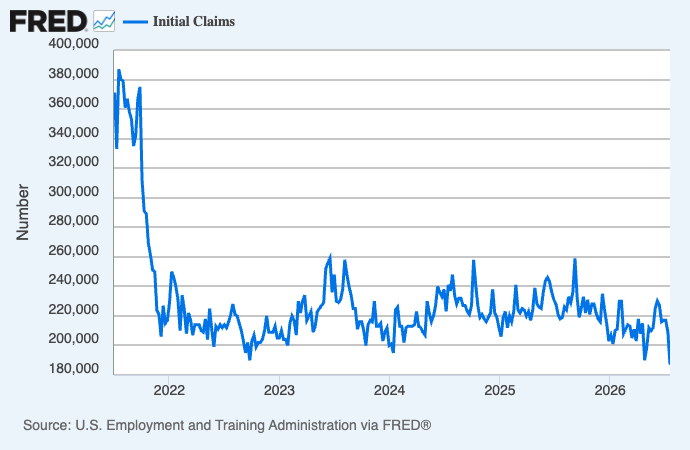
💼 New unemployment insurance claims, total ongoing claims remain low. Initial claims for unemployment benefits declined to 187,000 during the week ending July 18, down from 209,000 the week prior. It was the lowest weekly print since September 1969. This metric remains at levels historically associated with economic growth.
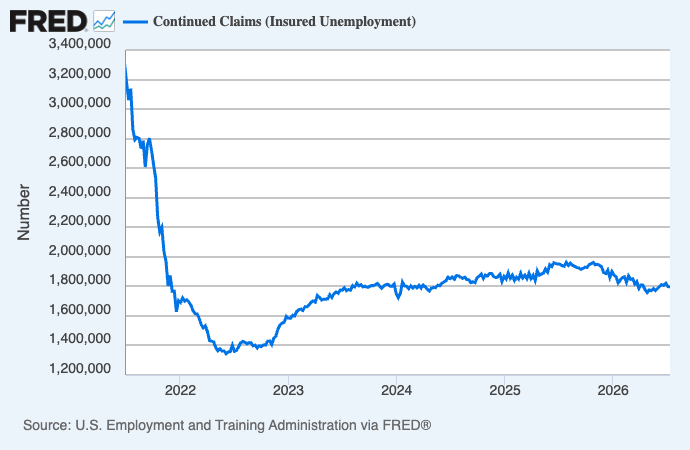
Insured unemployment, which captures those who continue to claim unemployment benefits, ticked down to 1.796 million during the week ending July 11.
For more on the labor market, read: Why mass tech layoffs have little effect on total employment 💾
🤔 Recent private job growth is cooling. According to payroll processor ADP, private U.S. employers added 16,500 jobs in the four weeks ending July 4.
For more on the labor market, read: Things are looking up in the labor market 👍
💳 Card spending data is holding up. From BofA: “TTotal card spending per HH was up 3.5% y/y in the week ending Jul 18, according to BAC aggregated credit & debit card data. Spending growth remains healthy but has slowed, likely due to unfavorable base effects from Prime Day timing change vs 2025. Y/y lower-income spending growth has outpaced higher-income growth for the past two weeks, after lagging for over a year.”
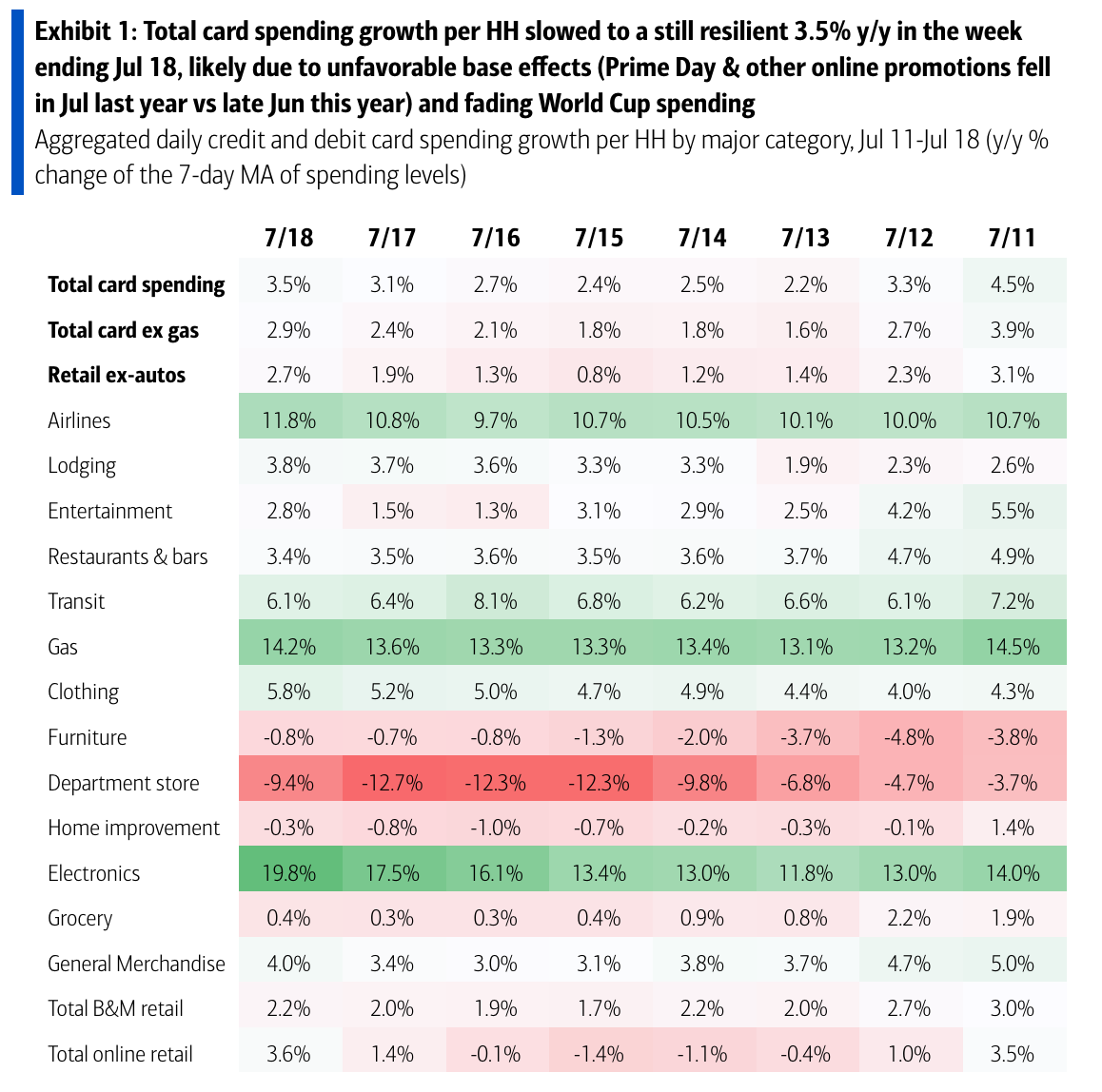
Consumer spending data has looked a lot better than consumer sentiment readings. For more on this contradiction, read: We’re taking that vacation whether we like it or not 🛫 and Household finances are both ‘worse’ and ‘good’ 🌦️
⛽️ Gas prices jump. From AAA: “The national average for a gallon of regular gasoline jumped 15 cents from last week to $4.09. Most states are now averaging $4 per gallon or higher. Rising crude oil prices are behind the spike at the pump. Volatility along the Strait of Hormuz and instability in the region have pushed crude oil prices into the $90 per barrel range and could continue driving up costs during the second half of summer.”
Here’s a longer-term look at the trajectory of gas and diesel prices, as tracked by the EIA.
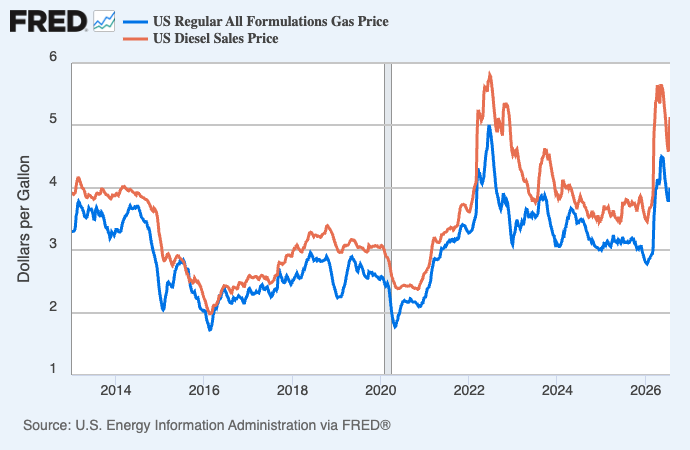
For more on energy prices, read: Our love-hate relationship with rising oil prices in charts 💔🛢️📊
🏠 Mortgage rates tick higher. According to Freddie Mac, the average 30-year fixed-rate mortgage rose to 6.58%, up from 6.55% last week.
As of Q1, there were 147.6 million housing units in the U.S., of which 86.0 million were owner-occupied and about 40% were mortgage-free. Of those carrying mortgage debt, almost all have fixed-rate mortgages, and most of those mortgages have rates that were locked in before rates surged from 2021 lows. All of this is to say: Most homeowners are not particularly sensitive to the small weekly movements in home prices or mortgage rates.
For more on mortgages and home prices, read: Why home prices and rents are creating all sorts of confusion about inflation 😖
🏘️ New home sales rose. Sales of newly built homes increased 1.6% in June to an annualized rate of 628,000 units.
🤔 Economic activity survey signals a pickup in growth. From S&P Global’s July U.S. Flash PMI: “Brighter news out of the Middle East has helped restore
some confidence among US businesses in June, though the overall rate of economic growth signalled by the flash PMI survey remains relatively sluggish compared to that seen earlier in the year in the lead up to the conflict. The survey signals that current output levels are consistent with the economy struggling to grow much faster than a 1% annualized rate in the second quarter.”
🇺🇸 Most U.S. states are still growing. From the Philly Fed’s June State Coincident Indexes report: “Over the past three months, the indexes increased in 46 states and decreased in four states, for a three-month diffusion index of 84. Additionally, in the past month, the indexes increased in 42 states, decreased in three states, and remained stable in five, for a one-month diffusion index of 78.”
For more on GDP and the economy, read: It’s too ambiguous to just say ‘the economy’ 🤦🏻♂️ and Economic data can often be both ‘worse’ and ‘good’ 🌦️
Earnings look bullish: The long-term outlook for the stock market remains favorable, bolstered by expectations for years of earnings growth. And earnings are the most important driver of stock prices.
Demand is positive: Demand for goods and services remains positive, supported by healthy consumer and business balance sheets. Personal spending activity remains at record levels. Core capex orders, which are a leading indicator of business spending, have been trending higher.
Growth rates have cooled: While the economy remains healthy, growth has normalized from much hotter levels earlier in the cycle. The economy is less “coiled” these days as major tailwinds like job openings and excess savings have faded. Job creation, while positive, is not as hot as it used to be. It has become harder to argue that growth is destiny.
Actions speak louder than words: We are in an odd period, given that the hard economic data decoupled from the soft sentiment-oriented data. Consumer and business sentiment has been relatively poor, even as tangible consumer and business activity continues to grow and trend at record levels. From an investor’s perspective, what matters is that the hard economic data continues to hold up.
Stocks are not the economy: There’s a case to be made that the U.S. stock market could outperform the U.S. economy in the near term, thanks largely to positive operating leverage. Since the pandemic, companies have aggressively adjusted their cost structures. This came with strategic layoffs and investment in new equipment, including hardware powered by AI. These moves are resulting in positive operating leverage, which means a modest amount of sales growth — in the cooling economy — is translating to robust earnings growth.
Mind the ever-present risks: Of course, we should not get complacent. There will always be risks to worry about, such as U.S. political uncertainty, geopolitical turmoil, energy price volatility, and cyber attacks. There are also the dreaded unknowns. Any of these risks can flare up and spark short-term volatility in the markets.
Investing is never a smooth ride: There’s also the harsh reality that economic recessions and bear markets are developments that all long-term investors should expect as they build wealth in the markets. Always keep your stock market seat belts fastened.
Think long-term: For now, there’s no reason to believe there’ll be a challenge that the economy and the markets won’t overcome. The long game remains undefeated, and it’s a streak that long-term investors can expect to continue.
For more on how the macro story is evolving, check out the previous review of the macro crosscurrents. »
Here’s a roundup of some of TKer’s most talked-about paid and free newsletters about the stock market. All of the headlines are hyperlinked to the archived pieces.
The stock market can be an intimidating place: It’s real money on the line, there’s an overwhelming amount of information, and people have lost fortunes in it very quickly. But it’s also a place where thoughtful investors have long accumulated a lot of wealth. The primary difference between those two outlooks is related to misconceptions about the stock market that can lead people to make poor investment decisions.
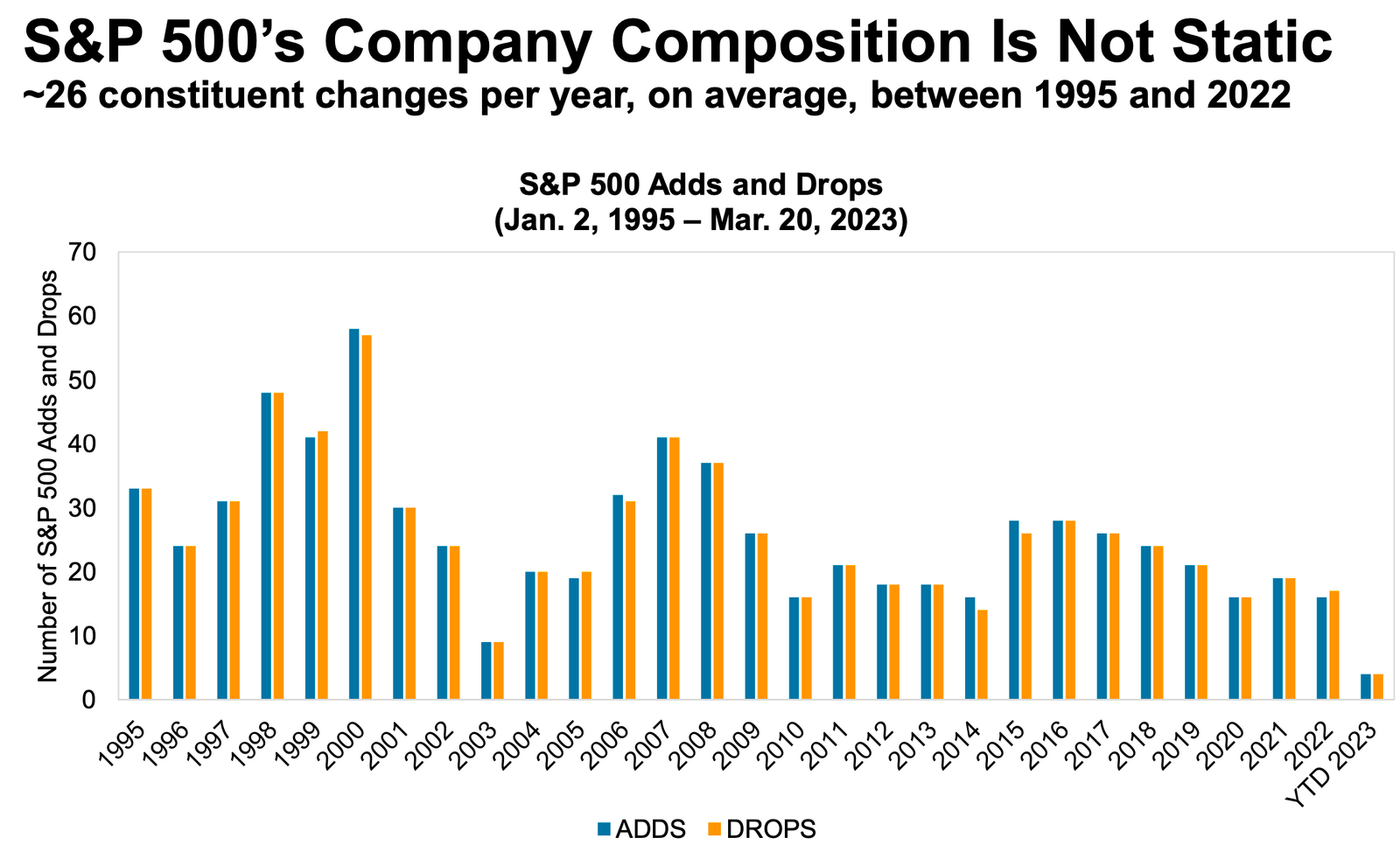
Passive investing is a concept usually associated with buying and holding a fund that tracks an index. And no passive investment strategy has attracted as much attention as buying an S&P 500 index fund. However, the S&P 500 — an index of 500 of the largest U.S. companies — is anything but a static set of 500 stocks.
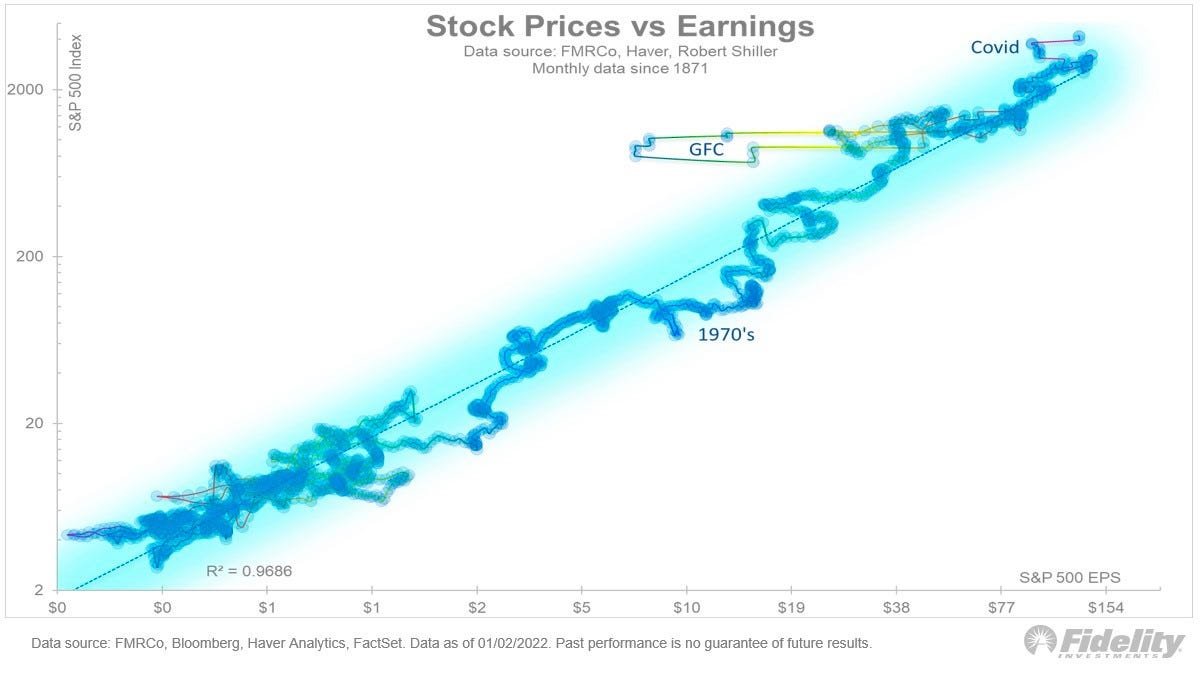
For investors, anything you can ever learn about a company matters only if it also tells you something about earnings. That’s because long-term moves in a stock can ultimately be explained by the underlying company’s earnings, expectations for earnings, and uncertainty about those expectations for earnings. Over time, the relationship between stock prices and earnings has a very tight statistical relationship.
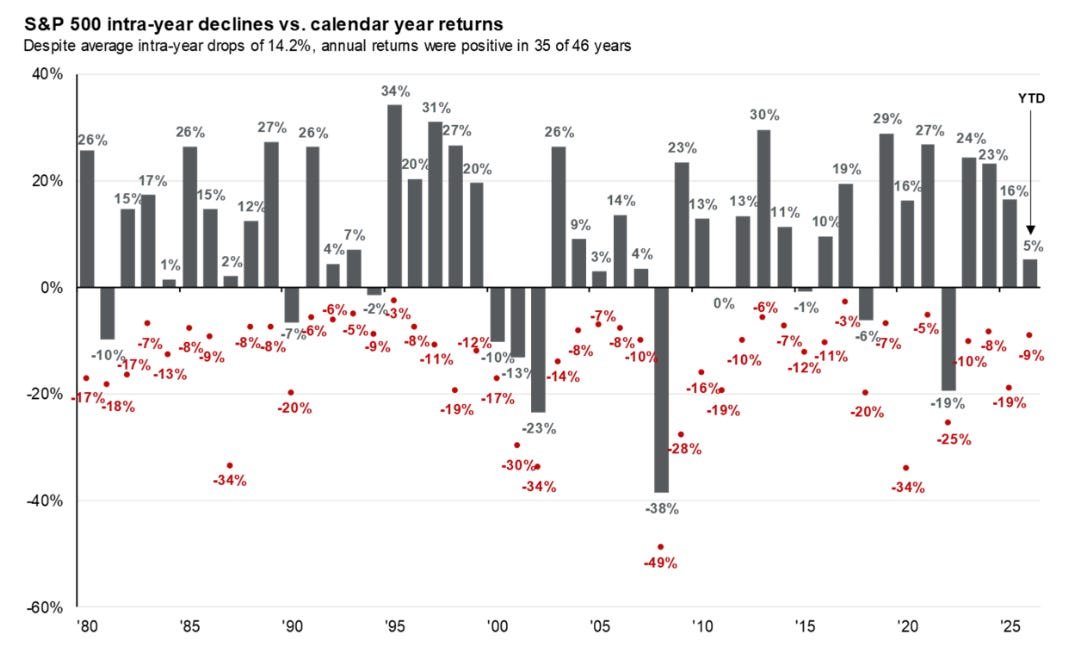
Investors should always be mentally prepared for some big sell-offs in the stock market. It’s part of the deal when you invest in an asset class that is sensitive to the constant flow of good and bad news. Since 1950, the S&P 500 has seen an average annual max drawdown (i.e., the biggest intra-year sell-off) of 14%.
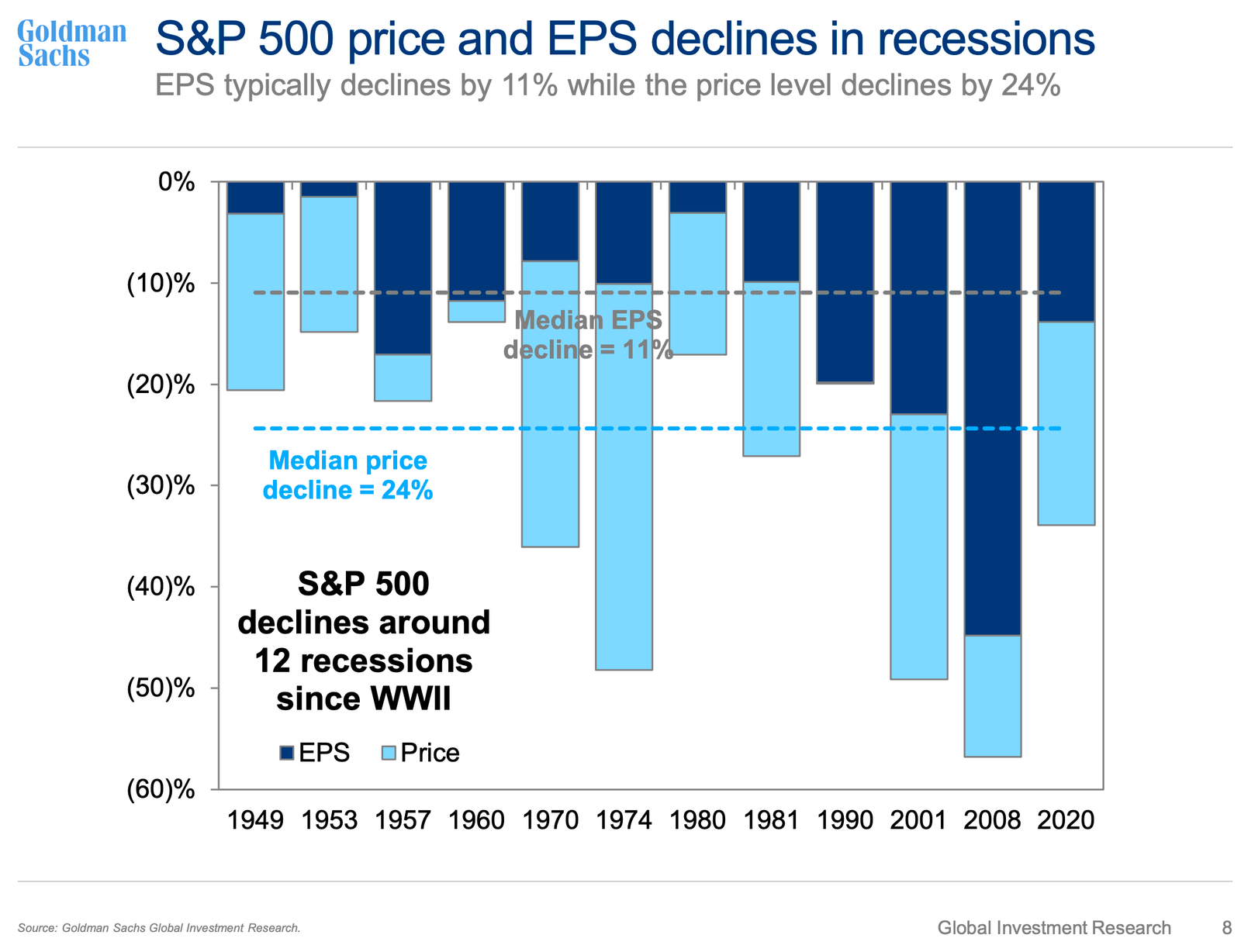
Every recession in history was different. And the range of stock performance around them varied greatly. There are two things worth noting. First, recessions have always been accompanied by a significant drawdown in stock prices. Second, the stock market bottomed and inflected upward long before recessions ended.
Since 1928, the S&P 500 has generated a positive total return more than 89% of the time over all five-year periods. Those are pretty good odds. When you extend the timeframe to 20 years, you’ll see that there’s never been a period where the S&P 500 didn’t generate a positive return.
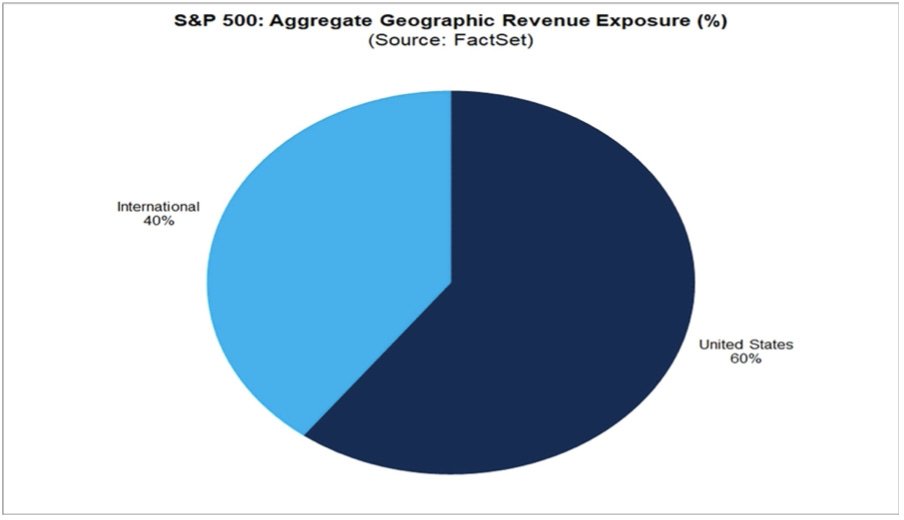
While a strong dollar may be great news for Americans vacationing abroad and U.S. businesses importing goods from overseas, it’s a headwind for multinational U.S.-based corporations doing business in non-U.S. markets.
…you don’t want to buy them when earnings are great, because what are they doing when their earnings are great? They go out and expand capacity. Three or four years later, there’s overcapacity and they’re losing money. What about when they’re losing money? Well, then they’ve stopped building capacity. So three or four years later, capacity will have shrunk and their profit margins will be way up. So, you always have to sort of imagine the world the way it’s going to be in 18 to 24 months as opposed to now. If you buy it now, you’re buying into every single fad every single moment. Whereas if you envision the future, you’re trying to imagine how that might be reflected differently in security prices.
Some event will come out of left field, and the market will go down, or the market will go up. Volatility will occur. Markets will continue to have these ups and downs. … Basic corporate profits have grown about 8% a year historically. So, corporate profits double about every nine years. The stock market ought to double about every nine years… The next 500 points, the next 600 points — I don’t know which way they’ll go… They’ll double again in eight or nine years after that. Because profits go up 8% a year, and stocks will follow. That’s all there is to it.
Long ago, Sir Isaac Newton gave us three laws of motion, which were the work of genius. But Sir Isaac’s talents didn’t extend to investing: He lost a bundle in the South Sea Bubble, explaining later, “I can calculate the movement of the stars, but not the madness of men.” If he had not been traumatized by this loss, Sir Isaac might well have gone on to discover the Fourth Law of Motion: For investors as a whole, returns decrease as motion increases.
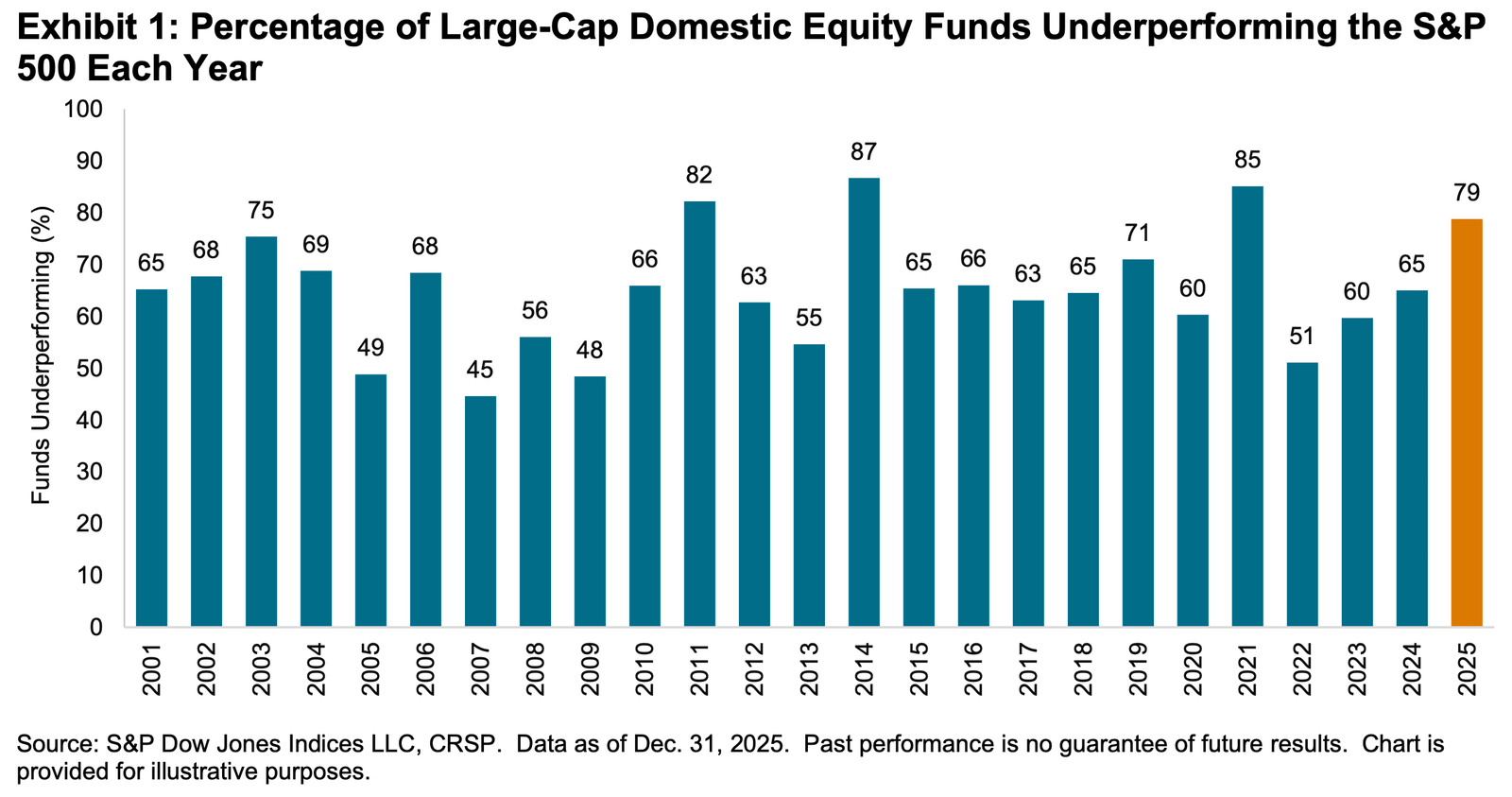
According to S&P Dow Jones Indices (SPDJI), 79% of U.S. large-cap equity fund managers underperformed the S&P 500 in 2025. As you stretch the time horizon, the numbers get even more dismal. Over three years, 67% underperformed. Over 5 years, 89% underperformed. And over 20 years, 93% underperformed. This 2025 performance was the 16th consecutive year in which the majority of fund managers in this category have lagged the index.
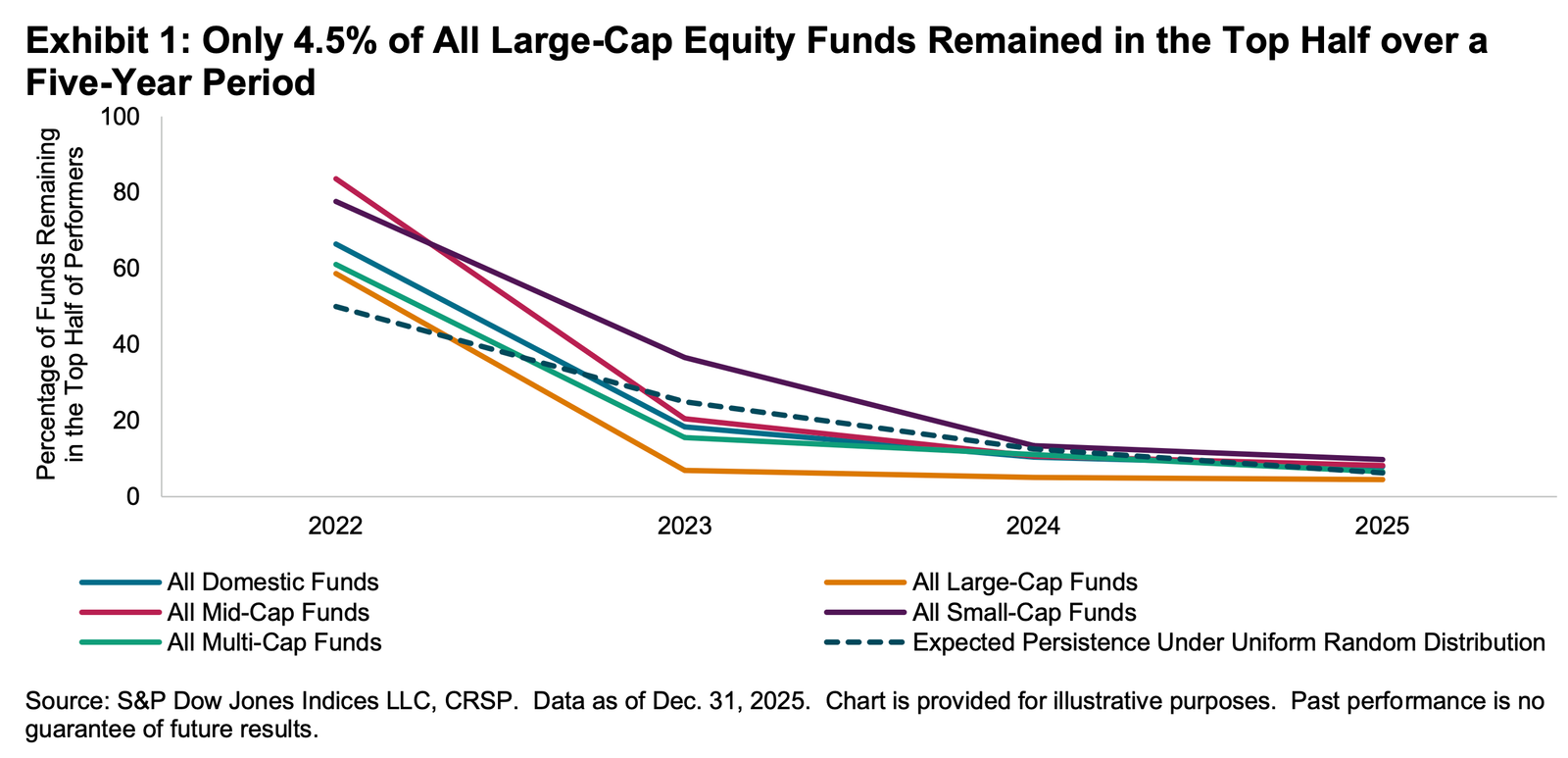
Even if you are a fund manager who generated industry-leading returns in one year, history says it’s an almost insurmountable task to stay on top consistently in subsequent years. According to S&P Dow Jones Indices, of the 334 large-cap equity funds in the top half of performance in 2021, 58.7% remained at the top half in 2022. However, just 6.9% remained on top through 2023. Only 4.5% stayed on top in the five consecutive years through 2025.
It’s much more dismal when you raise the bar. Of the 164 large-cap equity funds in the top quartile in 2021, just 20.1% remained in that category in 2022. That percentage fell to literally 0.0% in 2023.
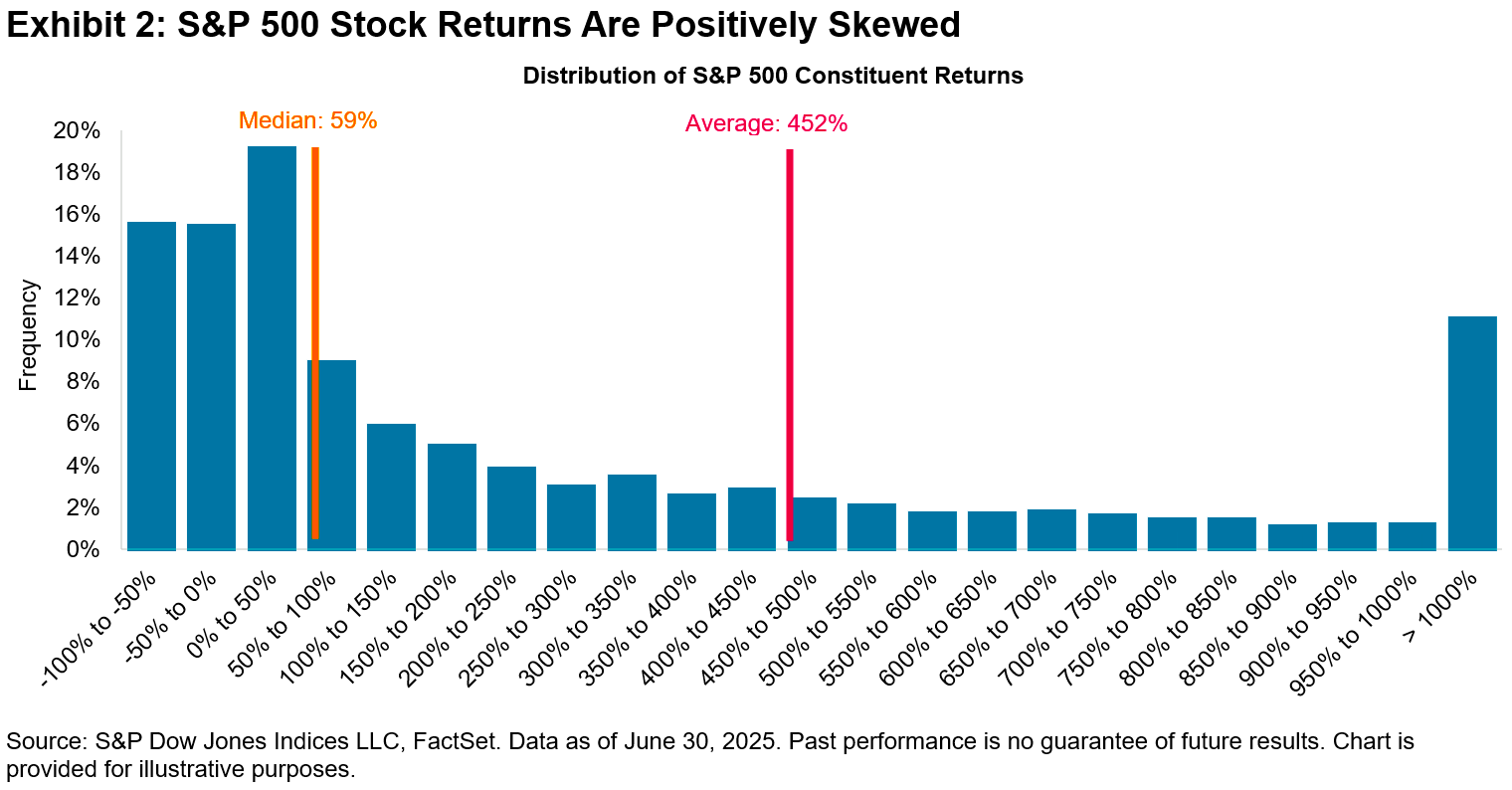
Picking stocks in an attempt to beat market averages is an incredibly challenging and sometimes money-losing effort. Most professional stock pickers aren’t able to do this consistently. One of the reasons for this is that most stocks don’t deliver above-average returns. According to S&P Dow Jones Indices, only 19% of the stocks in the S&P 500 outperformed the average stock’s return from 2001 to 2025. Over this period, the average return on an S&P 500 stock was 452%, while the median stock rose by just 59%.