-
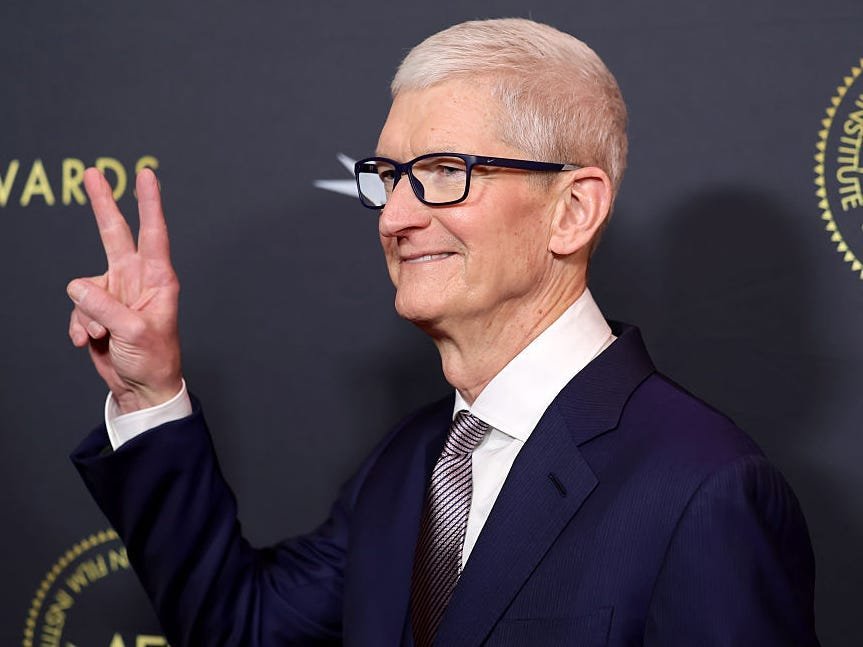
Tim Cook was a financial powerhouse during his roughly 15-year stint as CEO of Apple.
-
He optimized many Steve Jobs-era inventions, and also developed product lines of his own.
-
Detailed below are 5 stats that explain just how successful Cook was at creating value.
Steve Jobs’ enduring legacy is that of a product innovator. From iMacs and iPods to iPhones and iPads, he was the driving force behind some of society’s most ubiquitous items.
If Jobs was the creative visionary, his successor, Tim Cook — who just announced that he’ll step down as CEO later this year — has been a financial juggernaut.
Cook has optimized the manufacturing and sale of many Jobs-era inventions. He’s also added his own valuable product lines. The sum result has been nearly 15 years of market domination. Apple’s stock is up nearly 2,000% under Cook, roughly quadruple the S&P 500.
Given Cook’s financial prowess, it only makes sense to honor his Apple legacy with a series of eye-popping numbers that define his tenure as CEO:
$3.7 trillion … in market cap added
When Cook took over in 2011, Apple was worth about $350 billion. By 2018, it had become the world’s first trillion-dollar company. Now it’s worth about $4 trillion.
80% annual stock gains … in 2019 and into the 2020 pandemic boom
From a stock-return perspective, these two years marked the best stretch of the Cook era. In 2019, Apple saw explosive growth in its wearables business, which includes the Apple Watch and AirPods. Then, as COVID kept everyone home in 2020, demand for Apple computers and services spiked.
$700 billion in buybacks … the biggest program in corporate history
Jobs liked to hoard cash. Cook preferred to put cash to work by purchasing Apple stock. Under Cook, Apple bought back more than $700 billion worth of shares, more than the market value of most S&P 500 companies.
Buybacks can serve as a financial ace in the hole. They reduce the shares outstanding in a stock, pushing the per-unit value higher. It’s essentially a way to engineer gains during times devoid of other catalysts. Not to mention it signals to investors that a company thinks its own stock is cheap enough to buy.
$100 billion services business … an 8-times increase during Cook’s tenure
While Jobs excelled in designing hardware, Cook carved out his own lane selling services. When Apple first started breaking out the category, it mostly contained iTunes, the App Store, and software. Now it also houses: Apple Care, iCloud, Apple Music, Apple TV, and Apple Pay, among others.