As the war in the Middle East escalates, global markets are on edge, with the ASX opening in the red and oil prices jumping.
Wall Street closed lower ahead of the weekend raid by US stealth bombers on Iranian nuclear sites.
Follow the day’s financial news and insights from our specialist business reporters on our live blog.
Disclaimer: this blog is not intended as investment advice.
Key Events
Market snapshot
- ASX 200: -0.4% to 8,470 points (live values below)
- Australian dollar: -0.1% to 64.43 US cents
- Wall Street (Friday): Dow +0.1%, S&P 500 -0.2%, Nasdaq -0.4%
- Europe (Friday): DAX +1.3%, FTSE -0.2%, Eurostoxx +0.7%
- Spot gold: +0.2% at $US3,375/ounce
- Brent crude: +2.5% to US$78.94/barrel
- Iron ore (Friday): -1.1% to $US93.70/tonne
- Bitcoin: +1.3% at $US100,877
Prices current around 10.10am AEST
Live updates on the major ASX indices:
How super has morphed into a tax dodge for the wealthy
Alan Kohler’s Sunday explainer this week was a look into how superannuation, which was intended to fund retirements and reduce pressure on the aged pension, will soon cost more than the pension.
Tax breaks opened at the end of the Howard government made superannuation the most attractive tax shelter for wealthy Australians.
The lack of inheritance taxes mean the portion of those super savings that remains unspent in retirement (most of it for wealthier households) is passed on to the next generation with little taxation paid.
It’s a massive issue, which Alan does well to sum up in 140 seconds.
Loading…
Key Event
Threat to energy supply that’s never occurred before, analyst warns
Global markets remain on edge about whether Iran will disrupt the flow of oil and gas through the crucial Strait of Hormuz in the wake of the US bombing.
The price of Brent crude oil is currently up 2.7 per cent, while the ASX and Asian stock markets are falling.
MST Financial senior energy analyst Saul Kavonic joined business reporter Emilia Terzon on ABC News Channel.
He described the Middle East as “the most important source of oil and also gas in the world”, noting the Strait of Hormuz is where about 20 per cent of the world’s oil and liquefied natural gas supplies transit through to reach global markets.
“We’ve never actually seen that level of supply disruption ever occur.
“Many of us might remember when we saw the energy prices spike in 2022 turn in the wake of the Ukraine war, and for those who are old enough to remember the big oil price shocks in the Iranian revolution in the late 70s and into the 80s.
“What we’re talking about here, if Iran actually carries out what they threaten to do, would be three times the size of the shocks that we’ve seen in the past.
“It could drive petrol at the pump to 50 per cent or even double current prices for a period of time and so that’s what’s got oil prices on edge here.”
Stocks down in Tokyo and Seoul
A quick check of Asian markets, and while Hong Kong, Shanghai and Shenzen are yet to open, stocks in Tokyo and Seoul are down:
- Japan’s Nikkei 225 -1%
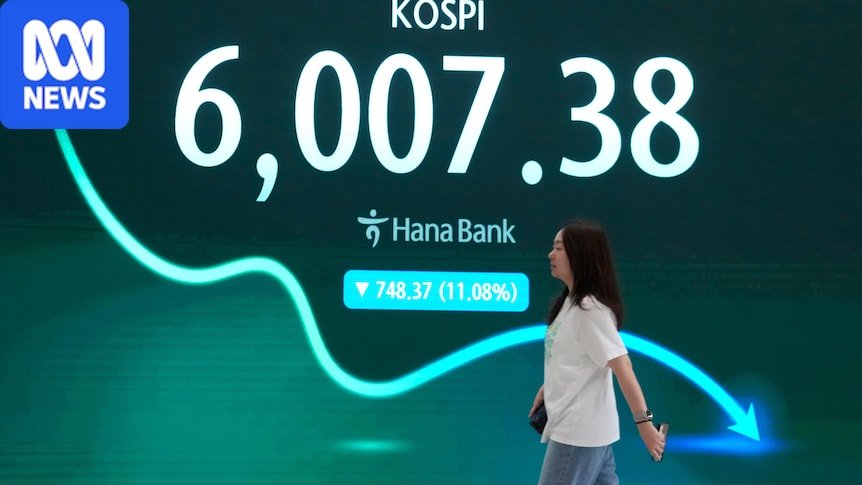
- South Korea’s Kospi 200 -1.2%
Price of stamps to rise to $1.70 as ACCC waves through postage hike
One for your trivia night … from July the price for ordinary small letters – known as the basic postage rate – will increase from $1.50 to $1.70.
The current median price of a stamp among OECD postal service operators is $1.93.
Australia Post will still be losing money on the deal.
Prices for ordinary large letters up to 125 grams will increase from $3 to $3.40, and ordinary large letters between 125g and 250g will rise from $4.50 to $5.10.
The ACCC has not objected to Australia Post’s proposed lift to the price. Unless the minister for communications disapproves, it’ll kick in from July.
Here’s ACCC Commissioner Anna Brakey:
“We understand that these price increases will mean extra costs for consumers. However, our decision to not object to Australia Post’s proposed price increase is based on evidence that the costs to Australia Post of providing the letter service are greater than the revenue it produces.”
Australia Post has submitted that its letters business is in decline, which is consistent with a trend occurring across postal services globally. Currently, Australia Post only delivers about two letters to each household a week and expects reserved letter volumes to continue to decrease by about 10.6 per cent annually until 2027–28.
“Our final decision recommends Australia Post examine ways to alleviate affordability issues for businesses, including those subject to requirements to send physical mail. Further we made recommendations to address a number of other concerns expressed by stakeholders during consultation.
“We are especially mindful of the impact price changes can have on vulnerable Australians, and so our decision paper recommends that Australia Post increases the number of concession stamps per customer, which is currently capped at 50 per year.”
Key Event
Most ASX sectors fall but energy limits fallout
The Australian share market remains in the red in early trade.
The ASX 200 is currently down about three-quarters of a per cent, so it’s declined further from the open.
Here’s a look at how the sectors are faring so far:
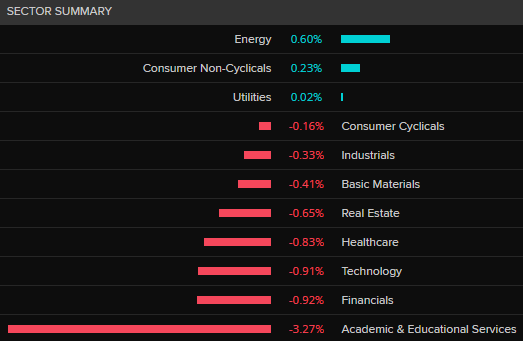
The best performing stocks so far:
- Metcash +4.6%
- Beach Energy +3.3%
- Westgold Resources +3.2%
- West African Resources +3%
- Viva Energy +2.9%
And the worst falls:
- Siteminder -6%
- Temple & Webster -4.2%
- DigiCo Infrastructure REIT -4%
- Clarity Pharmaceuticals -3.9%
- Pro Medicus -3.9%
Key Event
ASX 200 down 0.4pc in very early trade
Five minutes into the session and the ASX 200 is down 0.4% … not calamitous, but jittery.
As expected, oil and gas producers are doing well, with the energy sector up 1.5%.

JB Hi-Fi faces $13.5m penalty in The Good Guys store credit legal action
JB Hi-Fi faces a $13.5 million penalty for allegedly misleading customers over store credit promotions.
The retail group says it’s reached an agreement with the consumer regulator, subject to Federal Court approval, to resolve legal proceedings launched last year.
The ACCC accused JB Hi-Fi-owned appliance chain The Good Guys of making false and misleading statements when offering store credit to customers for purchasing goods of a specific value between July 2019 and August 2023.
According to court documents, The Good Guys’ advertising materials failed to mention customers also needed to opt-in to receive marketing materials and stay subscribed for a minimum period in order to qualify for the credit, which was only able to be used for a very short period.
The ACCC also alleged that thousands of eligible customers missed out on the credit.
In a statement to the ASX today, JB Hi-Fi said The Good Guys and the ACCC would make joint submissions seeking court approval for the penalty and $200,000 of the regulator’s legal costs, and a remediation program for customers.
It said the one-off expense of $13.7 million will be recognised in its results for the current financial year, while the cost of compensation has previously been accounted for and won’t impact its results.
“The Good Guys takes its compliance with the law very seriously and has worked cooperatively with the ACC to resolve the matter,” the statement read.
Oil price gains ease after early spike
As Steve reported earlier, in initial trade after the weekend, Brent crude futures rose more than 4% and briefly passed $US80 a barrel.
But, as you can see from the graph below, those initial gains subsided quickly this morning.
Digital platforms ‘critically important’ but ACCC ‘concerned about harms’
A lack of competition, a need to protect consumers, a concern about “prevalent” harms — a major new report about digital platforms is waving red flags about how we interact with the tech giants.
Our competition watchdog, the ACCC, has just released its Digital Platform Services Inquiry, a five-year examination of what to worry about and what to do about it.
The key findings, directly quoted, are here:
- Digital platform services are critically important to Australian consumers and businesses and are major drivers of productivity growth in our economy.
- The ACCC is concerned about harms to competition and consumers which are particularly prevalent on a small number of large digital platforms.
- A lack of competition in Australia’s digital markets can stifle productivity and innovation, reduce choices, and lead to higher prices for Australian consumers and small businesses.
- There is broad international recognition that reform is needed to protect consumers and increase competition in digital markets.
More to come …
Will America’s latest military adventure play into China’s hands?
That’s the question posed by Alan Kohler in his weekly column today.
Throughout China’s rise as an industrial power since it joined the World Trade Organization on December 11, 2001 — exactly three months after 9/11 — America has been constantly sidetracked and weakened by wars and unrest.
It started with the “War on Terror” after 9/11, then Afghanistan, Iraq in 2003, Yemen from 2002, Libya in 2007, Syria from 2014, the contested US election and riots of January 6, 2020, Ukraine and then Gaza over the past two years, Donald Trump’s two trade wars, and now … Iran.
Trump understood the problem and campaigned on “no more wars,” but has been unable to resist the pressure from America’s military establishment and Israel.
You can read the full piece via the link below:
ANZ raises oil price target to $US80/barrel
Just in from the ANZ commodities team of Daniel Hynes and Soni Kumani.
“Risks of supply disruption in the crude oil market have risen sharply following an escalation in the Israel-Iran conflict.
“We see three possible scenarios, each of which would have a different impact on oil prices.
- The most likely scenario (we estimate a 50% probability) in our view is an extended conflict. This would see supplies come under direct threat. However, the oil market is better equipped to respond to that than it has been in the past. OPEC has over 6mb/d of spare capacity that can be quickly activated. The price outcome for this scenario would be the USD75–85/bbl range.
- We view an escalation of the conflict as the least likely (20% probability) scenario. We can’t rule out that Iran may retaliate by disrupting the flows of oil from the Middle East. This could trigger action by Israel’s allies, including stricter sanctions on Iran. Energy export infrastructure in Iran and other regional states could be targeted. The price outcome for this scenario would be the USD90–95/bbl range.
- Finally, the conflict could subside (30% probability). Israel successfully neutralises Iran’s nuclear facilities, with Tehran capitulating to US demands on restoring or further developing its nuclear program. The price outcome for this scenario would be the USD60–65/bbl range.
“On a weighted average basis this would see Brent crude oil trade in a range of USD74–81/bbl. We have subsequently raised our short-term (0-3mth) price target to USD80/bbl. This is up from USD55/bbl, which assumed rising OPEC production would push the market into a sizeable surplus.”
Follow live updates on Iran-Israel war
Less than an hour until the ASX opens this morning and we’ll keep you updated on the financial markets fallout of the US strikes on Iranian nuclear sites.
To stay across all the latest developments on the war in the Middle East, open the ABC News live blog in a new tab:
This week: Inflation update and global manufacturing
Australia:
Mon: Purchasing Managers’ Indexes (Jun), Metcash results
Wed: CPI indicator (Mar)
Thu: Job vacancies (May)
International:
Mon: EU – PMIs (Jun)
US – PMIs (Jun)
Tue: US – Fed Reserve chair Jerome Powell testimony, home prices (Apr)
Wed: US – New home sales (May)
Thu: US – GDP (Q1), Advanced goods trade balance (May)
Fri: CN – Industrial profits (May)
US – PCE inflation (May), personal income & spending (May)
There will be some interesting releases of data this week, but from the markets’ point of view, they will largely be trumped (so to speak) by the repercussions of events unfolding in the Middle East.
Locally, the main interest will be the monthly consumer price index indicator of Wednesday.
The consensus view is headline inflation will ease further to around 2.3%, edging closer to the bottom of the RBA’s target band.
S&P Global releases its monthly purchasing mangers’ indexes for both the manufacturing and services sectors later today.
Activity is likely to be subdued given on-going uncertainty with tariffs and mounting anxiety in the Middle East.
Australian business is unlikely to be alone on that count.
PMIs out for most major economies this week are likely to show similar results.
Globally, the release of US PCE deflator (Friday), the Fed’s preferred measure of inflation, will be closely watched.
The expectation is inflation will continue to be modest in May, with impact of the US tariffs still yet to bite.
Ahead of that, Fed Reserve chair, Jerome Powell, will testify before the House Committee on Financial Services (Tuesday) with pro-Trump members keen to find out where the rates cuts are.
Perhaps the most interesting data of the week will be the US advanced goods trade balance (Thursday).
Much has been said about the impact of front-loading imports ahead of the April tariffs, but US exports also increased earlier in the year.
A narrowing of the deficit may boost the final estimate of March quarter GDP also out on Thursday.
Key Event
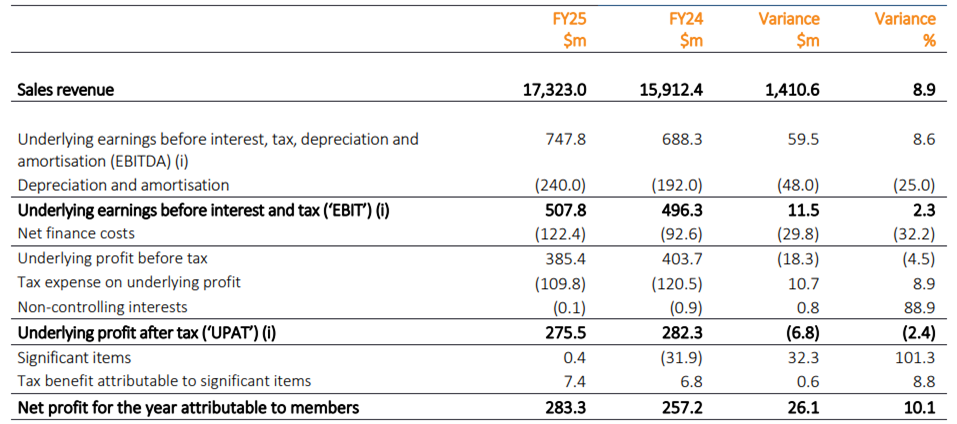
Metcash lifts FY profit 10% to $283 million
The grocery and hardware business Metcash has raised its full year profit by 10.1% to $283.3 million.
The company maintained its full year dividend at 18 cents per share having announced a final dividend of 9.5cps.
Key Event
NZ stocks slip in early trade
New Zealand’s NZ 50 has slipped 0.7% in early trade (8:50am AEST).
Equities during Gulf flare-ups – a brief history
As anyone knows from reading the T&Cs of an investment product, “past performance is no guide to future returns”.
Nonetheless, we on the blog love looking at past performances.
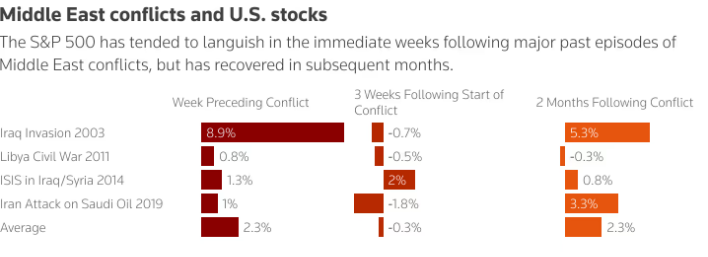
Flaring tensions in the Middle East have generally seen an initial slump in equities (in this case the S&P 500), but then a rebound.
“During past eruptions of Middle East tensions, including the 2003 Iraq invasion and the 2019 attacks on Saudi oil facilities, stocks initially languished but soon recovered to trade higher in the months ahead,” Reuters noted.
“On average, the S&P 500 slipped 0.3% in the three weeks following the start of conflict, but was 2.3% higher on average two months following the conflict, according to data from Wedbush Securities and CapIQ Pro.”
Absolutely NOT investment advice!
Oil opens 4% higher above $US80/barrel
The first flickers of life have popped up on the oil trading screens, and not surprisingly prices are heading higher.
At 8:10am AEST:
- Brent crude +4.0% to $US80.03/barrel
- NYMEX sweet crude: +3.9% to $US76.46/barrel
- Gold: +0.3% to $US3,375/ounce
Key Event
Reactions so far: Oil spikes, bitcoin tumbles, Middle East markets gain
It’s still very early in the trading week, but here are some knee jerk reactions:
- Crude oil CDF: +7.45%
- Bitcoin: -4.0% to $US99,399
- Egypt stock exchange +2.5%
As NAB’s head of market economics Tapas Strickland noted this morning the fallout from the US’ strikes on Iran will have superseded Friday’s moves.
The US dollar is up against the Euro and Yen.
The Australian dollar has also slipped against the greenback, down 0.4% to 64.25 US cents.
“Expect a knee jerk higher in the oil price and gold price, though it is unclear how wider risk assets will respond,” Mr Strickland said.
“The Egyptian stock market which was open on Sunday actually rose 2.5%, some seeing US intervention as bringing a quicker close to the conflict.”
Israel’s stock exchange, which also trades on Sunday, hit a record higher up 1.8%, while Tel Aviv’s blue-chip index, the TA 35, was up 1.5%.
Across the Gulf stocks trading on Sunday were mixed, but movements were modest.
Saudi Arabia’s Tadawul opened trading 0.5% higher before erasing earlier gains and closing down 0.3%.
Qatar gained 0.2% and Bahrain’s index added 0.3%.
IG Trading’s Tony Sycamore said looking at Crude oil CDF’s this morning, expect another spike in oil prices.
“IG’s Crude Oil CFD price is holding onto most of yesterday’s gains and trading 7.45% higher this morning,” Mr Sycamore said.
“Presuming this move flows through into WTI Crude Oil Futures on the open this morning, it indicates an open of around$79.30ish.”
Key Event
Wall Street closes lower on war worries
Global markets closed the week with a classic cliffhanger.
With tensions mounting all week in the Israel-Iran conflict, US President Donald Trump jumped in with the “I may do it. I may not do it” line on whether he was about to order direct US involvement in the conflict … cue dramatic music & “To be continued” graphic, roll credits.
The next episode, where the US Air Force B-2 bombers levelled three Iranian nuclear sites didn’t take long to play out, but the traders were long gone by the time the bombs were dropping.
All things considered, given the apprehension, markets were surprisingly resilient.
The S&P 500 fell 0.2% on Friday to be down 0.2% for the week.
The tech-centric Nasdaq slipped 0.4% but gained over the week, while the blue-chip Dow was flat over the week having eked out a small gain on Friday.
The lack of real direction came despite high volumes of trades with big funds rebalancing their holdings ahead of the so-called “triple witching” — the quarterly expiration of stock options, index futures and index options.
“Investors are a little bit nervous about buying stocks right in front of this situation and, more specifically, right in front of this weekend,” Cherry Lane Investments partner Rick Meckler observed.
However, the issue of the US overtly entering the fray will most likely continue to dominate the markets’ direction in the short term, or until Mr Trump comes up with a new plot twist.
“If we were to see the US enter the war or further escalation in the attacks between the two countries, that would give the S&P 500 and equity markets more reasons to react negatively,” Federated Hermes asset manager Damian McIntyre told Reuters.
“Markets are taking a bit of a wait-and-see approach here,” he said.
Now they’ve “seen”, last week’s pricing of risk will need to be adjusted.
In a morning note, Bob Savage, from the big US investment bank BNY, said the US actions over the weekend will be the start of a new course for markets.
“Some argue that nothing matters, the action defanged nuclear ambitions of Iran, others see this as a start to widening of the conflict,” Mr Savage wrote.
“The next logical risk is a reversal of the melt-up in US equities.
“Being able to shrug off a wider conflict and higher oil prices will be difficult.
“The peak of confessional warnings on earnings and margins will come in the next two weeks, just as markets will be waiting for clarity on the US involvement in the Iran-Israel and Russia-Ukraine conflicts and the number of deals to cross the line ahead of the July 9 reciprocal tariff deadline.”
Before the bombing, European markets, particularly Germany’s Dax, were stronger, although the FTSE in the UK faded.
Trading on ASX futures late on Friday pointed to 0.2% drop on opening. Once again, that was pre-US escalation.
Oil eased on Friday. Brent crude fell 2.3% over the session to a tad over $US77/barrel but was up 3.6% over the week.
Analysts are forecasting another spike in the oil price today as traders brace for Iran’s response.
Gold was little changed (-0.1%).
However, Bitcoin, which never ceases trading, has tumbled 4% this morning to be back below $US100,000.