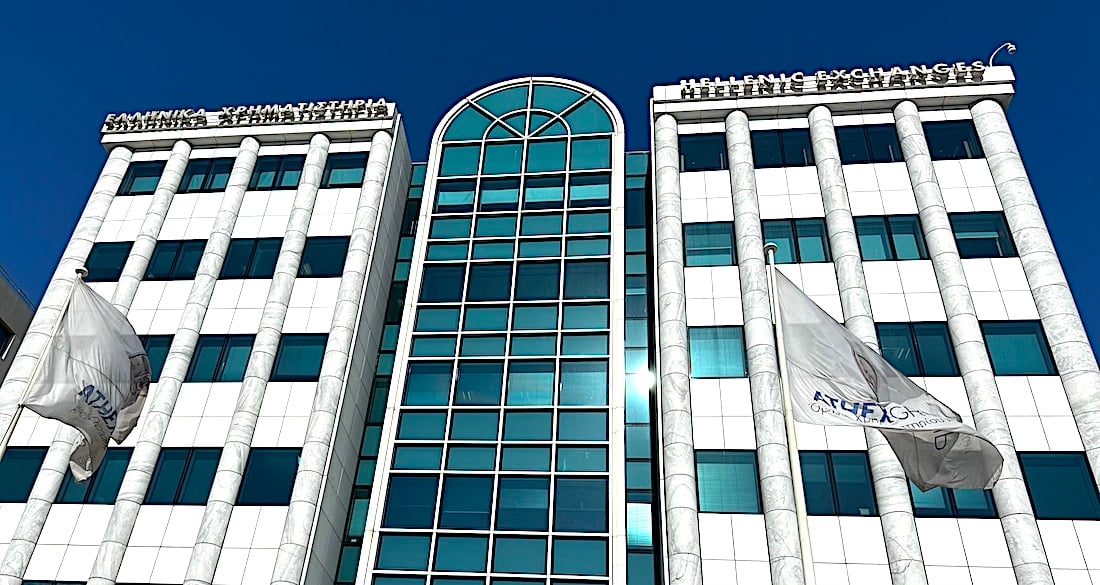
Greece’s stock market has taken a sharp hit since fighting erupted in the Middle East, with the total value of listed companies falling by €10.4 billion ($12 billion) and the benchmark index dropping 6.81%.
The selloff has all but wiped out the market’s gains for 2026. Meanwhile, the banking index has fallen 8.35% since the start of military operations, highlighting the pressure on some of the market’s most heavily traded stocks.
The total market capitalization of listed companies has dropped to €146.722 billion ($170,4 billion), down from €157.126 billion ($182,5 billion) before the conflict began.
Only a handful of stocks withstand the selloff in Greece’s stock market
Only a small number of large-cap stocks managed to withstand the broader market decline. EYDAP (Athens Water Supply and Sewerage Company) posted the strongest gains, rising 7.78%, while HelleniQ Energy advanced 1.87% and Motor Oil edged up 0.05%.
Losses were far steeper across the rest of the blue-chip index. Aegean Airlines recorded the biggest decline, falling 15.60%, followed by Optima Bank at 12.68%, Viohalco at 12.55%, ElvalHalcor at 12.47%, Titan at 11.43%, and Piraeus at 11.33%.
Other major decliners included Athens International Airport at 9.62%, Eurobank at 8.88%, PPC (Public Power Corporation) at 8.47%, Lamda Development at 8.44%, Allwyn -OPAP at 8.10%, Alpha Bank at 7.72%, Sarantis at 6.15%, National Bank of Greece at 6.06%, Jumbo at 5.96%, Bank of Cyprus at 5.83%, OTE (Hellenic Telecommunications Organization) at 4.74%, GEK TERNA at 4.43%, Coca-Cola HBC at 4.40%, and Metlen at 3.97%.
Aktor and Piraeus Port Authority proved more resilient, posting only modest declines of 0.38% and 0.53%, respectively.
Duration of conflict seen as critical for Greece’s stock market
Market analysts say the trajectory of the crisis will depend heavily on how long the confrontation involving the United States, Israel, and Iran continues, and how far it spreads. That will shape the consequences not only for financial markets, but also for the wider European Union economy and, by extension, Greece.
Moody’s has outlined a baseline scenario in which the conflict lasts four to six weeks. Under that assumption, it expects contained effects on energy markets, Gulf economies, and global trade flows.
However, the agency has warned that a longer conflict could trigger broader knock-on effects and increase credit risks.
Brokers see limited Near-Term impact for now
According to Axia and Alpha Finance, the effect of the war on the Athens market remains limited for the time being. Their assessment suggests that investors should distinguish between companies with more defensive characteristics and those with greater exposure to disruptions in energy, transport, and regional demand.
Among the stocks viewed as relatively defensive are OTE (Hellenic Telecommunications Organization), Allwyn – OPAP, Jumbo, GEK TERNA, Cenergy, ADMIE (Independent Power Transmission Operator), and EYDAP (Athens Water Supply and Sewerage Company).
The report points to mixed short-term implications for the refining sector. In the near term, both HelleniQ Energy and Motor Oil appear able to secure the feedstock they need for several weeks.
At the same time, companies such as PPC, Metlen, GEK TERNA, Motor Oil, and HelleniQ Energy could benefit in the short run from stronger pricing.
Airlines and transport face greater exposure
Aegean Airlines and Athens International Airport appear more vulnerable if passenger traffic to and from the Middle East weakens, directly affecting flight volumes.
Axia and Alpha Finance also expect only limited short-term effects on Piraeus Port and Thessaloniki Port in the event of a contained conflict. However, they caution that a broader escalation could quickly hurt demand and profitability at Piraeus, especially in its cruise and passenger terminals.
Energy prices remain a key risk for Greece
Optima Research says the central issue for investors remains the duration and intensity of the crisis. That will determine whether the impact stays manageable or develops into a more serious obstacle to growth in 2026.
For Greece, the energy channel is especially important. The country remains a net importer of energy products, meaning that any rise in oil and natural gas prices puts pressure on the trade balance and weakens growth momentum.
According to Optima Research, every $10 increase in the price of oil per barrel reduces Greek GDP (Gross Domestic product) by 0.15%.
Greece’s stock market still draws investor interest
Despite the current volatility, Bank of America continues to rank the Athens market among the more attractive exchanges in the broader EEMEA region, which covers Eastern Europe, the Middle East, and Africa.
The bank says Greek equities still offer a strong mix of valuations, dividend yields, and earnings prospects.
Even so, rising geopolitical tension in the Middle East has introduced a new layer of uncertainty that could weigh on investor appetite for risk across international markets.