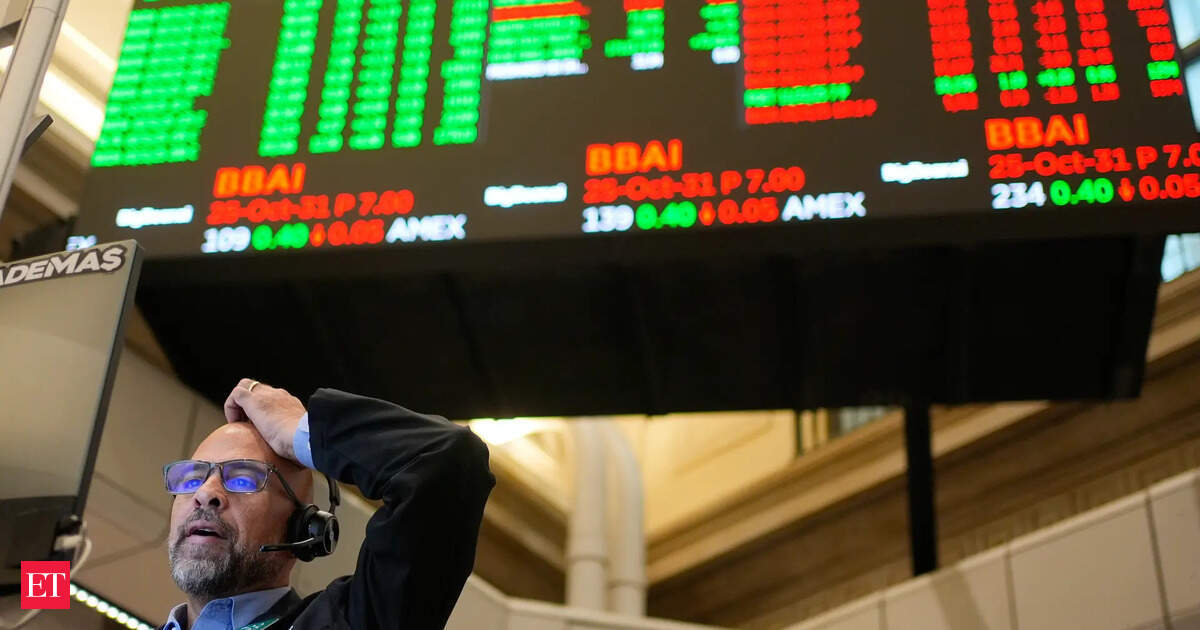
Why are US stock market indexes down today, and will S&P 500, Dow Jones and Nasdaq stay in red or turn green again? Investors are asking this question after Wall Street closed lower and recorded weekly losses. Oil prices moved above $100 per barrel as the war involving Iran affected global energy supply. Higher oil prices increased inflation concerns across the global economy. At the same time, new economic data showed slower economic growth and rising inflation pressure in the United States. Technology stocks also declined after news about artificial intelligence delays and leadership changes at major companies. Because of these factors, the Dow Jones, S&P 500, and Nasdaq ended the session lower.
Why are US stock market indexes down today, and will S&P 500, Dow Jones and Nasdaq stay in red or turn green again?
The main reason is the rise in oil prices and inflation concerns linked to the war involving Iran. Brent crude rose above $100 per barrel for the first time since August 2022, while U.S. crude settled near $99 per barrel. The increase in energy prices raised concerns about higher inflation and slower economic growth. Investors also reacted to weak economic data, including a sharp downward revision to fourth-quarter GDP growth. These developments pushed investors to sell risk assets, leading to declines in the S&P 500, Dow Jones, and Nasdaq.
Why are US stock market indexes down today?
Several economic and geopolitical factors pushed markets lower. Oil prices increased sharply as the Iran conflict threatened global oil supply. Iran tightened control over the Strait of Hormuz, which carries about one-fifth of global oil shipments. Economic data also weakened investor confidence. Fourth-quarter U.S. GDP growth was revised down to 0.7%. Inflation remained high according to the Personal Consumption Expenditures index. Bond yields also increased, with the 10-year Treasury yield rising to 4.28%. Rising yields and inflation expectations reduce the possibility of interest rate cuts, which also pressures stock markets.
Wall Street crash explained
Wall Street closed lower as rising oil prices and inflation concerns affected investor sentiment. The Dow Jones Industrial Average fell 119.38 points or 0.26% to 46,558.47. The S&P 500 dropped 40.43 points or 0.61% to 6,632.19. The Nasdaq Composite declined 206.62 points or 0.93% to 22,105.36.
All three indexes also recorded weekly losses. The Russell 2000 index of small companies closed at its lowest level of the year. The market decline happened as investors monitored the war involving Iran and its impact on global oil supply.
Wall Street downturn linked to oil prices and Iran war
The US stock market crash is closely linked to the surge in oil prices caused by the Iran war. Brent crude settled at $103.14 per barrel, the first time it crossed $100 since August 2022. U.S. crude oil futures settled at $98.71, rising 3.11% for the day.
The rise in oil prices followed statements from U.S. President Donald Trump that the United States would act strongly against Iran in the coming week. Reports also indicated that the conflict expanded to Lebanon, Kuwait, Iraq, the United Arab Emirates, Bahrain and Oman.
Iran tightened control over the Strait of Hormuz, a key route that carries around one-fifth of the world’s oil supply. The International Energy Agency warned that the war could create the largest disruption in global oil supply. Rising oil prices increase inflation pressure and create uncertainty for financial markets.
Economic data and inflation pressure explained
Another reason behind Why are US stock market indexes down today, and will S&P 500, Dow Jones and Nasdaq stay in red or turn green again? is weak economic data combined with persistent inflation. The U.S. Commerce Department reduced the estimate for fourth-quarter economic growth. GDP growth for the October-December period slowed to an annual rate of 0.7%. Data also showed weaker demand for durable goods and capital equipment.
The Personal Consumption Expenditures index, which the Federal Reserve uses to track inflation, remained elevated. Core inflation rose 3.1% year over year, the highest level in nearly two years. Consumer sentiment also declined as gasoline prices increased after the Iran war. Higher inflation expectations pushed the 10-year Treasury yield to 4.28%, up from 3.97% before the conflict started.
US stock market biggest losers and gainers
Technology stocks led the decline on Wall Street. The technology sector recorded the largest percentage loss among S&P 500 sectors.
Biggest losers
- Adobe – shares fell 7.6% after news that CEO Shantanu Narayen will leave the company once a successor is appointed.
- Meta Platforms – stock declined 3.8% after reports that its artificial intelligence model “Avocado” launch was postponed.
- Ulta Beauty – shares dropped 14.2% after quarterly results missed analyst profit expectations.
- Technology sector – recorded the largest percentage decline among S&P 500 sectors.
- Financial sector – fell 3.4% during the week due to concerns about credit quality.
Biggest gainers
- Utilities sector – recorded the largest percentage gain among S&P 500 sectors as investors moved toward defensive stocks during market volatility.
Will S&P 500, Dow Jones and Nasdaq stay in red or turn green again?
Analysts say market direction will depend on oil prices, inflation data, and geopolitical developments. If oil prices continue rising and the Iran conflict disrupts supply, inflation may remain high and stock markets may stay under pressure. The Federal Reserve is expected to keep interest rates unchanged at its upcoming meeting, which also limits short-term support for markets. However, if oil prices stabilize and geopolitical tensions ease, investors could return to equities. In that scenario, the S&P 500, Dow Jones, and Nasdaq may recover and turn green again.
Analysts insights and market outlook
Analysts say market volatility remains high because oil prices are driving market movement. Paul Nolte, senior wealth advisor at Murphy & Sylvest, said the energy market volatility rivals movements seen in cryptocurrency markets. He said investors should wait for the situation to stabilize.
Market strategist Michael Antonelli said equities are trading based on oil prices and updates about the Middle East conflict. Investors are also watching the upcoming Federal Reserve policy meeting. Traders expect the central bank to keep interest rates unchanged. The probability of a near-term rate cut has dropped below 1%. Higher oil prices could delay any policy easing because inflation remains elevated.
What should investors do now?
Analysts say markets may remain volatile until oil supply concerns ease. If oil prices continue rising and inflation increases, stock markets may remain under pressure. However, if geopolitical tensions reduce and oil prices stabilize, markets could recover. Investors are watching energy markets, inflation data, and Federal Reserve policy signals to determine whether the S&P 500, Dow Jones and Nasdaq will remain in red or turn green again.
FAQs
Q1. Why are US stock market indexes down today, and will S&P 500, Dow Jones and Nasdaq stay in red or turn green again?
Markets fell because oil prices rose, inflation fears increased, and economic data weakened.
Q2. What factors could help US stock markets recover after the recent decline?
Markets may recover if oil prices fall, geopolitical tensions ease, inflation slows, and the Federal Reserve signals future interest rate cuts.